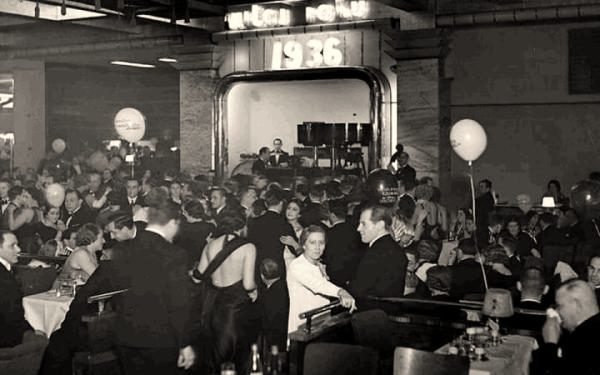
„Mr Zygmunt Heyman, well known in Warsaw society, opens in the coming days, in the new building of the »Generali« Company at 7 Złota Street, an elegant café under the name »Café Vogue«."
Warsaw knew him from the skin of a drum. The great white circle with the inscription „Front-Heyman-Jazz" stood on the bandstands of the city's best establishments for half a decade — and the man who sat behind it with a banjo could do considerably more than play. Zygmunt Heyman was a saxophonist, banjoist, accordionist and drummer; he was co-founder of one of the first true Polish jazz orchestras; he was an artistic director, an entrepreneur, a lottery lucky man, a film producer of one film and — at the end — a café owner who at 7 Złota Street built the most fashionable establishment of the last two years of peace. He lived one floor up. From his window he could see the neon of his own café.
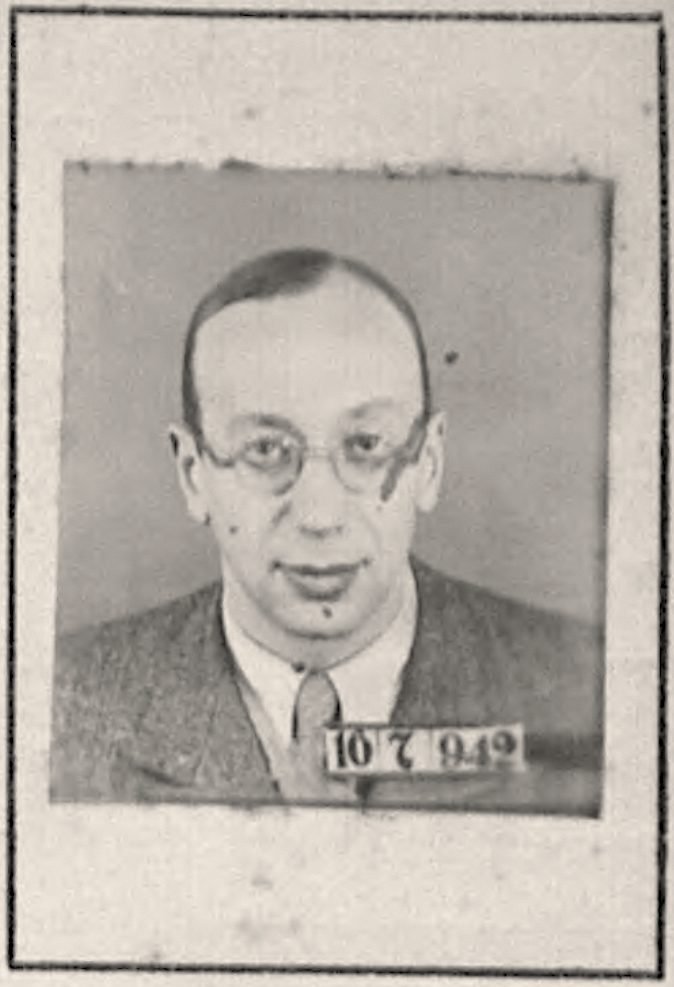
For eighty years Polish dictionaries and biographical databases have closed this life with one of three sentences: „died in the ghetto in 1942"; „deported to a labour camp — possibly Trawniki — and most probably murdered there"; „date of death unknown — during the Second World War". All three are wrong. The research carried out within this project proves that Zygmunt Heyman survived — and the proof is of the kind before which doubts fall silent: a photograph. The face on the card of the register of artists, filled out in Rio de Janeiro in August 1942, is the face of the banjoist from the frames of the Warsaw film of 1932. In December 1948 the same name appears in the Brazilian press on the list of the lucky ones collecting new Oldsmobiles.
This account retraces his road year by year — from the advertisements and reviews of the Warsaw, Łódź and Kraków press, from the programmes of Polish Radio, from the frames of an avant-garde film, from telephone directories, from the commercial register, from the civil-status books and from the archives of three continents.
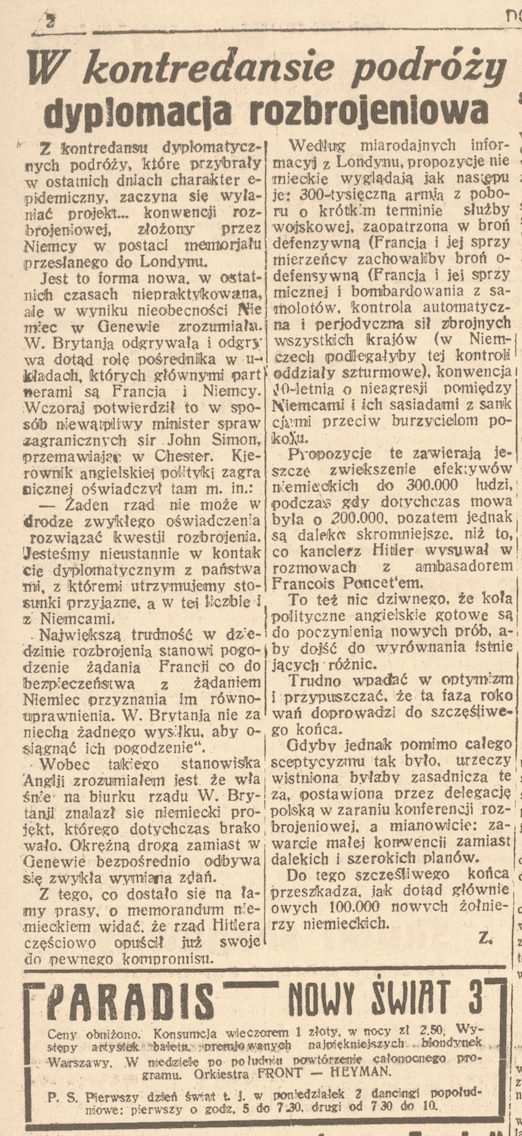
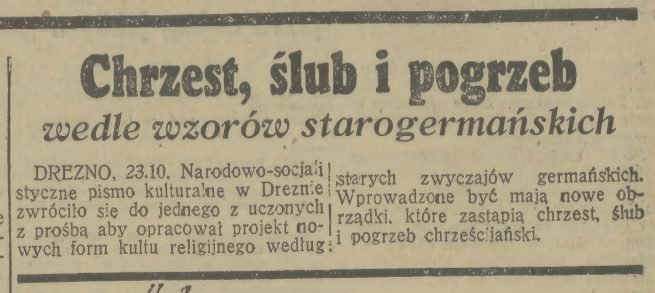
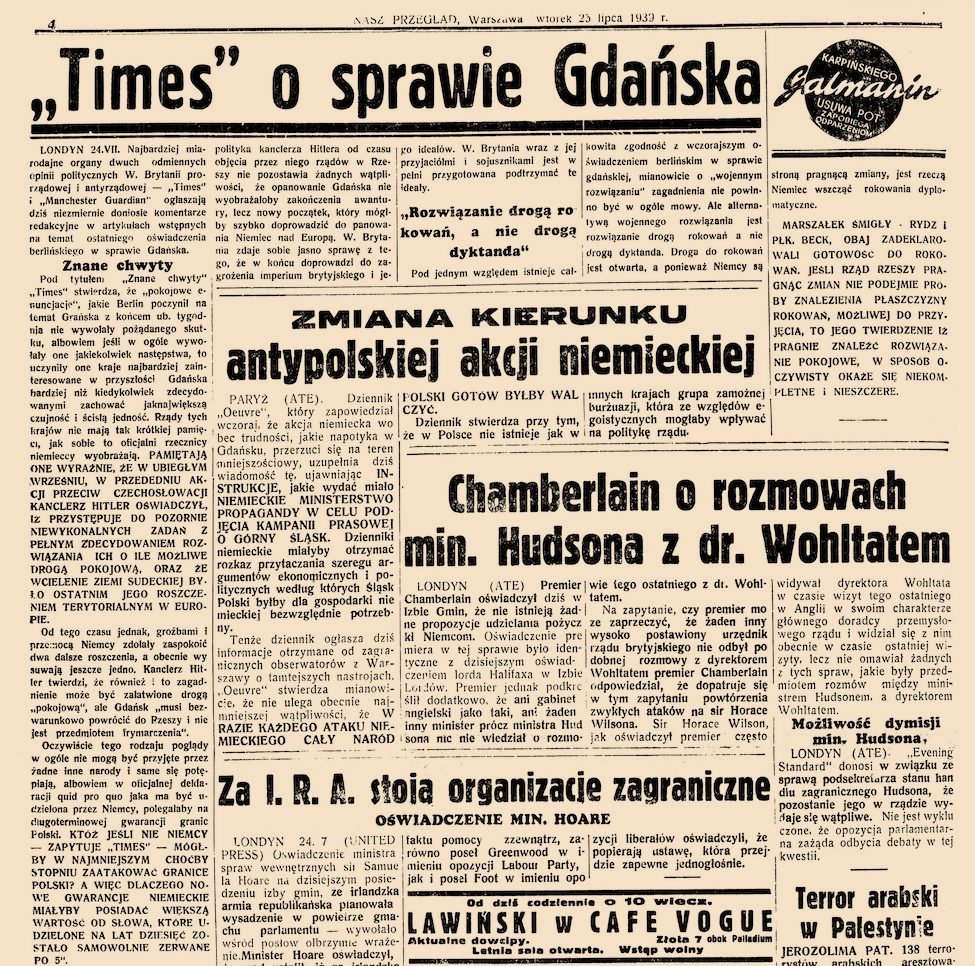
Editorial note. Café Vogue advertised in the dailies — and those dailies have survived whole, with the advertisement and everything that surrounded it. We reproduce the announcements here together with the columns on which they were printed, because the mounting tension of those years is nowhere so sharply visible as in this accidental adjacency: the invitation to jazz and afternoon tea stands beside the dispatches about what was growing and what was approaching. We did not arrange these juxtapositions. This is what the newspapers read by Zygmunt Heyman's guests looked like.
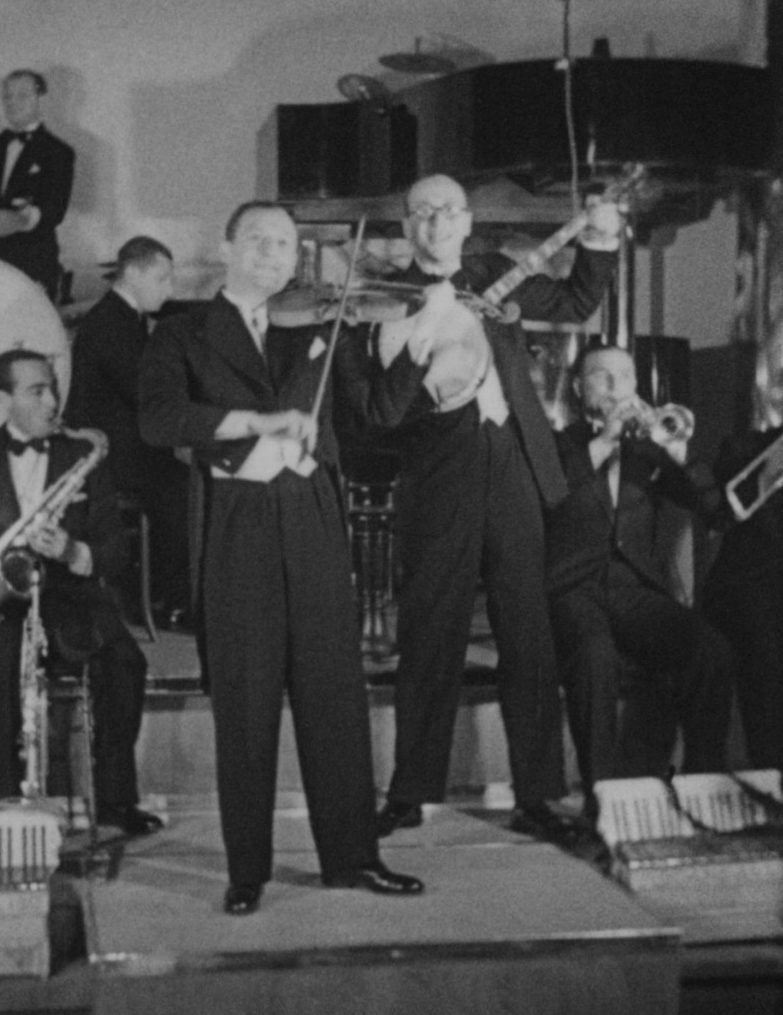
Before this account begins — its subject in the only surviving film footage: the Adria bandstand, February 1932. Press ▶ to watch the excerpt, with sound.
I. 25 October 1924 — „Jardin de Japon"
The earliest known trace leads to the autumn of 1924 — and to the name in a form he later no longer used. Warsaw was living then through the return of Henryk Sienkiewicz's ashes; the front pages printed funeral orations, and the back pages — that with which the city intended to console itself. The „Przegląd Wieczorny" of 23 October announced: on Saturday the 25th of the current month, in the winter hall of the „Bagatela" garden, there opens „the cheapest and most exquisite dancing in Warsaw" — „Jardin de Japon", the Japanese Garden. The artistic director of the undertaking is Zygmunt Brucz-Heyman.
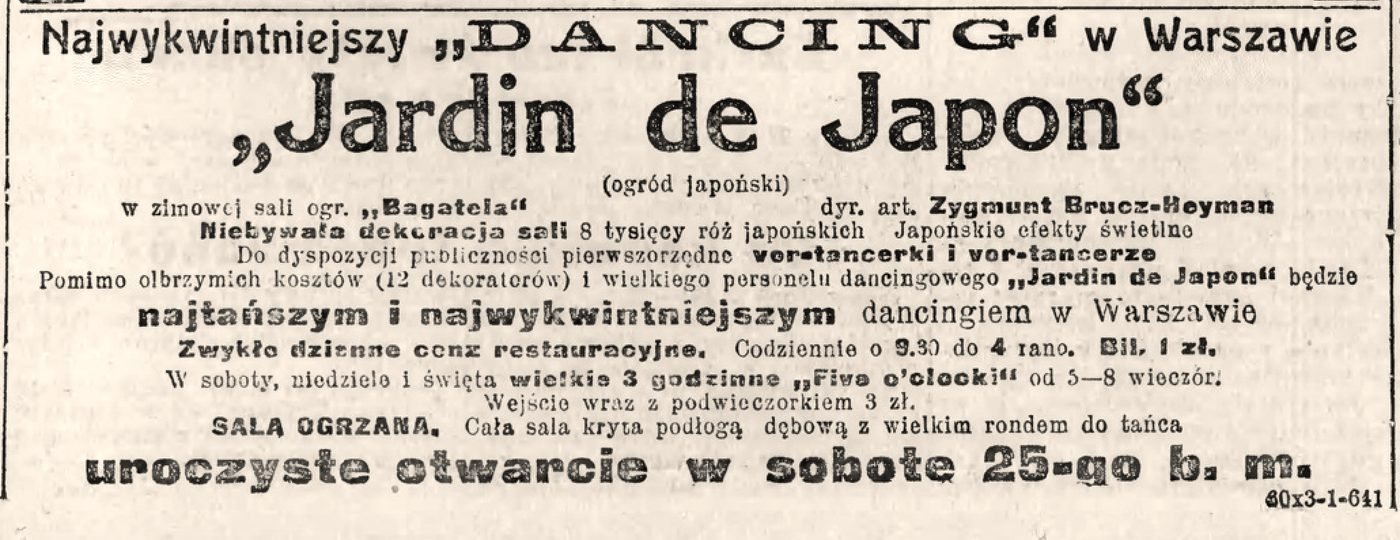
The advertisement promises everything that in the mid-twenties meant „the great world": eight thousand Japanese roses, Japanese lighting effects, first-rate vor-dancers of both sexes at the public's disposal, a heated hall entirely floored in oak with a great round for dancing, ordinary restaurant prices, the establishment open from half past nine in the evening until four in the morning — and on Saturdays, Sundays and holidays „grand three-hour Five o'clocks" from five to eight, admission with afternoon tea three złoty. Whoever reads this advertisement carefully will find in it Heyman's whole later programme: dance music, the cult of afternoon tea, décor calculated for delight and for a female clientele. Eighteen years later, filling out the artists' register card in Rio de Janeiro, he would answer the question about the start of his career: 1925. Memory rounded the date off by a few weeks — the Japanese rose he remembered well.
II. Around 1930 — Front-Heyman Jazz
Of the second half of the twenties we know for now only what fits between two advertisements. Around 1930 Heyman already stands as partner beside the violinist Julian Front — older than he, a composer and conductor born in Warsaw on 12 November 1897 — and together they found a dance orchestra of jazz character. The line-up the lexicographers would record reads like the payroll of a good firm: Julian Front — violin and direction; Zygmunt Heyman — saxophone and banjo; Michał Didyk — saxophone; Franciszek Witkowski — saxophone and clarinet; Filip Goldberg — drums; Stanisław Ferszko — piano and accordion; Tadeusz Jeselson — saxophone and violin. The repertoire: Western dance music, hits from foreign films and revues — what Warsaw wanted to hear before it had a chance to hear it anywhere else.
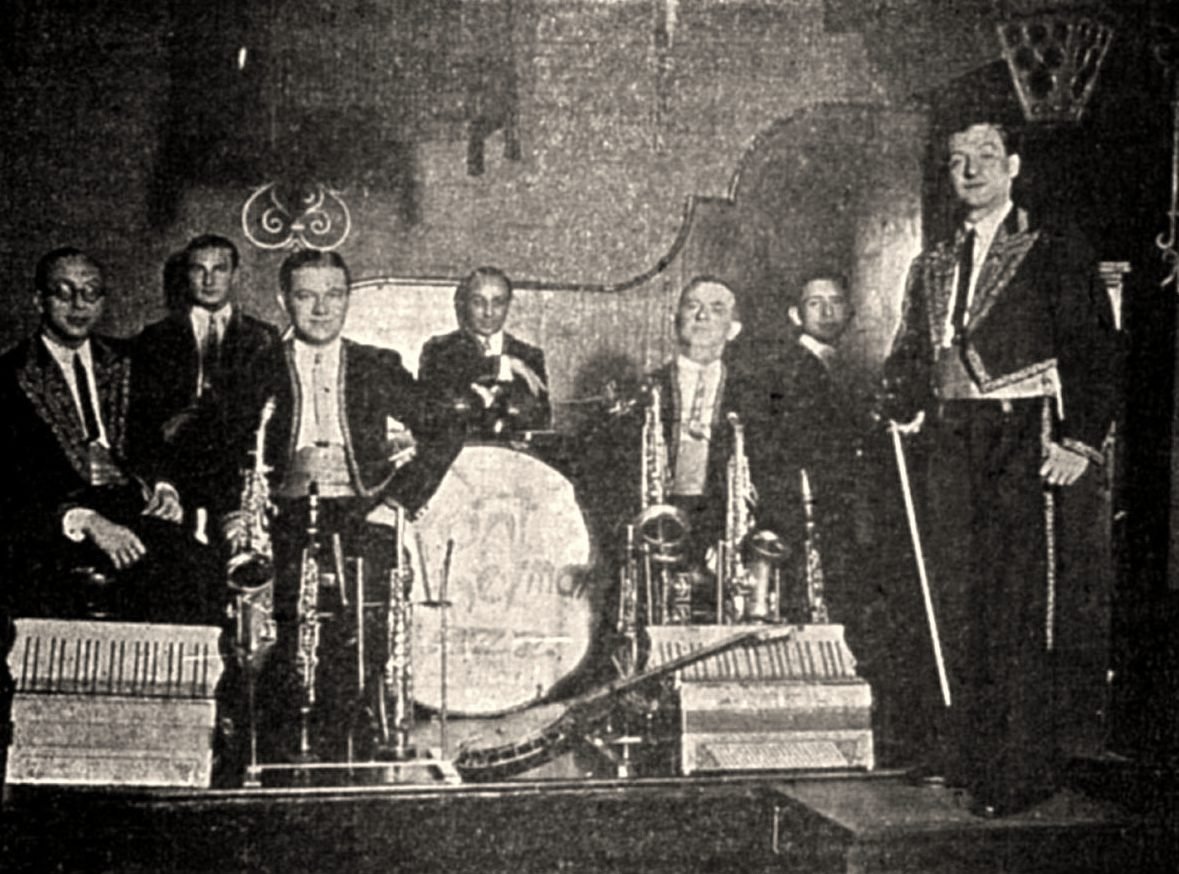
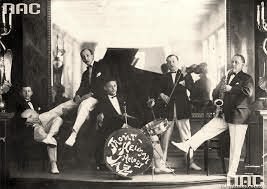
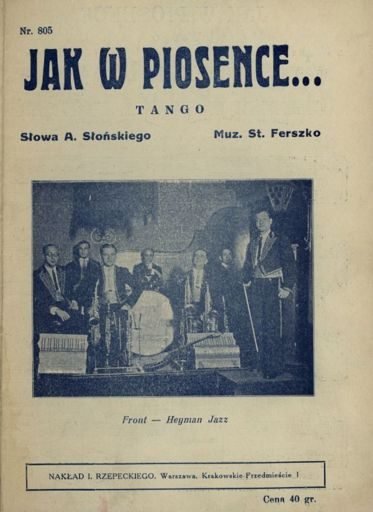
In 1931 the orchestra made recordings for the „Syrena Record" label — the only ones it left behind. The band also made it onto sheet-music covers: the tango „Jak w piosence" by Stanisław Ferszko to words by A. Słoński was published with a photograph of the whole orchestra on the front page. Sheet music was bought then the way records are bought today — and the musicians' faces went into homes together with the melody.
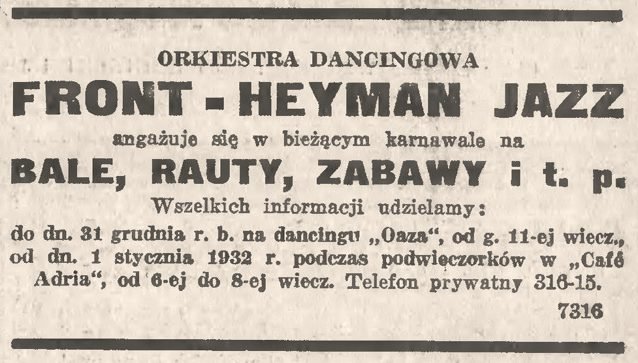
The carnival advertisement of December 1931 is the most eloquent document of this activity — for it is not the announcement of a venue but of an enterprise. The orchestra sells itself, gives the hours at which it can be found in two different cafés, and a private telephone number. Whoever wanted the best jazz in town at his ball dialled 316-15. From the beginning Heyman is in this duo not only a musician — he is a firm.
III. 7 February 1931 — Café Adria
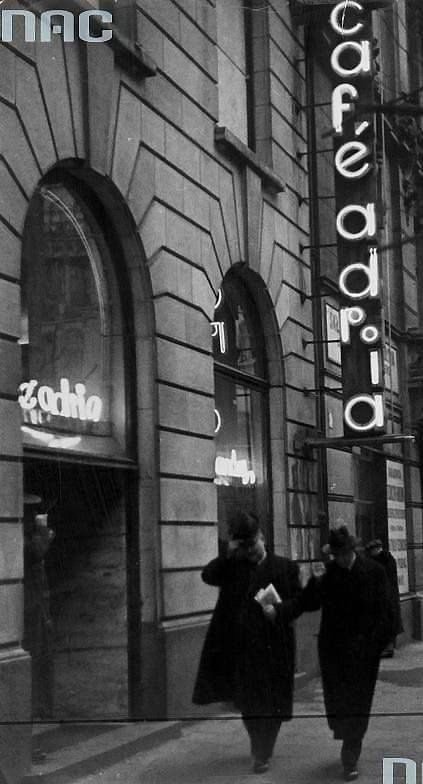
To understand what the Adria was for this orchestra, one must remember what the Adria was for Warsaw. In February 1931, in the basement and ground floor of the freshly completed building of the Italian insurance company Riunione Adriatica di Sicurtà at 10 Moniuszki Street, an establishment opened that for eight years was the capital's salon: a café, a dancing, an American bar, a winter garden — and the famous revolving dance floor, the only one in Poland. Here the diplomatic corps and the generals amused themselves, here one came to show oneself and to see, here landed everyone who counted for anything in Warsaw. The building was designed by Edward Zachariasz Eber — the same architect who a few years later would raise for the second Italian insurance giant, Assicurazioni Generali, the building at Złota 7/9. Fate can be symmetrical: Zygmunt Heyman's whole road, from his first great engagement to his own café, would play out in the marbles of one architect.
On opening day the „Kurjer Warszawski" wrote: „Today a new entertainment establishment opens in Warsaw — the Adria Café. The new enterprise, housed in the magnificent halls of the recently finished building at 10 Moniuszki Street, introduces to the capital a new type of entertainment venue". And among the attractions, in first place: „there Warsaw will see the masterly jazz-band ensemble Front & Heyman".
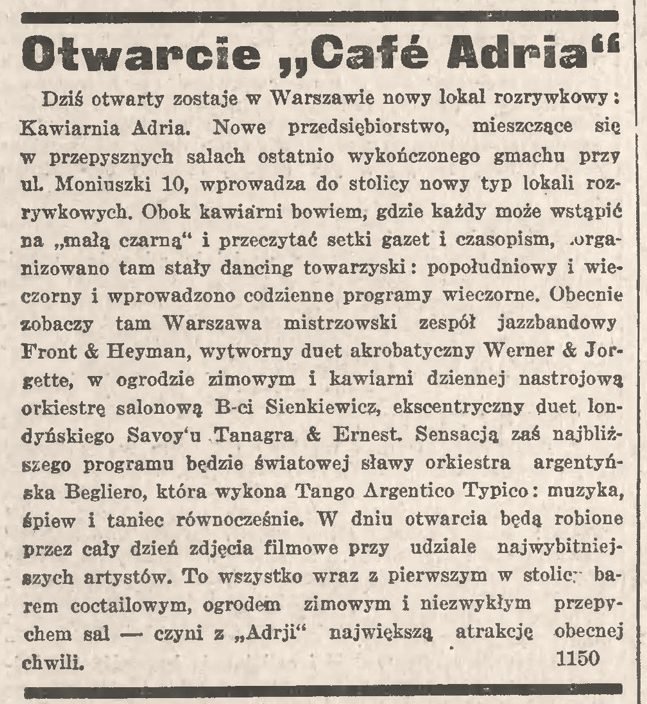
The good spirit of the Adria was its manager and co-owner Franciszek Moszkowicz — a one-man institution of pre-war gastronomy, who understood that an entertainment venue sells not coffee but events. For publicity he could lead a chimpanzee onto the floor; for prestige he brought in orchestras from three continents. The sentence in the advertisement about „film shots throughout the day" was no ornament: the Adria wanted to be filmed — and a year later it did indeed get onto celluloid, and with it Heyman's orchestra.
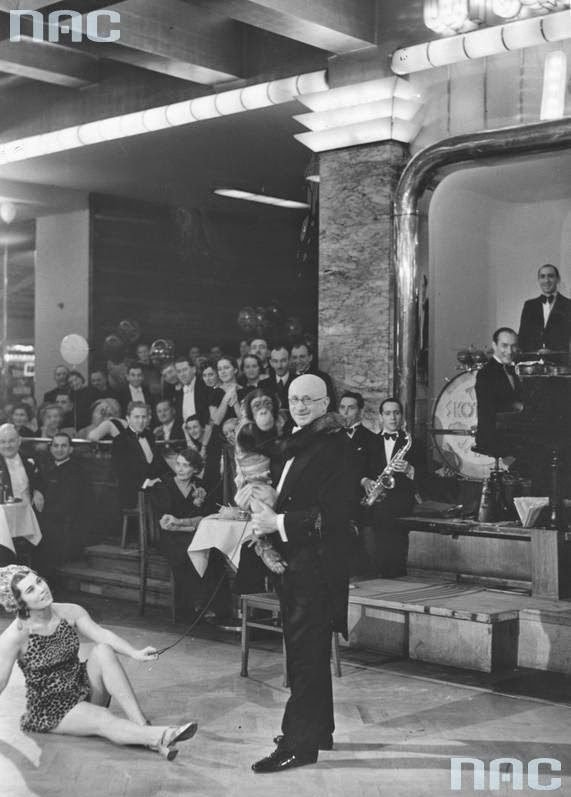
IV. February 1932 — „Dziś mamy bal"
Tadeusz Kowalski and Jerzy Zarzycki were in their twenties and belonged to Start — the Society of Devotees of the Artistic Film, out of which the post-war Polish documentary school would grow. They took as their subject the annual Ball of Young Architecture, held on 1 February 1932 in the twenty-three decorated halls of the Faculty of Architecture at 55 Koszykowa Street; the camera work was by W. Kaczkowski. The result was the seven-minute impression „Dziś mamy bal" (Tonight We Have a Ball) — today a classic of the pre-war avant-garde: arranging the ball by telephone, shopping at the Jabłkowski Brothers department store, the arrival, the whirl of the dance floor till the white morning, shots through glass, the visions of a drunken guest, an expressive play of light. The reviewer of „Kino" called the film „the first attempt to treat reportage in an artistic manner" — and advised the authors not to be discouraged.
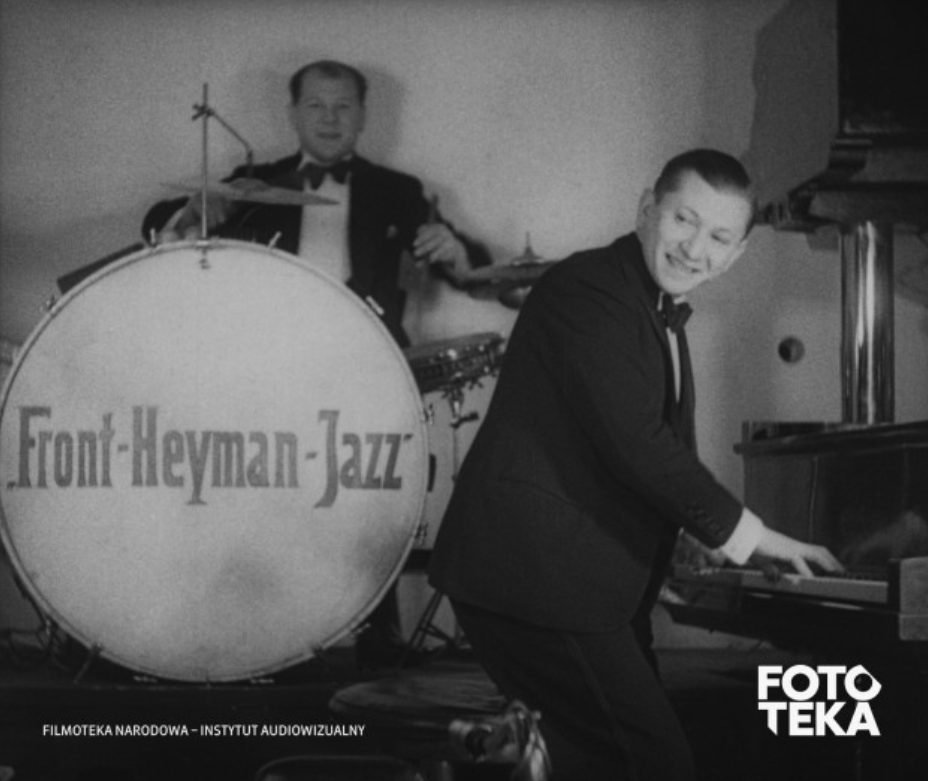
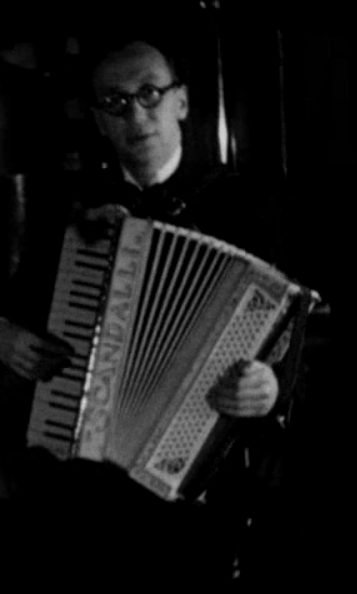
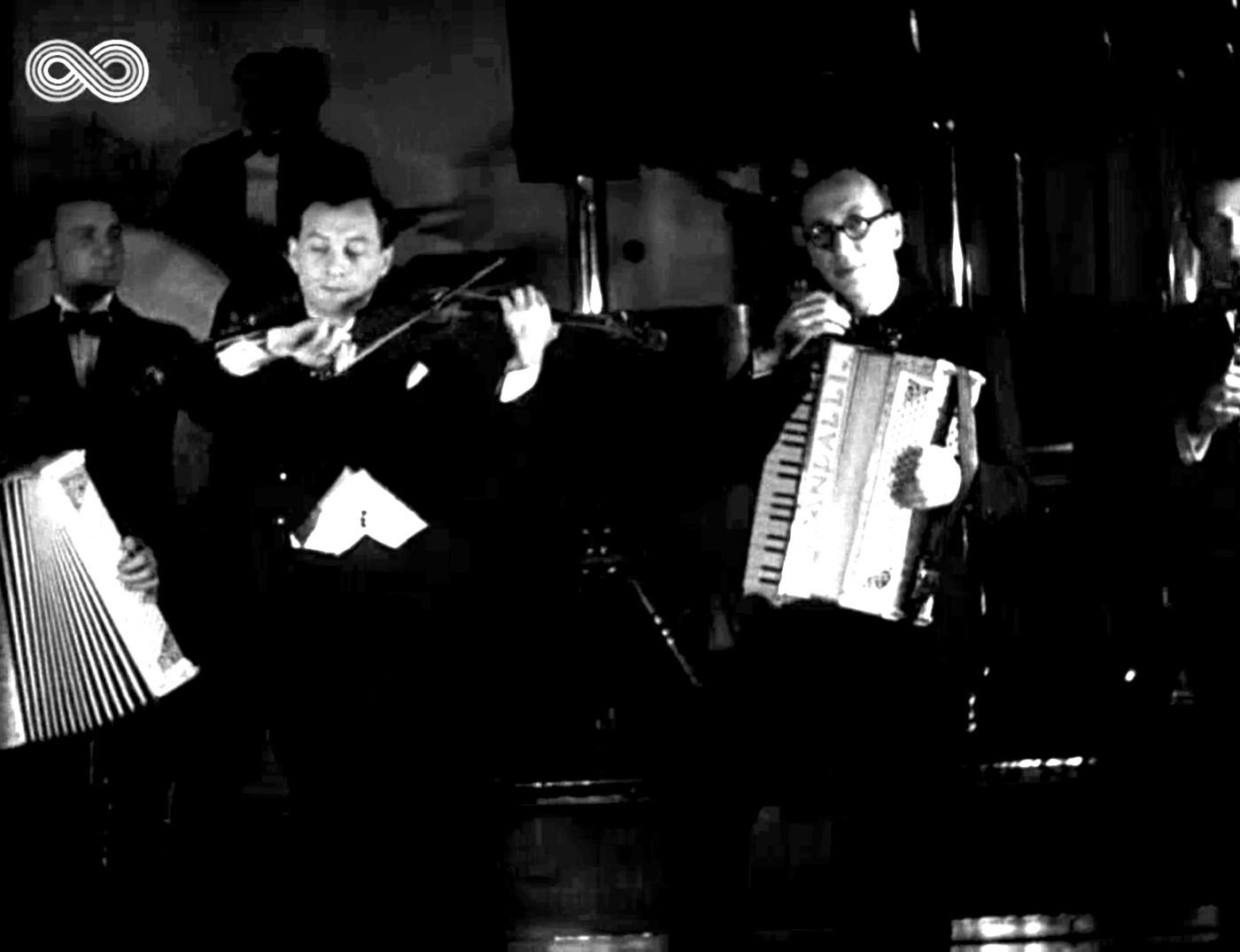
The ball scenes were shot on Koszykowa. But the scenes with the orchestra — at the Adria. And it is to those few shots that we owe something almost no musician of that Warsaw possesses: the face of Zygmunt Heyman in motion, close up, in the light of the spotlights.
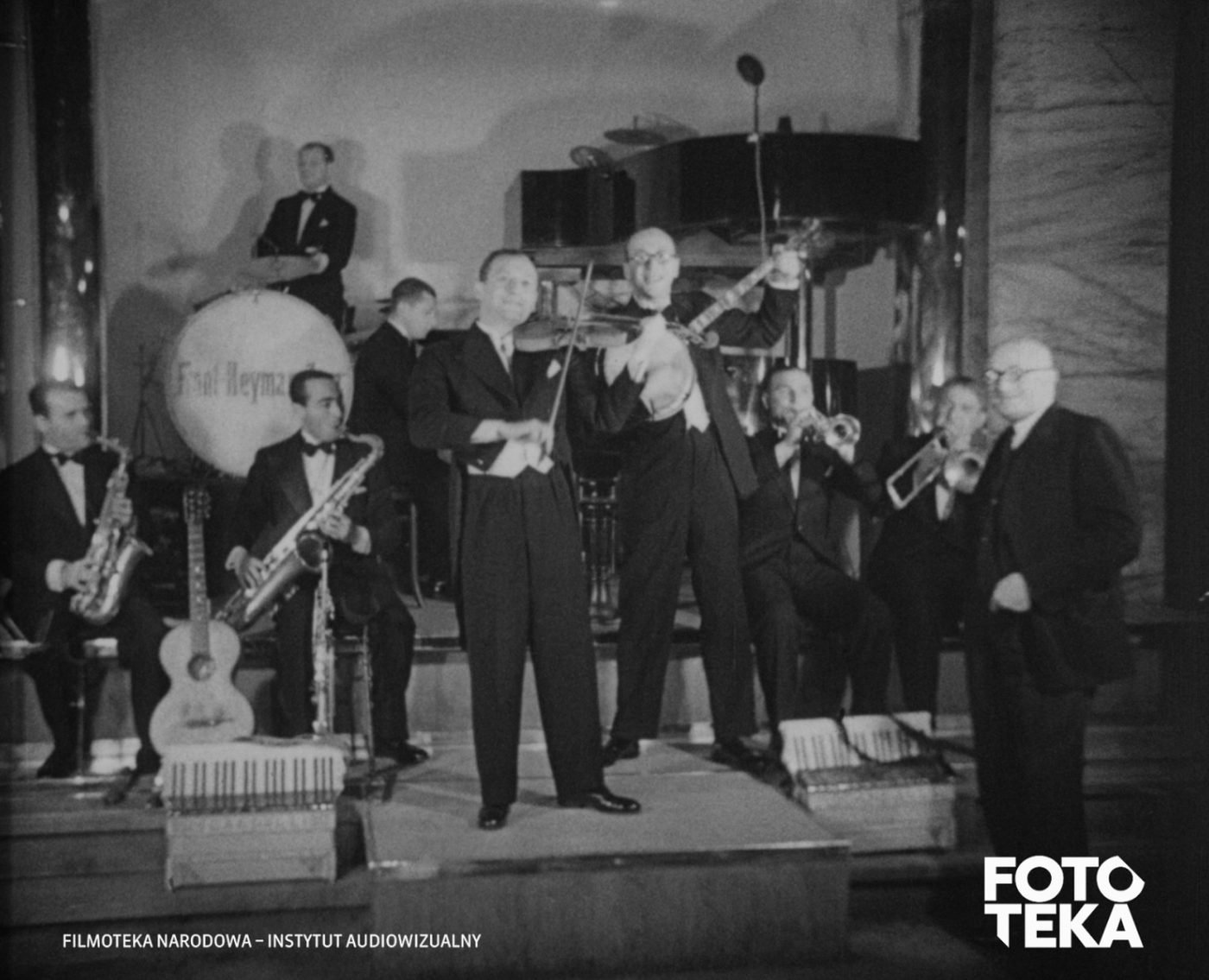
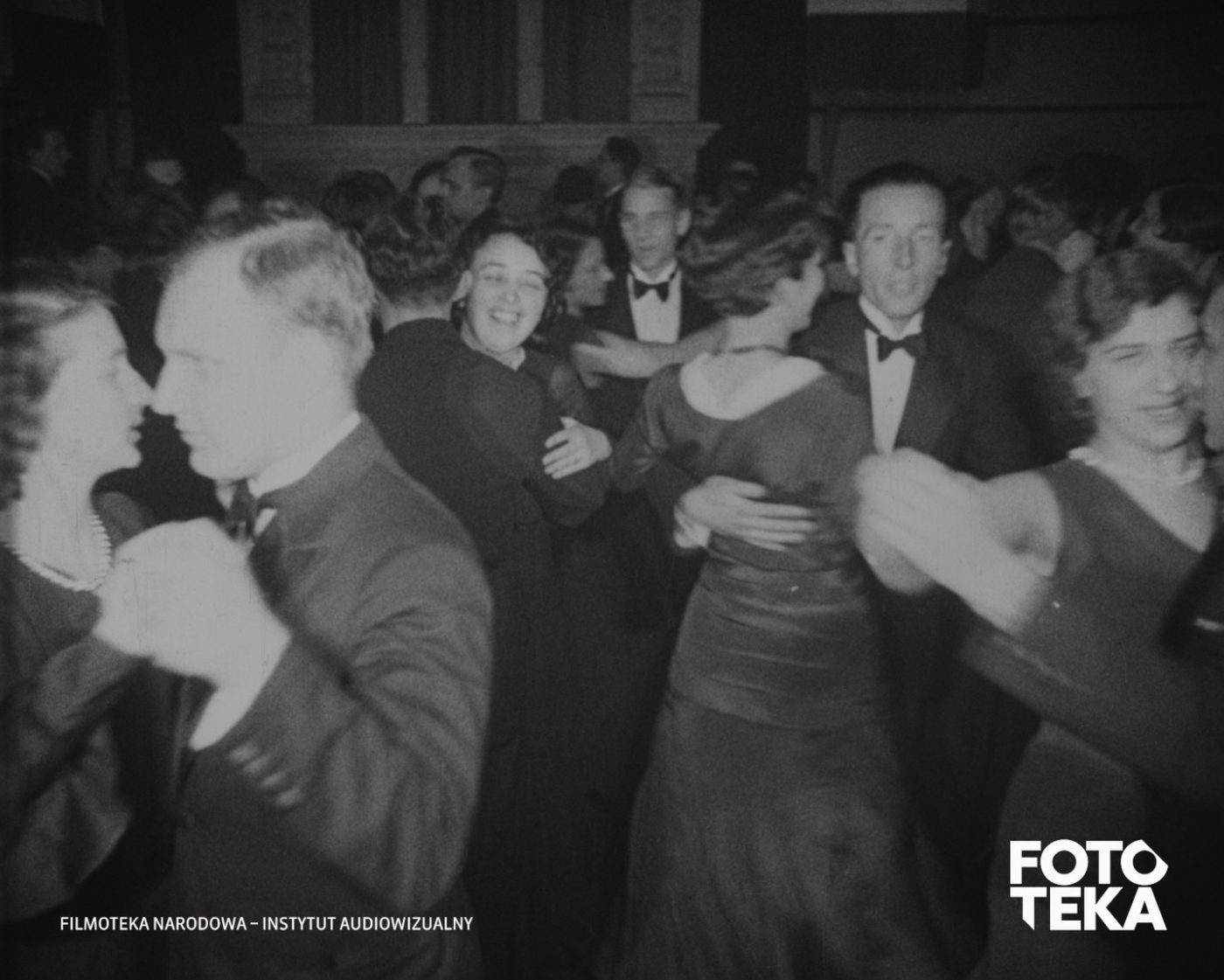
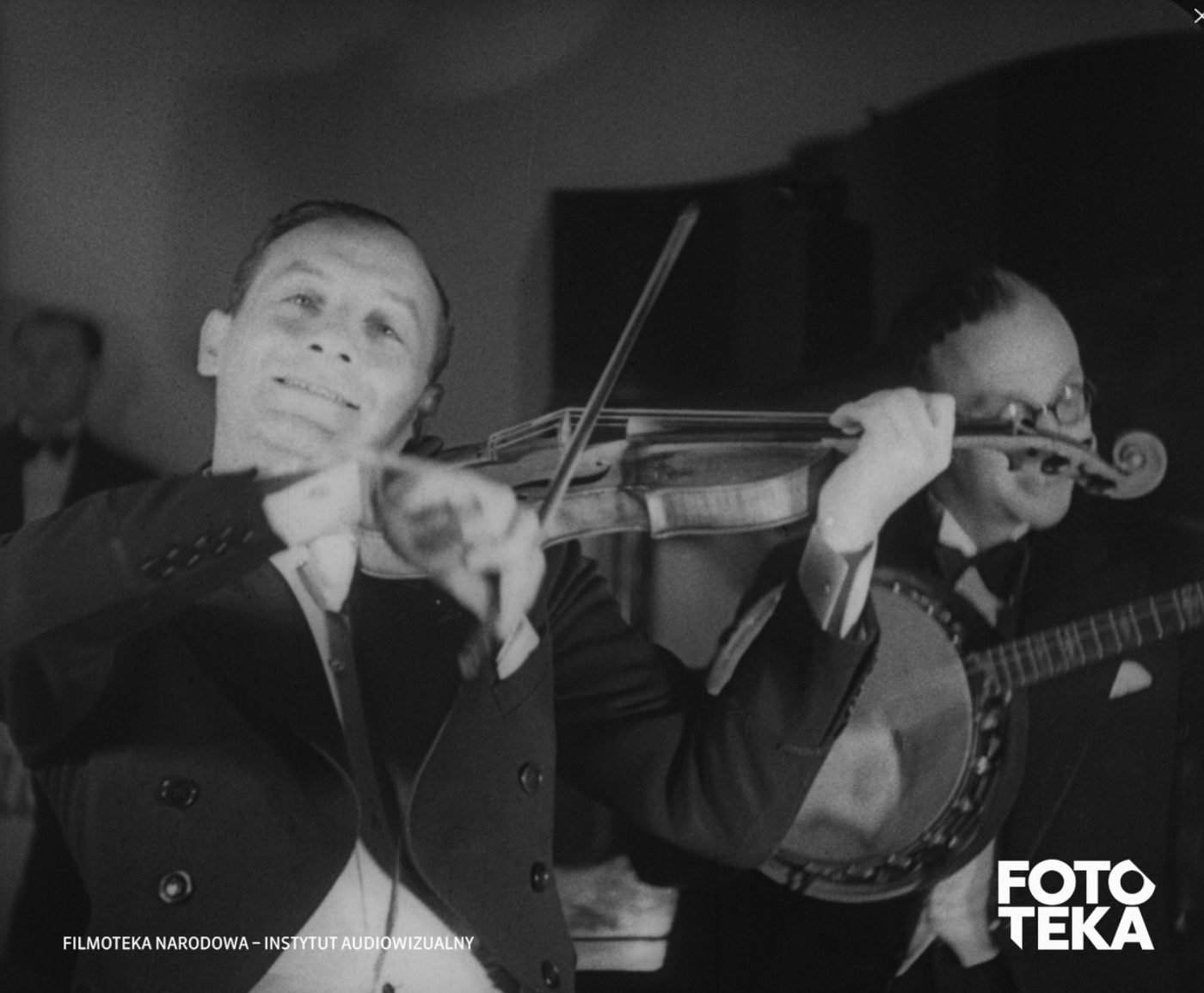
V. 1931–1934 — Oaza, Bodega, Ordonówna, Truskawiec
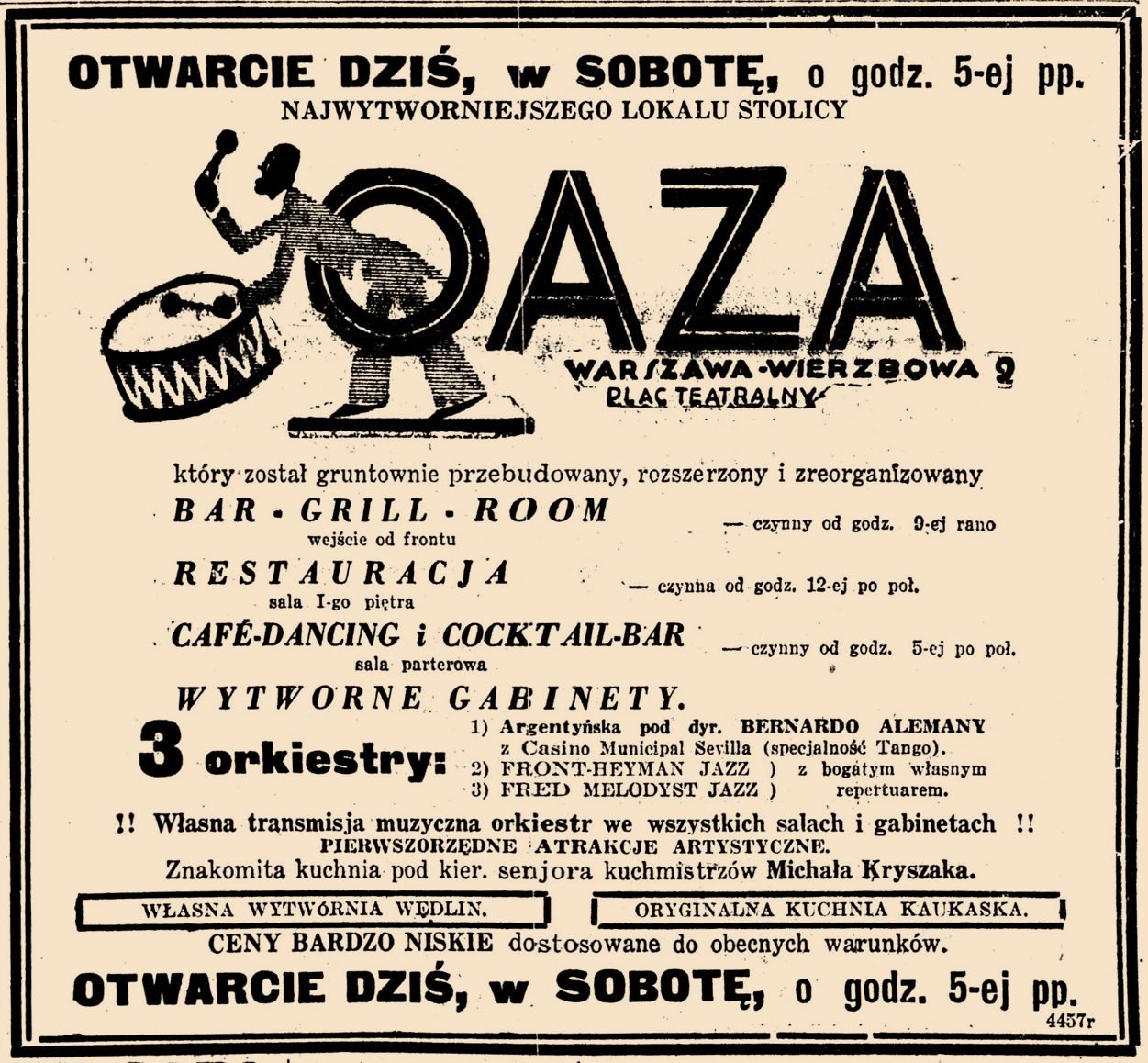
The band's calendar can be reconstructed almost week by week — and it reads like a map of nocturnal Warsaw. On 12 September 1931 the „Oaza" at 9 Wierzbowa Street on Theatre Square opens after a thorough rebuilding: a bar and grill-room at the front, a restaurant upstairs, a café-dancing and cocktail-bar in the ground-floor hall, elegant private rooms. The establishment advertises three orchestras — the Argentine one under Bernardo Alemany of the Casino Municipal Sevilla, Front-Heyman Jazz and Fred Melodyst Jazz — „each with a rich repertoire of its own", with „its own musical transmission in all halls and rooms".
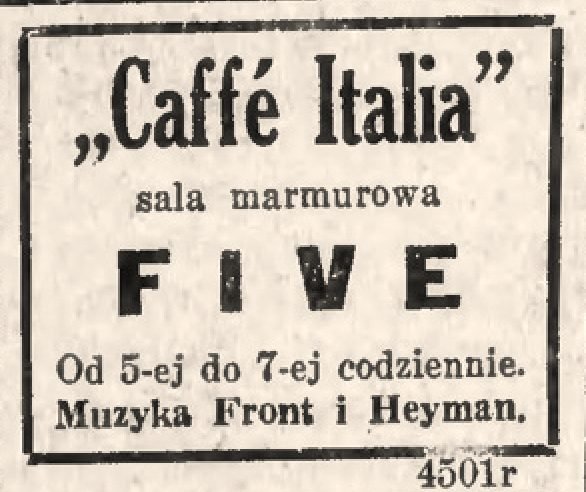
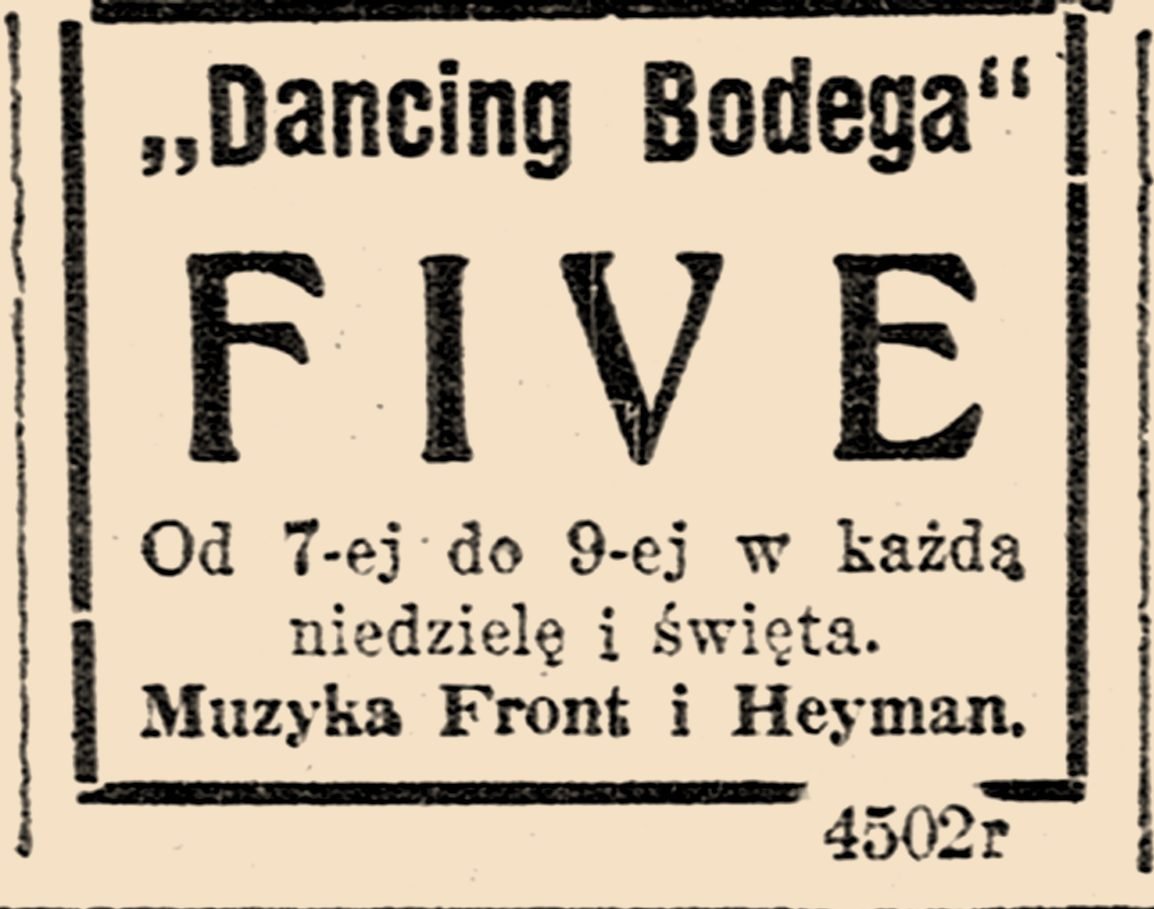
A year later the band plays twice a day at two addresses at once. The „Kurjer Warszawski" of 17 September 1932 carries two advertisements side by side: „Caffé Italia", the marble hall — five o'clock daily from five to seven; „Dancing Bodega" — five on Sundays and holidays from seven to nine. Under both the same signature, short as a trademark: „Music by Front and Heyman".
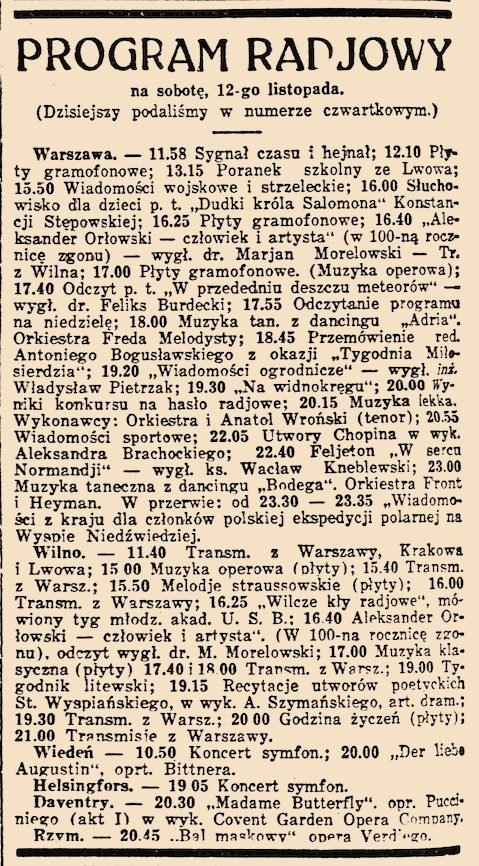
From the Bodega the orchestra went on the air. The Polish Radio programme for Saturday 12 November 1932 leads through a whole day of the Polish radio of the era — the radio play „King Solomon's Pipes" by Konstancja Stępowska, the lecture „On the Eve of the Meteor Shower", sports news, Chopin — up to 11 p.m.: „Dance music from the »Bodega« dancing. The Front and Heyman Orchestra". In the middle of the transmission, between 11.30 and 11.35 p.m., the announcer interrupted the jazz to broadcast „News from home for the members of the Polish polar expedition on Bear Island". Somewhere beyond the Arctic Circle Polish meteorologists listened to the communiqué — and then, if they stayed by the receiver, the Bodega danced for them.
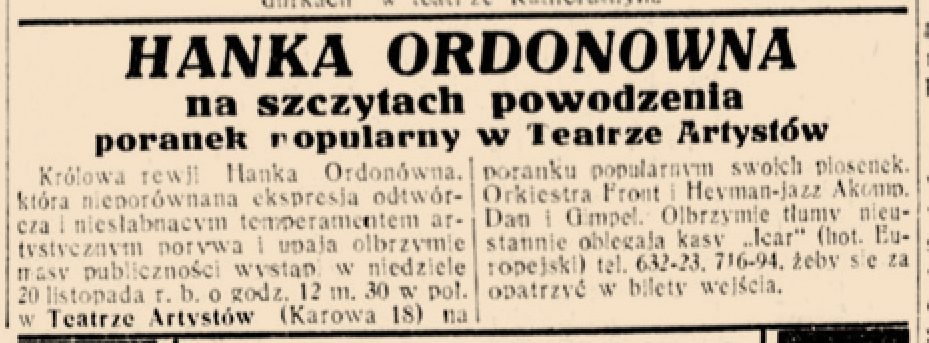
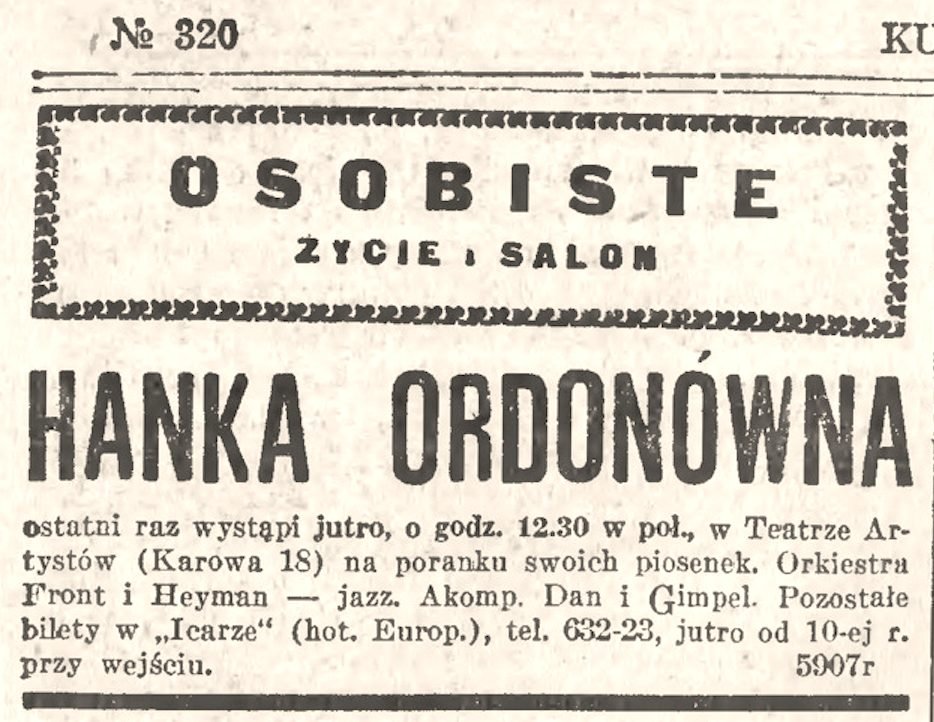
That same autumn the orchestra reached for the highest shelf of the Polish stage. Hanka Ordonówna — „the queen of revue", the first lady of Polish song, the star of Qui Pro Quo, a woman Warsaw went to see as if to a festival — was giving matinées of her songs at the Artists' Theatre at 18 Karowa Street. She was accompanied by the pianists Dan and Gimpel; the setting was provided by „the Front and Heyman-Jazz Orchestra". „Enormous crowds ceaselessly besiege the box offices" — wrote „Dobry Wieczór!"; the „Kurjer Warszawski", in its society column „Personal — life and salon", reported that Ordonówna „will appear for the last time tomorrow, at 12.30 noon". For a dance orchestra there was then no higher certificate of class than Ordonówna's name on a shared bill.
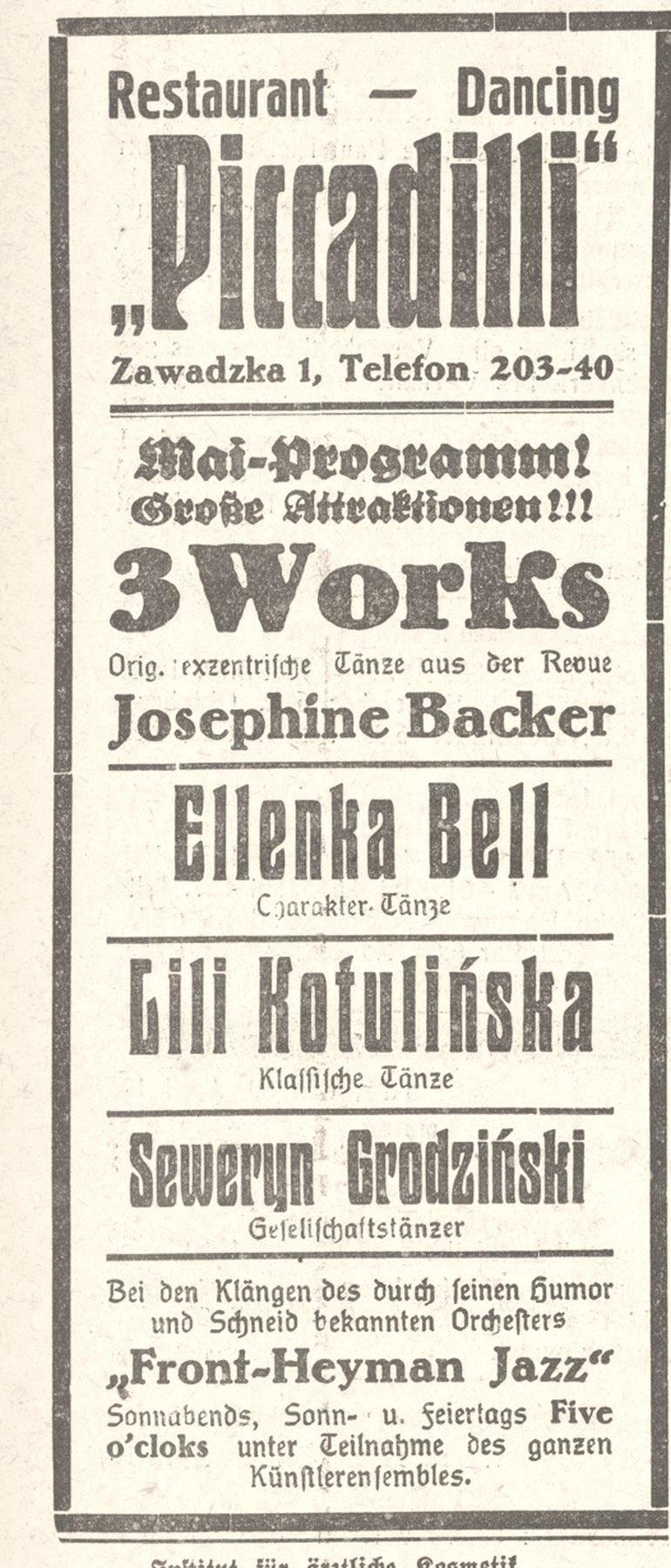
The band's reach did not end at the Warsaw toll-gates. The Łódź „Freie Presse" — the daily of German-speaking Łódź — advertised the Restaurant-Dancing „Piccadilli" at 1 Zawadzka Street with a programme in which, beside revue dancers, it announced: „Bei den Klängen des durch seinen Humor und Schneid bekannten Orchesters »Front-Heyman Jazz«" — to the sounds of the orchestra known for its humour and dash. Humour and dash: it would be hard to find a better two-word review of this band.
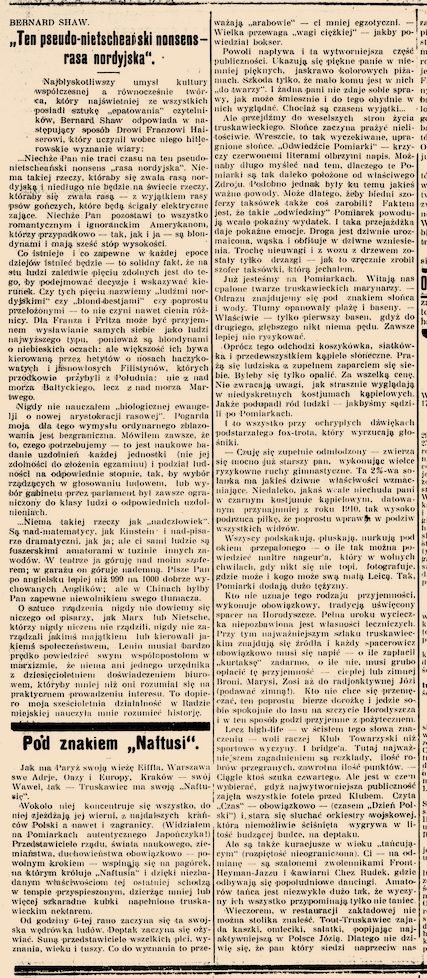
In the summer of 1933 the band went to the spas. Truskawiec — a fashionable resort with the „Naftusia" mineral water, a promenade and a social club — got its own jazz for the season. The columnist of the Kraków „Czas" described on 2 August the local ritual: from six in the morning „a homely migration of peoples" with cups to the springs, at noon the beach at Pomiarki, and in the afternoon — the spa guests „are mad devotees of the Front-Heyman-Jazz and of the Chez Rudek café, where the afternoon dancings are held. The lovers of dance are extraordinarily numerous". And a portrait of the partner, malicious and tender at once: „Mr Front, moderately elegant, moderately blasé, conducts the orchestra enthusiastically".
On the same column, a single column-width from the foxtrots of Pomiarki, the editors reprinted a voice from another world. Bernard Shaw — then the most famous playwright on the globe — mocked the racial doctrine of the Third Reich: „that pseudo-Nietzschean nonsense — the Nordic race". It was August 1933, half a year after Hitler's coming to power. In a Polish resort played an orchestra most of whose musicians would not have survived a world arranged according to that doctrine — and a columnist could still dismiss it with an Irishman's mockery.
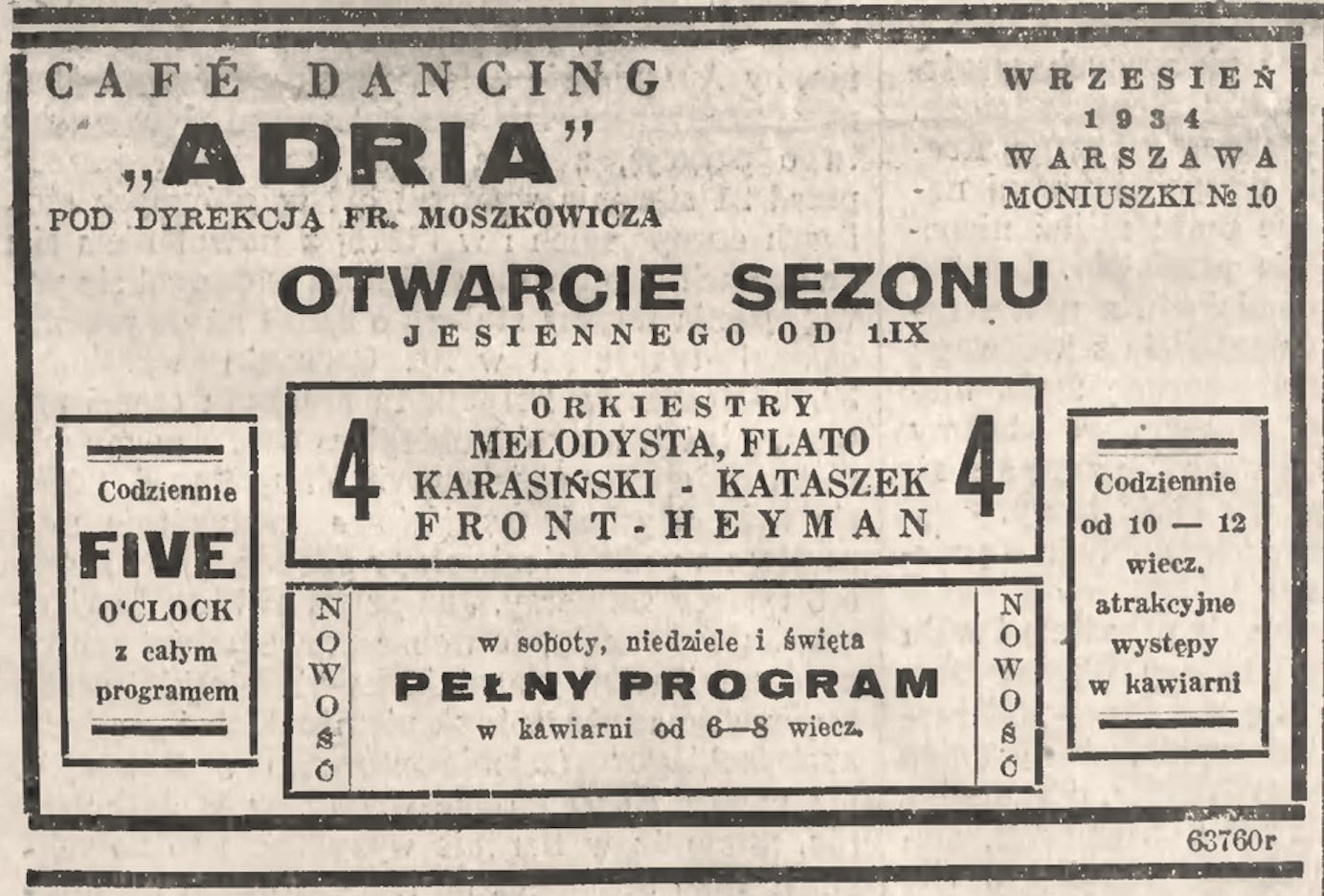
The orchestra played under its trade name longer than the dictionaries state. As late as 1 September 1934 the „Kurjer Warszawski" printed the Adria's great advertisement for the opening of the autumn season: four orchestras — Melodyst, Flato, Karasiński-Kataszek and Front-Heyman — a daily five o'clock with a full programme, performances in the café from six to eight in the evening. It is the band's last known bill. Soon afterwards the partners went their ways to their own undertakings — Front to his own establishments, Heyman in a direction no one expected of a musician.
VI. 1934 — the lottery office on Mazowiecka and the film about Skałłon
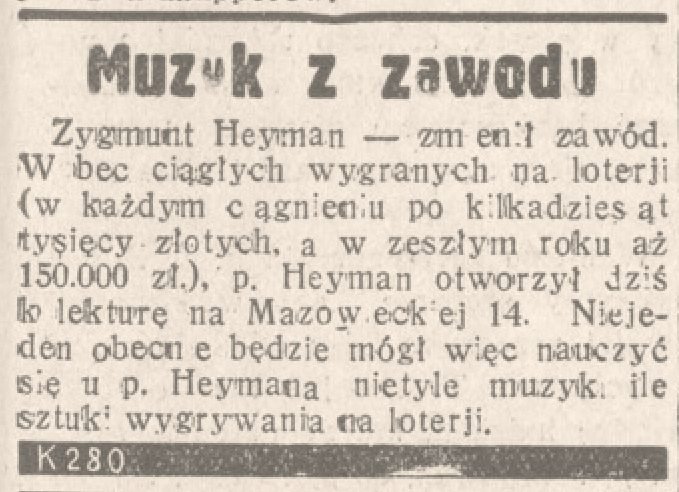
In January 1934 Heyman did a thing that amused the columnists — and that explains everything that came later. „Dobry Wieczór! Kurier Czerwony" of 25 January reported under the title „A musician by profession": „Zygmunt Heyman — has changed profession. In view of his continual lottery winnings (several tens of thousands of złoty in every drawing, and last year as much as 150,000 zł), Mr Heyman has today opened a lottery office at 14 Mazowiecka Street. Many a man will now be able to learn from Mr Heyman not so much music as the art of winning the lottery". A hundred and fifty thousand złoty a year — in times when a three-course dinner cost two złoty — made the banjoist a seriously wealthy man. The note incidentally settles a riddle one might puzzle over for years: the musician and the „owner of a lottery office" of the later reports are one and the same man.
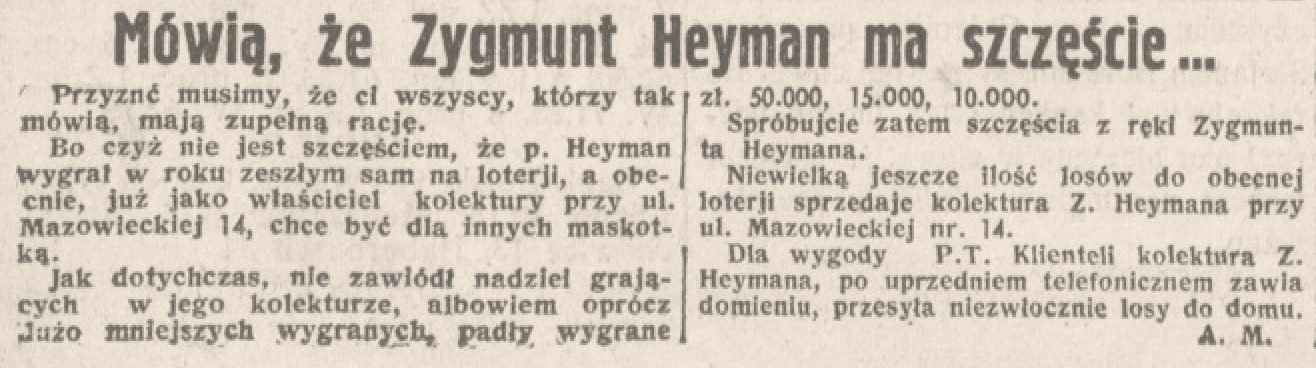
The office prospered. In the autumn the same newspaper wrote: „They say Zygmunt Heyman is lucky… We must admit that all those who say so are entirely right" — and listed winnings of fifty, fifteen and ten thousand złoty from tickets sold at 14 Mazowiecka Street, adding a service from another era: upon telephone notification the office „dispatches tickets to the home without delay". Luck became his second trade — and the founding capital of everything he would build.
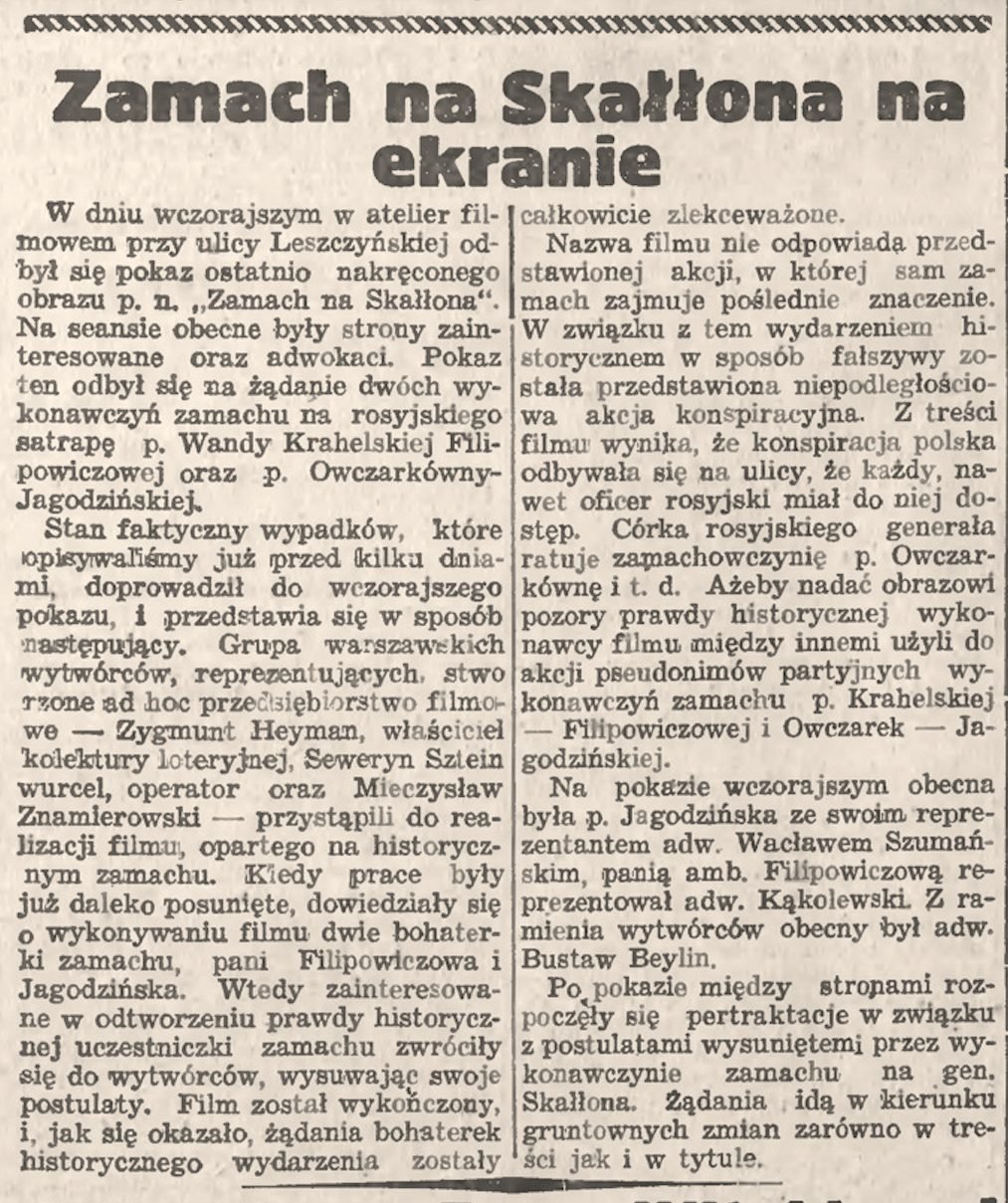
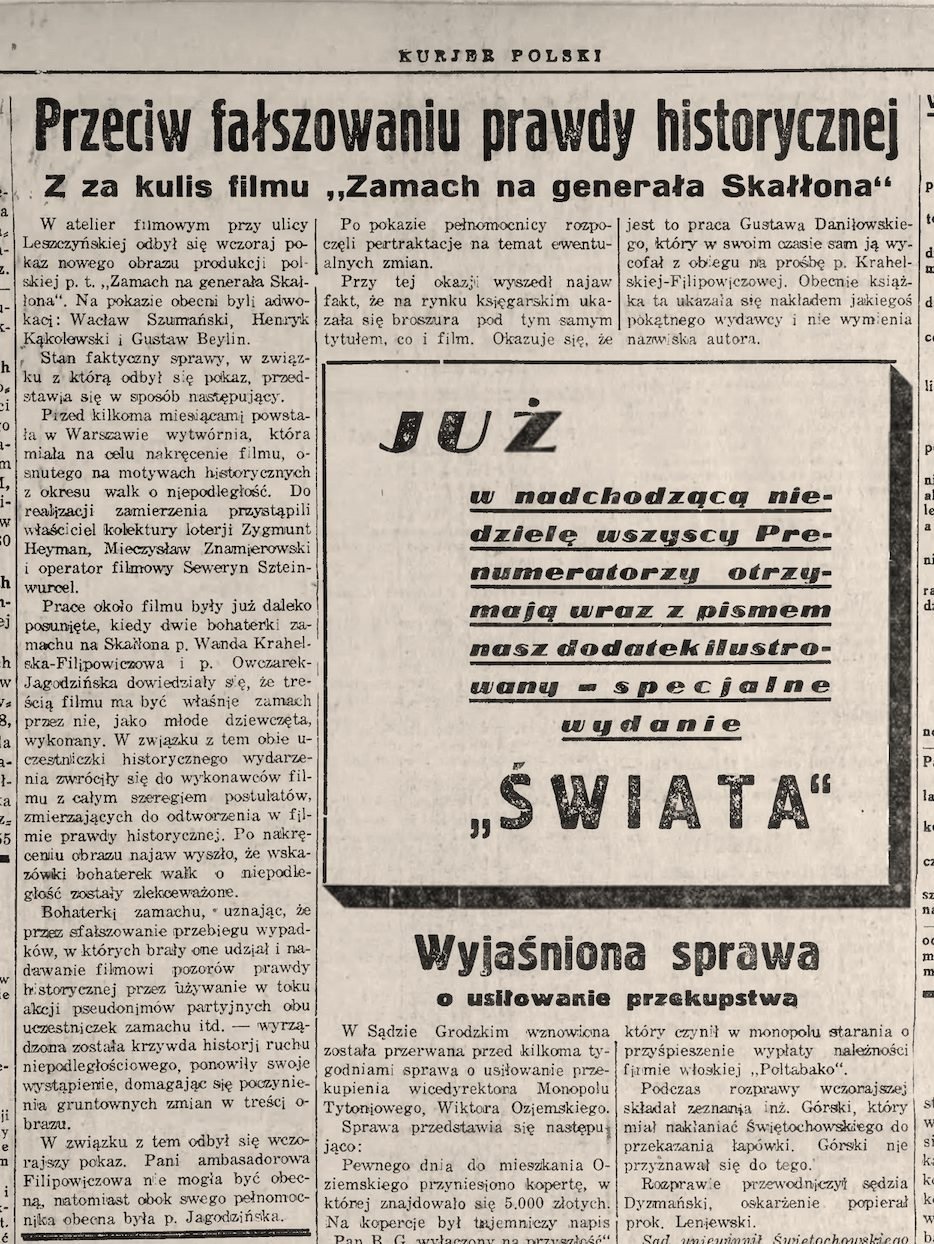
From the lottery office came also the strangest undertaking of this life. In the summer of 1934 Heyman — together with Mieczysław Znamierowski and the cameraman Seweryn Szteinwurcel — financed the feature film „The Attempt on General Skałłon", woven around the 1906 attempt by PPS fighters on the life of the tsarist governor-general of Warsaw. The work was far advanced when two living heroines of those events learned of the film — Wanda Krahelska-Filipowiczowa and Owczarek-Jagodzińska — and judged that the screen was falsifying their history. In September the press reported a screening for their representatives at the studio on Leszczyńska Street, the dispute „against the falsification of historical truth" and demands for „thorough changes". The musician who wanted to become a producer had run into opponents impossible to defeat: women who had thrown their own lives into that attempt.
VII. Koszykowa 59, Złota 7 — the addresses
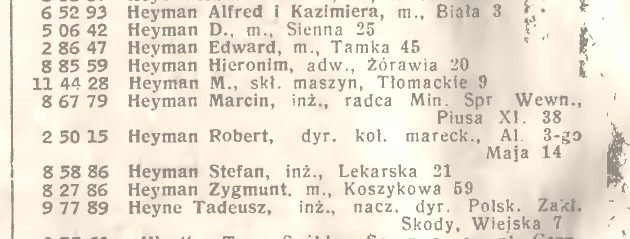
The subscriber directories of the Warsaw telephone network — the most prosaic source imaginable — allow his addresses to be reconstructed down to the number of the apparatus. The edition for 1937–38 notes: „Heyman Zygmunt, m., Koszykowa 59", telephone 8-27-86. The letter „m." stands for apartment.
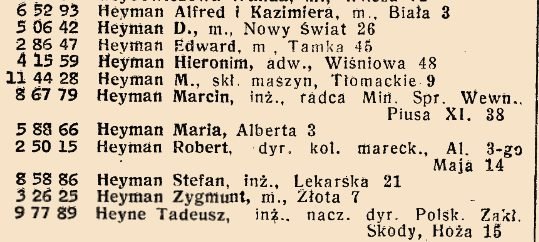
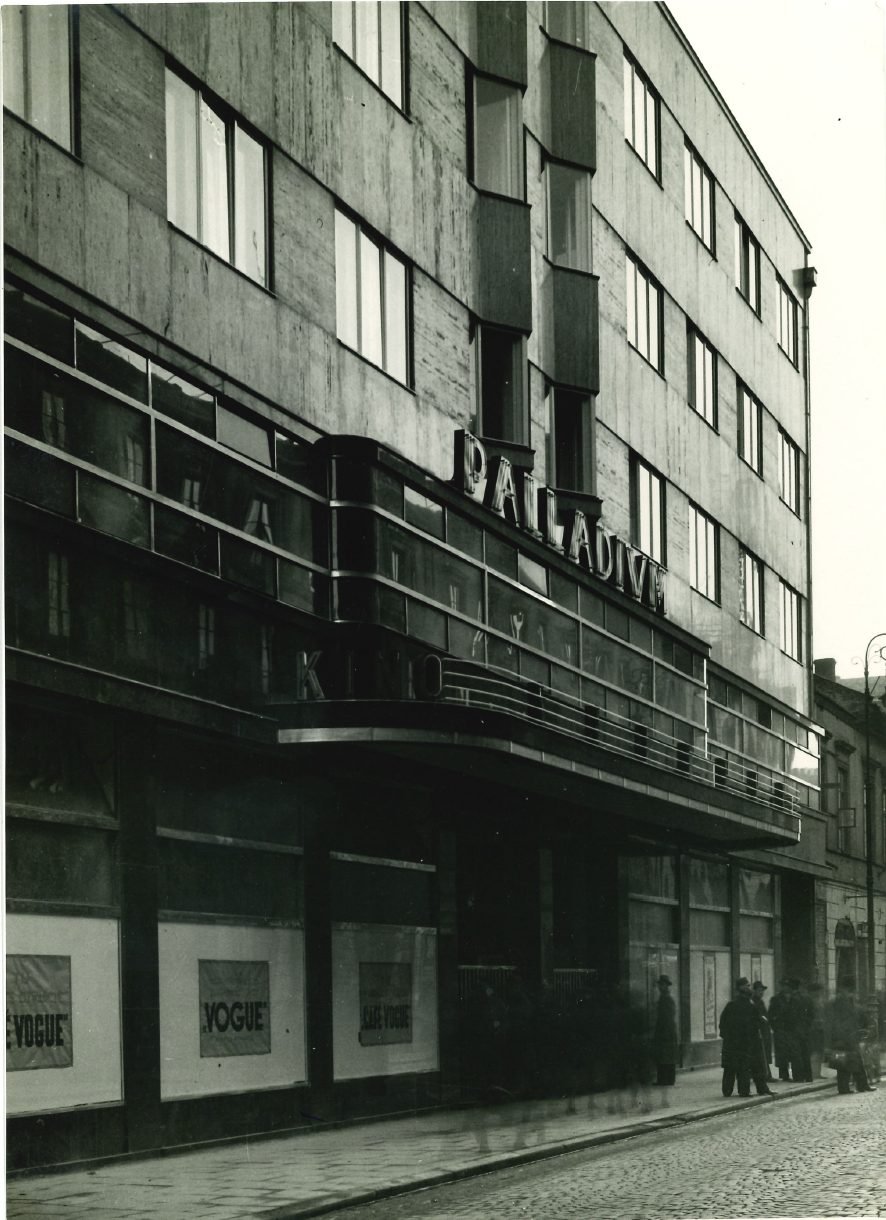
The next edition — already after the café's opening — gives a new address: „Heyman Zygmunt, m., Złota 7", telephone 3-26-25. The owner of Café Vogue had moved into the Assicurazioni Generali building — completed in 1937, Eber's luxurious, multi-purpose house with the Palladium cinema — and taken up residence literally above his own establishment. At the exchange his home number stood beside the café's numbers: 326-20, 326-24, 326-25. Work, home and neon — one staircase.
VIII. Karolina
At this point there enters the story the woman whose name it bears in its title. Karolina came into the world on 2 August 1909 — the twentieth of July by the old style — at nine in the evening, at the Kośminek farm near Lublin. Act number 455 of the Lublin civil-status books of the Mosaic faith, drawn up in Russian like all the acts of the Kingdom, says: father — Abram Dauman, aged twenty-nine, lessee of a distillery, resident in Żarki in the Będzin district; mother — Chaja née Rackier, aged twenty-six. The father reported his daughter's birth six weeks late, in the presence of two Lublin day-labourers, Izrael and Moszek Frajman; the clerk noted dryly at the end that „the delay of the declaration is in no way justified". Perhaps the distillery gave no respite; perhaps the road from Żarki to Lublin was long. The girl was given the name Karolina.
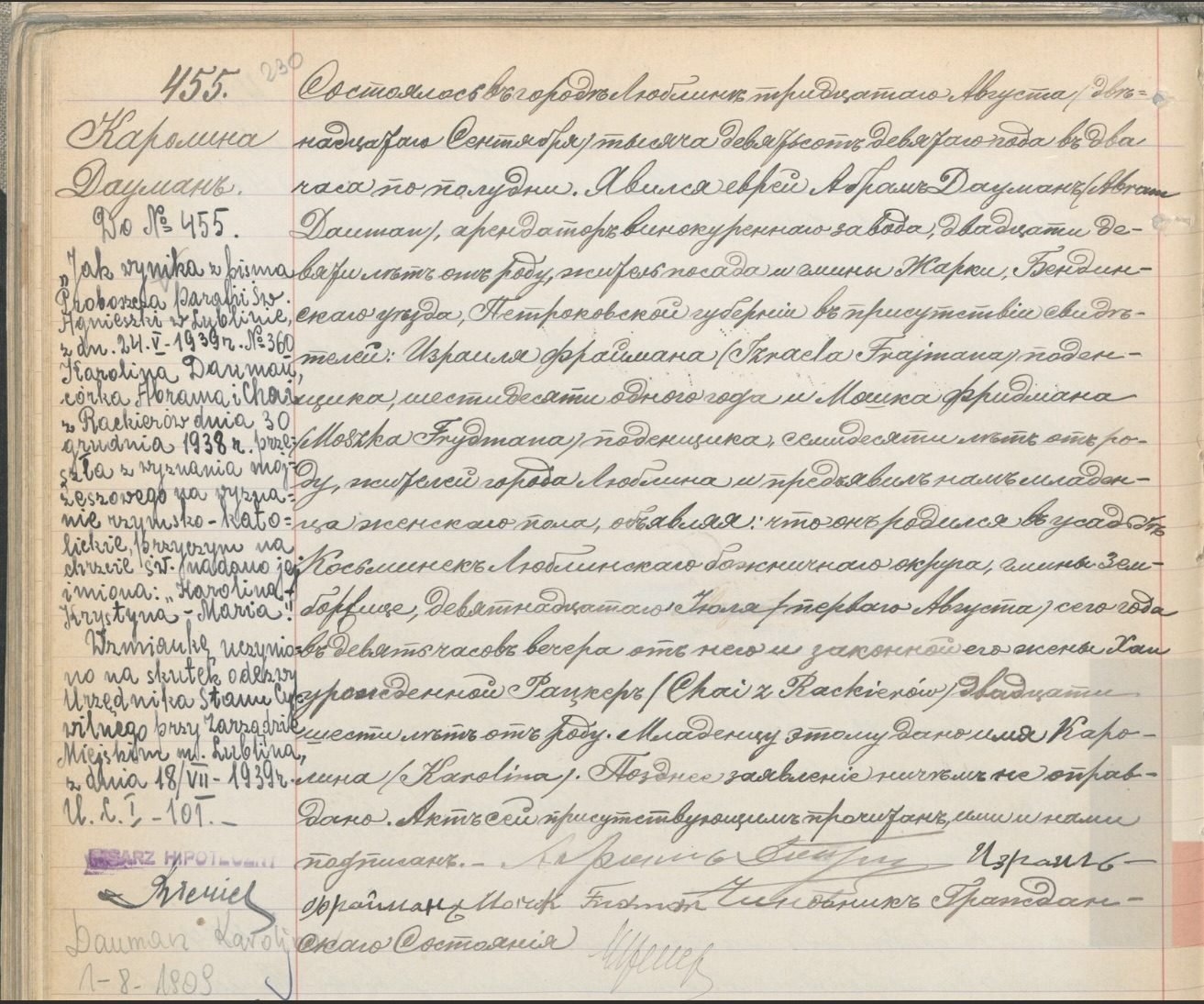
Before she became Mrs Heyman, she bore another name. The „Zakopane Guest List" of 1932 notes among the arrivals: „Wiszniewiecka Karolina, Warsaw, Carlton" — a twenty-three-year-old from Warsaw at the Carlton guesthouse, in the register of guests between holidaymakers from Kraków and Łódź. Wiszniewiecka is almost certainly the name from a first, very early marriage: under it she would travel to Zakopane, under it — though she would by then be Heyman's wife — the commercial register would record her in 1938. Who the first husband was, when and how that marriage ended — is not known; it is one of the project's open tasks. One thing is certain: when her second husband opened a café under the banner of fashion, she was twenty-eight and had one life already behind her.
IX. October 1937 — „has the honour to announce"
The café's press campaign started on 19 October 1937 — a strip at the head of a column: „Opening soon »CAFE VOGUE« Złota 7 (the new building of the Generali Co.)". The name was meant to do the work by itself. Vogue meant fashion; fashion liked the setting of round café tables at which ladies read and talked about it; and all this in a building that was itself a manifesto of modernity. The interiors were designed by the team of the architect Edward Seidenbeutel (Sułkowski); the attraction was to be jazz concerts on two silver grand pianos set on a special podium.

The Warsaw to which Heyman addressed his invitation was, however, no longer the city of the carnivals of Front-Heyman Jazz. That same autumn the rectors of one university after another were introducing by decree the bench ghetto — separate „odd-numbered" benches for Jewish students; whoever would not sit stood through entire lectures. Three days after the café's first announcement, the „Wieczór Warszawski" reported on page four the protests of the Bund, the PPS and Jewish youth against those decrees — and the protest strike of Jewish shops during which „on Nalewki one sold from the back door".
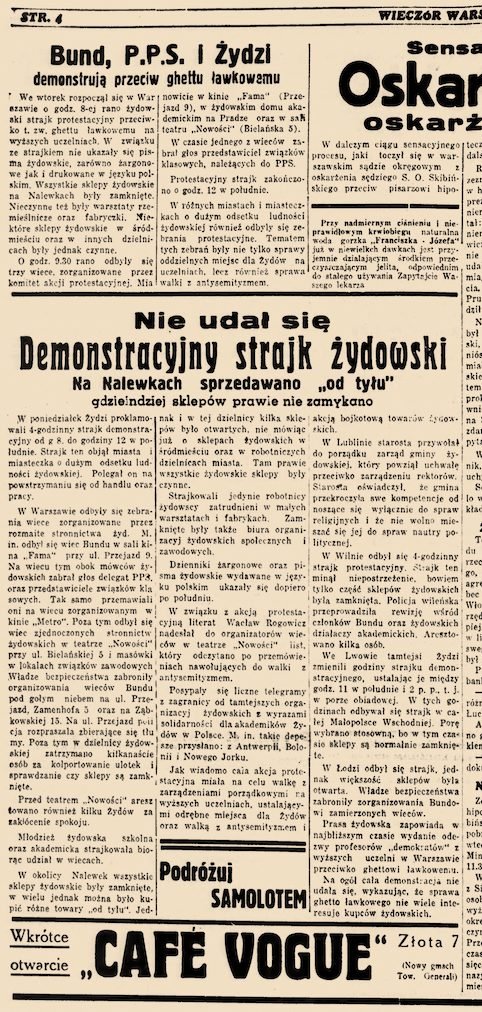
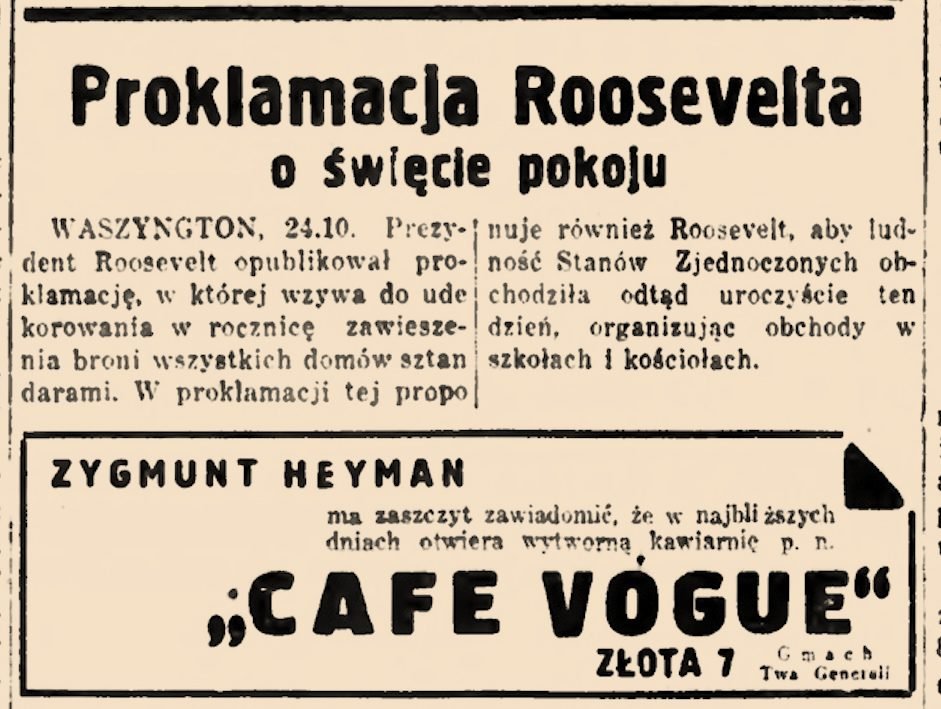
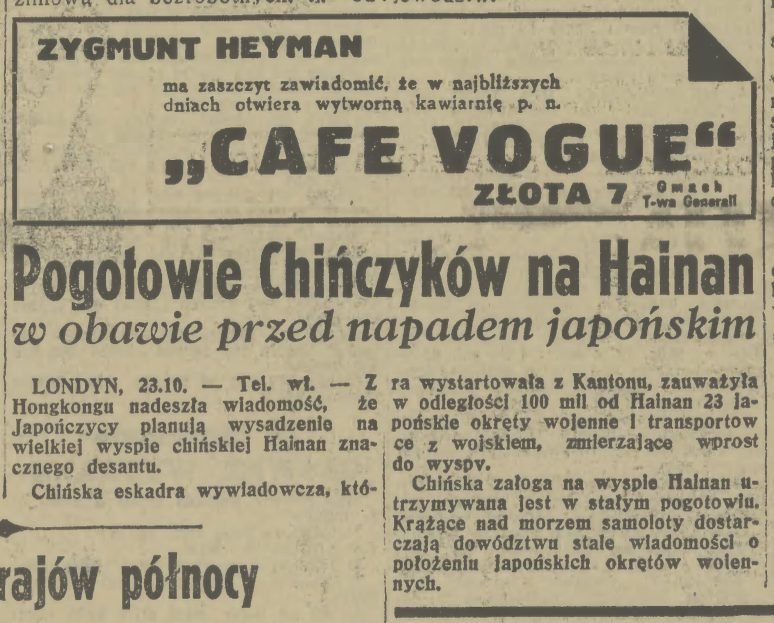
On 24 October an advertisement in the first person appeared — the kind one places once in a lifetime: „ZYGMUNT HEYMAN has the honour to announce that in the coming days he opens an elegant café under the name »CAFE VOGUE«, ZŁOTA 7, the building of the Generali Co.". Two dailies printed it that day at once — and both columns are today documents of the era, each in its own way.
X. 9–18 November 1937 — the opening
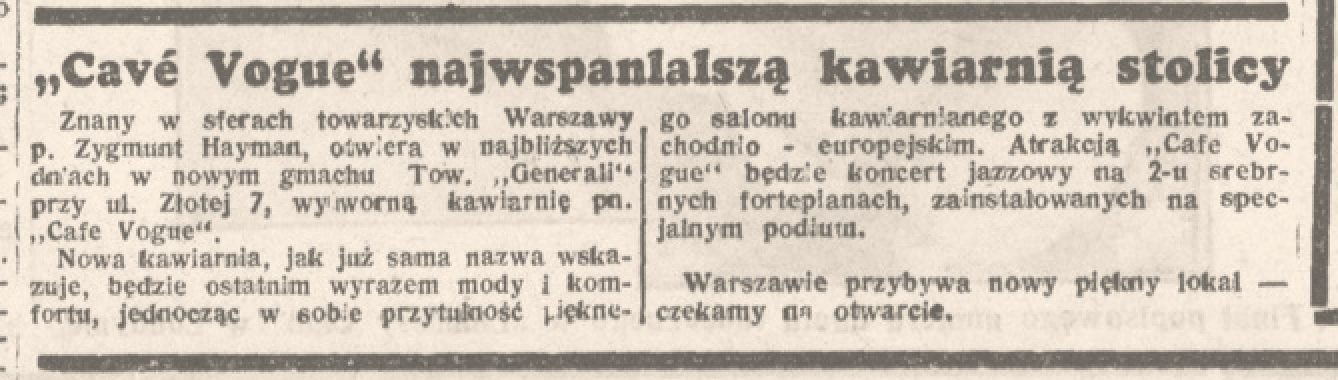
On 9 November the daily devoted a separate note to the new establishment: „»Café Vogue« the most splendid café of the capital". The new café — it wrote — „as its very name indicates, will be the last word in fashion and comfort, uniting the cosiness of a café salon with West European refinement. The attraction of »Café Vogue« will be a jazz concert on two silver grand pianos installed on a special podium. Warsaw gains a beautiful new establishment — we await the opening".
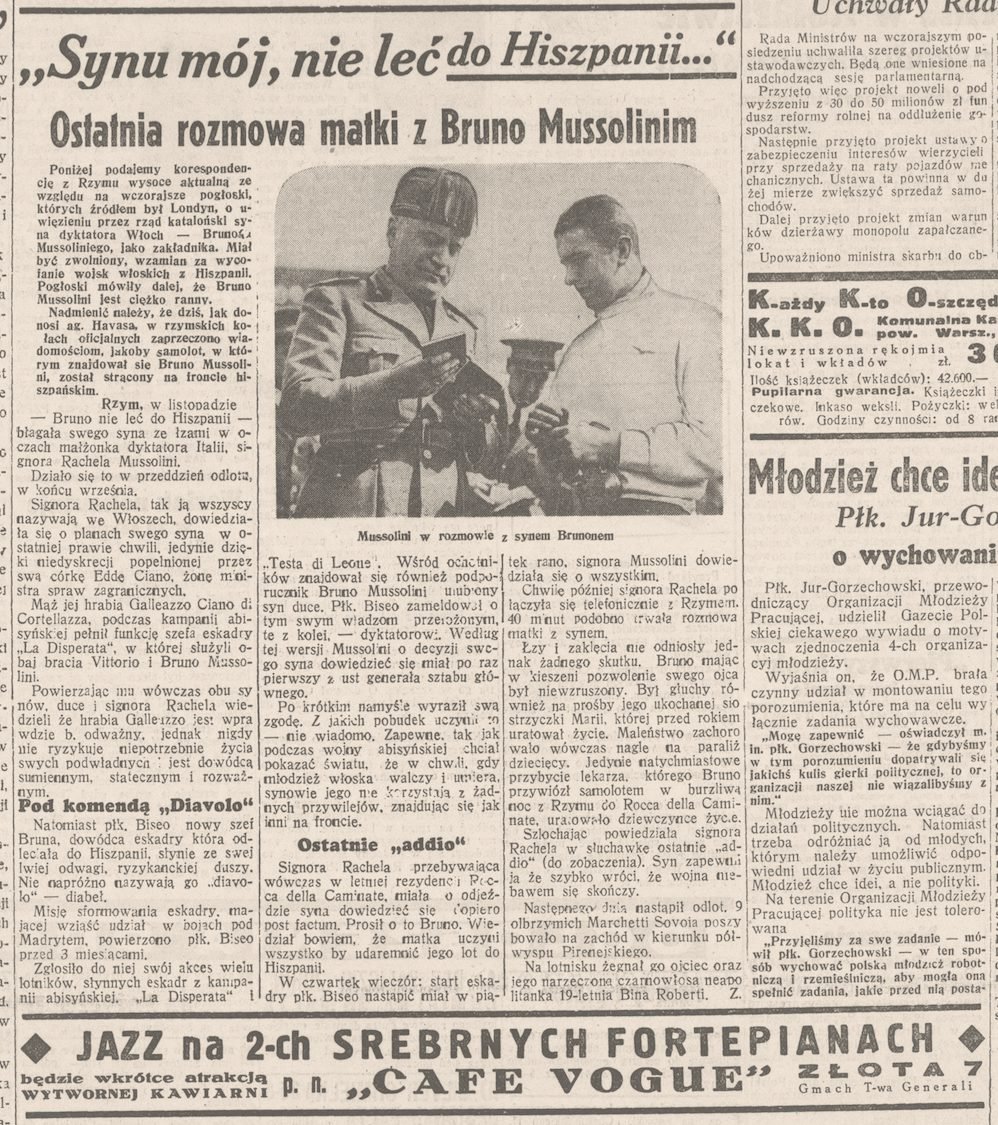
The next day the advertisement of the two silver grand pianos was printed at the foot of a column entirely taken up by a dispatch from Rome: „My son, do not fly to Spain…" — a mother's last conversation with Bruno Mussolini. Rachele Mussolini, wife of the dictator of Italy, begged her son with tears in her eyes — a pilot of the „La Disperata" bomber squadron — not to fly to the Spanish war; London gossiped that day that Bruno was in Catalonian captivity or gravely wounded, and Roman official circles issued denials. Beneath the photograph of the father bent over his son, beneath Signora Rachele's last „addio", a strip was printed: jazz on two silver grand pianos will soon be the attraction of an elegant café at 7 Złota Street. In the same issue the Palladium cinema — the neighbour through the wall — advertised the third week of the comedy „One of Us Has Gone Mad". The titles arranged themselves.
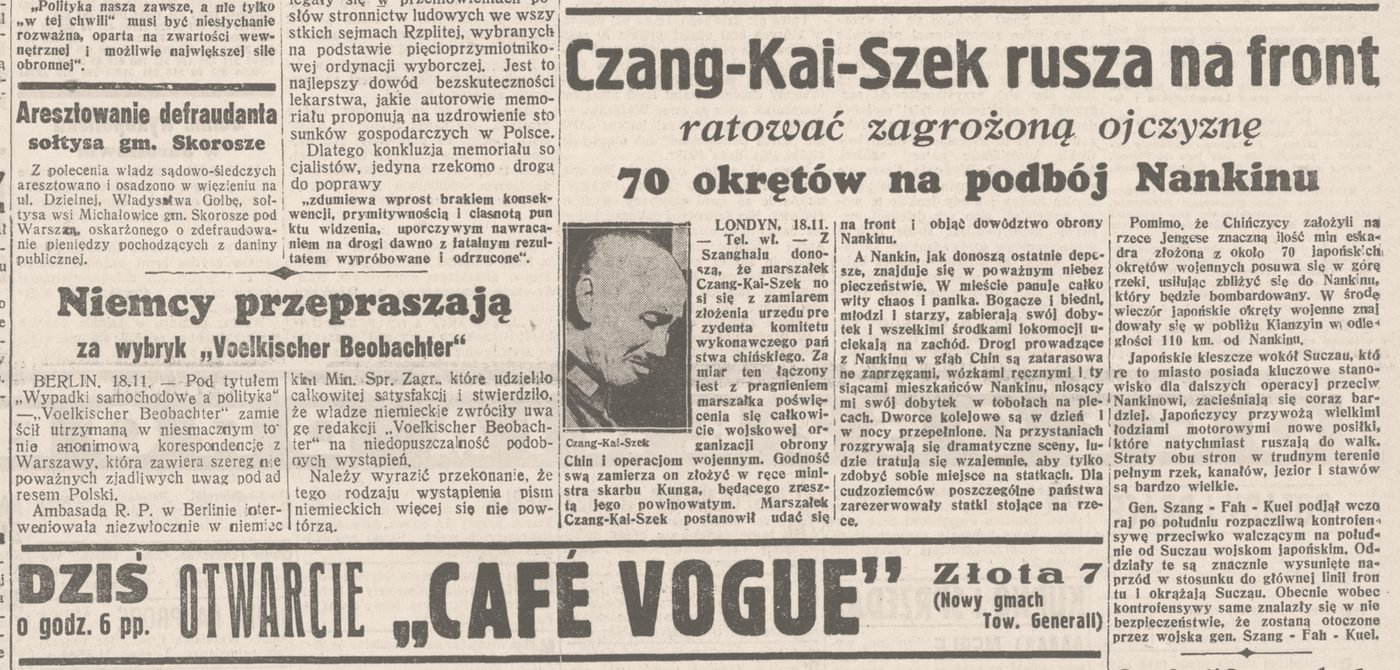
The café started on Thursday 18 November 1937 at six in the afternoon — a week after Independence Day, for whose parade, as the press announced, half a million people had turned out. The establishment was calculated for a female clientele and for those who wished to be seen: piles of domestic and foreign fashion magazines awaited the ladies, and for the gentlemen — periodicals of a somewhat different subject matter. Open from nine in the morning to midnight; admission free. On opening day the neighbouring column reported that Germany was apologising for the „escapade" of its party newspaper — it was still apologising.
XI. 8 March 1938 — the firm and the prenuptial agreement
Four months after the opening the café received its official birth certificate. „Monitor Polski" no. 54 of Tuesday 8 March 1938 announced the entry in the commercial register, item XLVI 140: „»Cafe Vogue« Zygmunt Hejman" in Warsaw, Złota 7. Café. Zygmunt Hejman. Between the owner of the firm and his spouse Karolina Wiszniewiecka née Dauman an arrangement has been concluded by way of a prenuptial agreement establishing separation of property and community of acquisitions". Three lines of official print — and they say two things about this man that no advertisement had said.
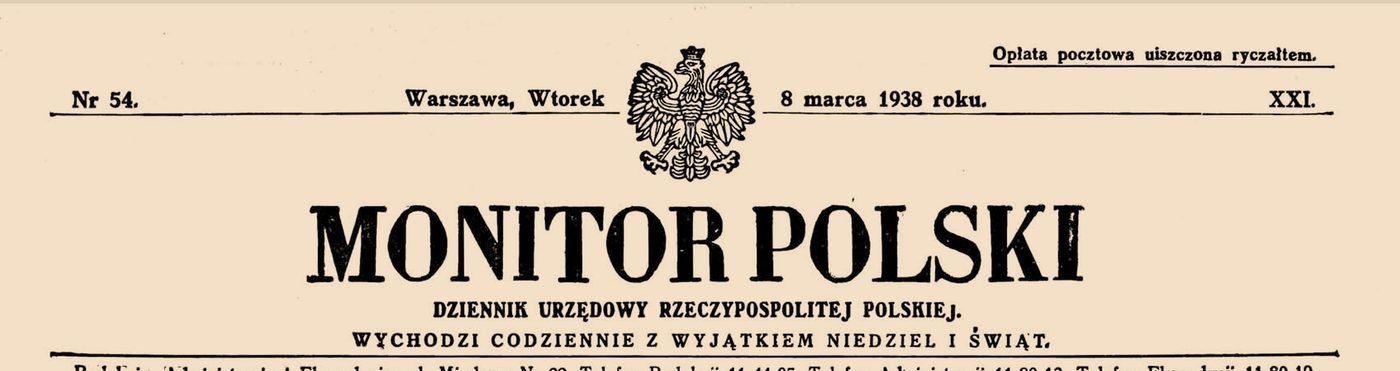
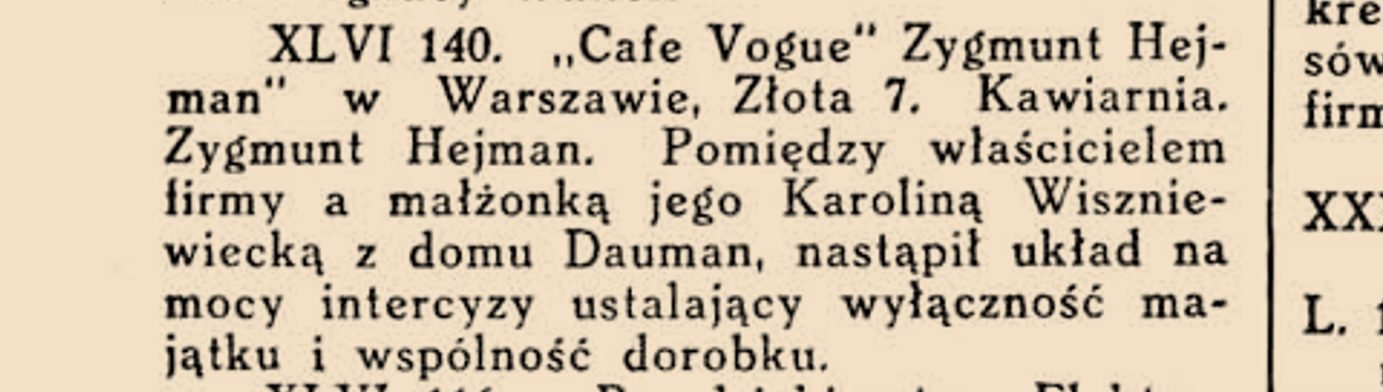
First — the spelling. The Polish state recorded the owner as Zygmunt HEJMAN; exactly the same way a clerk in Rio de Janeiro would record him in 1942. „Heyman" of the bills and the drumhead was the stage form; „Hejman" — the official one. Second — his marital status. On 8 March 1938 Karolina was already his wife; the wedding must have taken place before that date, and its record has not yet been found. The prenuptial agreement — separation of property, community of acquisitions — is the signature of a man who made his fortune himself and who secures the firm sensibly, but shares what is to come. In the register the wife appears under the name of her first marriage and her maiden name at once — as if the clerk wanted to fit her whole biography so far into one column.
A third thing must be added from the Lublin books — and left for now without comment, because the comment will be provided by the newspaper columns of the later part of this account. On 30 December 1938, ten months after the announcement of the prenuptial agreement, Karolina converted in Rachów from the Mosaic to the Roman Catholic faith; at her baptism she received the names Karolina Krystyna-Maria. The annotation was entered in the margin of her birth act on 18 July 1939 — six weeks before the outbreak of the war.
XII. Spring and summer 1938 — Wiera Gran, Whiteman on record, a two-złoty dinner
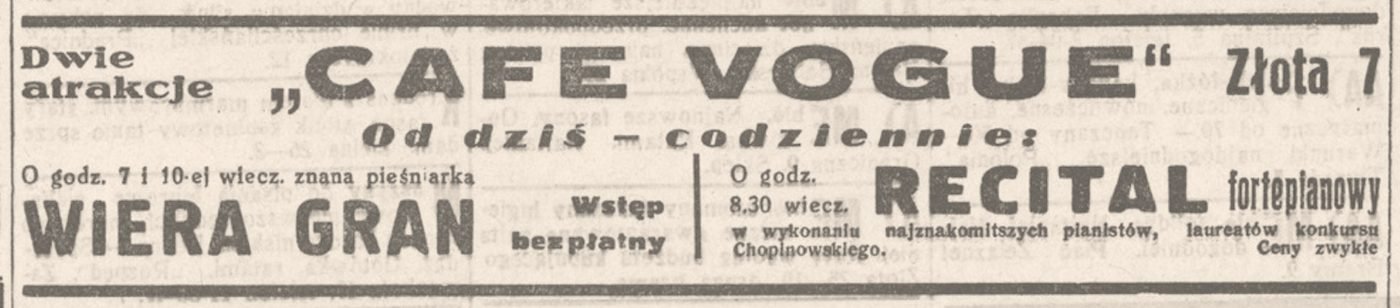
In the spring of 1938 there played in the café, „after great successes abroad", Messrs Rosner, Herbst and Glasberg. And on 1 May there stood on the bandstand at Złota a twenty-two-year-old singer with a low, dark contralto, who was only beginning — and whose name would pass into the history of Polish song, and then into its most painful disputes: „Two attractions… At 7 and 10 p.m. our singer WIERA GRAN, admission free. At 4.30 p.m. a piano RECITAL performed by the most eminent pianists, among them Chojnowski". The word „our" says everything: Café Vogue already had a star of its own.

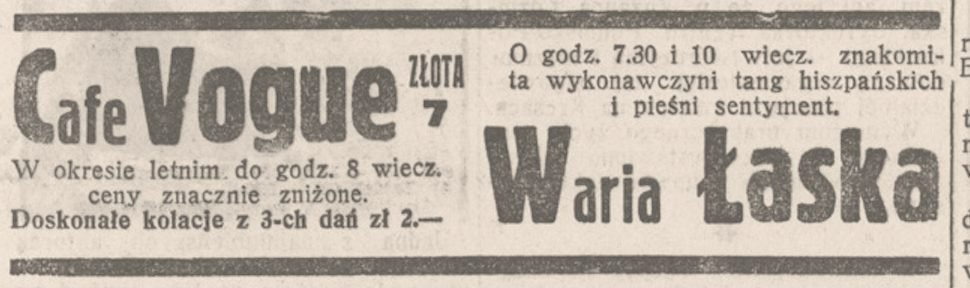
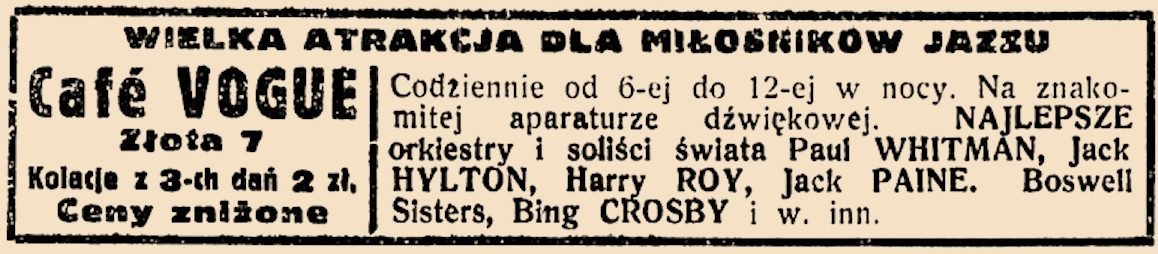
In July the café began advertising also in „Nasz Przegląd" — the great Polish-language daily of Jewish Warsaw — and with an announcement that reveals its technical secret: „A GREAT ATTRACTION FOR LOVERS OF JAZZ… On excellent sound equipment the BEST orchestras and soloists of the world: Paul WHITEMAN, Jack HYLTON, Harry ROY, Jack PAYNE, the Boswell Sisters, Bing CROSBY and many others". Café Vogue had a sound system and played Warsaw from records what could be heard nowhere else — American and English jazz in the best recordings of the era. The owner who had once himself played Warsaw to dance now played it Crosby. He knew repertoire like no one in that city.
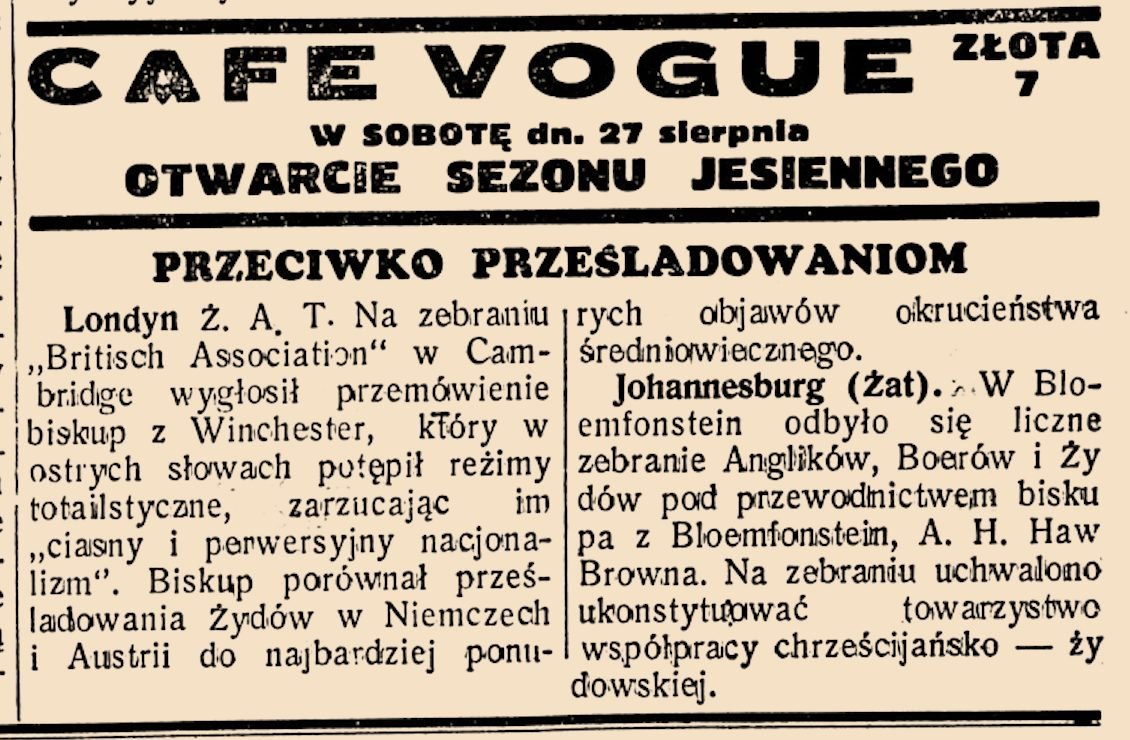
The autumn season opened on Saturday 27 August. In „Nasz Przegląd" the announcement stood directly above the dispatches gathered under the title „Against the persecutions": the Bishop of Winchester condemned in Cambridge the „narrow and perverse nationalism" of the totalist regimes and the persecution of Jews in Germany and Austria — the Austria the Reich had swallowed half a year earlier — while in Bloemfontein, South Africa, Englishmen, Boers and Jews were founding a society of Christian-Jewish cooperation. The world protested by letter; the café opened its season.

XIII. September–October 1938 — the crisis
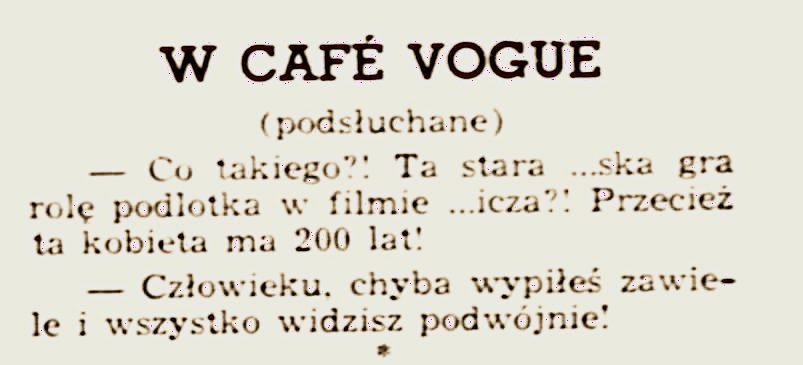
The café began September 1938 with a joke. The press published in its humour column the scene „At Café Vogue (overheard)": — „What?! That old …ska is playing an ingénue in …icz's film?! Why, the woman is 200 years old!" — „Man, you must have drunk too much and are seeing everything double!". An establishment about which jokes are written without giving the address is already part of the city's folklore. But it is enough to turn the same newspaper a few columns further to come upon Gęsia Street.
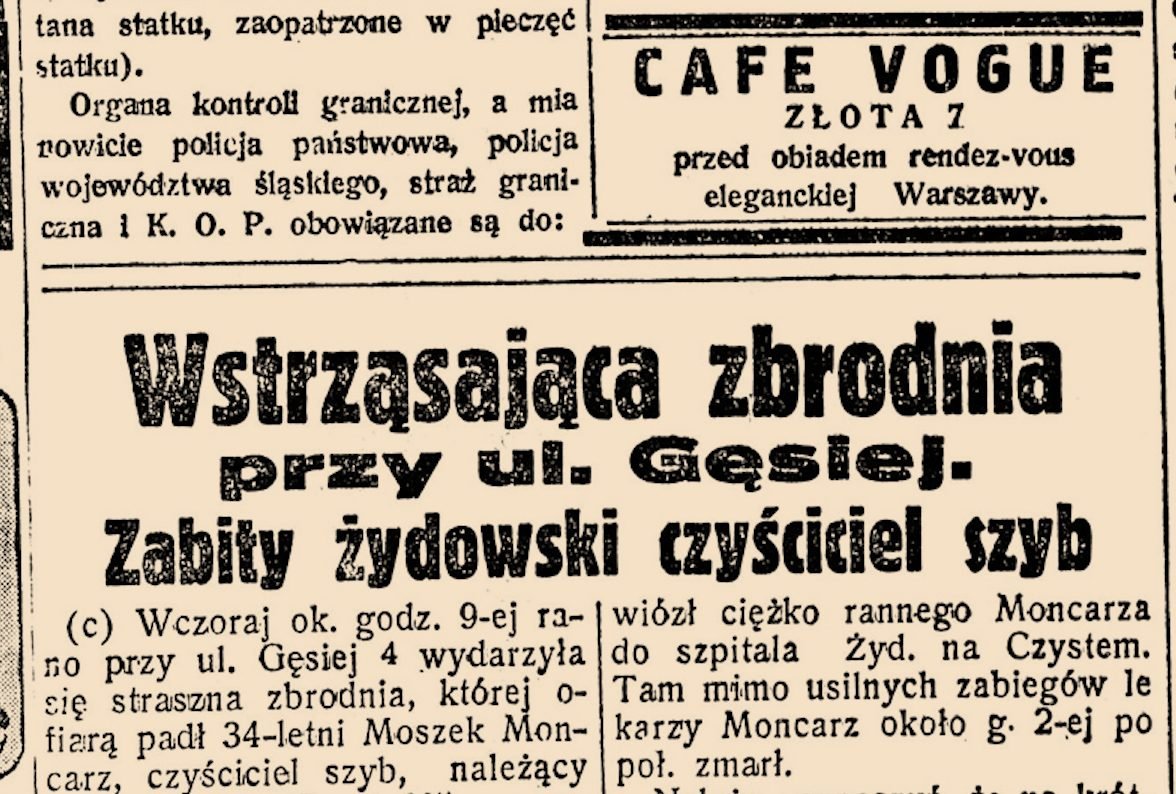
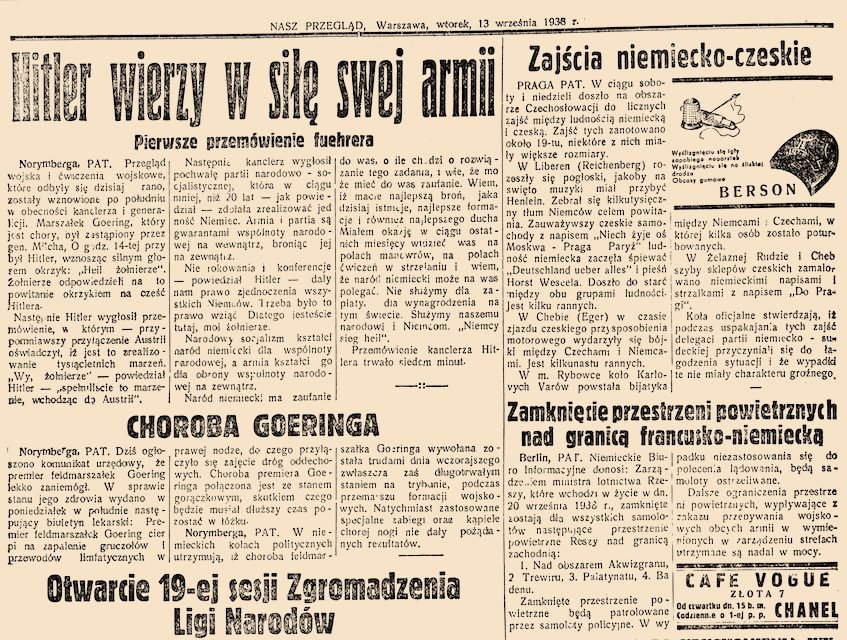
Then came the weeks in which the café's advertisements were printed on the columns of the Czechoslovak crisis — and today they read like freeze-frames of a countdown. On 13 September, the day after the Reich leader's Nuremberg speech, „Nasz Przegląd" came out with the headlines: „Hitler believes in the strength of his army", „Goering's illness", „German-Czech incidents", „Closure of the airspace over the French-German border", „Opening of the 19th session of the Assembly of the League of Nations". In the bottom right corner of the same page a small box announced: „CAFÉ VOGUE, Złota 7. From Thursday the 15th inst., daily at 1 p.m. — CHANEL". Who or what that „Chanel" was — a soloist, an ensemble, a lunchtime attraction with a French-sounding pseudonym — the advertisement does not reveal; all that is known is that it was to begin on Thursday the fifteenth. That same Thursday Neville Chamberlain boarded an aeroplane for the first time in his life and flew to Berchtesgaden to negotiate with Hitler.

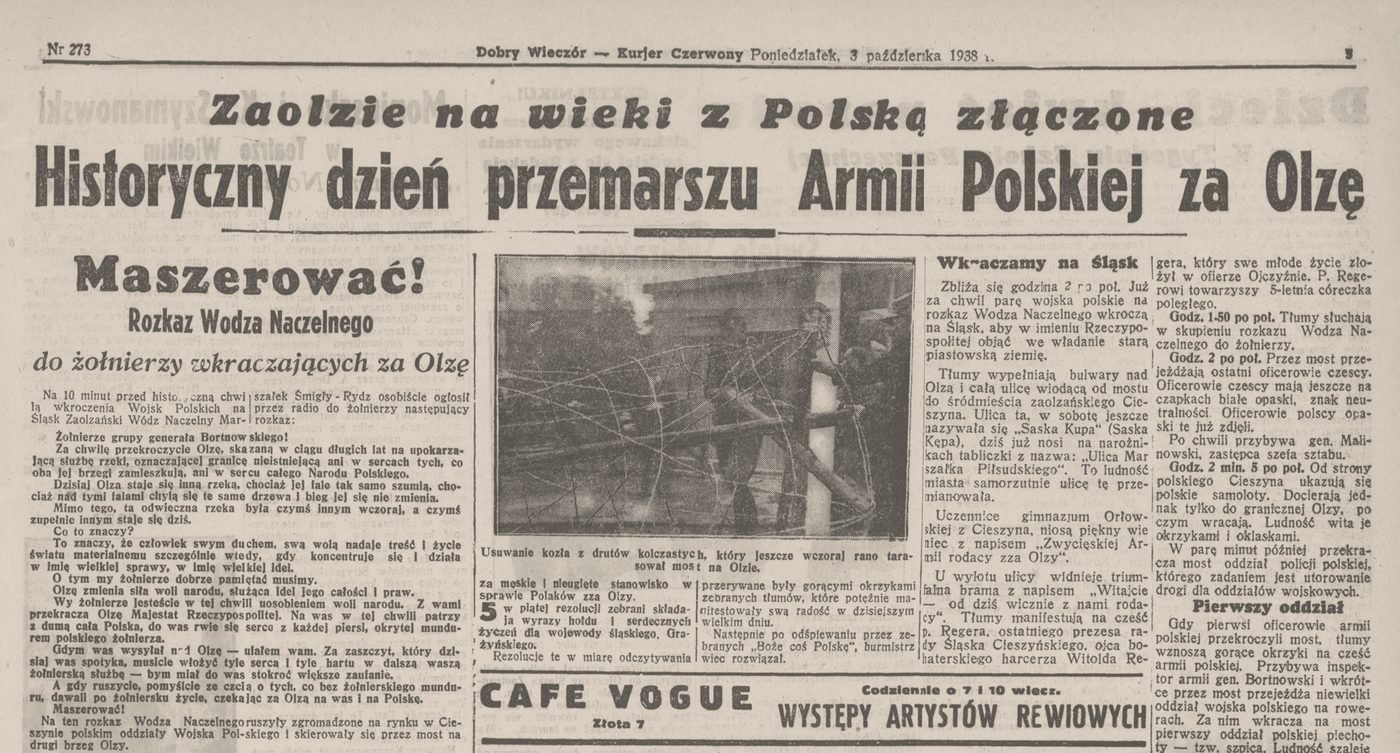
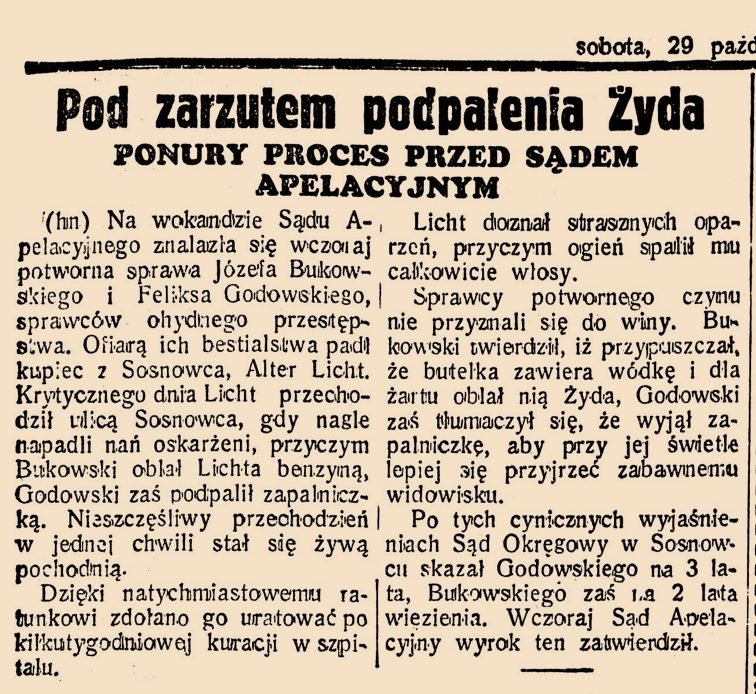
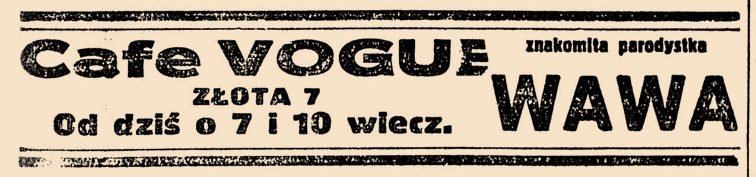
The last days of October brought an event that touched tens of thousands of Polish Jews. On the night of 27–28 October the Germans expelled across the border — mainly through Zbąszyń — over ten thousand Polish citizens of Jewish origin; the expelled camped in the border strip, between two states neither of which wanted them. „Nasz Przegląd" of 29 October, beside its reports of that catastrophe, described an appeal trial in a case from Sosnowiec: two men had doused with petrol and set alight in the street the merchant Alter Licht — „the unfortunate passer-by became in an instant a living torch"; they received three and two years. On the same page the café announced the performances of „the excellent parodist WAWA", and Max Factor — daily free distribution of cosmetics. The Jewish newspaper of that Saturday is a document of a world still trying to do everything at once: to count the expelled, to try the arsonists and to go and see the parodists.
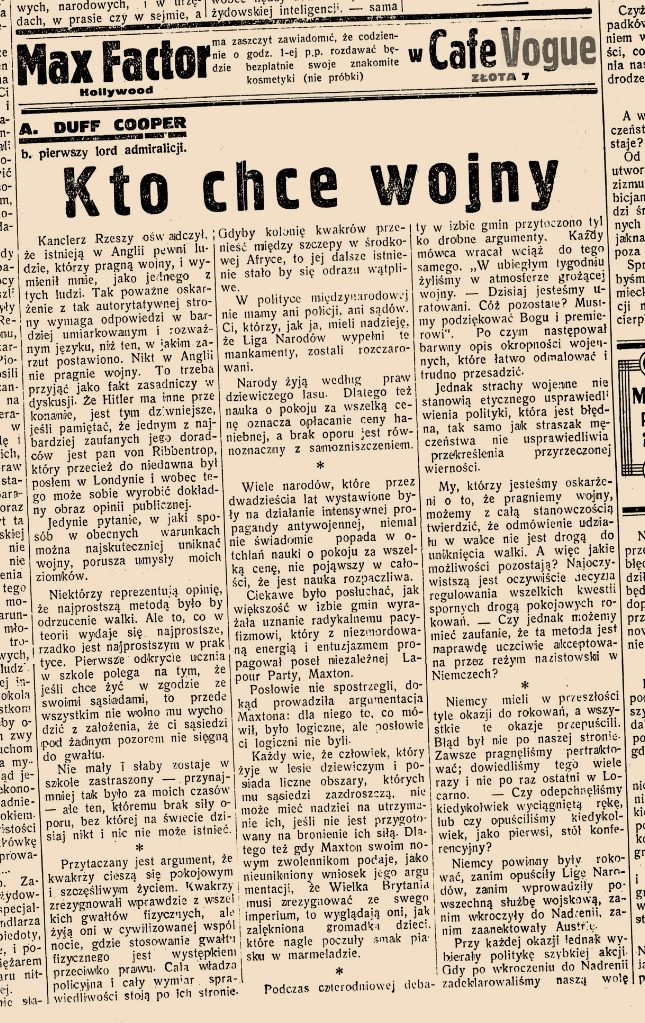
XIV. November–December 1938 — after Kristallnacht
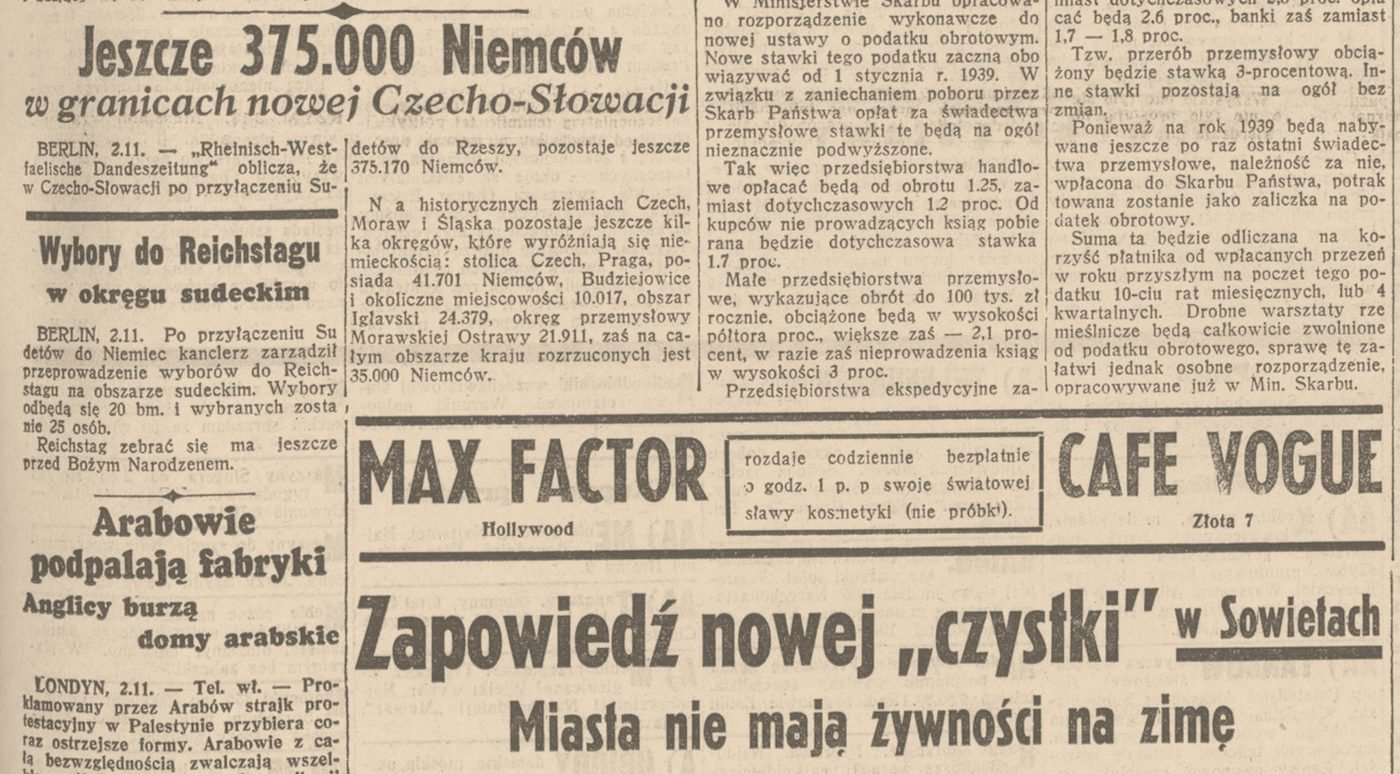
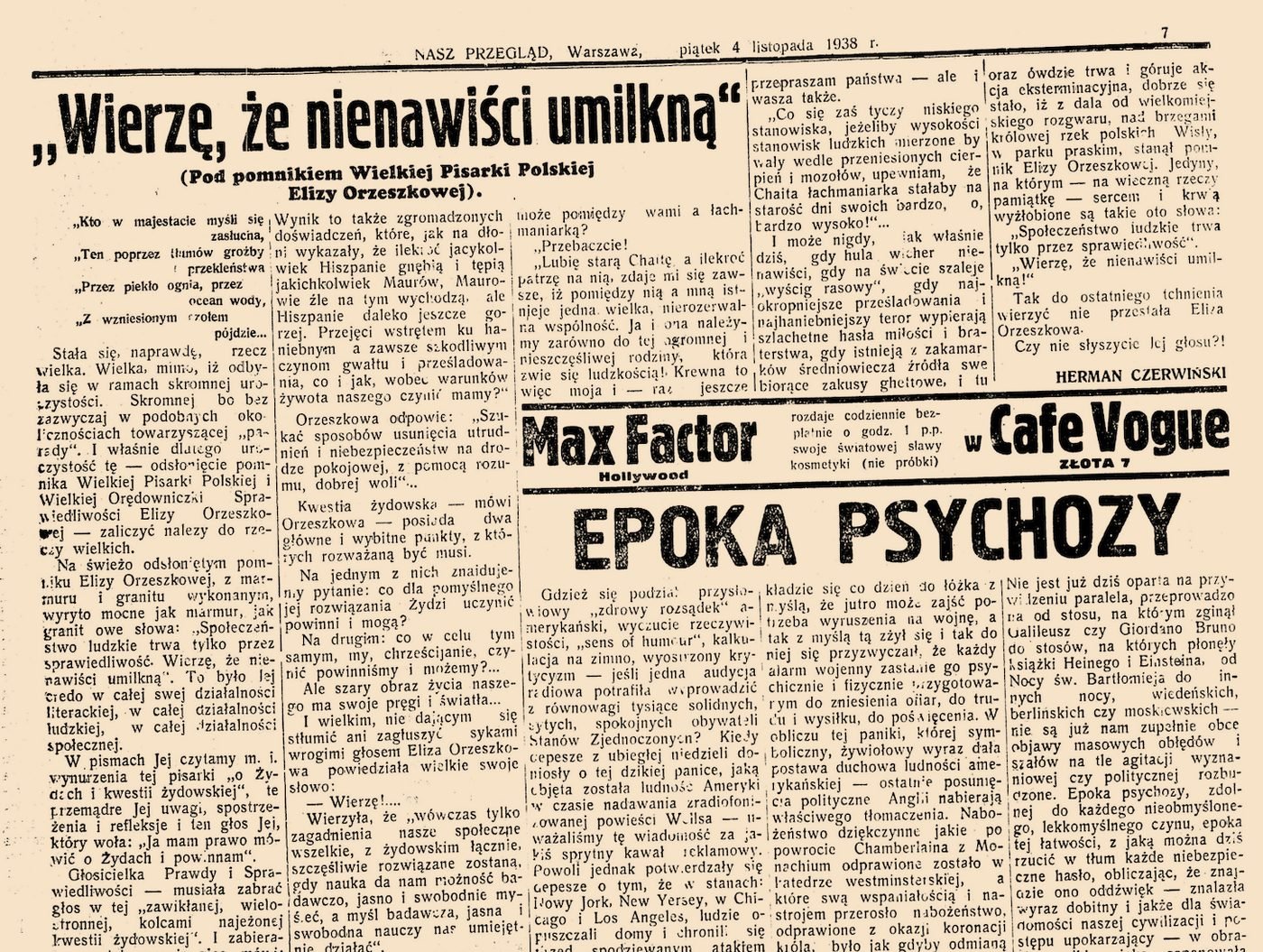
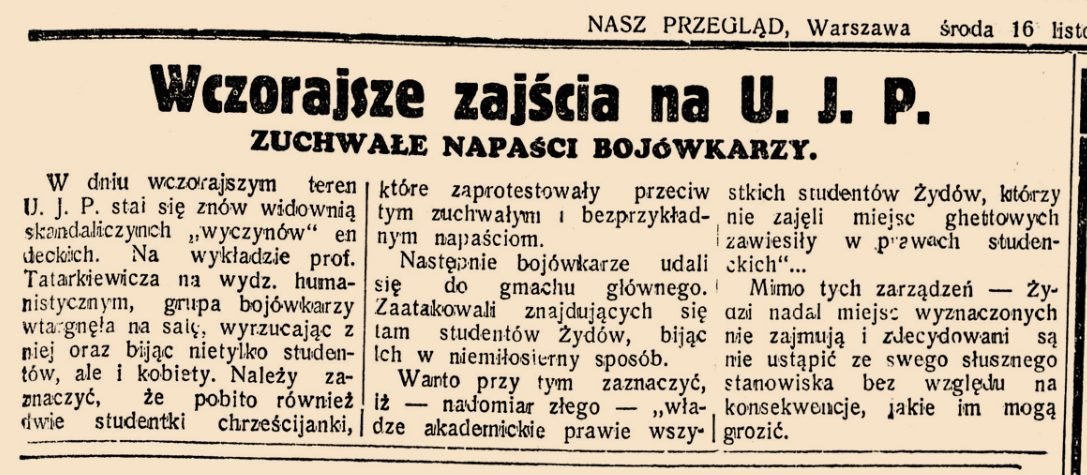
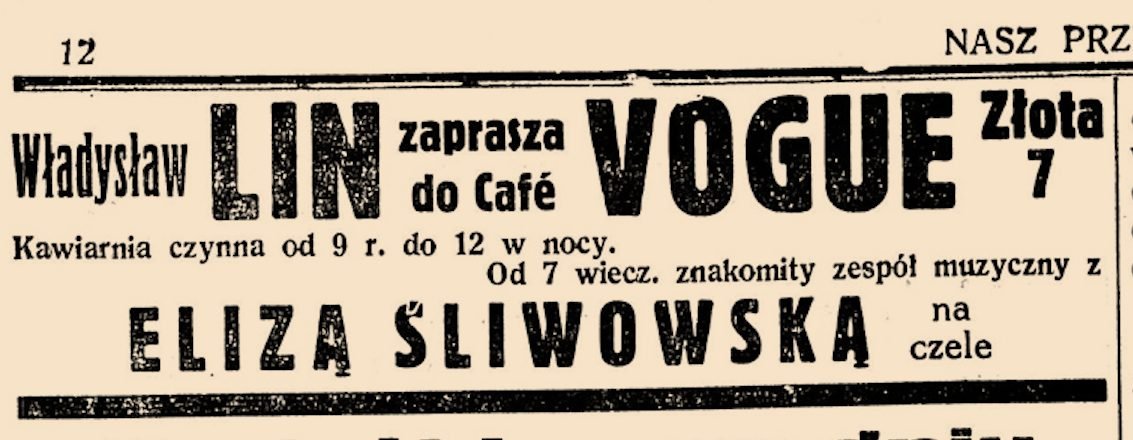
On the night of 9–10 November synagogues burned across the whole Reich. „Nasz Przegląd" of 16 November brought the week's balance: „The tragic situation of the Jews in Germany" — mass arrests of men between sixteen and sixty, sixteen thousand imprisoned in Wrocław alone, transports to Oranienburg and Buchenwald, synagogues wrecked and closed, prayer possible only furtively, ten at a time in private apartments — and the threat of arrest „for taking part in an illegal gathering". The same newspaper reported that day incidents closer to home: militants beating Jewish students at the Józef Piłsudski University. And it was on these very pages that Café Vogue placed its calmest-toned advertisement — as if someone at the café had decided that in such a week it was enough to give the opening hours.
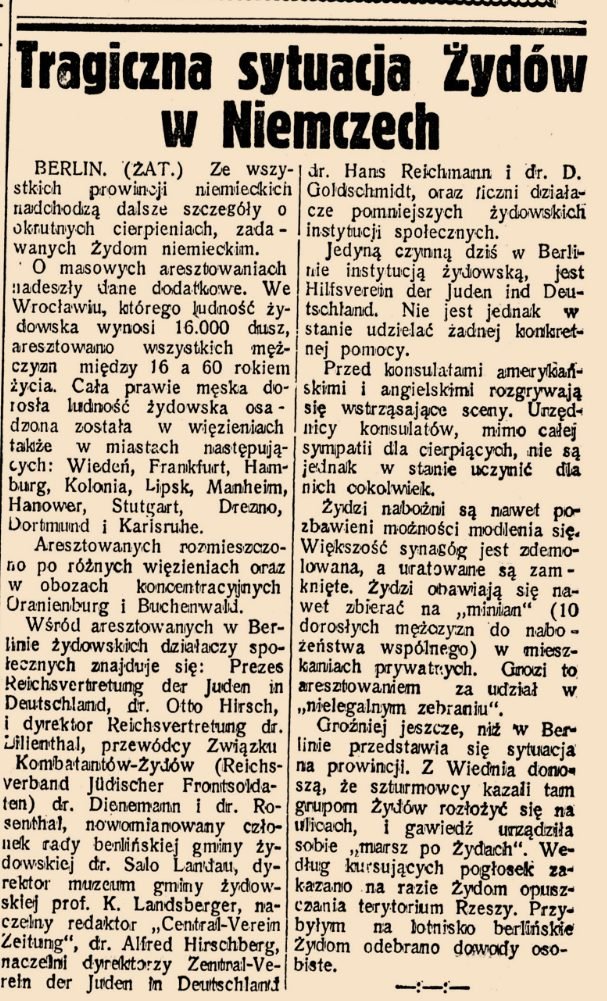
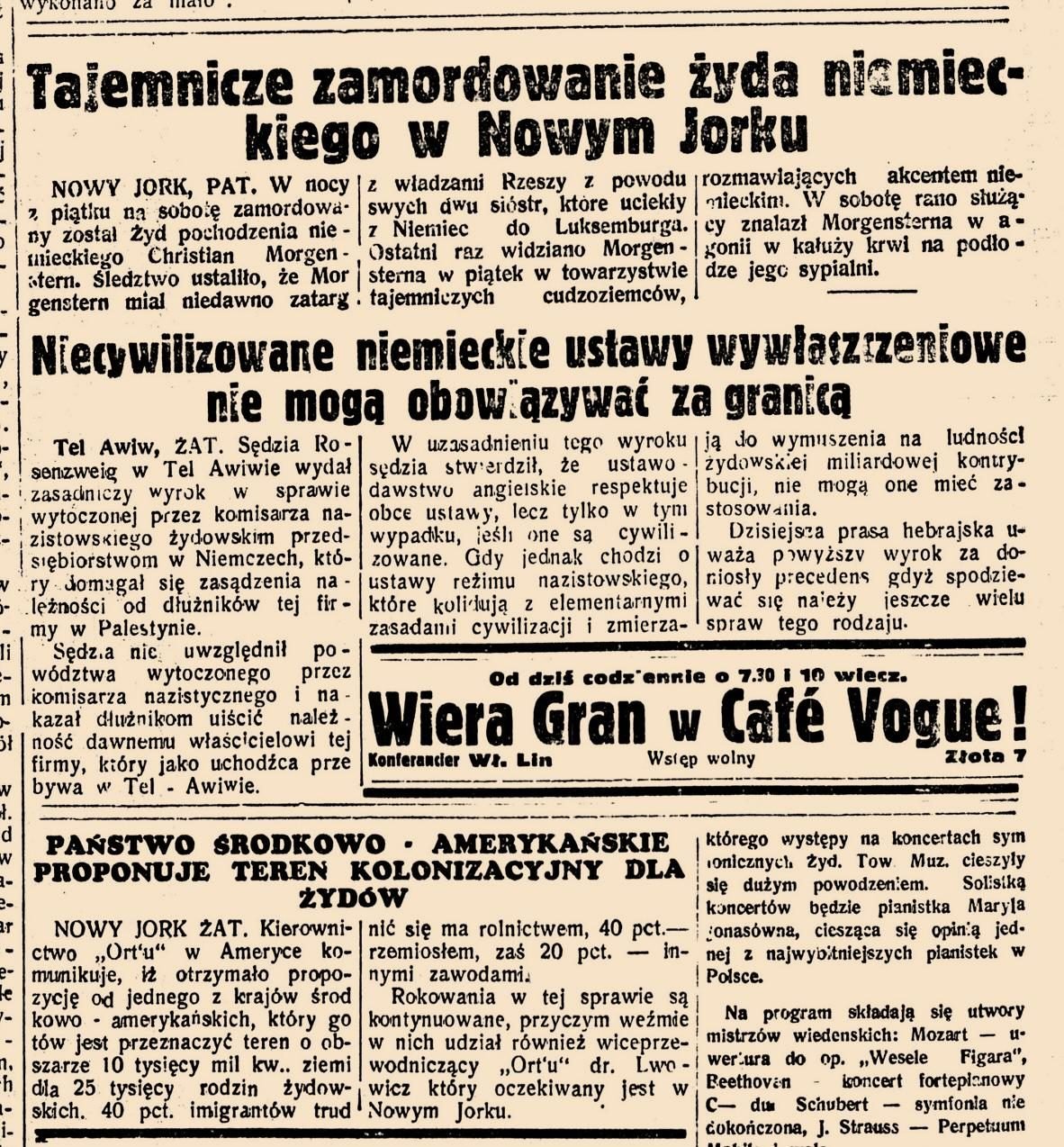
In December Wiera Gran returned to the bandstand. „Nasz Przegląd" of 5 December announced: „From today daily at 7.30 and 10 p.m. Wiera Gran at Café Vogue! Compère Wł. Lin. Admission free" — on a column whose headlines read: „Mysterious murder of a German Jew in New York", „Uncivilised German expropriation laws cannot be binding abroad", „Central American state offers colonisation territory for the Jews". The world was debating where to ship people who had just been stripped of everything; at Złota, Gran sang. The compère Władysław Lin — let us remember that name: it will return in this account in a role no one would guess.
Just before the holidays the café played its Hollywood card: „GLADYS PICKFORD at Cafe »Vogue« distributes her world-famous cosmetics daily from 5 to 8 p.m. FREE TO EVERY LADY". Gladys was the real first name of Mary Pickford — the greatest star of silent cinema, who after leaving the screen lent her name to a line of cosmetics. The actress herself almost certainly did not come to Złota; her little jars — did. The advertising worked: for three hours a day the café was the most attractive address for every Warsaw woman.

XV. 1939 — the last season
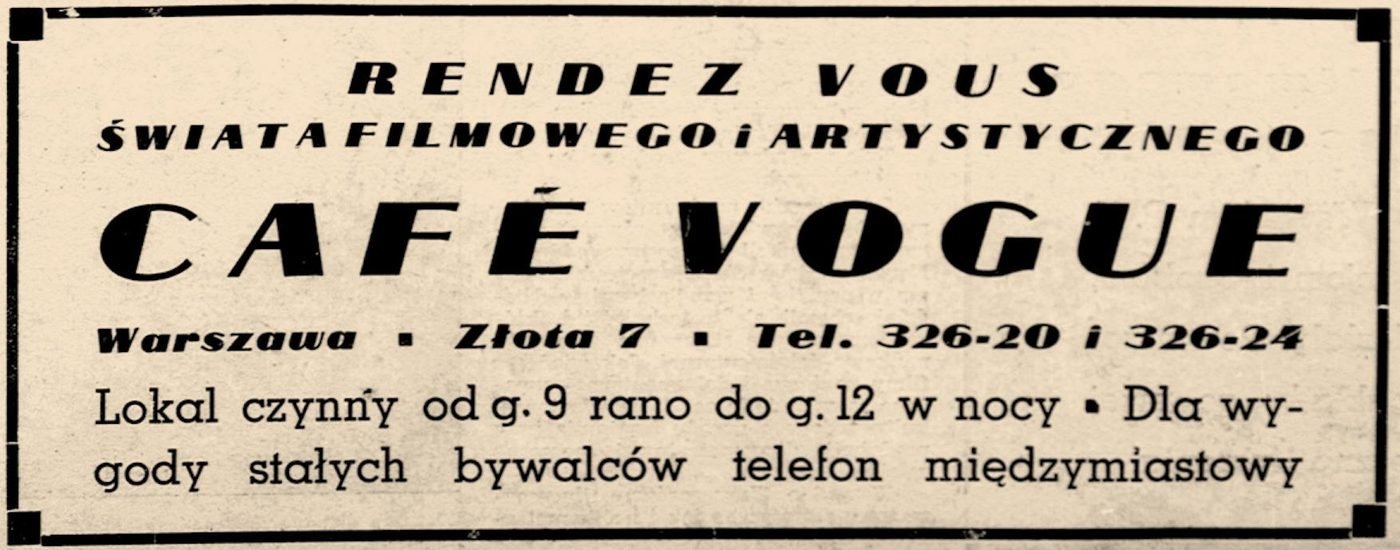
By the beginning of 1939 Café Vogue was an institution. The trade journal „Wiadomości Filmowe" in its New Year issue gave it the whole footer of the front page: „THE RENDEZ-VOUS OF THE FILM AND ARTISTIC WORLD — CAFÉ VOGUE, Warsaw · Złota 7 · Tel. 326-20 and 326-24. Open from 9 a.m. to 12 at night · For the convenience of regular patrons a long-distance telephone". A long-distance telephone at the guests' disposal — that one detail says everything about the establishment's ambitions: at Złota 7 one dropped in between one deal and the next, between Łódź and Lwów, between the shoot and the premiere.
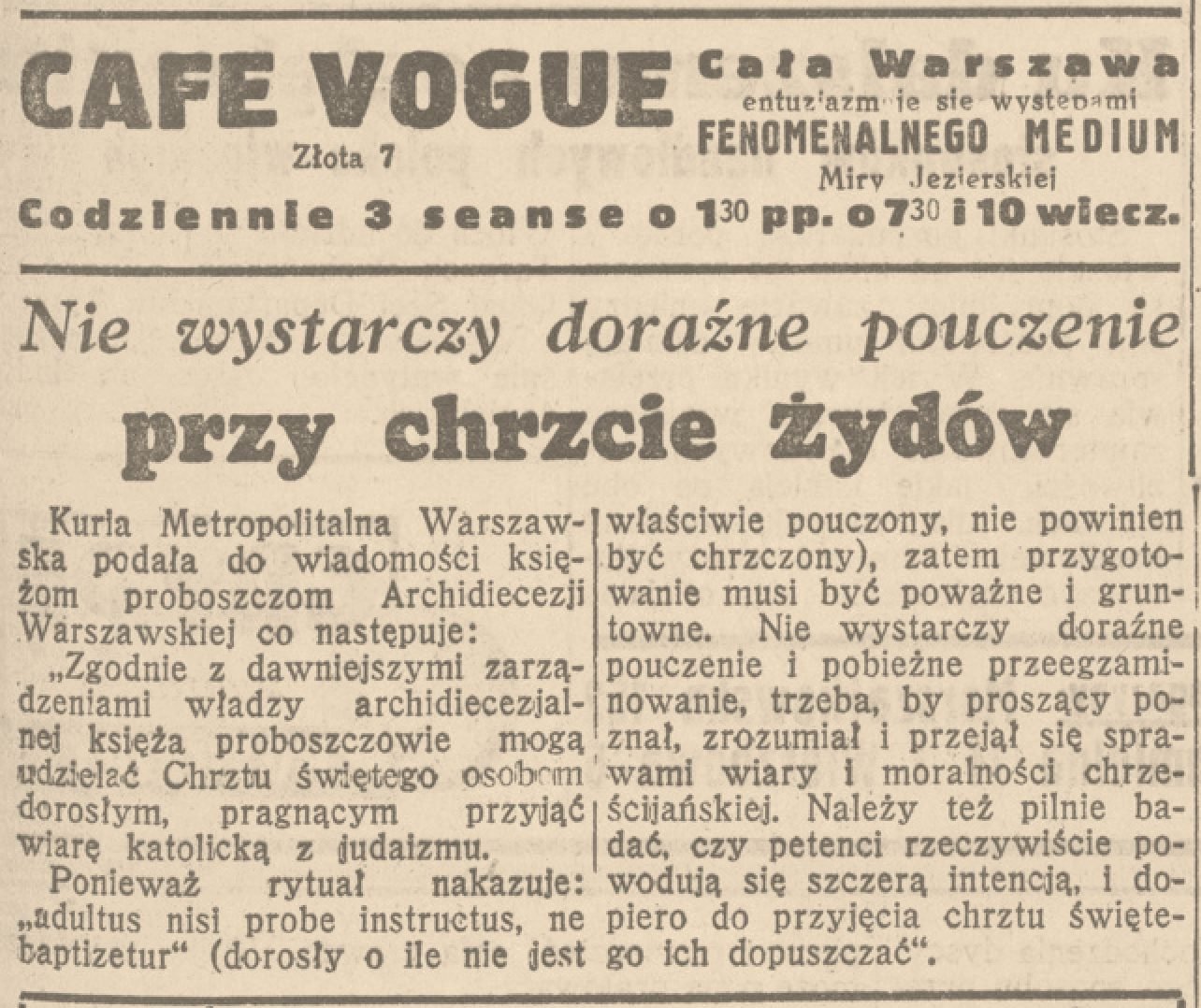
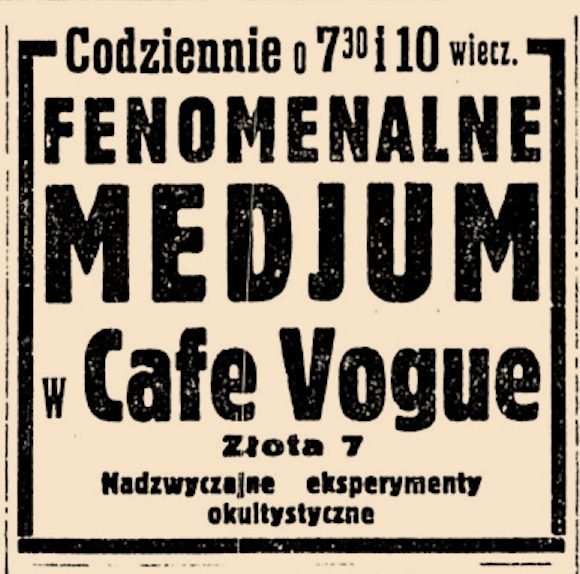
In the spring the hit turned out to be „extraordinary occult experiments". From 1 March „all Warsaw was enthusing over the performances of the phenomenal medium Mira Jezierska" — three séances a day, at 1.30, 7.30 and 10 p.m. In „Dobry Wieczór" the advertisement stood above a text whose adjacency — in view of what had happened three months earlier in Rachów — leaves one speechless: the Warsaw Metropolitan Curia instructed parish priests on the conditions for baptising „adult persons wishing to accept the Catholic faith from Judaism". „Ad hoc instruction is not enough… one must also diligently examine whether the petitioners are truly moved by sincere intention" — wrote the Curia, quoting the Latin rule: let the untaught adult not be baptised. The wave of conversions was growing in the same rhythm as the fear; the Church was beginning to pick and choose. Karolina had made it before the instruction.
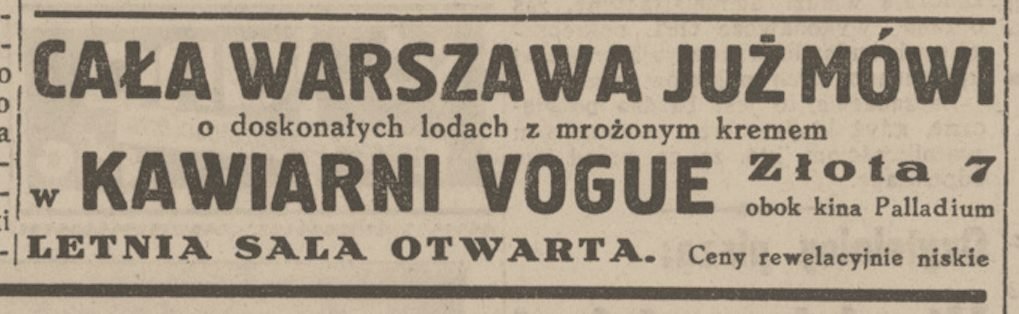
The summer was an ice-cream summer. „All Warsaw is already talking about the excellent ices with frozen cream at the Vogue Café, Złota 7, next to the Palladium cinema. The summer hall is open. Prices sensationally low" — portions at forty, sixty-five and a hundred groszy. In the evenings Lawiński scattered jokes from his sleeve. The last peacetime summer smelled in this café of frozen cream.
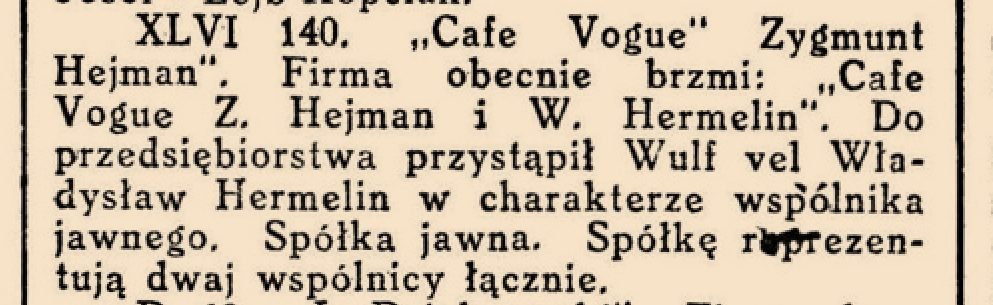
In mid-July the owner made his last business move — and solved the riddle of the compère. „Monitor Polski" of 19 July 1939 announced: „The firm now reads: »Cafe Vogue Z. Hejman and W. Hermelin«. Wulf alias Władysław Hermelin has joined the enterprise as a general partner. General partnership. The partnership is represented by the two partners jointly". Wulf alias Władysław Hermelin — and on the bandstand since December: „compère Wł. Lin". It would be hard to find a more legible pseudonym: the man who for half a year had announced the programme to the guests, shortening his surname to its last three letters, entered the firm as a full partner. Six weeks before the war Zygmunt Hejman was sharing his café with his own compère.

The last known advertisement dates from 25 July 1939 — „LAWIŃSKI at CAFE VOGUE. Topical jokes. From today daily at 10 p.m. The summer hall open. Admission free" — and stands on a column whose headlines arrange themselves into a weather forecast for September: „The »Times« on the question of Danzig", „A change of direction in the anti-Polish German action", „Chamberlain on Minister Hudson's talks with Dr Wohltat", „Arab terror in Palestine". „Topical jokes" — the bill promised. What one jokes about in Warsaw in the last days of July 1939, every reader of that column knew only too well.
XVI. September 1939 — the flight
Café Vogue operated until September 1939. Then the bombs fell on Warsaw; the Generali building survived the siege, the Palladium cinema resumed operation under the occupation — but the world for which a café of fashion existed ended within a few weeks. Zygmunt Hejman did not wait for the new order to attend to him: he fled Warsaw southward and made it across the border. He walked the route taken that autumn by tens of thousands — across the Carpathians to Hungary, to Budapest, where the legation of the Republic still operated, issuing passports and travel documents, where committees cared for the refugees and from where the further roads led: through Yugoslavia and Italy, and after June 1940 through the Balkans and Lisbon — across the ocean.
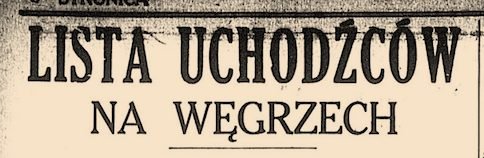
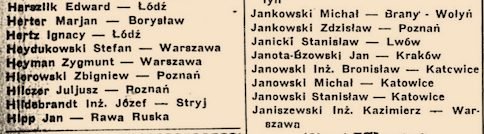
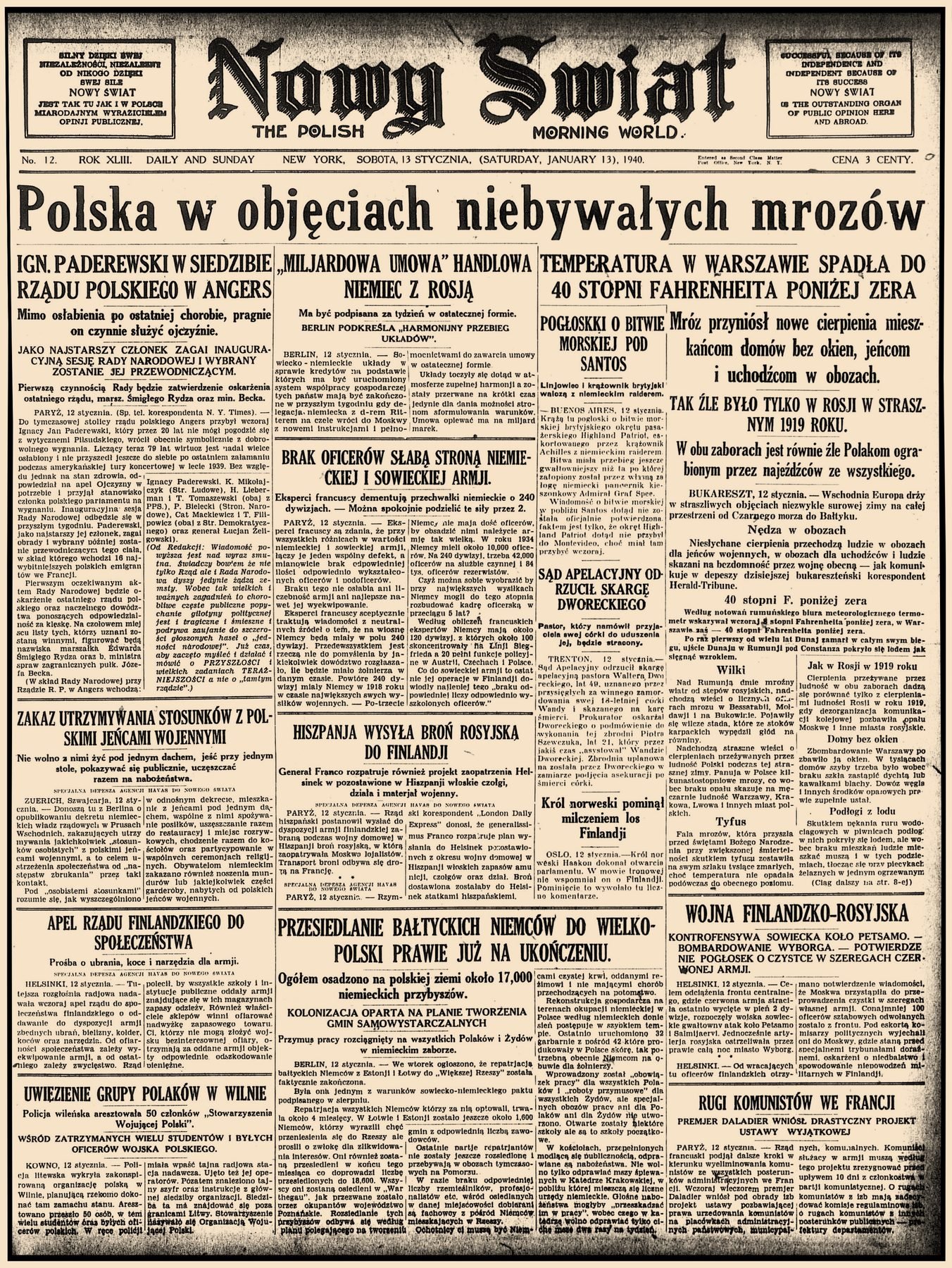
The trace of that flight survives on the other side of the Atlantic. The Polish-American daily „Nowy Świat", published in New York, printed in instalments the „List of refugees in Hungary" — a register of Poles who had reported to the Polish missions. In the issue of Saturday 13 January 1940, in alphabetical order, between Heydukowski Stefan and Hierowski Zbigniew, stands the entry: „Heyman Zygmunt — Warsaw".
XVII. 28 August 1942 — Avenida Atlântica 540
In the National Archive of Brazil, in the fonds of the Delegacia de Costumes e Diversões of Rio de Janeiro — the office registering artists performing publicly in the country's capital — a card survives bearing the date 28 August 1942 and artist register number 34: HEJMAN, ZYGMUNT, son of Ludwik and Barbara, Polish nationality, born in Warsaw, married, resident at Avenida Atlântica 540 — the seaside avenue of Copacabana. Description: complexion white, hair fair, eyes hazel, height one metre eighty. In the top right corner — a photograph with the date stamp 10.7.[1]942.
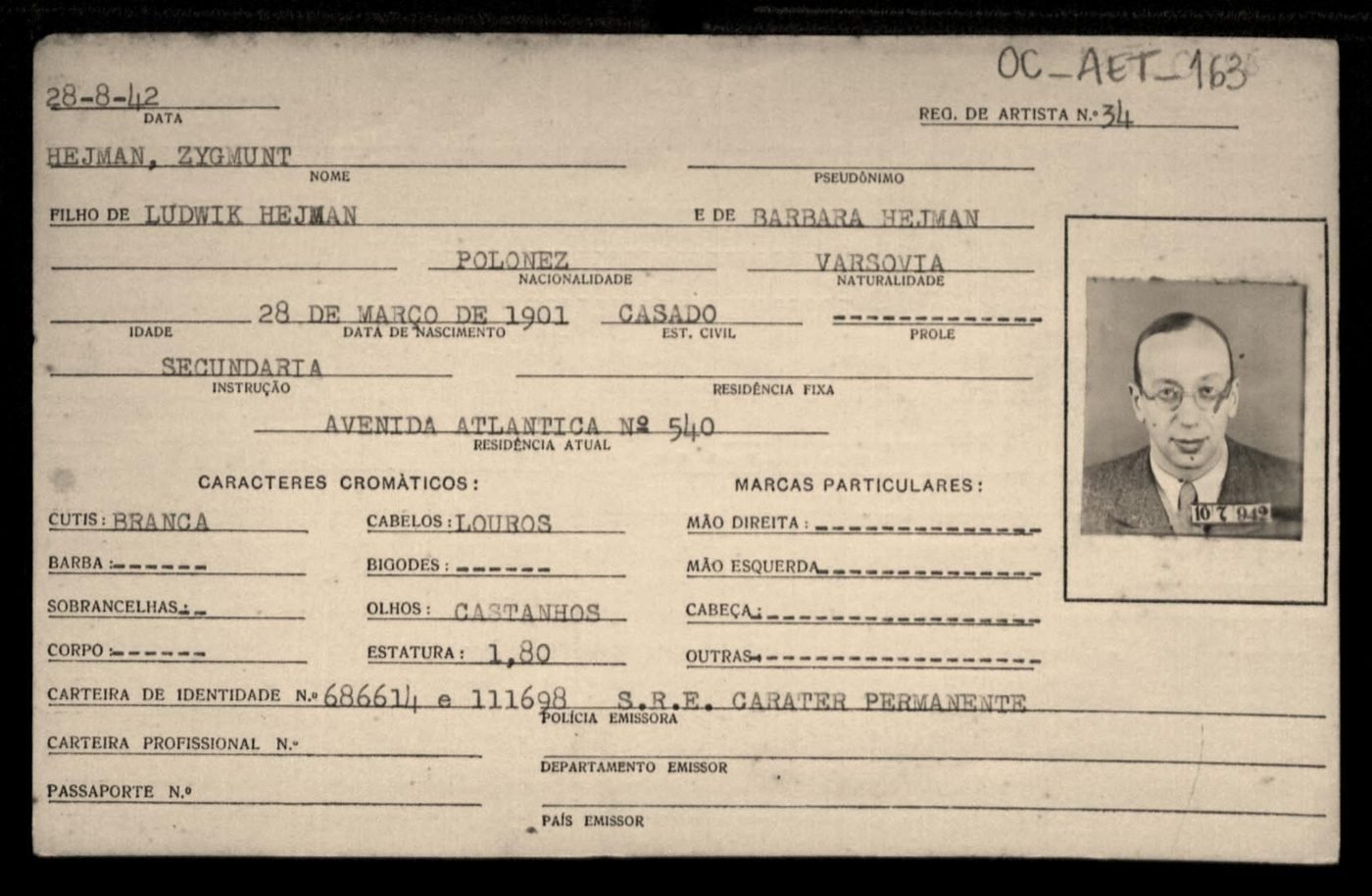
And here comes the moment for which this account was written. In Poland it has been assumed since the war that Zygmunt Heyman perished in the Holocaust — the databases give the ghetto and the year 1942, the jazz literature the camp at Trawniki. Yet it is enough to lay two photographs side by side: the face from the Brazilian card and the face of the banjoist from the frames of „Dziś mamy bal". Zygmunt Hejman did not perish in the ghetto.
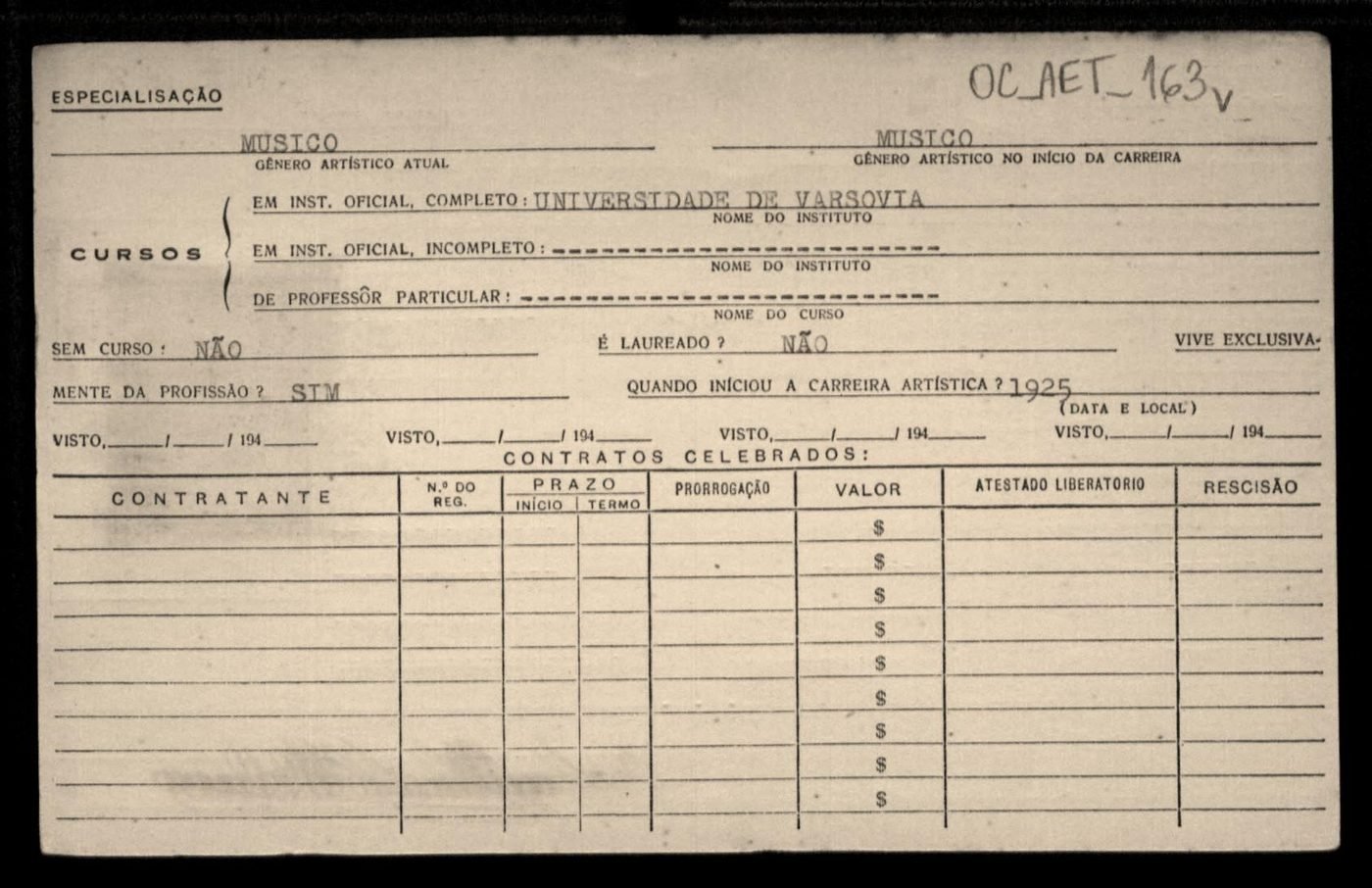
The reverse of the card confirms the professional identity. „Gênero artístico atual: MÚSICO. Gênero artístico no início da carreira: MÚSICO". To the question whether he lives exclusively from the profession — „SIM", yes. To the question about the start of the artistic career — 1925: the year after the Japanese roses of the Bagatela. Five years later, in 1947, the Brazilian immigration cards would register his permanent residence: Zygmunt Hejman, born in Warsaw, married, son of Ludwik and Barbara.
XVIII. 19 December 1948 — Oldsmobile number 191
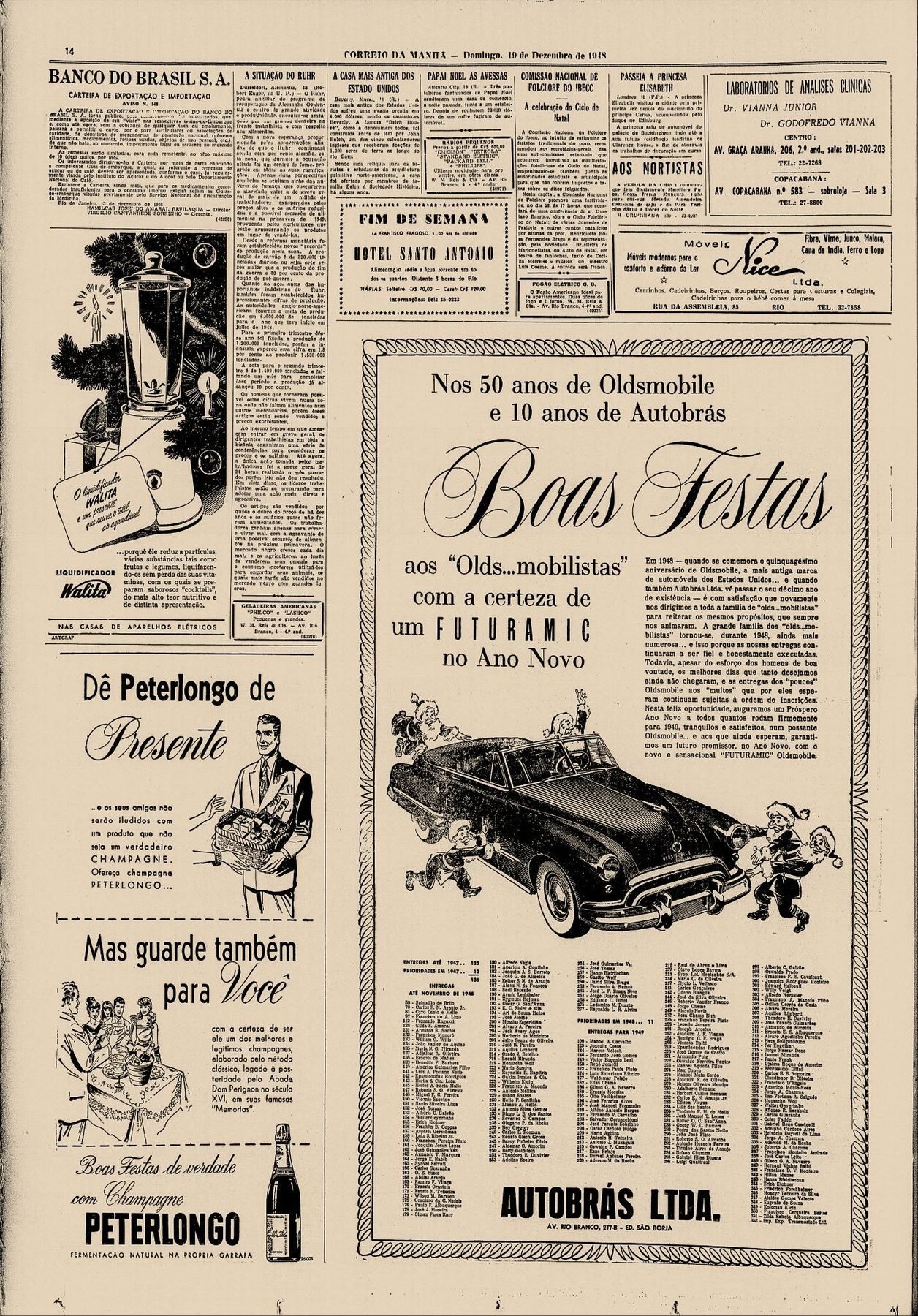
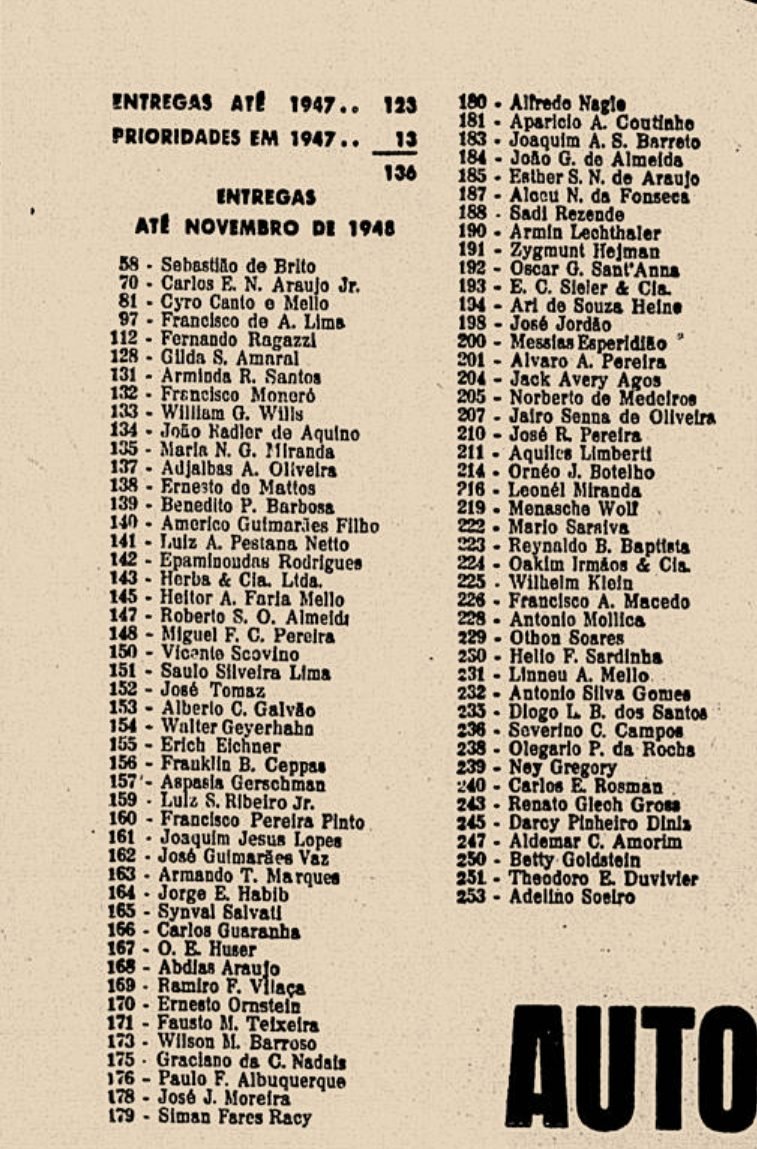
The last known trace is a sign not only of life but of prosperity. The „Correio da Manhã", one of the largest dailies of Rio de Janeiro, printed on Sunday 19 December 1948 a full-page advertisement of the Autobrás firm — the exclusive distributor of Oldsmobiles — with „Boas Festas" wishes for all „olds…mobilists" on the fiftieth anniversary of the marque and a name-by-name list of the customers to whom cars had been delivered. In the column „Entregas até novembro de 1948" — deliveries up to November 1948 — under item 191 stands: Zygmunt Hejman. Nine years after the flight from Warsaw the former banjoist of the Adria collects a new Oldsmobile for the holidays. The man of whom it was said that he was lucky evidently took his luck with him across the ocean.
XIX. The fates of the band
The orchestra that parted after the 1934 season later scattered across three continents — and its fates are a miniature of the fate of a whole generation of Warsaw's popular musicians.
Julian Front, partner and violinist, ran his own establishments after the parting: the „Café Dancing F.F." at 6 Niecała Street, belonging to the Front brothers, and „Pod Krzywą Latarnią" at 25 Podwale Street; he composed for the Jewish theatre Banda and formed a songwriting partnership with Stanisław Ferszko — from it came the hits „Nie płacz", „Żal", „Bo to się zwykle tak zaczyna" and „Ty jeszcze wrócisz do mnie" from the repertoire of Wiera Gran and Mieczysław Fogg. After the outbreak of the war he left for Lwów, from there into the depths of the Soviet Union; with Anders' Army he reached Palestine, played in Henryk Wars's orchestra, and demobilised in 1946 he settled in Tel Aviv, where he ran the „Delfin" bar. He died there in 1964 — the violinist of the Bodega as a barman by the Mediterranean.
Stanisław Ferszko — pianist, prodigy of the Warsaw conservatory, author of the tango „Jak w piosence" from the sheet-music cover reproduced in this account — left for Palestine as early as 1937. The accompanist of Wiera Gran and Waria Łaska became there one of the most popular composers; he was called „the Israeli Gershwin", and his songs, like „Bab el-Wad", pass to this day for folk songs. In 1952, engaged by NBC, he left for the United States; he died in 1990 in Florida.
Of the others less is known — and that silence too is part of this history. Tadeusz Jeselzon (saxophone, violin), Michał Didyk (saxophone), Franciszek Witkowski (saxophone, clarinet), Filip Goldberg (drums) and Zygmunt Jaroszewski (trombone, visible in the film) — their wartime fates have not yet been established; the search continues. Nor is it known what became of Wulf alias Władysław Hermelin, the partner and compère of the last six weeks. Franciszek Moszkowicz, director of the Adria, the man of the chimpanzees and the four orchestras, perished during the occupation.
And the two women of the bills? Hanka Ordonówna, whom the band accompanied in November 1932, passed through a Soviet prison and the wanderings with Anders' army, cared for Polish orphans deported into the depths of Russia, and died in 1950 in Beirut. Wiera Gran, who made her debut on the bandstand at 7 Złota Street, ended up in the ghetto and sang at the „Sztuka" café beside Władysław Szpilman; she got out to the Aryan side, survived — and for the rest of her long life, until her death in Paris in 2007, defended herself against accusations of which successive commissions cleared her. Her history is a separate, bitter book; here let us note only that it began with the bill of 1 May 1938 on which Café Vogue called her „our singer".
XX. Karolina — the Brazilian trace
And Karolina? Her travel documents have not yet been found in the passenger lists — but two independent registers say that she too survived, and that her road led where her husband had reached. In the database of Jewish refugees who made it to Brazil through France there is one record: HEJMAN, Krystina Karolina, née DAUMAN, born in Kośminek, of Polish nationality — the birthplace matching, down to the farm, the Lublin act number 455, the names matching the baptism of December 1938. And in the card index of the Arolsen Archives — the former International Tracing Service — two cards of the same person survive, opened under both names: Dauman married Heyman and Heyman née Dauman, daughter of Abraham and Chaje Racker; in the nationality column one word is entered: Brazilian.
The wife of the owner of Café Vogue thus ended as a citizen of Brazil as well.
XXI. Memory
Of Café Vogue not a single photograph of the interior remains. What remains are the advertisements — a few dozen strips in the newspapers, from which two seasons can be reconstructed: who played, at what hour, what a dinner cost, when the cosmetics were given out and whose voice flowed from the „sound equipment". There remains the reviewer's sentence about two silver grand pianos on a special podium. There remain the frames of a seven-minute avant-garde film in which the owner's face can be seen — and thanks to which, ninety years later, that face could be recognised on a card from Rio de Janeiro.
For eighty years the Polish dictionaries buried Zygmunt Heyman in the ghetto or at Trawniki. The research of this project — from the advertisement of eight thousand Japanese roses of 1924 to the list of happy Oldsmobile owners of 1948 — makes it possible to write the ending anew. The man who for fifteen years played Warsaw to dance and who built it its most fashionable café escaped, survived and played on — on the other side of the ocean, by Copacabana beach. The story of his death turned out to be a mistake. The story of his life still awaits its Brazilian chapter — and the day when at 7 Złota Street someone stops before the plaque with his name.
—————
Timeline
| Date | Event |
|---|---|
| 28 Mar 1901 | Zygmunt's date of birth according to the Brazilian artist's card: Warsaw; son of Ludwik and Barbara. |
| 2 Aug 1909 | At the Kośminek farm near Lublin Karolina Dauman is born, daughter of Abram, lessee of a distillery, and Chaja née Rackier (act no. 455). |
| 25 Oct 1924 | Opening of the „Jardin de Japon" dancing in the winter hall of the „Bagatela" garden; artistic director — Zygmunt Brucz-Heyman („Przegląd Wieczorny", 23 X). |
| 1925 | The year given years later as the start of the artistic career on the card in Rio de Janeiro. |
| c. 1930 | Founding of the Front-Heyman Jazz orchestra with Julian Front. |
| 7 Feb 1931 | Opening of Café Adria at 10 Moniuszki Street, in the building designed by Edward Eber — „the masterly jazz-band ensemble Front & Heyman" in the programme. |
| 12 Sep 1931 | Front-Heyman Jazz one of the three orchestras of the „Oaza", reopening after rebuilding. |
| 1931 | Recordings for „Syrena Record"; the band's photograph on the sheet-music cover of the tango „Jak w piosence" by St. Ferszko. |
| Dec 1931 | The orchestra's carnival advertisement: balls, routs, parties; private telephone 316-15. |
| 1 Feb 1932 | The Ball of Young Architecture; the orchestra scenes for the film „Dziś mamy bal" shot at the Adria (premiere March 1932). |
| 1932 | The Łódź season: „Piccadilli", 1 Zawadzka Street („Freie Presse"). Karolina Wiszniewiecka among the guests of Zakopane (the Carlton guesthouse). |
| 17 Sep 1932 | Five o'clocks at the „Caffé Italia" (daily) and the „Dancing Bodega" (Sundays and holidays) — „music by Front and Heyman". |
| 12 Nov 1932 | Polish Radio, 11 p.m.: transmission of dance music from the „Bodega", the Front and Heyman orchestra. |
| Nov 1932 | The orchestra accompanies Hanka Ordonówna at the matinées at the Artists' Theatre (18 Karowa St.); the last matinée 20 XI. |
| Aug 1933 | The season in Truskawiec; dancings at „Chez Rudek" („Czas", 2 VIII). |
| 25 Jan 1934 | „A musician by profession": after winnings reaching 150,000 zł a year Heyman opens a lottery office at 14 Mazowiecka Street. |
| Sep 1934 | The band's last known bill: the Adria's four orchestras for the autumn season, Front-Heyman among them. The film „The Attempt on General Skałłon", co-financed by Heyman, provokes the protest of the women who took part in the attempt. |
| c. 1935–1937 | Front runs his own establishments (F.F., Pod Krzywą Latarnią); Ferszko leaves for Palestine (1937). Heyman lives at 59 Koszykowa Street (subscriber directory 1937/38). |
| 19 Oct 1937 | The first press announcement of Café Vogue, Złota 7 — in the Assicurazioni Generali building, Edward Eber's second Warsaw work. |
| 24 Oct 1937 | „Zygmunt Heyman has the honour to announce…" — advertisements in „Dobry Wieczór" and „Wieczór Warszawski" (beneath Roosevelt's peace proclamation). |
| 9 Nov 1937 | „»Café Vogue« the most splendid café of the capital" — two silver grand pianos on a special podium; interiors by the team of Edward Seidenbeutel. |
| 18 Nov 1937 | Opening of Café Vogue at 6 p.m. |
| 8 Mar 1938 | „Monitor Polski" no. 54, item XLVI 140: the firm „Cafe Vogue" Zygmunt Hejman; prenuptial agreement with his spouse Karolina Wiszniewiecka née Dauman. Official spelling of the name: HEJMAN; the marriage concluded before this date. |
| Mar 1938 | In the café play Rosner, Herbst and Glasberg — „after great successes abroad". |
| 1 May 1938 | Wiera Gran's debut — daily at 7 and 10 p.m., admission free; the artificially cooled hall. |
| summer 1938 | Three-course dinners at 2 zł; performances of Waria Łaska; from the „sound equipment" — Whiteman, Hylton, Roy, Payne, the Boswell Sisters, Crosby („Nasz Przegląd", 19 VII). |
| 27 Aug 1938 | Opening of the autumn season; guest performances of Ludwik Lawiński. |
| 15 Sep 1938 | Start of the daily „CHANEL" performances at 1 p.m. — the same day Chamberlain flies for the first time to Berchtesgaden. |
| Sep–Oct 1938 | The café's advertisements on the columns of the Sudeten crisis, Munich and Zaolzie; 20 IX abolition of the higher evening prices; 29 X — the parodist Wawa and Max Factor beside the report of the burning of Alter Licht, in the week of the expulsions to Zbąszyń. |
| 2–4 Nov 1938 | Daily free distribution of Max Factor Hollywood cosmetics at 1 p.m. |
| 9/10 Nov 1938 | Kristallnacht in the Reich. |
| 16 Nov 1938 | The advertisement „Władysław Lin invites you to Café Vogue" (Eliza Śliwowska's ensemble) — on the pages of „Nasz Przegląd" about the pogrom in Germany and the assaults on Jewish students in Warsaw. |
| 5 Dec 1938 | Wiera Gran's return; the compère Wł. Lin — Wulf alias Władysław Hermelin, the future partner. |
| 15 Dec 1938 | „Gladys Pickford" cosmetics distributed to every lady free, 5–8 p.m. |
| 30 Dec 1938 | Karolina converts to Catholicism in Rachów; baptismal names Karolina Krystyna-Maria (annotation in the act, 18 VII 1939). |
| 1 Jan 1939 | „Wiadomości Filmowe": Café Vogue „the rendez-vous of the film and artistic world"; a long-distance telephone for regular patrons. |
| Mar–May 1939 | Three séances a day of the „phenomenal medium" Mira Jezierska; 1 III the advertisement above the Curia's instruction on the baptism of adult Jews. |
| Jul 1939 | Ices with frozen cream, the summer hall; 19 VII the partner Wulf alias Władysław Hermelin joins the firm („Monitor Polski"); 25 VII the last known advertisement — Lawiński, on the Danzig column. |
| Sep 1939 | Outbreak of the war; the end of Café Vogue. Zygmunt flees Warsaw southward, to Budapest. |
| 13 Jan 1940 | „Nowy Świat" (New York), „List of refugees in Hungary": „Heyman Zygmunt — Warsaw". |
| 10 Jul 1942 | Date of the photograph taken for the Brazilian artist's card. |
| 28 Aug 1942 | Rio de Janeiro: card no. 34 of the register of artists — Zygmunt Hejman, musician, married, Avenida Atlântica 540. The photograph on the card — the face known from the frames of the 1932 film: the proof of survival. |
| after 1940 | Karolina Krystyna Hejman née Dauman reaches Brazil by way of France; in the Arolsen Archives card index with Brazilian nationality. |
| 1947 | Brazilian immigration cards: Zygmunt Hejman's permanent residence in Rio de Janeiro. |
| Nov 1948 | „Correio da Manhã", 19 XII 1948: on the list of recipients of Autobrás Oldsmobiles, deliveries to November 1948, item 191 — Zygmunt Hejman. |
—————
A Note on Sources
The account rests exclusively on sources. The press: „Przegląd Wieczorny" of 23 October 1924; „Kurjer Warszawski" of 7 February 1931, 12 September 1931, December 1931, 17 September 1932, 11 and 19 November 1932 and 1 September 1934; „Freie Presse" (Łódź) 1932; „Czas" (Kraków) of 2 August 1933; „Dobry Wieczór! Kurier Czerwony" of 17 November 1932, 16 December 1933, 25 January and 5 October 1934, issues 290, 295, 311, 312 and 320 of 1937, issues 119, 137, of 2 July, no. 236, of 20 September, of 3 October and no. 303 of 1938, and of 1 March and 5 July 1939; „Wieczór Warszawski" of 22 and 24 October 1937; „Kurjer Poranny" of 7 September 1934; „Kurjer Polski" of September 1934; „Nasz Przegląd" of 19 July, 25 August, 3 and 13 September, 29 October, 4 and 16 November, 5 and 15 December 1938 and of 8 May and 25 July 1939; „Wiadomości Filmowe" no. 1 (138) of 1 January 1939; „Zakopiańska Lista Gości" no. 10 (1932); „Nowy Świat" (New York) of 13 January 1940; „Correio da Manhã" (Rio de Janeiro) of 19 December 1948.
Official documents: „Monitor Polski" no. 54 of 8 March 1938 and the issue of 19 July 1939 (commercial register, item XLVI 140); the subscriber directories of the Warsaw PAST Telephone Network (editions 1937/38 and following); birth act no. 455 of the civil-status books of the Mosaic faith of the city of Lublin, 1909, with the marginal annotations of 1939 (State Archive in Lublin; Jewish Records Indexing – Poland index).
Film and iconographic material: the film „Dziś mamy bal" (dir. Jerzy Zarzycki and Tadeusz Kowalski, cam. W. Kaczkowski, 1932) and the frames made available by the National Film Archive — Audiovisual Institute (Fototeka); photographs of the National Digital Archives; the sheet-music cover of „Jak w piosence" (no. 805).
Foreign archives: Arquivo Nacional (Brazil), fonds Delegacia de Costumes e Diversões do Rio de Janeiro, BR_RJANRIO_OC — card no. 34 of the register of artists of 28 August 1942; Brazilian immigration cards, Rio de Janeiro 1900–1965; the „Jewish Refugees France–Brazil" database; Arolsen Archives, Red Line Cards, files 660700 and 660728. Literature: Leon Tadeusz Błaszczyk, „Żydzi w kulturze muzycznej ziem polskich w XIX i XX wieku", Warsaw 2014; Tomasz Lerski, „Encyklopedia Kultury Polskiej XX Wieku. Muzyka — Teatr — Film"; Łukasz Biskupski, „Kinofilia zaangażowana", 2017; the biographical database of the Jagiellonian Library — the dates of death cited there have been verified negatively in the present study.
Opracowanie w ramach projektu upamiętnienia mieszkańców kamienicy przy ul. Złotej 7 i 9 w Warszawie — prepared as part of the project commemorating the residents of the house at 7 and 9 Złota Street in Warsaw · www.zlota7-9.com