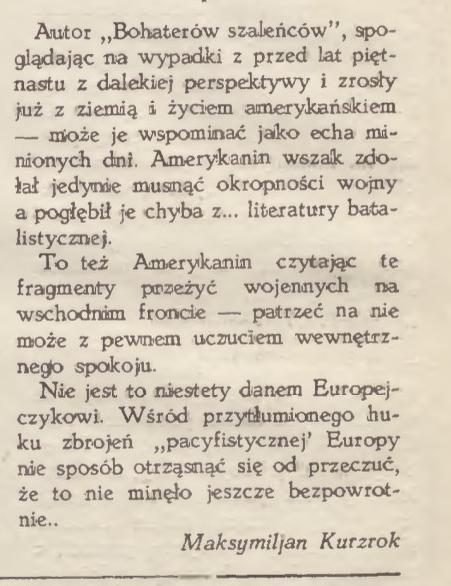
„Amid the muffled roar of the armaments of a «pacifist» Europe it is impossible to shake off the foreboding that this has not yet passed beyond recall…"
He wrote that in 1932, closing a review of the memoirs of a physician from the fronts of the Great War. He was then a young internist, a man of two cities: in summer he practised in Truskawiec, the most famous spa of the Second Republic, in winter he saw patients in Warsaw. In the second half of the thirties his Warsaw address was the new house at 7 Złota Street. Eleven years after writing that sentence he perished in the Lwów ghetto during its liquidation — as a doctor who to his last days was pulling people out of German hands.
He was not alone in Warsaw with his story. The Kurzroks were a Galician family: a father, a merchant from Kozowa in Podolia, a mother from Synowódzko Wyżne in the Carpathians, a younger brother, a clerk in Chodorów, a wife whose first name until recently we did not know, and a cousin on the mother's side. Of the closest family no one survived; one first cousin came through — as it turned out only now — and of him too there will be word. Not a single photograph of them has survived.
This account gathers everything that could be established about him. Every fact comes from a source: from the civil-status books, from the archive of the Lwów university, from the pre-war academic, medical and spa press, from the announcements of the Warsaw dailies, from a hospital staff list, from the notes of a twelve-year-old girl who survived the Janowska camp, from the memoirs of Lwów physicians and from the Pages of Testimony of Yad Vashem. Where the sources speak with different voices — and they do so above all about the circumstances of his death — we record it plainly instead of choosing the more convenient version. Where we do not know, we say that we do not know.
I. 7 June 1905 — Synowódzko Wyżne
He was born on 7 June 1905 in Synowódzko Wyżne — a large village in the Stryj district, spread along the Stryj river at the gates of the Carpathians, about a hundred kilometres south of Lwów. It was then the Austrian partition, imperial-royal Galicia. The registration district covered neighbouring Skole, which is why some registers give that little town as his birthplace; the discrepancy is apparent only.
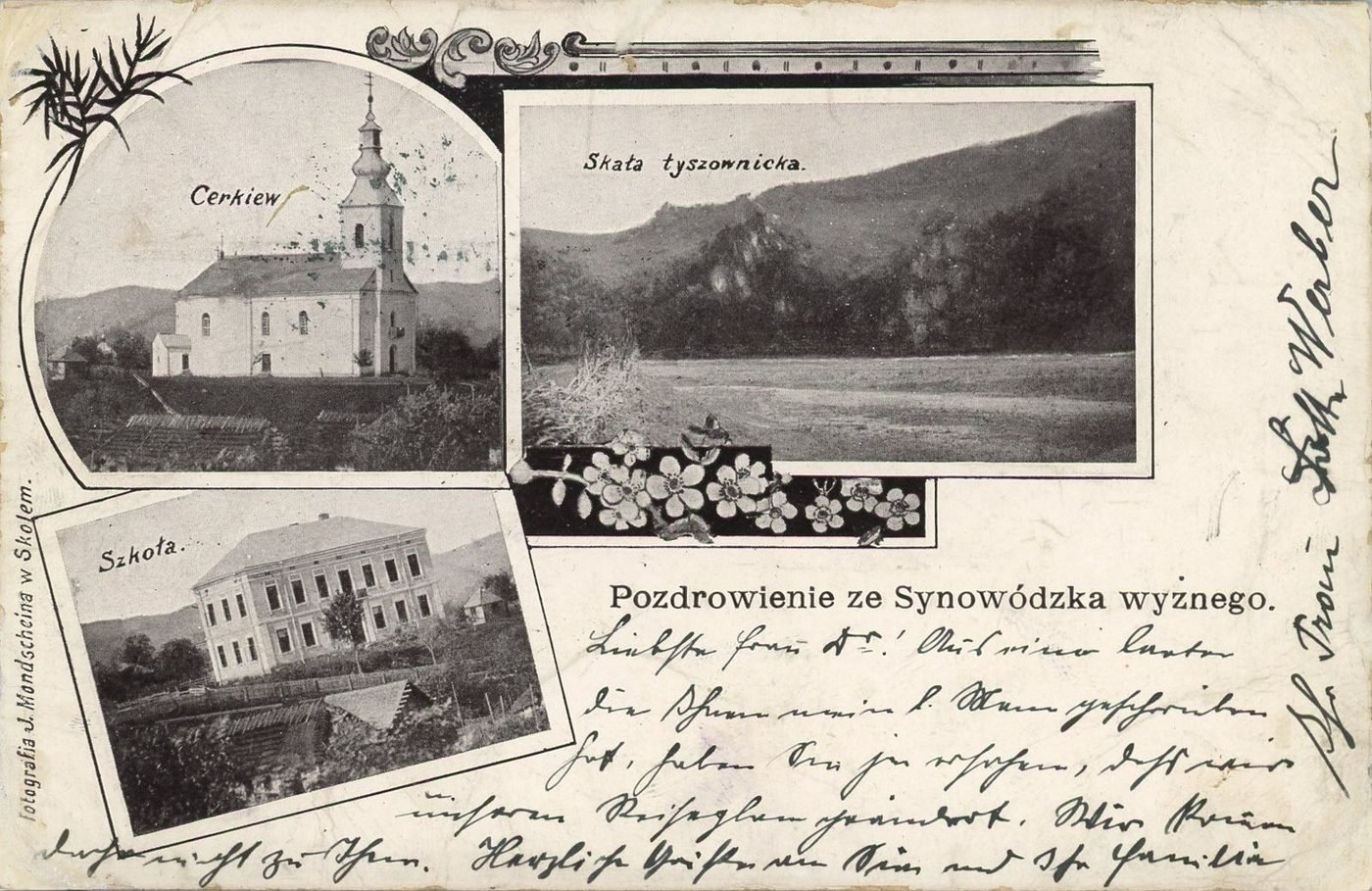
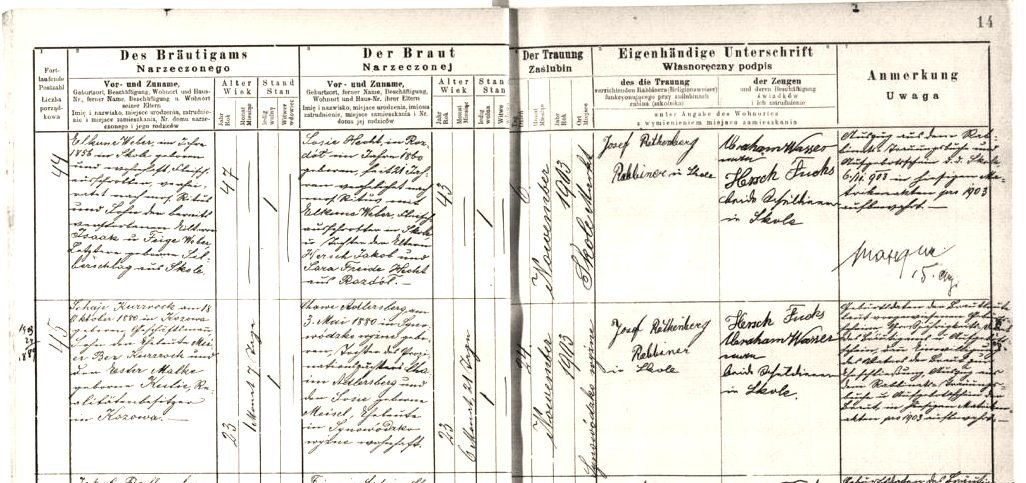
His parents married in November 1903 in Skole, before Rabbi Josef Rothenberg. The father, Szaja — in Polish documents Ozjasz — Kurzrock, son of Meier Ber and Estera Malka née Kulie, came from Kozowa and was a merchant. The mother, Chawa — in Polish documents Ewa — Adlersberg, daughter of Abraham Chaim and Sosie Gittel née Meisel, was from Synowódzko. Both were twenty-three. The witnesses were Hersch Fuchs and Abraham Wasserman.
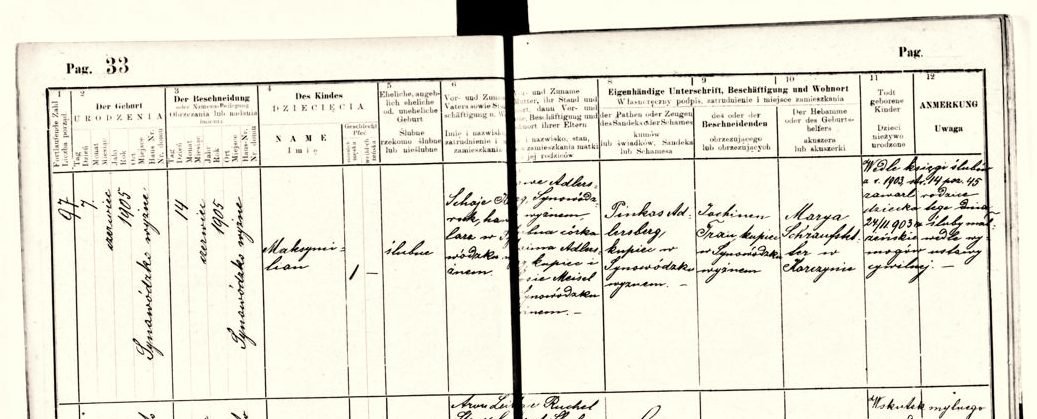
A year and a half later, at the entry of Maksymilian's birth under position 97, the witness is Pinkas Adlersberg, a merchant of Synowódzko — the mother's brother. The circumcision took place on 14 June 1905. The midwife was Marya Schraufsteller of Korczyn. In the father's column was written: „Schaje Kurzrock, merchant".
The mother's family scattered across the world, like many Galician families of that generation. The mother's sister, Mina, born in Synowódzko in 1878, married Charles Wolf in Skole in 1897, and in June 1925 sailed on the SS Laconia to New York and settled in Cleveland, where she died in 1958. Those who stayed in Galicia — did not survive the war.
II. Kozowa and Chodorów — the other side of the family
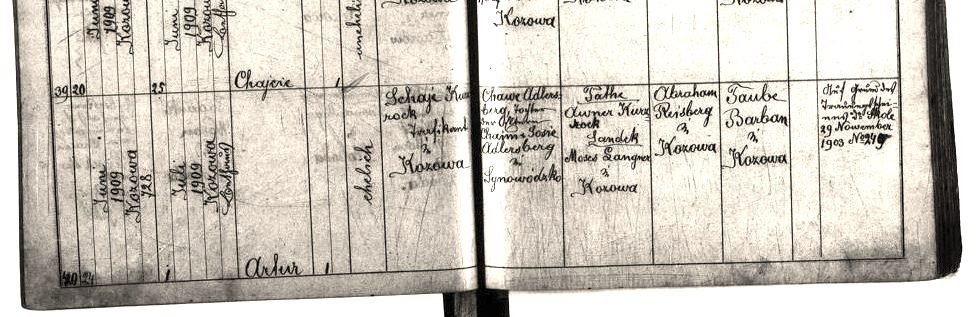
The father's family came from Kozowa, a small town in the Brzeżany district of Podolia, a good two hundred kilometres from Synowódzko. There the Kurzrocks lived after the wedding, and there in June 1909 Maksymilian's younger brother Artur was born. The sandek — holding the child at the circumcision — was Awner Kurzrock, the father's brother. The entry refers back to the Skole marriage book of 1903, which allows the two branches of the family to be tied into one whole.
Artur went a different way than his brother. In 1939 he held a master's degree and was a clerk of the Municipal Board in Chodorów — a large industrial centre by Galician standards, with a sugar refinery, a gasworks and a state meat-processing plant. His name appears in the telephone subscriber directory of the Republic of 1939 under number 64. It is the last certain trace of his existence.

III. 1924 — student book 6840
He began his studies abroad — at the Faculté des Sciences in Toulouse. He returned to the country and enrolled at the Jan Kazimierz University in Lwów. His enrolment card for the second trimester of the academic year 1924/25 survives, student book number 6840: a first-year student of medicine, Mosaic religion, mother tongue Polish, Polish citizenship, parents „Ozjasz and Ewa — merchant", lodgings at 7 Skarbkowska Street in Lwów, „below conscription age". In the column of documents deposited with the bursar he entered three items in his own hand: the secondary-school certificate, the birth record and the student card from Toulouse.
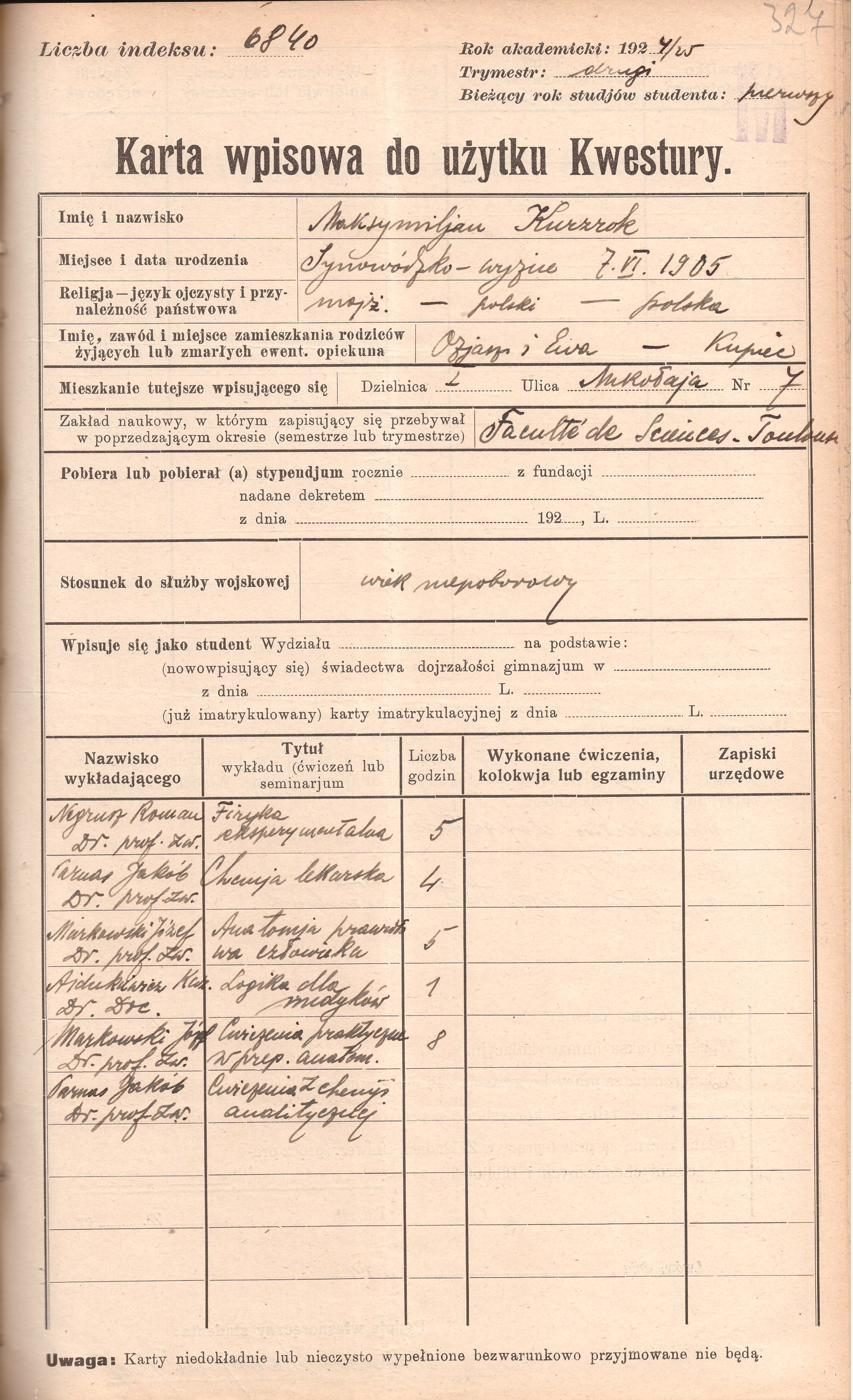

The names in that column are the names of Lwów medicine in its best years. Medical chemistry was taught by Jakub Parnas, founder of a biochemical school of world renown; anatomy by Józef Markowski; logic for medics was lectured by Kazimierz Ajdukiewicz, one of the most eminent philosophers of the Lwów–Warsaw school.
Kurzrok arrived at the university at a moment when student life was already an arena of sharp national tensions. In 1928 a new board of the Executive Committee was elected — the body uniting the eight Jewish student associations of the university. Saul Langnas became president; the vice-presidents were Maksymilian Kurzrok, named in the source already with the title of physician, and the engineer Jan Knossow; the secretary — the law student Marceli Ruhrberg. Of the committee's fifteen members ten were Zionists, two socialists, two independents, one represented the Hitachdut; the source, however, does not assign any of these options to particular persons. Of his own views we know from elsewhere — from what he himself wrote; we shall return to it in a moment.
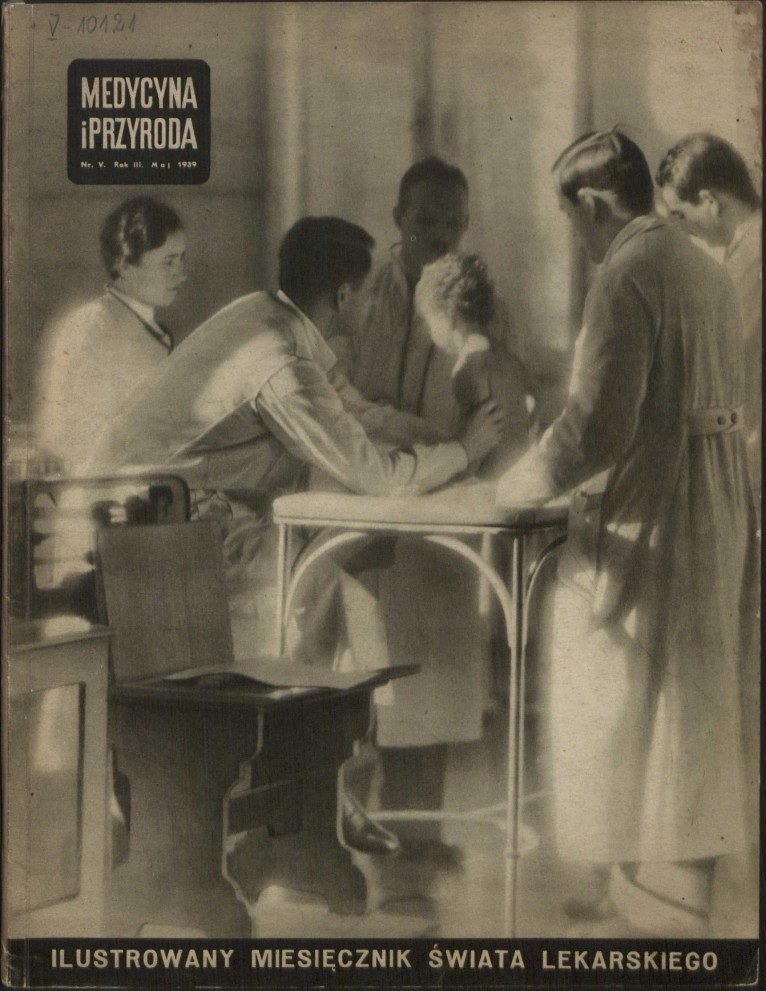
He wrote from the beginning. The earliest text of his known to us appeared in May 1929 — he was then twenty-four — in „Medycyna i Przyroda", the illustrated monthly of the medical world. It is not a clinical paper. It is a review of a photography exhibition, entitled „Photography and Experience".
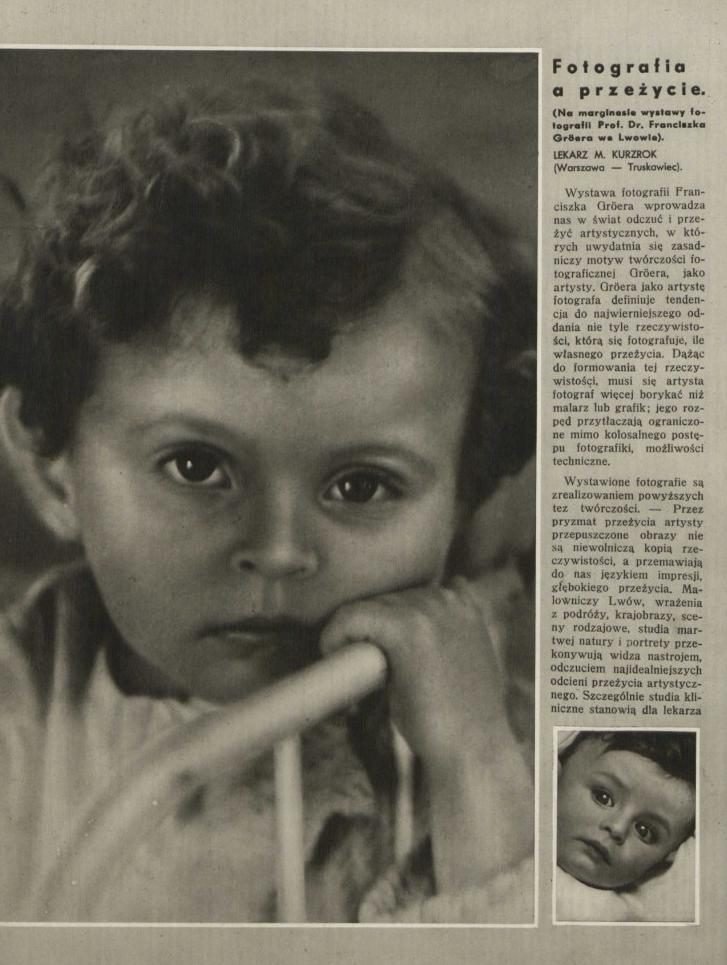
The exhibition was mounted by Professor Franciszek Groër — an eminent Lwów paediatrician and at the same time an artist photographer. Kurzrok writes about it like an art critic: that what defines Groër as an artist is the striving to render not so much the reality he photographs as his own experience of it; that the photographer has it harder than the painter or graphic artist, for technique constrains him; that images passed through the prism of experience are not a slavish copy of reality but speak the language of impression. He lists picturesque Lwów, travel impressions, landscapes, genre scenes, still lifes and portraits — and singles out the clinical studies, which, he notes, hold particular value for a physician.
This small text says two things about him. The first is personal: a twenty-four-year-old physician, fresh from his diploma, writes about art — and writes well. The second is hard and concerns facts. The byline under the title reads: „Physician M. Kurzrok (Warsaw — Truskawiec)". So the division of his life between two cities — winter Warsaw, summer Truskawiec — existed already in 1929, eight years before the move to Złota 7, and was obvious enough to serve as his professional address.
There is in it one more trace which in 1929 no one could have read. Franciszek Groër, whose photographs the young doctor was then viewing, is the same professor whom thirteen years later Ludwik Fleck would notify from the Lwów ghetto of the invention of a typhus vaccine — in an affair in which Kurzrok would play the leading role.
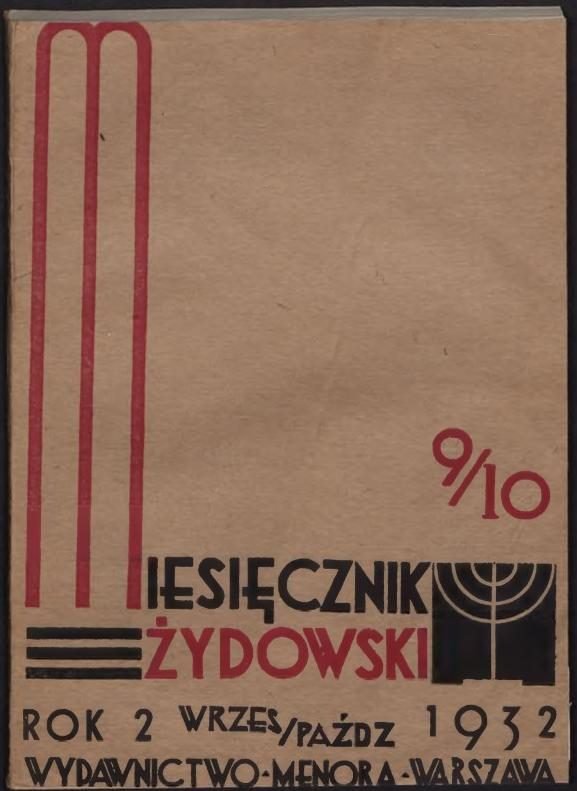
He wrote for the Jewish press as well. In the „Miesięcznik Żydowski" of the autumn of 1932 appeared his review of the book „Mad Heroes" by Dr Józef Tennenbaum — the memoirs of a Lwów physician who went through the First World War in uniform. Kurzrok read it as a physician and as a Jew at once, and ended with a sentence that today sounds like a prophecy of his own fate.
Two years later, in issue 119–120 of the „Trybuna Akademicka" of October–November 1934, appeared his article „Maturzyści" (School Leavers) — the most personal of his known texts. Kurzrok addresses in it directly the Jewish school-leavers standing, as he writes, before the wall of life's problems that crushes the young Jew. He lists without illusion what awaits them: the numerus clausus at Polish universities, the obstructed recognition of diplomas earned abroad, a student host several thousand strong wandering the cities of Europe, fascist Italy closing its doors, and before the entrance to Eretz — the English gendarme. The only bright ray on the firmament of the life of the young Jewish intelligentsia he sees in productive enlistment in the building of Jewish Palestine. He ends with a sentence hard to read calmly today:
„School leavers, the thing is difficult, but the present generation is clearing the way. New roads are an inescapable necessity for young Jews. The searching is arduous and will consume many a victim. But woe to him who with the herd takes the road of least resistance."
In the „Trybuna Akademicka" he published at least one more text — and this next one says more about him than any other document. The article „A Storm in a Teacup", printed on page 18 of issue 2–3, is a commentary on the dispute that broke out among the General Zionists after the Tel Aviv conference. The matter was an internal one: whether the General Zionists should form their own workers' organisation or remain within the left-dominated Histadrut.
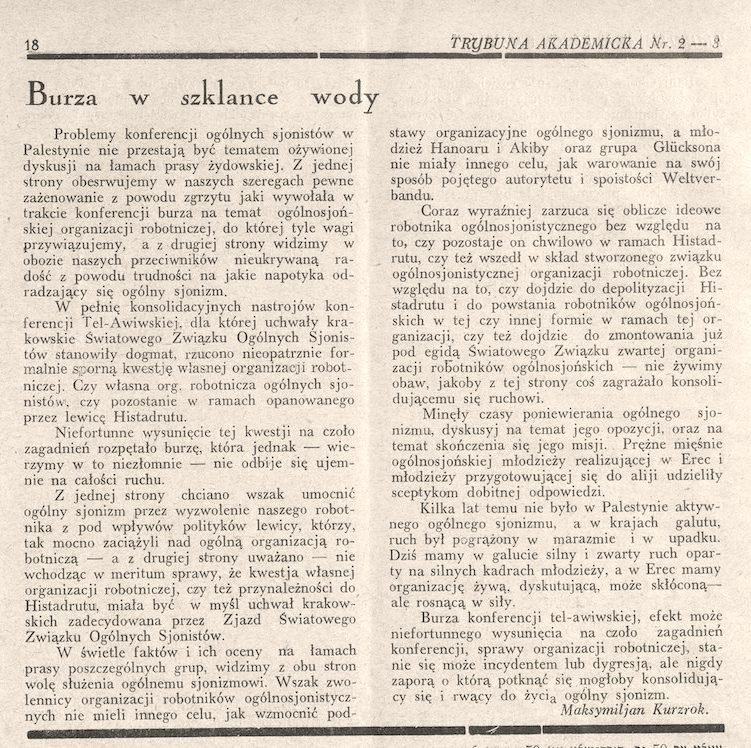
It is not the substance of the dispute that matters most here, however, but the pronoun. Kurzrok writes „in our ranks", „in the camp of our opponents", „our worker". He speaks from inside the movement — as a General Zionist, a participant, not an observer. He reassures: the storm will not harm the movement as a whole, the incident will not become a barrier. And he adds a sentence in which one hears a man who defended this movement also when it was not the obvious thing to do — that the times of disparaging General Zionism, and of debating whether its mission was already over, had passed.
This settles a question which until recently we could not settle. The source describing the composition of the Executive Committee of 1928 gives only a collective political balance — ten Zionists, two socialists, two independents, one representative of the Hitachdut — without assigning views to particular persons. In the project's papers there even circulated a note claiming Kurzrok was one of the few who did not identify with Zionism. It is simply wrong. Kurzrok was a General Zionist and wrote of it under his own name, in an academic journal, two years before he became the responsible editor of the Truskawiec commemorative paper.
The third text of his known to us from that journal bears the title „The Blind Track of Academic Self-Help" and appeared on page 3 of issue 1 (121). Kurzrok writes in it of a thing mundane and painful: money. The Society of Friends of Academic Youth, set up to distribute government funds, supported the Polish student poor and passed over the Jewish. He lists how much Jewish self-help had to build by itself — dormitories, kitchens, scholarships, foreign placements, student exchange — and with what „complete indifference" the central institutions treated it. He recalls that before the war there had existed in the Senate of the university a customary commitment to help build Jewish dormitories; now, he writes, the paragraph has fallen away, and the voice of two hundred of the student poor „has been sunk in the darkness of the incomplete prosperity of the Jews".
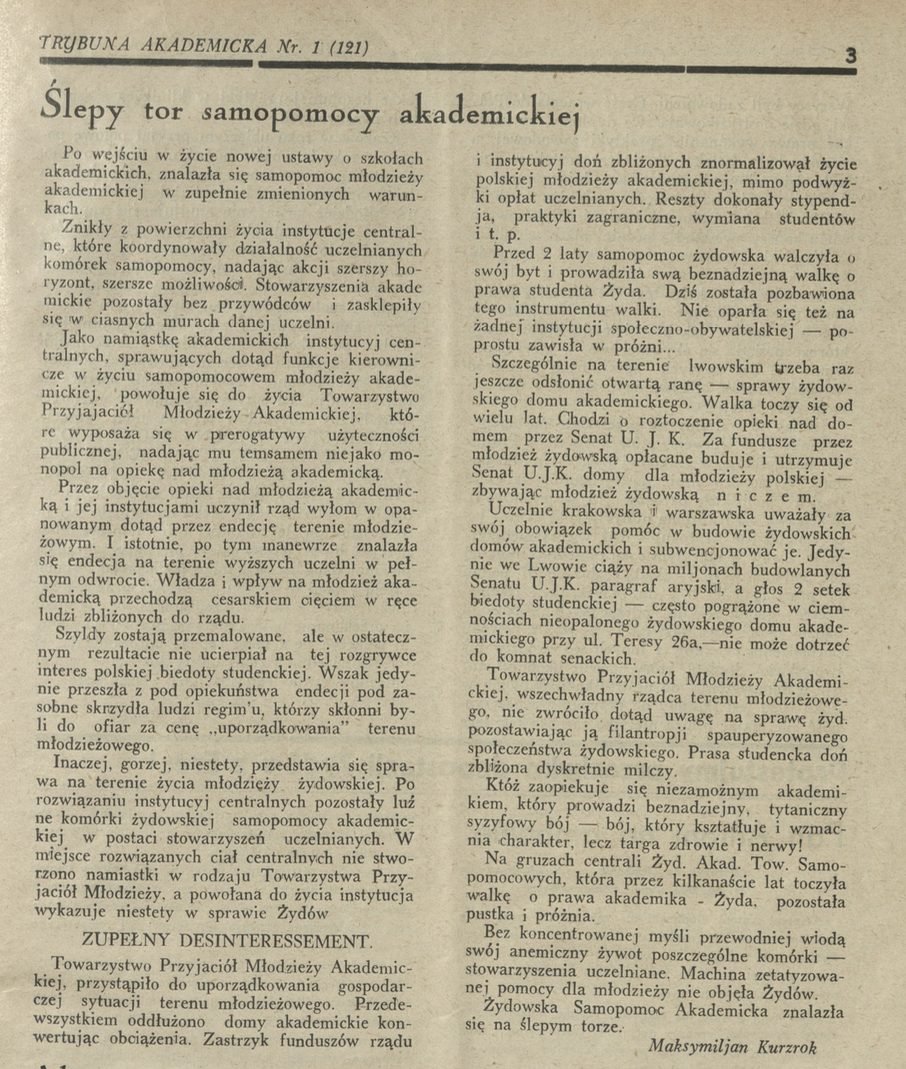
Three texts, three subjects — the school-leaving examination, an ideological dispute, money for dormitories — and one attitude: practical, organisational, bent on helping people get themselves settled. Exactly the same attitude we shall see ten years later in the ghetto.
IV. 22 November 1933 — the committee with Giedroyc
In the autumn of 1932 Kurzrok was still writing as a Lwów reviewer. A year later he was already sitting in Warsaw, at a table where decisions of an entirely different kind were being made. A note in the Warsaw „Express Poranny" is the earliest known trace of his presence in the capital — it precedes all others by a good four years.
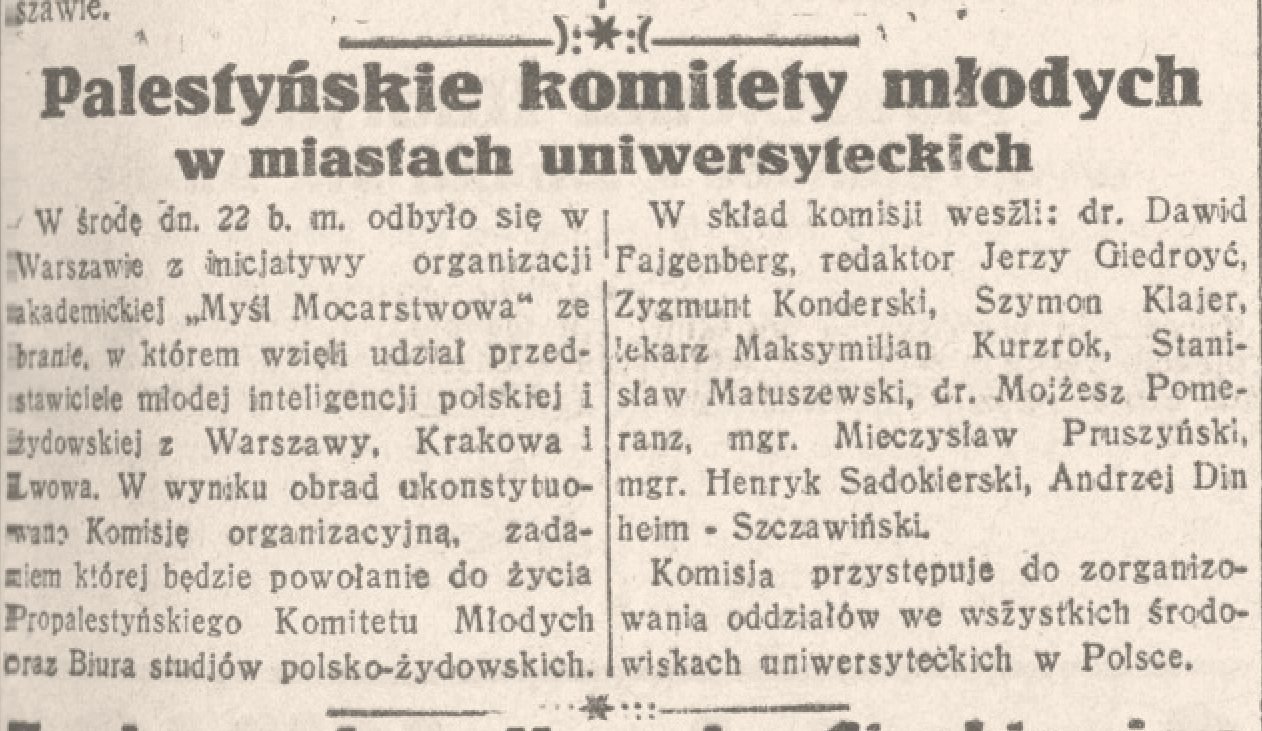
The meeting took place on Wednesday the 22nd of the month, at the initiative of the academic organisation „Myśl Mocarstwowa". It was attended by representatives of the young Polish and Jewish intelligentsia from Warsaw, Kraków and Lwów. An organising committee was appointed, whose task was to create a Pro-Palestine Committee of the Young and a Bureau of Polish-Jewish studies; the committee announced the founding of branches in all the university centres of Poland.
The committee's members were listed by name: Dr Dawid Fajgenberg, editor Jerzy Giedroyc, Zygmunt Konderski, Szymon Klajer, physician Maksymiljan Kurzrok, Stanisław Matuszewski, Dr Mojżesz Pomeranz, mgr Mieczysław Pruszyński, mgr Henryk Sadokierski, Andrzej Dinheim-Szczawiński.
It is worth pausing over this list. „Myśl Mocarstwowa" was a conservative academic organisation founded in 1927 which — as Mieczysław Pruszyński recalled years later — opposed the National Democratic conception of a nation state and stood for a state of many nations and religions, in the Jagiellonian and Promethean spirit. Editor Jerzy Giedroyc, then a twenty-six-year-old official of the Ministry of Agriculture, was just then running „Bunt Młodych", the journal that from February 1933 became an independent fortnightly — and that after the war would become the Paris „Kultura", the most important Polish émigré periodical of the twentieth century. Mieczysław Pruszyński led „Myśl Mocarstwowa" in 1933–1939; his brother Ksawery travelled to Palestine in 1932 and brought back „Palestine for the Third Time" — persuaded to make that journey, as the literature on Pruszyński records, precisely by Mojżesz Pomeranz, named among the committee's members.
For Kurzrok's biography this note means three things at once. First, it moves his Warsaw trail from 1937 back to 1933: he frequented and worked in the capital long before he lived at Złota 7. Second, it tidies the question of his title: in November 1933 he signs as „physician" — and rightly, for the diploma, as we shall see, he had obtained a year earlier. Third, finally, it adds hard, institutional proof to what was already visible in his journalism: he not only wrote of the rebuilding of Jewish Palestine as the bright point on the firmament of the young Jewish intelligentsia, but sat on the committee that was to organise that direction in the Polish university cities. And he did it together with Poles — in a circle seeking for the Republic a road other than nationalism.
The date of publication could be established: the note appeared in the issue of the „Express Poranny" of 24 November 1933 and reports the meeting of Wednesday 22 November. The copy in the project's collection bears a mistaken catalogue label „1 January 1933" — the calendar rules it out, for New Year's Day fell that year on a Sunday.
V. Truskawiec — the season from May to September
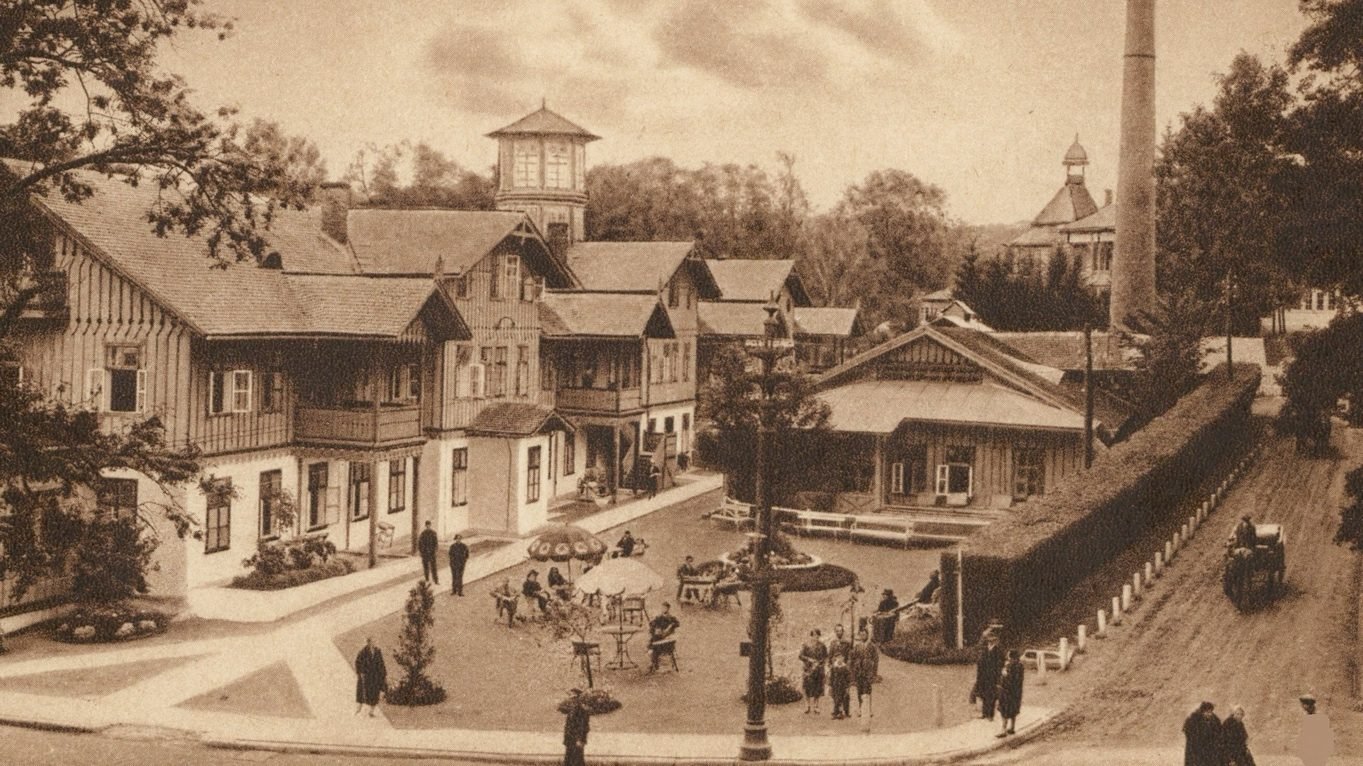
He specialised in internal diseases and urology, and his professional life settled into the rhythm of two seasons: from May to September he practised in Truskawiec, the rest of the year he received patients in Warsaw. To understand that choice one must know what Truskawiec then was.
Formally — a spa village near Drohobycz, thirteen hours by express train from Warsaw; Kurzrok covered that route every season, both ways. Practically — the most famous resort of the Second Republic and one of the most celebrated spas of this part of Europe, of which foreign guests used to say that it beat Karlsbad. Reporters described in unison the overcrowded trains, the station where no cab could be caught, and the hunt for lodgings: the actress Stanisława Wysocka recalled in 1927 that day after day a dozen or more people came away with nothing, and she herself, after four sleepless nights beside a snoring room-mate, at last secured „a tiny cubbyhole — but her own".
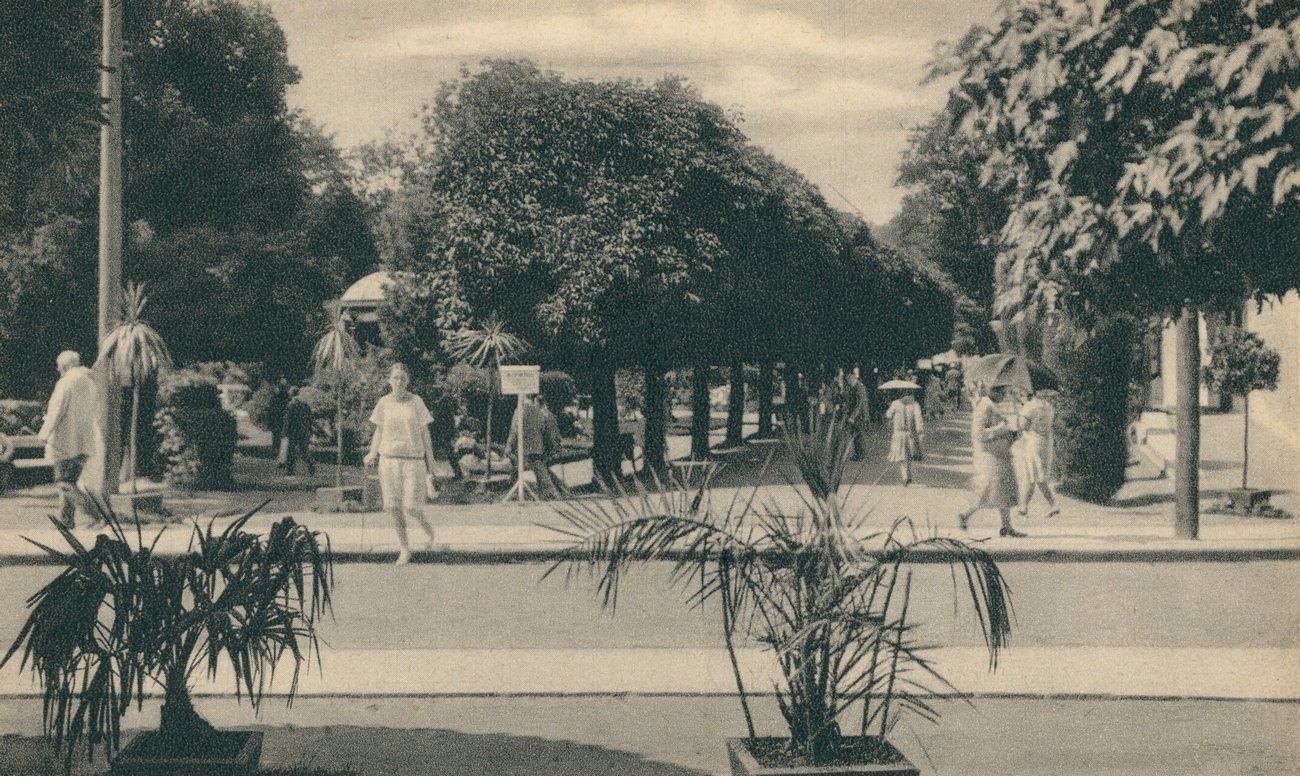
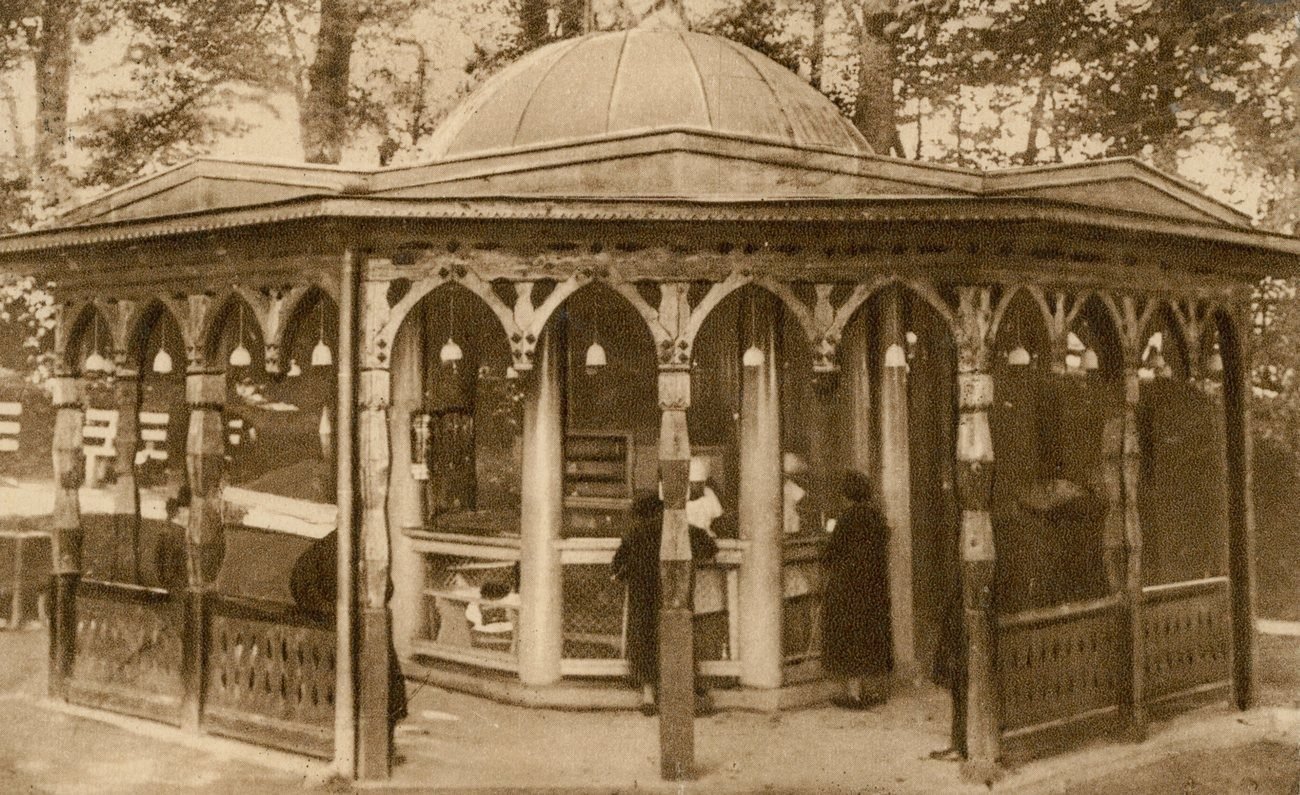
The magnet was the water. Truskawiec commanded a whole array of springs, to each of which separate powers were ascribed: „Bronisława" for the throat and nose, „Zofia" for the liver and constipation, „Józia" — advertised as strongly radioactive, which then passed for a healing virtue — and above all „Naftusia": a cloudy water smelling of crude oil, of unique chemical composition, held to be unrivalled in diseases of the kidneys and urinary tract. The guests joked about its taste — the reporter Jan Tadeusz Wróblewski noted in 1928 a conversation of two ladies outbidding each other as to whose belches after it were worse — but they drank it obediently, cup after cup. For a doctor of the speciality „internal diseases and urology" a better matched workplace could hardly be found in all Poland: the profile of the spa and the profile of the doctor coincided to the letter.
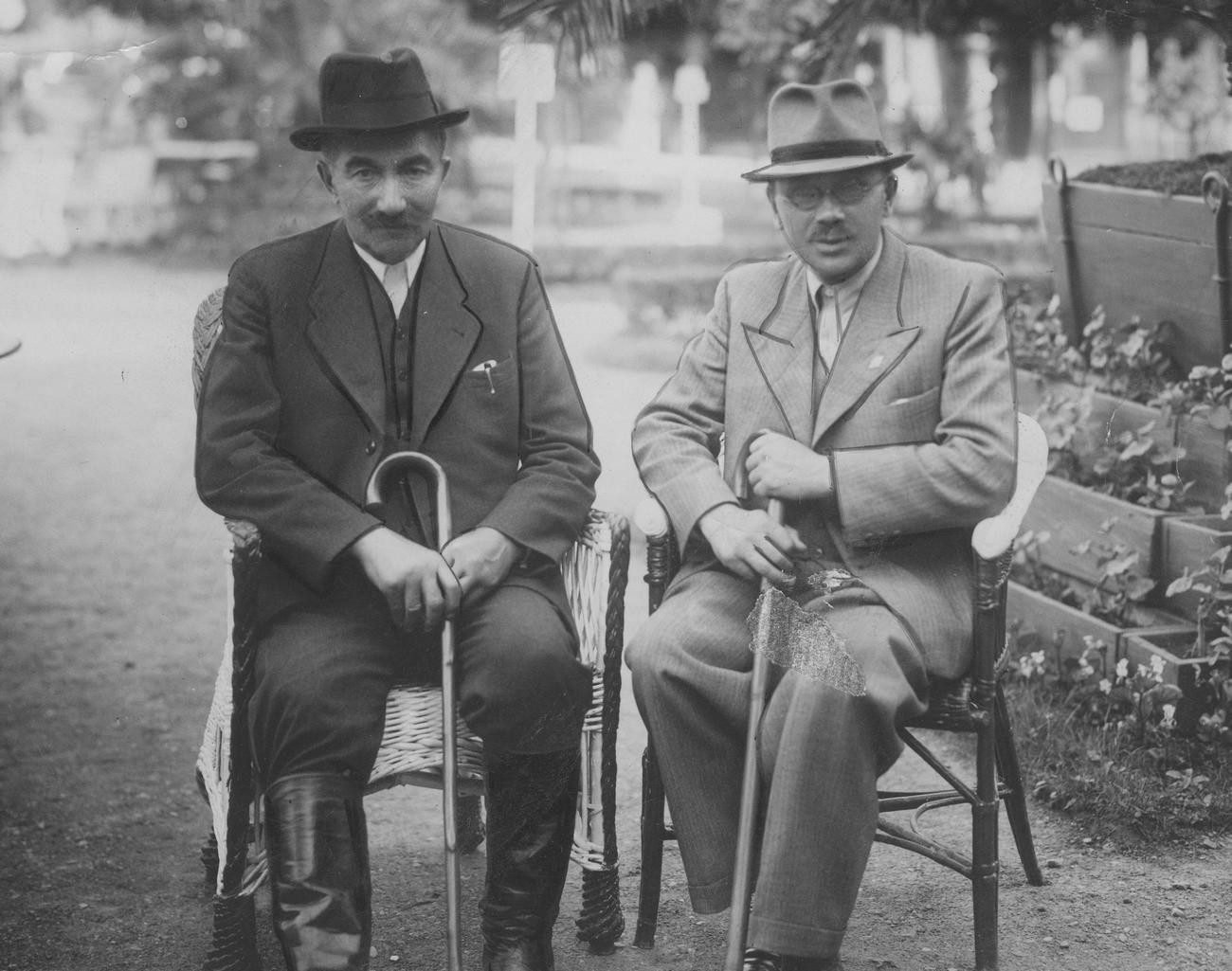
The second magnet was the company. After the May coup the deposed president Stanisław Wojciechowski took the cure here; after the Brześć fortress and exile — Wincenty Witos; Piłsudski passed through, and his ministers stayed for weeks: Sosnkowski, Sławoj Składkowski, Car. Bruno Schulz from neighbouring Drohobycz found literary inspiration here, Zofia Nałkowska lived through a romance, Jan Kiepura strolled the promenade with his fiancée, Miss Polonia Zofia Batycka. Beside them walked teachers, merchants, priests and plain Jews from the whole country — Poland in miniature. The same promenade had its dark page too: in 1931 Ukrainian nationalists shot dead in Truskawiec the deputy Tadeusz Hołówko, a reminder that the resort flourished in a region of sharp national tensions.
Kurzrok received patients in the very middle of that world, in the villa „Słońce" — we know it not from any family account but from his own press announcements.
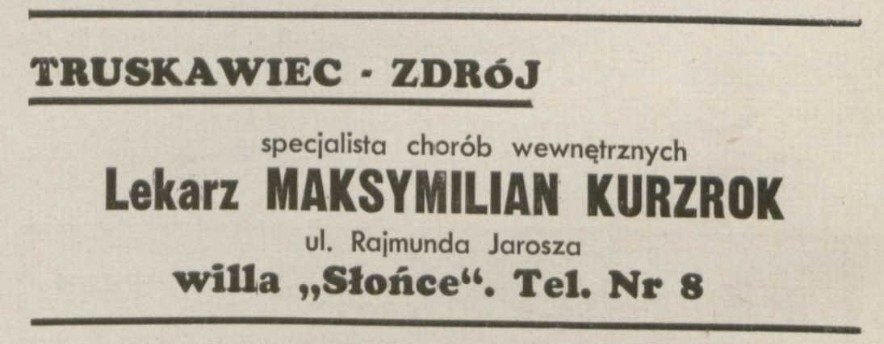
The villa „Słońce" stood on Rajmund Jarosz Street — named after the president of the spa, and it was no courtesy honour. When Jarosz took over Truskawiec in 1911, it was a run-down locality that had passed through the hands of the Austrian authorities, a company of Jewish entrepreneurs and a cooperative of aristocrats with Prince Adam Sapieha, earning mainly from the extraction of earth wax; the guests numbered from a few hundred to two thousand a year. A quarter of a century later Truskawiec had over two hundred and twenty hotels, villas and guesthouses, nearly twenty thousand guests a season, spa waterworks and bath-houses issuing up to six hundred baths a day, and Jarosz — a man who had started without a penny — passed for one of the Croesuses of the interwar years. Exactly that quarter-century, 1911–1936, was celebrated by the commemorative paper of which Kurzrok was the responsible editor. The telephone number of his consulting room: 8. That was enough in those days.
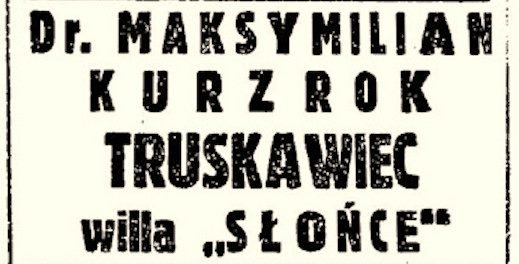
The place of publication is here as telling as the content. „Nowy Głos" was a Warsaw Jewish daily, published at 38 Nalewki Street. Kurzrok was thus advertising in Warsaw — in the New Year issue, on the threshold of the season, to the Warsaw clientele he expected to see in Truskawiec in the summer. The announcement appeared in the same year in which he was already living at Złota 7.
A third announcement, from the professional press of the same year, fills in the dates. In „Medycyna i Przyroda" — the same monthly in which he had made his debut in 1929 — he announced in issue 5 of 1938:
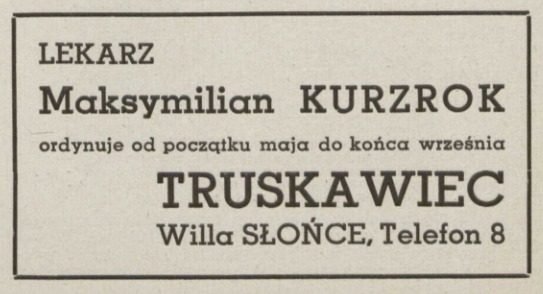
The season: from the beginning of May to the end of September — exactly the rhythm he had been signing since 1929 with the formula „Warsaw — Truskawiec". And the title: in the daily „Dr.", in the medical journal „Physician". With the year of the diploma established, the only remaining riddle is the „Dr med." of the „Głos Położnej" of 1937 — a doctorate after the diploma or an editorial embellishment; a matter to be settled in the official registers.
The spelling of the first name draws attention. Here and in the Medical Yearbook: Maksymilian. In the texts he signed with his own hand — in the „Trybuna Akademicka" and in the commemorative paper — Maksymiljan, in keeping with the pre-war norm. Both forms are his own.
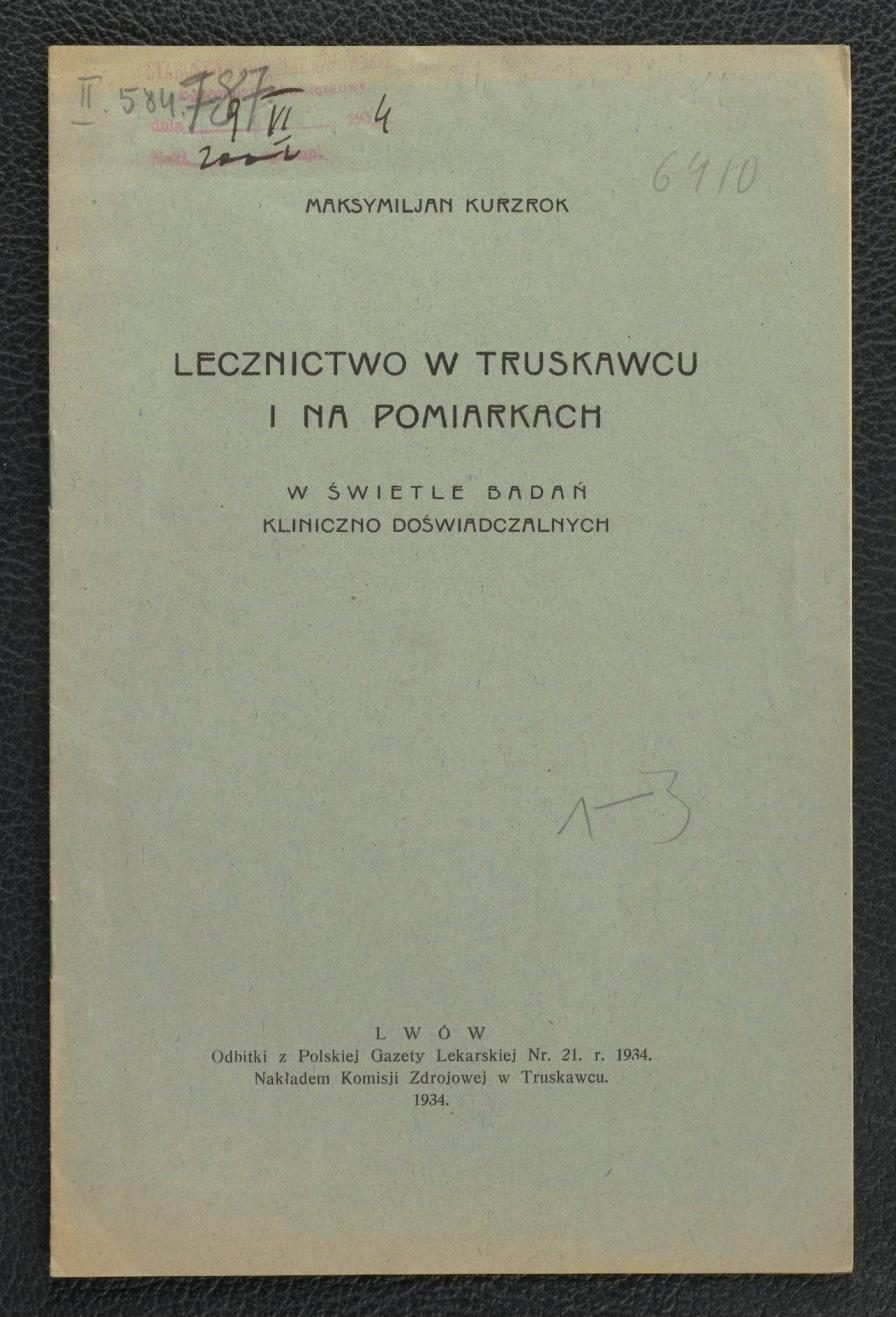
In 1934 he published the treatise „Therapeutics in Truskawiec and at Pomiarki in the light of clinical-experimental research" — an offprint from the „Polska Gazeta Lekarska" no. 21, issued by the Spa Commission in Truskawiec. The work is cited to this day in studies of the spa's history.
Two years later he stood at the centre of Truskawiec public life. The Citizens' Committee published a handsome „Jednodniówka Truskawiecka" — a one-day commemorative paper — to honour the twenty-five years' work of president Rajmund Jarosz, the owner of the spa. Kurzrok was on the editorial committee — and the responsible editor
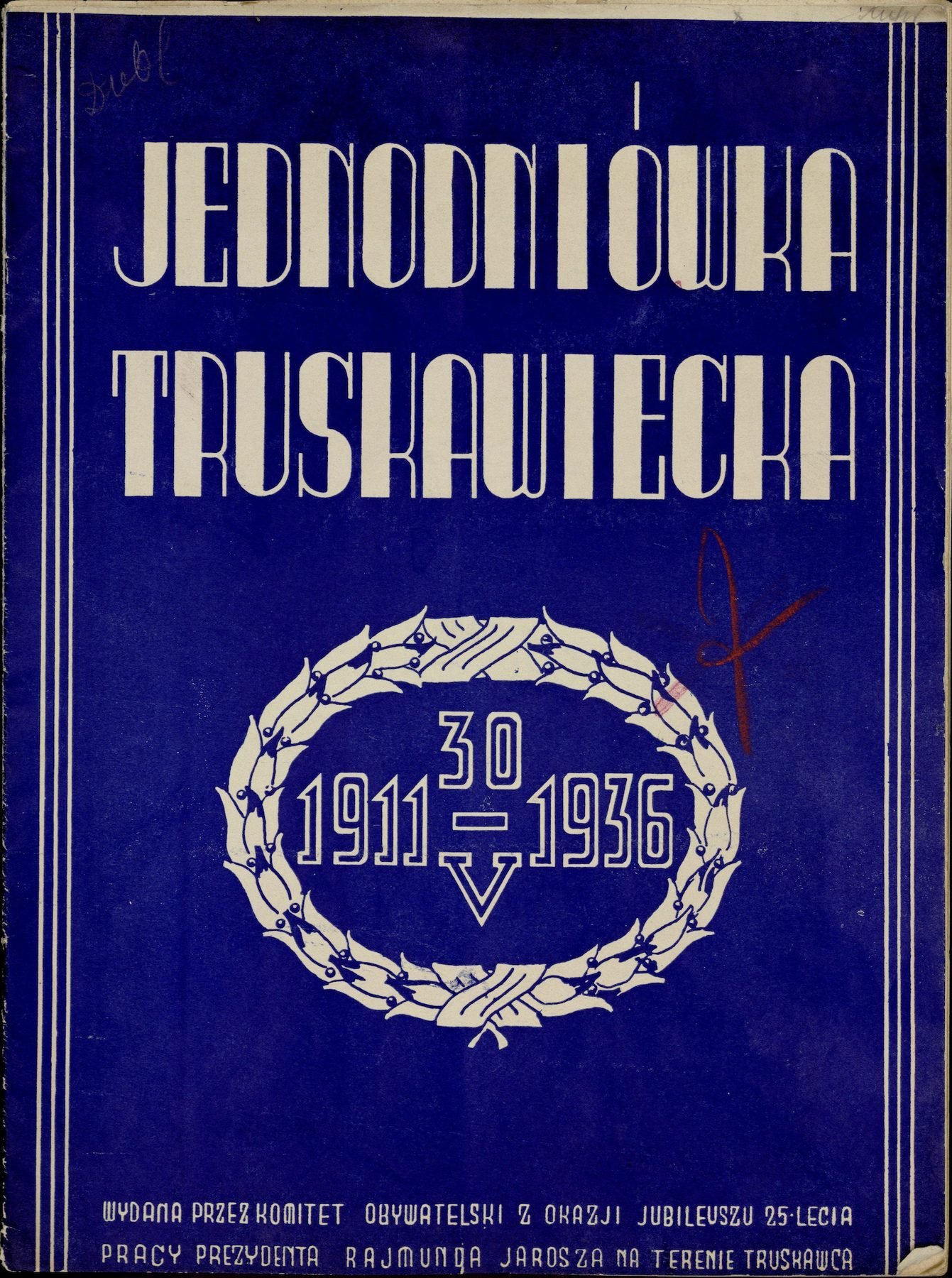
The colophon of the paper: on the editorial committee „Physician Maksymiljan Kurzrok" beside Dr Wiktor Proszowski, Tadeusz Łodziński and Dr Ignacy Zieliński; below: „Responsible editor: Physician MAKSYMILJAN KURZROK".
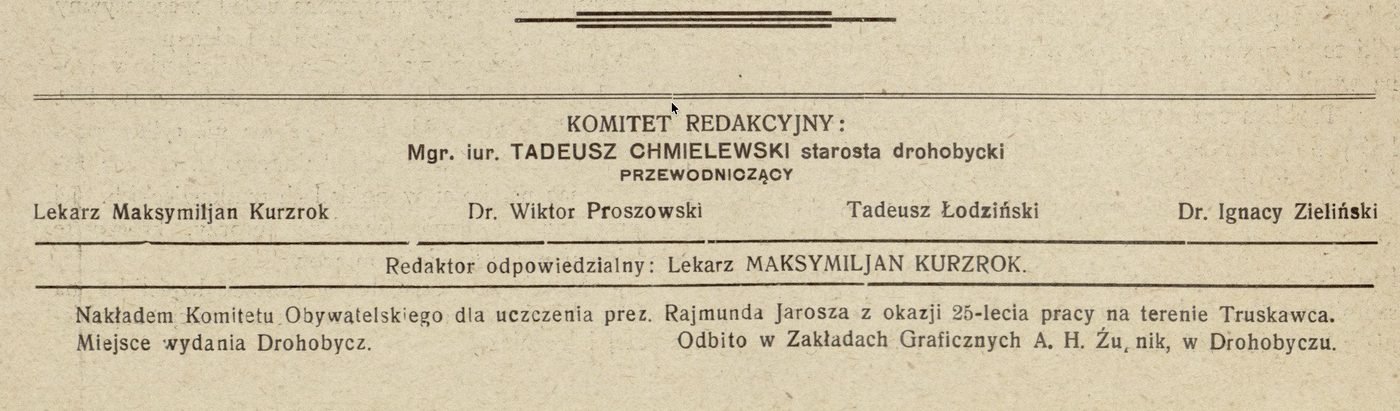
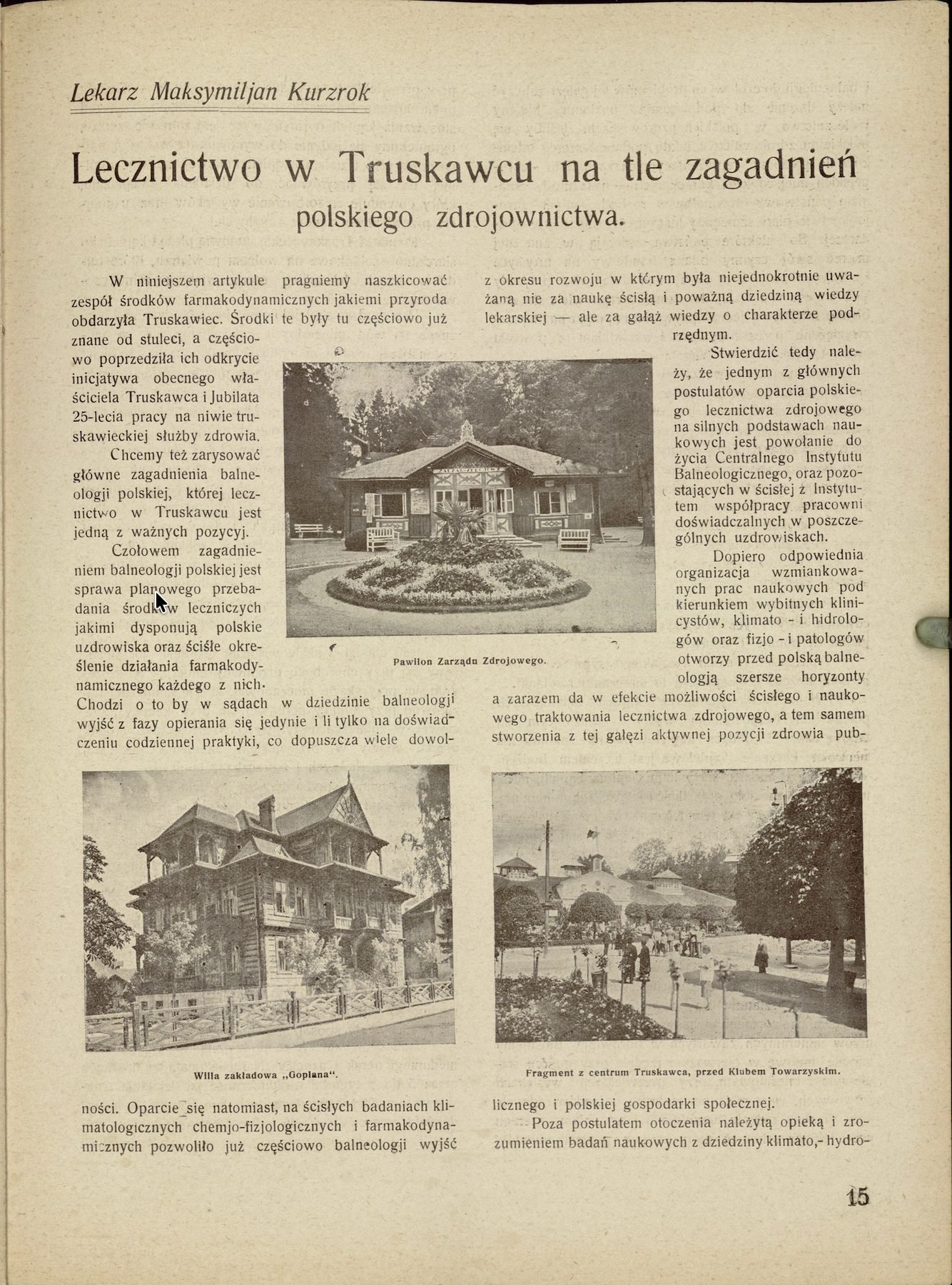
He wrote two texts for it. The first is an interview with the jubilarian, headed with a title taken from his own words: „Everything I won by hard work…". The second — „Therapeutics in Truskawiec against the background of the problems of Polish balneology" — is programmatic. Kurzrok writes in it of Polish balneology as a neglected and slighted field that at last requires planned research and cooperation with the climatological institutes; he calls for the founding of a Central Balneological Institute and recalls that the spas are not only health but also the state's balance of payments — a patient taking the cure at home does not carry money abroad.
A fragment of Kurzrok's article in the „Jednodniówka Truskawiecka", 1936.
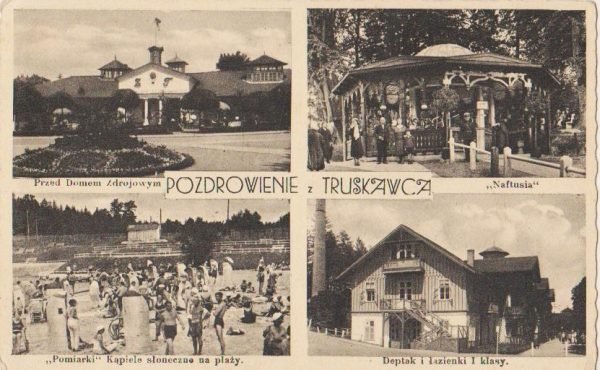
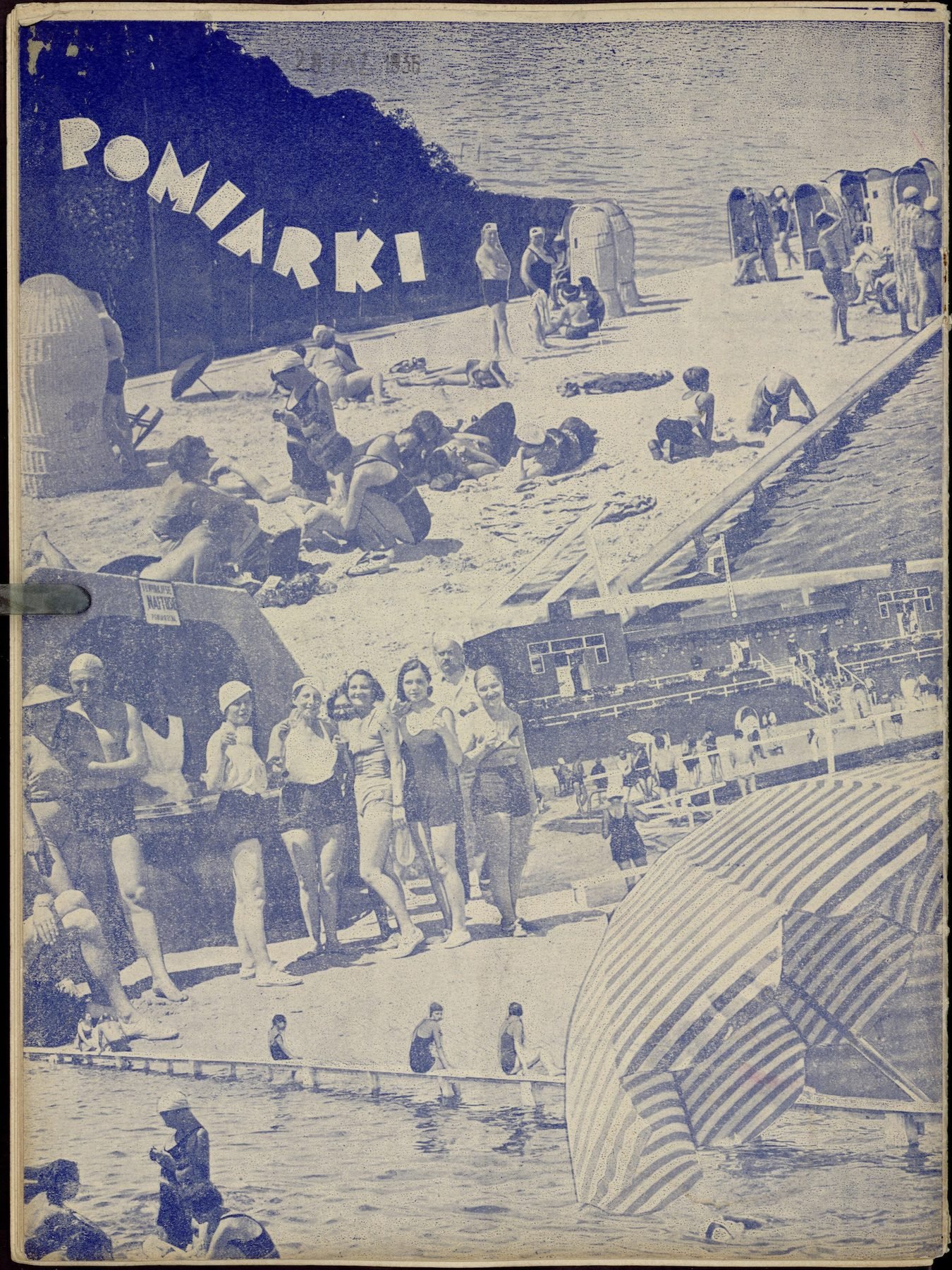
It is worth pausing a moment over what the world he worked in looked like. The spa's greatest pride was the complex at Pomiarki with its enormous brine-and-sulphur pool of six thousand four hundred square metres — the guidebooks enthused that its surroundings resembled corners of a sea beach transplanted to the foot of the Carpathians. An illustrated insert from precisely there was attached to the commemorative paper. It is the only image preserved in the project's collection of the place where Kurzrok spent his summer months. The photograph was taken in the spring of 1936 at the latest. Six years later almost everyone on that beach was dead.
„POMIARKI" — the illustrated insert of the „Jednodniówka Truskawiecka", c. 1936. Project collection.
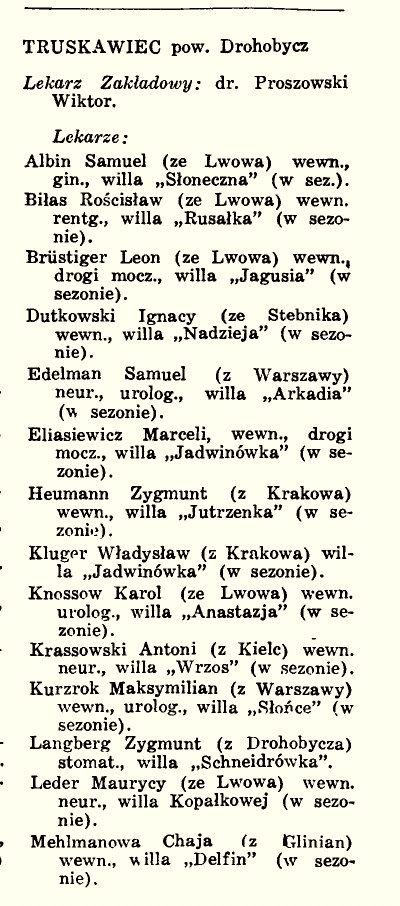
What that season looked like from the official side can be seen in the Medical Yearbook of the Republic of Poland. Under the heading „TRUSKAWIEC, Drohobycz district" are listed the establishment physician and a dozen or more seasonal doctors, each with the city he came from, his speciality and his villa. Truskawiec drew them from all over Poland: from Lwów, from Kraków, from Kielce, from Drohobycz, from Warsaw. Kurzrok's entry reads: „Kurzrok Maksymilian (from Warsaw) intern., urolog., villa «Słońce» (in season)".
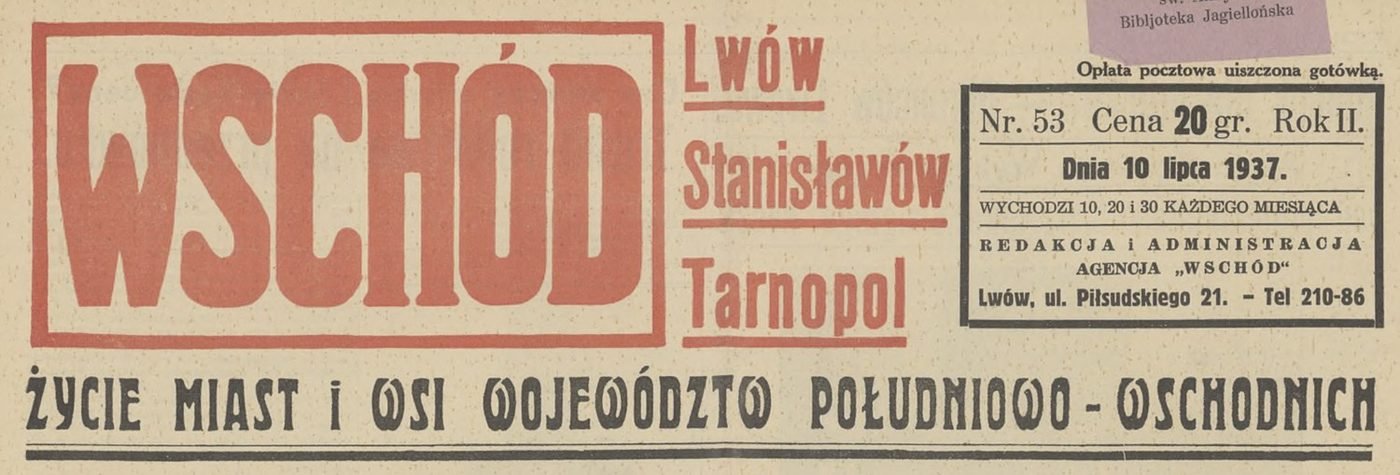
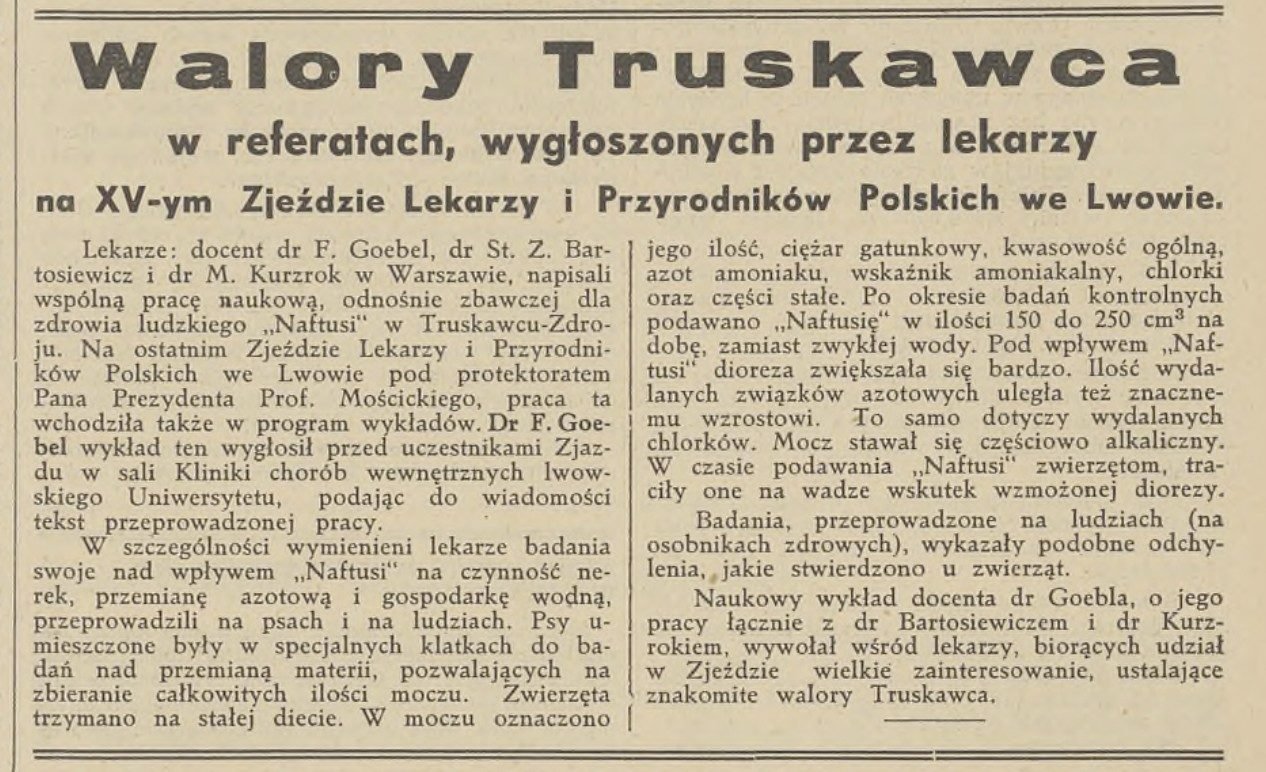
On 10 July 1937 the Lwów „Wschód" reports on the 15th Congress of Polish Physicians and Naturalists in Lwów, held under the patronage of president Ignacy Mościcki. Under the heading „The virtues of Truskawiec in the papers delivered by physicians" the newspaper writes of the joint scientific work of three researchers — docent Dr F. Goebel, Dr St. Z. Bartosiewicz and „Dr M. Kurzrok in Warsaw" — on the influence of „Naftusia" on kidney function, nitrogen metabolism and water balance. The research was conducted on dogs and on humans; the paper was delivered in the hall of the Clinic of Internal Diseases of the Lwów university and, as the journalist noted, aroused great interest among the physicians.
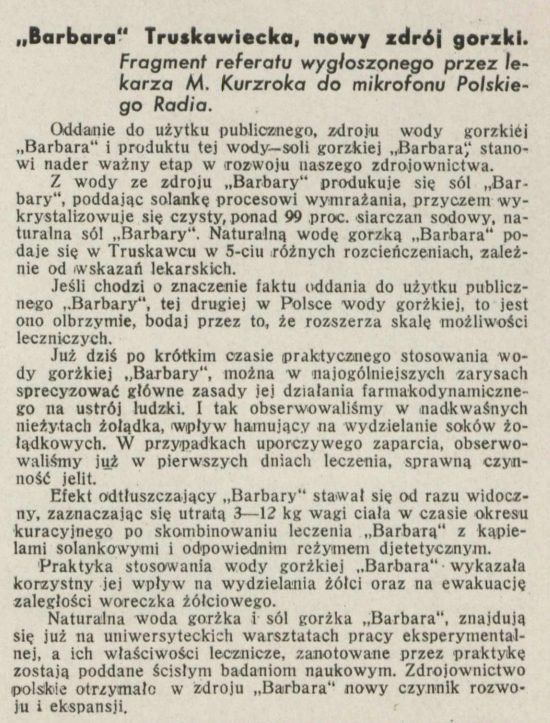
In 1937 a new spring joined them — the bitter water „Barbara", of which he wrote in the „Głos Położnej". The matter did not end with the professional press, however. Kurzrok delivered a talk on „Barbara" into the microphone of Polish Radio in Lwów, and its text was printed by the „Polska Gazeta Lekarska" in issue 36 of 5 September 1937 and then issued as a separate offprint.
The offprint from the „Polska Gazeta Lekarska" no. 36 (5 September 1937), year XVI: „Physician Maksymilian KURZROK, Truskawiec. Barbara of Truskawiec. — A new Polish bitter spring. From a talk delivered into the microphone of Polish Radio in Lwów". National Library, shelfmark II.653.109.
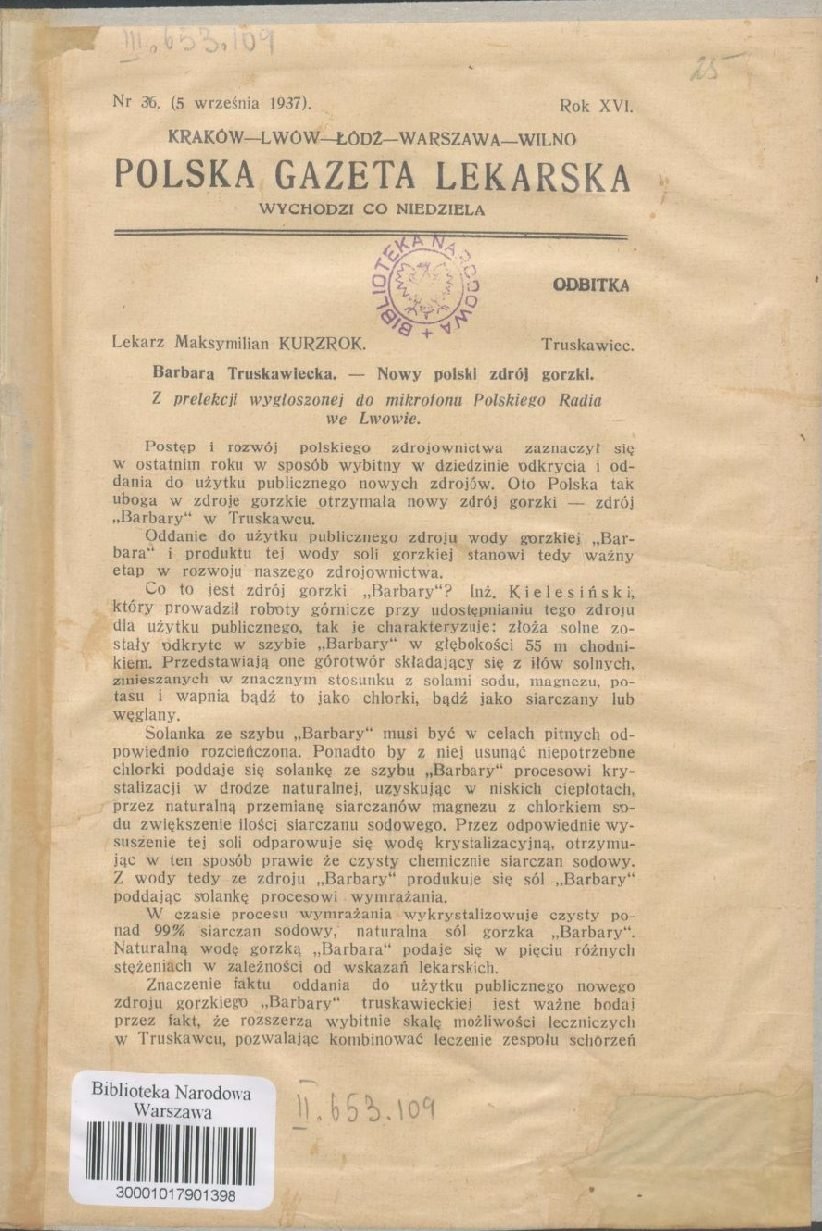
A radio text reads differently from a scientific article — Kurzrok explains to the listeners that the „Barbara" salt crystallises at a purity above ninety-nine per cent, that the water is given in five dilutions according to medical indications, that in a slimming cure the loss of weight reaches three to twelve kilograms. And he does not hide his pride: the opening of „Barbara" to public use he calls an important stage in the development of Polish balneology, for it is only the second bitter-water spring in Poland.
VI. Złota 7, telephone 3 22 10
In winter he practised in Warsaw — and not just now and then. The Medical Yearbook of the Republic of Poland lists him in the Warsaw section, between Kurzman Józef Izydor and Kurtz, in a formula as terse as all the entries there: „Kurzrok Maksymilian (1905, 1932) gen., 1 Hipoteczna St., tel. 3-86-76 (in summer Truskawiec)".
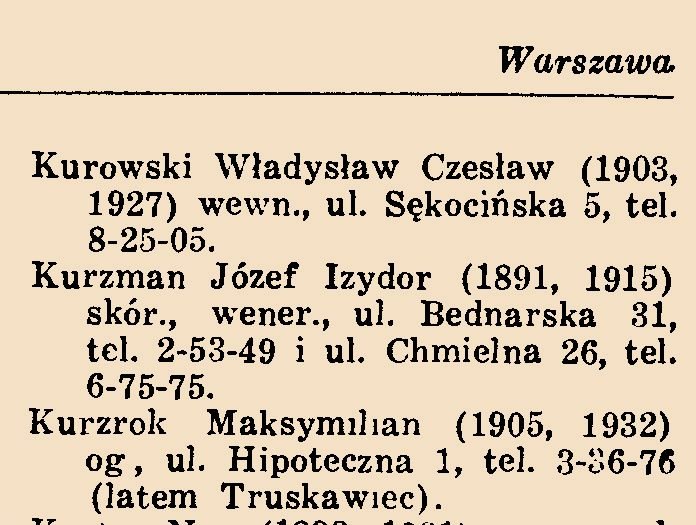
That one line settles two things over which biographers stumbled for years. He obtained his medical diploma in 1932 — not in 1928, as would be suggested by the source calling him a physician already in his student days, and not in 1929, though that is how he signed his text in „Medycyna i Przyroda". He therefore used the title „physician" before it formally belonged to him, or the editors used it for him. Second: the Warsaw consulting room at 1 Hipoteczna Street had the telephone 3-86-76.
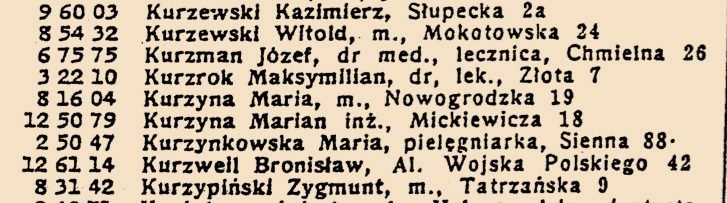
In the second half of the thirties he moved to Złota 7 — to the house that had just been completed and to whose first residents this project is devoted. It was an address in the very centre of the city: a few dozen paces from Marszałkowska, in the complex in whose part at number 7/9 the „Palladium" cinema operated. And this address too is documented — in black and white, in the subscriber directory of the telephone network of the capital city of Warsaw.
The last pre-war trace leads to the outskirts of Warsaw. In 1939 Kurzrok visited the newly built Military Sanatorium in Otwock — opened on 1 May 1938, one of the most modern anti-tuberculosis facilities in Europe — and wrote a report of the visit. He signed it the same way as ten years earlier: „Physician MAKSYMILIAN KURZROK (Warsaw — Truskawiec)".
„We visit the Military Sanatorium in Otwock…", 1939. Photo at the top: the induction of a pneumothorax with Dr M. Tekstycki's apparatus. Project collection.
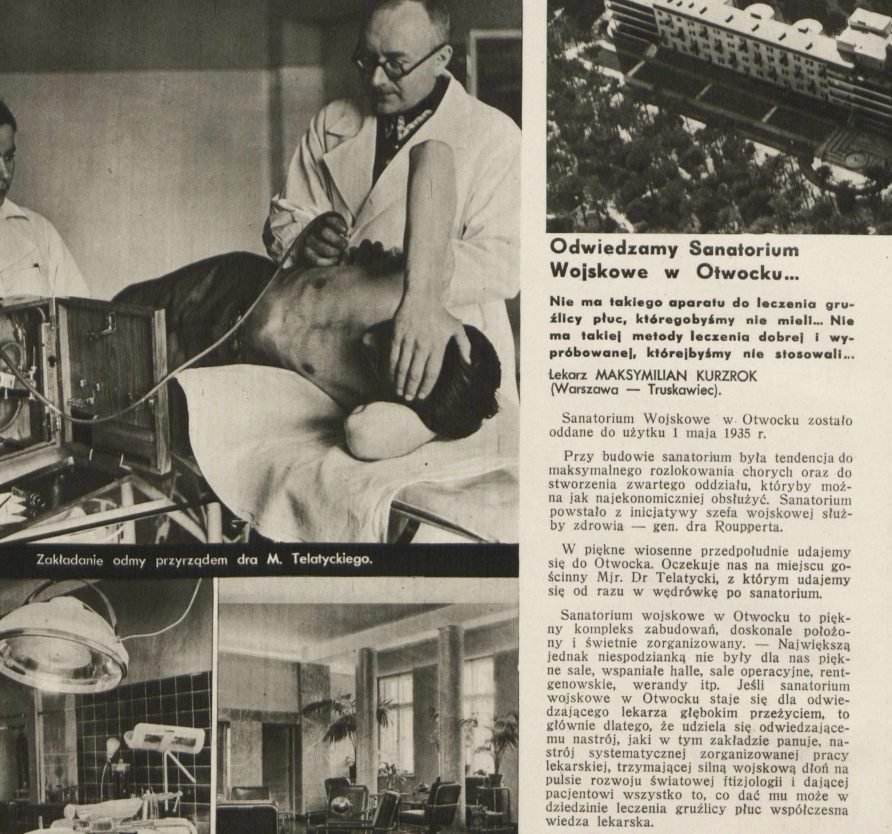
He writes like a man touring and unable to believe it: that there is no apparatus for the treatment of pulmonary tuberculosis that they do not have there, nor any good and proven method of treatment that they do not apply. That the sanatorium arose at the initiative of the head of the Health Department and against the resistance of the Treasury. That the greatest surprise was not the operating theatres nor the splendid halls, but the way the staff engage with the patients on their rounds — systematically, in an organised way, with conversation about the methods of treatment and about where world physiology is heading. He ends with a sentence about „the strong military hand on the pulse of the development of world physiology".
He wrote this a few months before the outbreak of the war.
VII. September 1939 — Lwów under two occupations
Before we begin on the war, one more document from peacetime — for it shows where in this story the family was. The Lwów telephone subscriber directory lists under 7 Św. Mikołaja Street two names: „Kurzrok Ewa" and „Kurzrok Maksymiljan". Ewa is the mother — Chawa née Adlersberg, in Polish documents Ewa. She had her own telephone number, which in interwar Lwów meant a woman running a business — she dealt in the sale of carpets and kilims.
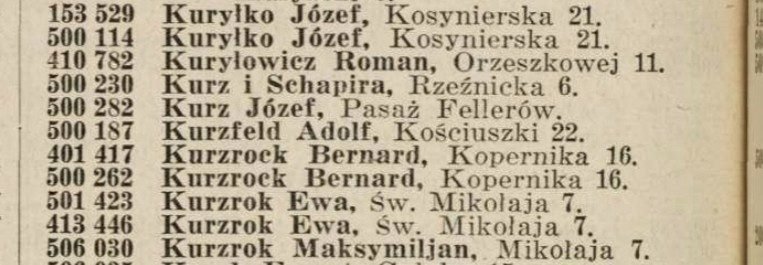
Register of Holders of Cheque Accounts at the Postal Savings Bank, the Year 1938
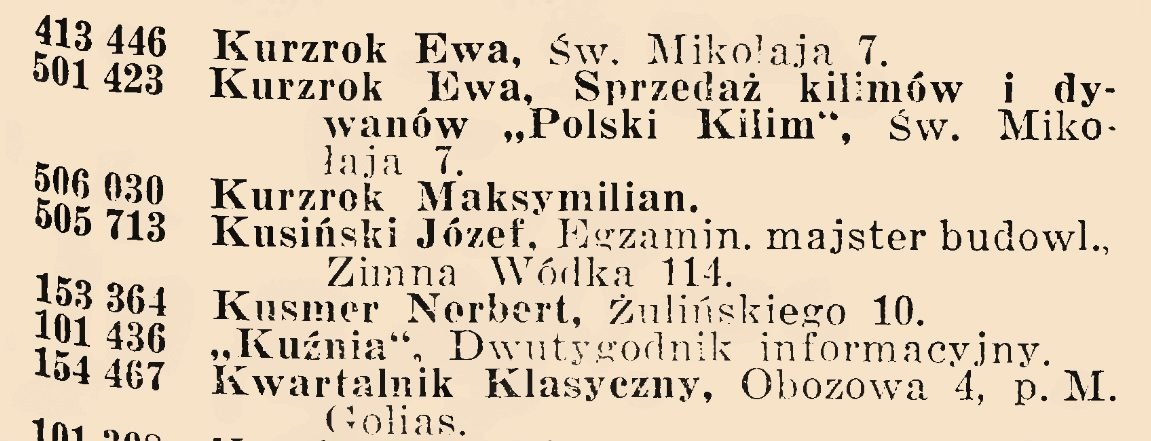
Lwów was the second home — the mother lived at 7 Św. Mikołaja Street, and he himself appeared under the same address. When in September 1939 the border closed, he returned to where the family was.
The war found him in the east. After 17 September 1939 Lwów came under Soviet occupation. From that period comes a small but telling trace: Janina Hescheles, daughter of the Lwów journalist Henryk Hescheles, wrote that even before the war „Doctor Kurzrok was often in touch with Papa about articles", and that when under the Soviet occupation Kurzrok became a vice-dean, her father intended to ask him for help in finding work. He did not manage to. On 22 June 1941 Germany attacked the USSR, on 30 June it entered Lwów, and Henryk Hescheles was murdered in the first days of the German occupation.
Lwów. The Ukrainian population greets the German army entering the city. On the left a fragment of the Latin Cathedral. June 1941
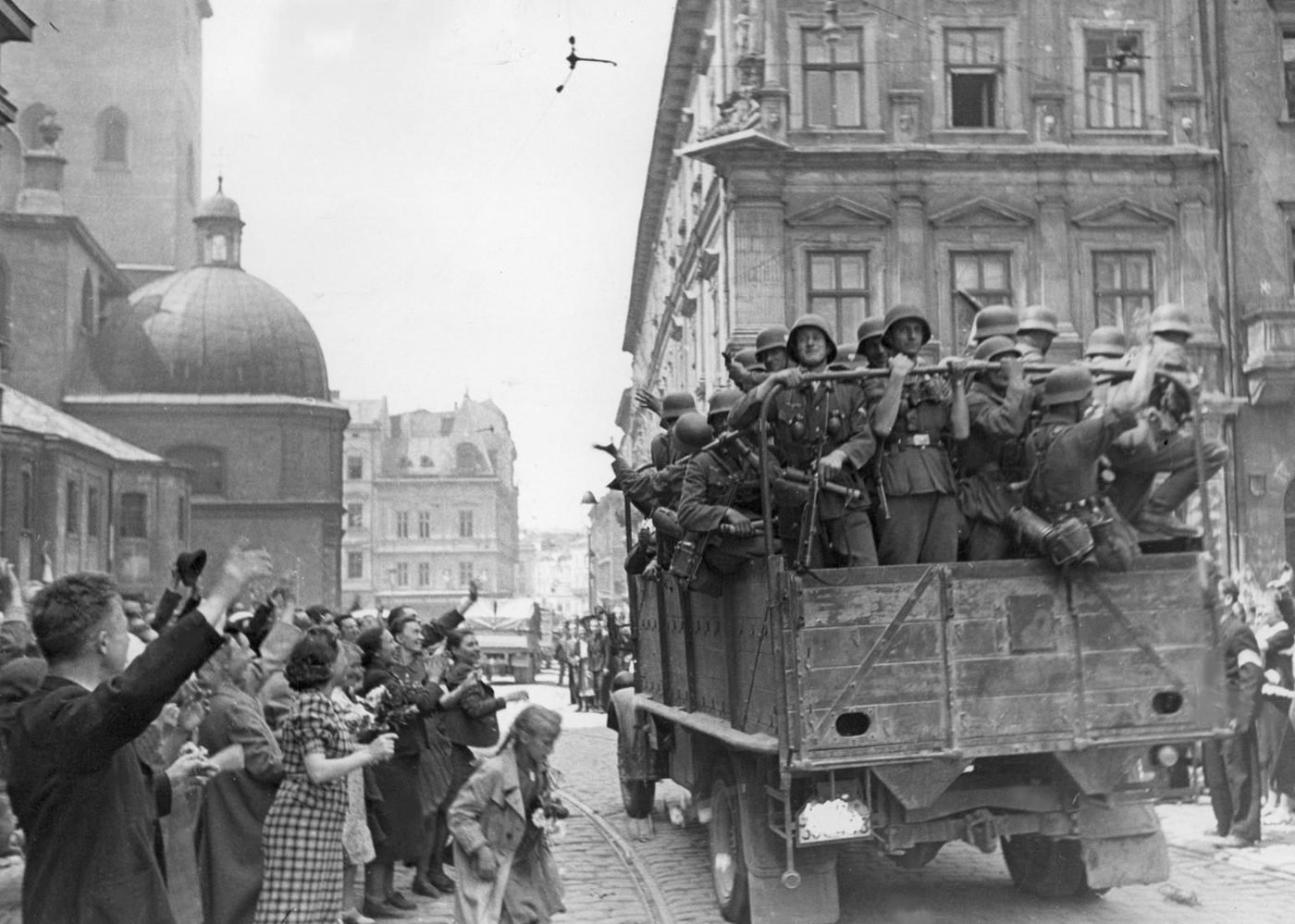
July 1941 in Lwów means pogroms: during the „Petlura days", between 25 and 27 July, the Ukrainian militia seized over two thousand Jews. „From the first days armed bands of Petlurists began staging pogroms against the Jews; in some streets by themselves, in others with the help of the Germans. The pogroms consisted of beating passers-by, beating to death and shooting. In other streets they also broke into Jewish homes and dragged out everyone they found. Whoever was taken from his home never saw the light of day again. Everyone was taken, men, women and small children. The people taken from the homes and caught in the street were led to special premises, where they were beaten to death. Many were shot on the spot. Many the Ukrainians took away in an unknown direction and shot there. The scenes of the pogroms were terrible. In their cruelty they recalled the dreadful pogroms in Ukraine during the war of 1914. A band of Ukrainians and Germans catches a beautiful Jewish girl with long black hair. They fall upon her like wild animals, drag her by the hair over the stone pavement. The unfortunate girl screams in a choked voice. The bandits beat her savagely, kick her all over her body. Terribly bloodied, they haul her to the premises. Many Jews already lie there, old, young, men and women. Many are already dead, others beg for mercy, crying «shoot us», but the brutalised bandits kick the wretches, beat them with rifle butts and sticks. Many they kill on the spot. Some they take away by car in an unknown direction and shoot there."
Jewish women maltreated in Lwów by Ukrainian militias in July 1941
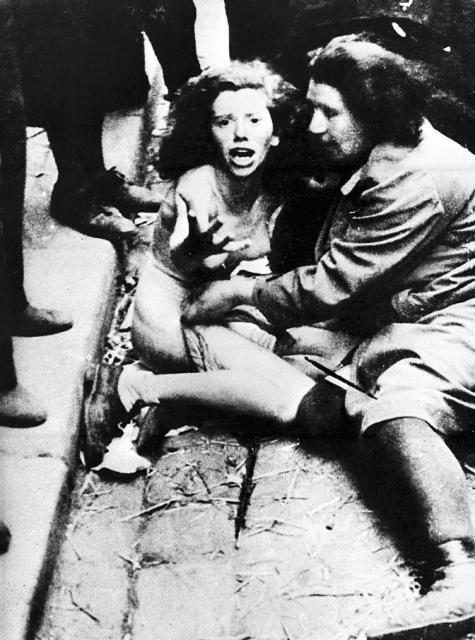
The Germans requisitioned the main Jewish hospital on Rappaporta Street — the only large facility the community possessed, seized at the very start of the occupation. A community nearly eight hundred years old, dating from the privilege of Casimir the Great, was within a few weeks stripped of its hospital, its property and its right to the city. And here begins the proper history of Doctor Kurzrok.
VIII. 1941–1943 — the anatomy of the Lwów ghetto
To understand what the work of Maksymilian Kurzrok in 1941–1943 was, one must know in what place he performed it. The Lwów ghetto was no ordinary prison. It was a machine which for twenty months systematically reduced the number of people shut inside it — first by hunger and typhus, then by transports, at the end by fire. The description below rests on the monograph of the Janowska camp published together with the memoirs of Michał Maksymilian Borwicz, on the findings of Jakub Honigsman, Eliyahu Jones and Filip Friedman, and on the report of SS General Fritz Katzmann — a document drawn up by the perpetrator and for that reason particularly merciless in its numbers.
On 1 August 1941 the lands of the former Lwów, Stanisławów and Tarnopol voivodeships were incorporated into the General Government as District Galicia. Overnight the whole anti-Jewish legislation built up in the General Government over the previous two years was extended to them. Every Jew over the age of ten had to wear on the left arm a white armband with a blue Star of David. The curfew began for Jews at eight in the evening, for the other inhabitants at nine. Travel by rail and leaving the city were forbidden. All property — movable and immovable — was subject to confiscation. Work became the duty of everyone between fourteen and sixty. Whoever had no certificate of employment was liable to be caught in the street and held in prison until the next transport. Fritz Katzmann became the SS and Police Leader in the district; the governors were, in turn, Karl Lasch and Otto Wächter.
In parallel the propaganda started: radio broadcasts, posters, „exhibitions", a defamatory press, even songs. From October 1941 it was directed also against those who had left the Jewish faith — the number of people wishing to change religion was growing, but the racial law counted them as Jews all the same. Only a few could be saved, those with close friends or relatives on the non-Jewish side who gave them shelter or false papers.
In October 1941 the creation of the ghetto was announced. Zamarstynów and Kleparów were designated as the Jewish quarter — the poorest and most ruined districts in the north-west of the city. Four streets passing under railway embankments connected them with the rest of Lwów. All the Jews of Lwów were to move there between 16 November and 15 December, using a single crossing only — Pełtewna Street, where a control point was set up in the former municipal bath-house under the viaduct.
That crossing was the first selection. From dusk to dawn a file of people with bags, bundles, carts and wheelbarrows dragged through it. Whoever could not produce a certificate of work, whoever looked starved, sick or old, was pulled out of the crowd and directed to the control point. There they beat — often to death. Those who survived the beating were taken to the prison on Łąckiego Street or straight to the suburban woods where the executions took place. The prisoners named that crossing the „Todbrücke" — the bridge of death.
The deadline of 15 December 1941 for closing the ghetto passed without consequence. Many people had failed to find a place in the new quarter and stayed where they had lived before. That uncertainty dragged on through the whole of the following year, until September 1942.
At the turn of December and January the surrender of all furs, sheepskins, hides, collars and woollen clothing was demanded — for the soldiers fighting in frozen Russia. Immediately afterwards several actions were carried out against beggars, orphans and the old. All of them vanished, murdered in the woods near Lesienice.
To this was added the economics of hunger. The already impoverished community was selling off furniture, clothes and household goods. People worked practically for nothing. The food rations were radically cut. Cold, overcrowding, lack of clothing and chronic malnutrition did the rest: spotted typhus, tuberculosis and scurvy broke loose. People collapsed and died in the street of exhaustion. The number of suicides grew. Every day mortally ill or starved workers were carried home from the labour camps.
And exactly at this point Doctor Kurzrok appears. The main Jewish hospital on Rappaporta Street the Germans had seized at the very start of the occupation, so the hospital service had to be built from nothing. Within the ghetto three facilities arose: two in school buildings on Alembeków and Kusiewicza Streets and a third, on Zamarstynowska, intended for the infectious cases. The beds for the first of them came from a burnt-out prison. The first employee and head of the hospital on Alembeków was Janina Hescheles's mother, Amalia. This picture agrees in two sources independent of each other — in the girl's notes and in the scholarly literature — down to the addresses.
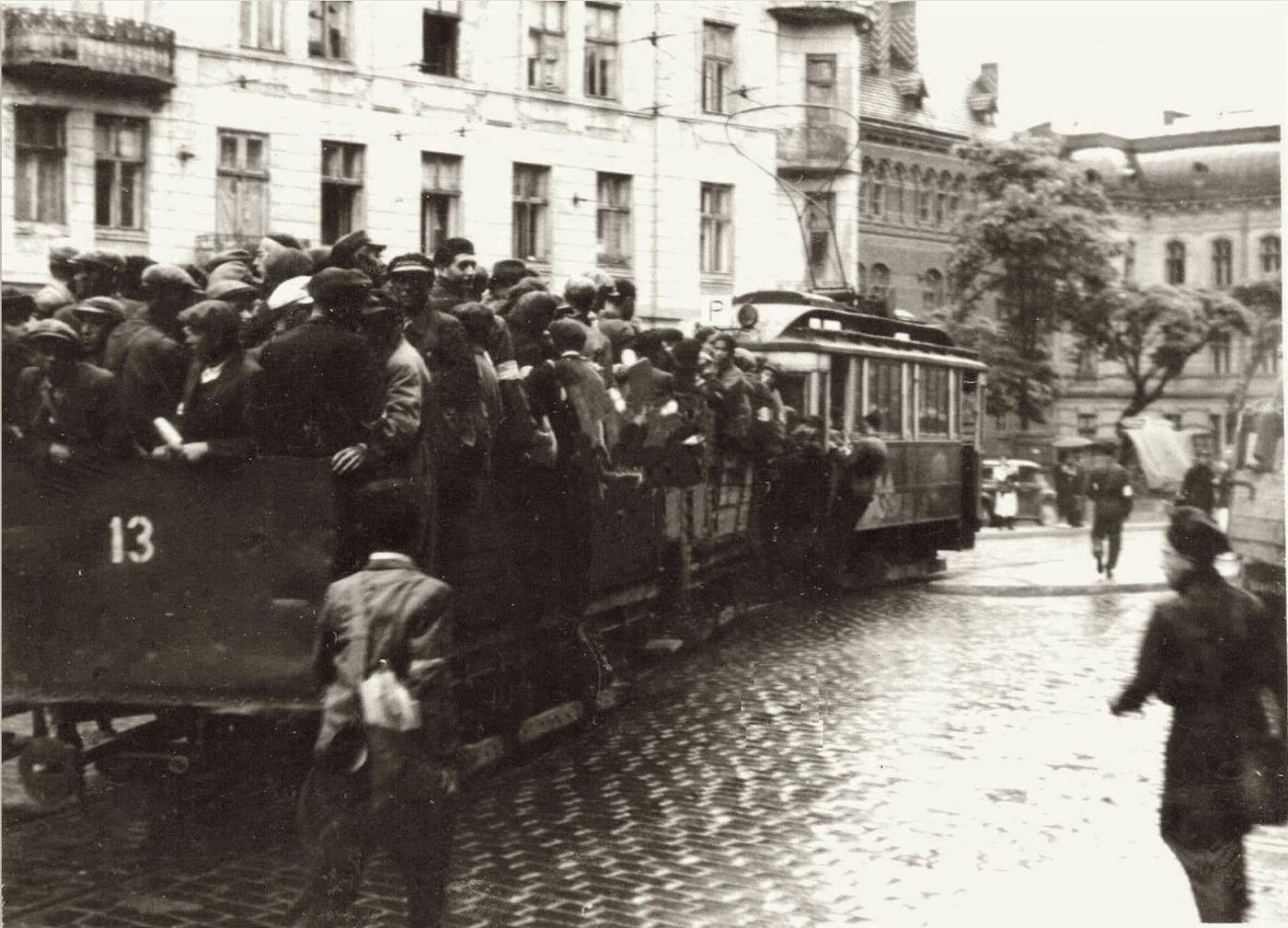
The first deportations to the extermination camp at Bełżec began in March 1942. The assembly point was set up in the former Sobieski gymnasium on Zamarstynowska; the unemployed, the old, sick children, and sometimes also workers with valid documents were brought there. From there, in open tramcars, through the middle of the city, they were taken to the small Kleparów station. Since the Jewish militia performed these tasks without conviction, after a few days the Germans took the action over: they blockaded selected parts of the city and searched house after house. The action ended on 1 April 1942, on the eve of Passover. Over fifteen thousand people lost their lives in it.
Then a new registration of workers was carried out, new identification cards and armbands distinguishing the employed from the unemployed were issued. Private German firms, lured by cheap labour, began opening branches in Lwów. The largest was run by the Berlin industrialist Schwarz, employing over three thousand Jews in several shifts. They repaired and remade clothing brought to Lwów from all of Eastern Galicia — from the places whose owners had just been murdered. The lice-ridden, bloodstained and torn clothes were disinfected and sent to German charitable organisations. The people who did this believed that the work would save them from the machine rolling daily through the streets of the city.
On 26 June 1942 that apparent calm ended. From two in the afternoon to two at night a flying SS liquidation brigade combed the ghetto. Six to eight thousand people — the old, women, children, the unemployed and those found outside the quarter's boundaries — were marched to the assembly point by the Janowska camp, tortured, and then shot at the Piaski. In the summer several smaller actions followed: the Jewish veterinarians were taken, then the pre-war employees of construction firms, finally two to three hundred officers of the Jewish militia. In July another levy was demanded; the sum collected disappointed the Germans, who understood that there was nothing left to take.
On 10 August 1942, a Monday, the „great action" began. For two weeks people were shipped to Bełżec — fifty to sixty thousand persons. The open trams ran through the centre of the city to Kleparów, where people, partly or wholly stripped, were crammed into goods wagons. Katzmann directed it in person, supported by a Vernichtungskommando, the Gestapo, the German police and the Ukrainian militia. Street after street was blockaded and the houses searched. The population had not expected the attack and no greater resistance was offered. Many committed suicide. Those who tried to jump from the open trams were chased and shot.
And then the hospitals were touched. They were cleared together with the orphanages, with not only the patients arrested but the doctors and the whole staff. On 20 August 1942 all of them perished in a mass execution. The sick who could not rise from their beds were shot in those beds. Children were thrown into the wagons one on top of another, like sacks. This is exactly the moment at which Kurzrok — eleven days earlier — had moved his father, his cousin and the Labiner family to the camp hospital.
A note survives by a German administration official who watched those transports pass through the city. He had no doubts about the liquidation of the Jews itself — he wrote that the German and the whole non-Jewish population of the city were convinced of its necessity. He had, however, a reservation of an aesthetic nature: he considered the state of the trains so dreadful that escapes could not be prevented, that shots rang out constantly and round-ups went on at the stations — and that it would be fitting to conduct it all in a manner less sensational and less repulsive.
On 7 September 1942 Katzmann issued a decree on the hermetic closure of the ghetto. From that date a Jew caught outside the quarter's boundaries was subject to the death penalty — as was every non-Jew who gave him shelter. The area was surrounded with a wooden fence with a single exit gate; the Jewish militia guarded it, and on the other side stood detachments of the SS and the Ukrainian police. Social and family life ceased to exist.
The ghetto was bursting at the seams. People who found no roof camped in the streets, in courtyards, in passageways and shanties. The quarter's only square — Kleparowski Square — filled with tents and people lying half-naked under the open sky. Ten or more persons lived in a single room. Workers could go out only in groups and only with documents, which cut the ghetto off from the black market and at once deepened the hunger; the official allocations did not suffice for survival. In the autumn a typhus epidemic broke out. The inhabitants defended themselves as they could: they scalded their clothes, washed despite the lack of privacy. There was no bath-house in the ghetto, and the nearest one was reserved for the militia and held a hundred persons a day.
A series of actions in November and December 1942 and in January 1943 announced the end. Soon after the January action the quarter was transformed into a labour camp — a Judenlager, Julag for short, divided into part A for workers and part B for women and children. Strict military discipline was introduced. In February 1943 SS-Hauptsturmführer Josef Grzymek became commandant — a man operating on the edge of madness.
Grzymek set about cleaning. The streets were buried in refuse, and on the courtyards of the collapsing houses mountains of waste were growing. He ordered little signs hung up reading „Ordnung muss sein", and laid the responsibility for cleanliness on the Jewish women, whom he called employees of the municipal cleansing services; the signs were hung to the constant accompaniment of beating. In the morning the commandant toured the camp in a horse-drawn carriage, and behind the carriage ran a detachment of the Jewish militia, waiting for orders. He entered selected houses and barracks; if something displeased him, he smashed the furniture and crockery and threw out the food. He hunted those living illegally and those absent from work — the caught were sent first to the prison, then to the Piaski. On his orders an orchestra was formed in the ghetto, playing at the gate of the Julag as the work brigades went out to the city: dance music, marches, including the Radetzky March, and also Beethoven and Mozart.
The final liquidation was preceded by the shooting of more than three quarters of the Jews held in the Janowska camp; all the Julag's external work details were then transferred to Janowska. Those who remained in the ghetto — children, women, the young and the workers of the internal details — understood at once what it meant. A feverish search for hiding places began. Katzmann described it later in his report of 30 June 1943 almost as a curiosity: people hid in pipes, chimneys and sewage channels, bored tunnels under corridors, widened cellars, dug ditches, fitted out hiding places in attics, in woodsheds, in lofts and inside furniture.
The action began on 1 June 1943 and did not go according to plan. In many places of the Julag the Germans were met with shots, grenades and petrol bottles. Afraid to enter the houses, the SS men began setting the buildings alight with flamethrowers to drive the people into the streets. Those resisting and those fleeing — men, women and children — were murdered on the spot. Children were killed with particular cruelty: they were thrown alive into the fire or their heads were dashed against walls and street lamps. Those hidden in the bunker on Łokietka Street defended themselves heroically. A young married couple, fleeing, shot and wounded several SS men before burning together with the house. Katzmann himself admitted that during the action several Germans were killed, a dozen or more wounded, and many caught spotted typhus and died.
Over seven thousand people were taken to Janowska and there subjected to another selection: thousands were sent to be shot at the Piaski, a small group was added to the decimated work brigades. Katzmann noted in his report two numbers that say everything. Instead of the twelve thousand registered Jews, twenty thousand were caught. And nearly three thousand corpses had to be removed from the hiding places — of people who in those days had taken their own lives with poison.
After the action ended Katzmann declared Lwów a city free of Jews. It was the end of a community that had existed here for nearly eight hundred years, since the privileges of Casimir the Great — a community that had survived the massacres of Chmielnicki and the Haidamaks, the partitions and the First World War. Within two years the Germans murdered over ninety-seven per cent of the Jews living in Lwów in June 1941. In the ghetto itself about a hundred and thirty-six thousand people perished; in the Janowska camp and the city's other camps — over two hundred thousand. Of the hundred and sixty thousand Jewish inhabitants of Lwów of the summer of 1941 there survived, by cautious estimates, about three per cent. Just after the liberation of the city in July 1944, eight hundred and twenty-three survivors registered in Lwów.
The list of the murdered reads like a biographical almanac of Polish Jewry: the lawyer Maurycy Allerhand, the mathematician Szymon Auerbach, the rabbi and Sejm deputy Aaron Lewin with his brother Jechezkel, the philosopher and critic Debora Vogel — the addressee of the letters of Bruno Schulz out of which „The Cinnamon Shops" grew, the art collector Maksymilian Goldstein, the entire editorial staff of the Polish-language daily „Chwila" with its editor-in-chief Henryk Hescheles — Janina's father.
One number concerns Kurzrok directly. Of the nearly one thousand physicians of Jewish origin practising in Lwów in June 1941, almost no one survived.
He was, moreover, not merely the organiser of three facilities. The earliest study of the destruction of the Lwów Jews — Philip Friedman's book of 1945, written just after the war, while it was still hot — calls him outright the chief physician of the Jewish hospital. The later literature describes him as director of the Jewish General Hospital in Lwów. He was thus responsible for the whole Jewish health service in a city that had just been robbed of its only large hospital.
Friedman recorded, too, an episode found in no one else. For a time it proved possible to obtain the right to transfer the sick from the camp to the city — and then the chief physician Doctor Maksymilian Kurzrock fitted out for them a separate building at the Jewish hospital and surrounded them with solicitous care. In time the camp authorities abolished that facilitation and set up their own „hospital" by the camp: a completely unequipped, bare barrack, unheated in winter.
It is worth noticing what follows from this. A separate building for the sick from the camp is not the improvisation of a single day — it is an administrative decision fought out of the Germans and maintained for some time. And the quotation marks in which Friedman sets the word „hospital" with reference to the camp barrack are the same quotation marks that must today be set beside any critical assessment of Kurzrok's work in the camp.
In these conditions — under a ban on all public gatherings, in a sealed quarter, in the middle of an epidemic — Kurzrok did a thing without parallel. On 31 January 1942 he convened in his hospital a scientific conference on spotted typhus. Five papers were delivered: on the biology of the louse, on the clinical picture of the disease, on prophylaxis, on epidemiology, and on bacteriology and serology. Over a hundred participants came. Two of the five speakers were Aryans, among them an employee of the Rudolf Weigl Institute — an institution subordinate to the German army.
Researchers of this episode stress that it is the only known case in occupied Poland of Jewish and non-Jewish physicians meeting at a scientific symposium in a ghetto. The conference was part of a game: it was to convince the Germans that the epidemic was recognised and under control, and thus that it paid, for the moment, to leave these people alive. Two weeks earlier at Wannsee the decision on the „final solution" had been taken, and at Bełżec the first gas chamber was being built — for now a wooden barrack. In a month and a half the first transport from Lwów was to go there.
Among the speakers was docent Dr Ludwik Fleck, microbiologist, a former assistant of Weigl, today known throughout the world also as a philosopher of science. He spoke on the bacteriology and serology of typhus. What he spoke of became, a few months later, the basis of the most extraordinary operation in which Kurzrok took part.
IX. 1942 — the vaccine from the ghetto
In the laboratory of the hospital on Kuszewicza Street, Fleck and his team were searching for a way to produce a typhus vaccine in conditions where there was no apparatus, no reagents, not even bottles. The Judenrat appealed to the ghetto's inhabitants to bring empty litre flasks. The vacuum pump was obtained, as Fleck recalled, almost by a miracle; the dialyser was an improvisation driven by a mill wheel connected to the water main. The team was made up of professionals and of trained-up members of their own families.
Fleck discovered that the typhus antigen appears in the urine of the sick from the first days of the disease, and worked out a method of concentrating and purifying it. He calculated that from the urine of one patient forty doses of vaccine could be made. The preparation was weaker than Weigl's, but simple, cheap, and it protected against a severe course of the disease. On 28 August 1942 Fleck vaccinated himself. In the end about five hundred people received the vaccine — inhabitants of the ghetto and prisoners of the Janowska camp.
And here Kurzrok enters. The discovery by itself saved no one; it could save only if the Germans recognised it as something they cared about. That part of the task — Fleck's biographers call it the gambit — was taken on by the hospital's director. He used his extensive contacts to „sell" the invention to the occupier. The stake was the life and protection of the staff of both hospitals, their patients, their families and hundreds of inhabitants of the Jewish quarter and the camp.
Gazeta Żydowska, 15 July 1942
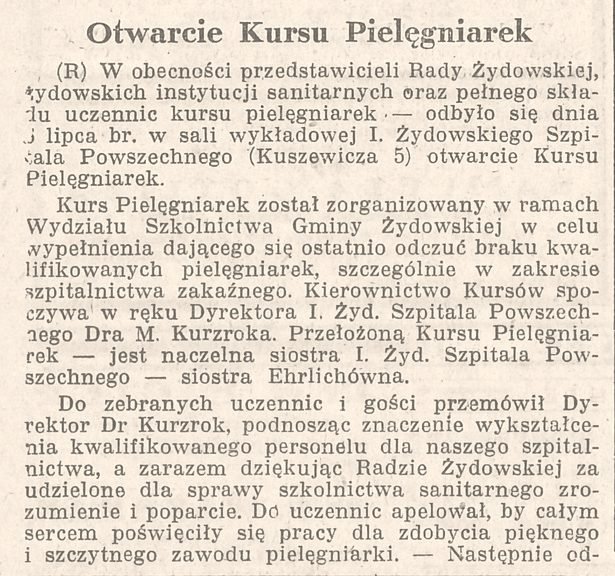
On 27 May 1942 the „Gazeta Żydowska" announced the matter on its front page, set in bold type: in the bacteriological laboratory of the Jewish hospital in Lwów important experiments on spotted typhus are being conducted, and the head of the laboratory, Doctor Fleck, has found a simple and cheap way of obtaining a vaccine. The publicity was part of the plan.
The plan went further. Fleck and Kurzrok met Dr Hans Schwannenberg, the German director of the Lwów pharmaceutical-drugstore factory „Laokoon", and presented him with the documentation, the charts and the research results. On the cover of the patent documentation they entered his name. Schwannenberg saw a place for himself among those of merit to the Thousand-Year Reich and swallowed the bait. On 4 December 1942 an SS lorry drew up at the hospital on Kuszewicza for Fleck and his closest co-workers with their families — not to kill them, but to drive them to the factory.
The pretext of the vaccinations opened one more door. Under the guise of experimental vaccination Kurzrok and Fleck gained entry where the German overseers admitted no one — the grounds of the Janowska camp. The sanitary staff of the hospital on Kuszewicza held documents allowing free movement about the city; the journey by tram or cart from the ghetto to the camp took some twenty minutes. Along that road went news, secret messages, food, money and medicines into the camp. Paradoxically, typhus itself helped: the SS men gave the hospital a wide berth.
It is worth pausing over what this means. The story of Fleck's vaccine is told today as the story of a scientist who outwitted the Nazis — and rightly. The scientist was Fleck. The man who turned his discovery into a shield for hundreds of people and into a pass into a concentration camp was the physician from Złota 7. Fleck himself survived: through „Laokoon", Auschwitz and Buchenwald. Kurzrok did not.
X. The Janowska camp — „the university of thugs"
The camp was founded on the grounds of the former A. Steinhaus mill-machinery factory at 134 Janowska Street; that use of the site was proposed by the Ukrainian starosta of Lwów, Yurii Polanskyi. In the autumn of 1941 the works were transformed into the SS-run Deutsche Ausrüstungswerke, directed by SS-Obersturmführer Fritz Gebauer. From October the Jews working there could no longer return to their homes. On 1 November 1941 a board was hung above the gate: „Der SS- und Polizeiführer im Distrikt Galizien — Zwangsarbeitslager in Lemberg". That date is taken as the day of the camp's founding. At first Poles and Ukrainians were also held there, in separate barracks and with armbands — the Poles red, the Ukrainians blue; non-Jewish prisoners, after serving their sentence, were sometimes released.
By the spring of 1942 the camp had grown into three clearly separated parts. In the first were the office, the SS men's quarters — in the middle the commandant's villa — the askaris' billets, garages and workshops, and also the sorting camp, that is, the place of selection of the Jews brought in: those unfit for work were sent on to Bełżec or liquidated at the Piaski. In the second part, fenced with barbed wire, lived the prisoners: thirteen barracks thirty to forty metres long, ten wide and one metre sixty high, the roll-call square and the kitchen. At the back, where the ground fell away, was a narrow passage with a wicket-gate — through it people were led out to the Piaski. Both parts were paved for the most part with matzevot from the nearby Jewish cemetery. The third part, practically a separate camp, was formed by the DAW works.
On 2 March 1942 SS-Untersturmführer Gustav Willhaus became commandant, with two deputies from April — Wilhelm Rokita and Adolf Kolonko. From that moment inventive murder became the daily routine. Willhaus shot at prisoners from the balcony of his villa for entertainment. An account survives of a young Jew named Szajewicz who could not endure the humiliation and struck the commandant in the face; Willhaus shot him by reflex, and then could not forgive himself that the man had died so easily, and abused his body. Gebauer could strangle a man with his bare hands for pleasure, and in social company passed for pleasant. The gendarme Kolonko, who came from the Poznań region and spoke perfect Polish, specialised in shooting and liked the game of firing at „living targets". The accounts of survivors name a dozen or more others — among them men who killed several people daily for pleasure, and one who in a single day, 18 November 1943, murdered a hundred and eighty people with his own hands.
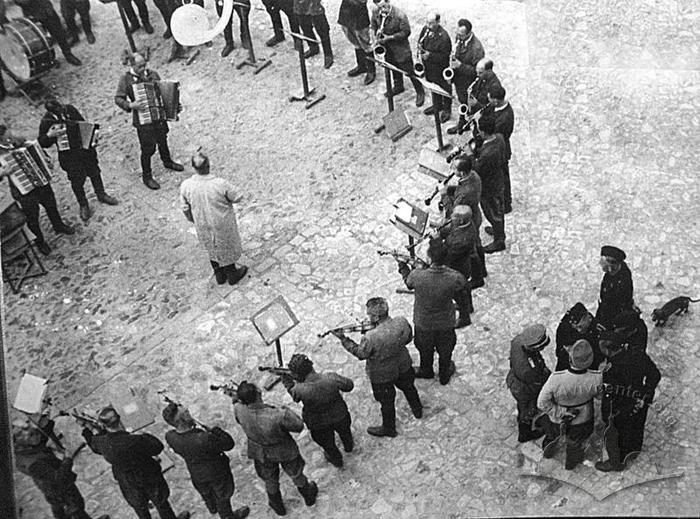
In the summer of 1942, at Rokita's initiative, a camp orchestra was formed from well-known pre-war musicians. A „tango of death" was composed for it, played when groups of the condemned were led to the Piaski. In the same camp, as early as 31 December 1941, the prisoners managed to organise a literary evening; it was prepared by Emanuel Szlechter — the lyricist of pre-war hits, among them „Tylko we Lwowie". He was murdered in 1943 during the camp's liquidation. Camp songs arose too, bitterly satirical: that they were ordered to work, given nothing to eat and shot at daily, and that dinner was a litre of water with a single grain of kasha.
The camp orchestra, 1942
The Piaski — a sandy ravine just behind the camp — served one function. The condemned were led down into the hollow and killed with bursts of machine-gun fire, row after row. Since this method was less „modern" than gas, many people were only wounded, and were then burned on the pyre that served in place of a crematorium. A special detail — the Death Brigade — dealt with the corpses. The bodies of the freshly murdered and those dug up from old mass graves were laid in layers alternating with wood, doused with petrol and set alight. The ash was sifted through sieves, and half-melted gold chains, dental prostheses, wedding rings and medallions picked out. The remains of slag and unburned bones were ground in a special machine to fine powder.
The members of the Death Brigade were forbidden to speak to one another or to look about them. They were obliged to wear on their faces an expression of contentment with their lot — sometimes a smile. The SS men questioned them about it; they answered singly or in chorus that they were content. Whoever could not smile, or did it unconvincingly, went straight onto the pyre: he was shot or thrown into the fire. Among them worked the „bookkeeper", counting those burned in the course of the day, who immediately afterwards was obliged to forget those numbers — to the question of how many were burned yesterday he had to answer that he did not remember. It was on these pyres that the exhumed bodies of the professors of the Lwów universities burned, murdered on 4 July 1941 on the Wulka Hills.
Borwicz recorded also a scene that says more about this place than statistics. A brigade returning from the bath-house came upon the drunken SS man Brombauer, who had fallen over on the road. One of the prisoners, with the escort's consent, fetched a cab and helped the German in. The touched Brombauer shook his hand and looked for a way to repay him. He proposed a transfer to a better brigade, but judged that too little — and added that the prisoner, once he found himself at the Piaski, should call him by name; he would then shoot him so accurately that he would not suffer for an instant. He said it entirely sincerely, without a shadow of cynicism.
Kleparów station, just opposite the camp gates, was the hinge of the whole machine. From here departed the sealed trains, wound with barbed wire, for Bełżec and Sobibór. People jumped from them in motion; along the embankment lay the bodies of those who had not succeeded. In winter the inhabitants of the surrounding villages met naked people dying propped against fences of cold and hunger. Some were killed by having nothing left to buy themselves off with, others by having managed to hide something and falling into the hands of thieves. There were those whom they managed to load onto the death train at Kleparów three times. Later the station began receiving transports as well — survivors of the liquidated provincial camps, brought in so as to be killed without delay.
Borwicz called the Janowska camp a higher school of bestiality: a place where commandants and guards were trained and then sent out to other camps, and where the methods of prolonging suffering were perfected. The factories of death exchanged experience, specialists, even apparatus. By May 1944, it is estimated, over two hundred thousand Jews passed through the Janowska camp.
It was in this camp that Doctor Kurzrok ran the hospital.
Here a thing must be added which it would be easy to pass over in silence. According to Jakub Honigsman the hospital created in the camp in the summer of 1942, after the outbreak of the typhus epidemic, did not fulfil its function — the physician, recorded there as Doctor Maksymilian Kurcrok, worked outside the hospital as an ordinary labourer in the works, and the sick were shot anyway. Janina Hescheles's notes say otherwise: the hospital block was to have arisen at the end of September 1942, Kurzrok was to be its head and to travel twice a week to the ghetto. Both versions can be true at once, and together they give a picture more exact than either alone: twelve beds, almost no medicines, „selections" twice a month, and a doctor who after a day of physical labour tried to treat people marked for killing. The hospital in the Janowska camp could not fulfil its functions, because it was not for that that it was allowed to exist there. We leave both judgements side by side.
This doubling — a hospital in the ghetto and a hospital in the camp — had, however, a value the Germans had not foreseen. As administrator of both facilities Kurzrok could move between them, and he used this to smuggle medicines into the camp. For nearly a year he was the link between two worlds neither of which had the right to contact the other. The hospital in the ghetto was run in that time by his deputy, Doctor Tadanier.
In the notes of the twelve-year-old girl Kurzrok appears from then on again and again, always in motion: it is he who on Sunday, the staff's only free day, walks at the head of the column clearing the city of snow; it is he who brings Janina's mother a stamped Meldekarte, the registration card on which life depends; it is to him that people come whose relatives have just been taken — and he went to save them. There is in those notes also a scene entirely ordinary, and for that reason particularly human: the girl runs at night for a doctor because her mother is suffocating, and finds the duty doctor drinking with Kurzrok; she returns alone. It is not the portrait of a saint. It is the portrait of a man who for two years did superhuman things and for two years was as afraid as everyone else.
XI. 9 August 1942 — the family in the hospital
Let us return now to August 1942 — to the „great action" described above and to the one day that preceded its start.
The day before it began, Janina Hescheles noted a scene that says more about Kurzrok than all the official records put together. In the afternoon he came to the hospital and took to the camp hospital his father, then in the Julag, his cousin — Mrs Adlersberg — and Mr Labiner with his wife and child. The camp hospital, the place of fortnightly „selections", was at that moment safer than the ghetto.
In that sentence from a child's notes lies the whole genealogy of this family. The father — Szaja Kurzrock, merchant of Kozowa, aged sixty-two. The cousin — Mrs Adlersberg, bearing the mother's maiden name, and so of the Synowódzko line. Two ends of Galicia, gathered into one hospital barrack in the Janowska camp, by a son who happened to hold a pass.
„For me the «action» is already on. And in spite of the cyanide, dying will be hard, because you are here."
XII. October 1942 — the list
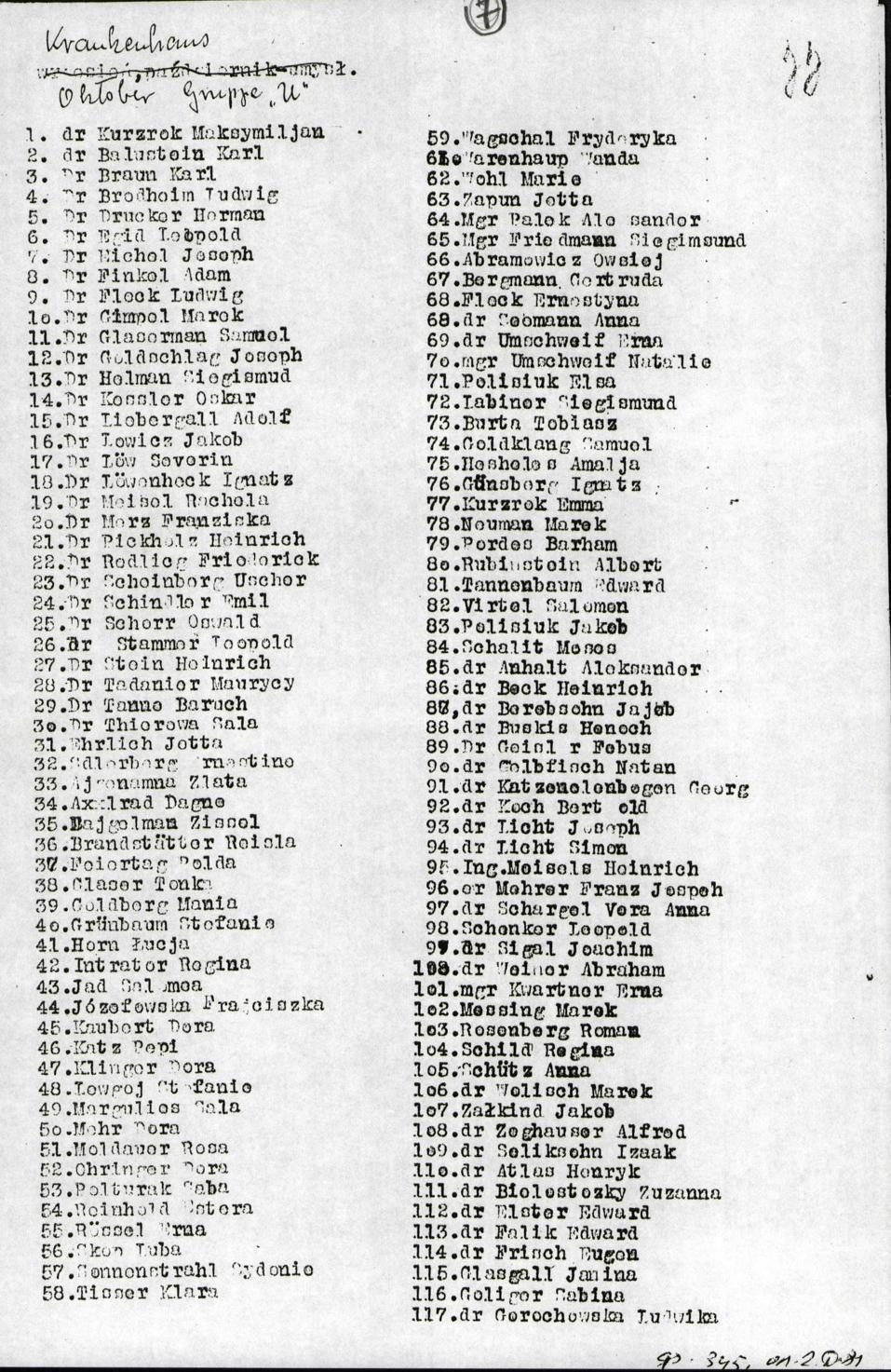
A document survives that allows us to look inside that hospital. It is a typescript staff list, headed by hand „Krankenhaus" and — after the striking out of an earlier date — „Oktober, Gruppe «U»". A hundred and seventeen names, arranged in two columns: first thirty physicians, then the remaining employees.
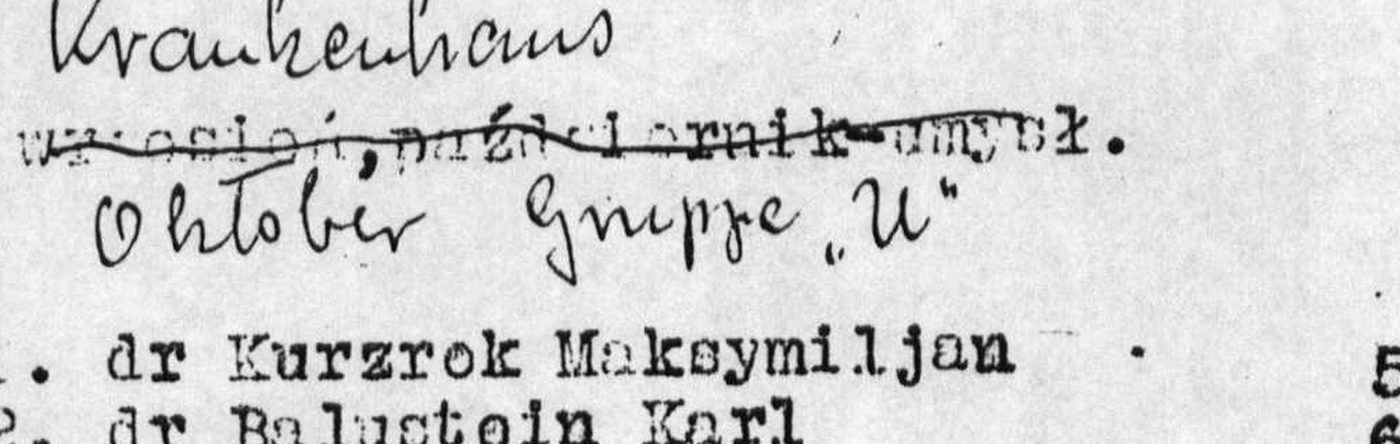
Under number one: dr Kurzrok Maksymiljan. Not alphabetically — first, because director. The list is in practice a register of the people who by belonging to the hospital had papers, and papers meant life. It reads today like a passenger manifest.
Everyone we already know from this account is on it. Under number 9 — dr Fleck Ludwig, and under 68 his wife, Fleck Ernestyna, drawn into the vaccine work. Under 8 — dr Finkel Adam, the one to whom Rudolf Weigl smuggled vaccine into the ghetto in thermos flasks. Under 66 — Abramowicz Owsiej, a laboratory assistant of Fleck's team. Under 68 and 69 — dr Seemann Anna and dr Umschweif Erna, chemists of the same laboratory. Under 85 — dr Anhalt Aleksander.
There are also the people from Janina's notes. Under number 75 — Hescheles Amalja, her mother, the first employee of the hospital on Alembeków, who will perish in June 1943 in the cellar bunker. Under 72 — Labiner Siegismund, the same Labiner whom Kurzrok moved with his wife and child to the camp hospital. Under 28 — dr Tadanier Maurycy, his deputy, whose first name we did not know until now.
And there are two names for which this list is, in this project, a discovery.
Under number 77 stands Kurzrok Emma. We know of no document that would name her outright as Maksymilian's wife — but everything points to it. The Yad Vashem Page of Testimony records that he was married. Janina Hescheles writes that he tried to escape „with his wife". Employing one's closest kin at the hospital was the standard and often the only way of obtaining a Meldekarte for them; exactly so did Fleck with his wife and son. If it is she — and this is the most probable reading — then after eighty years the wife of Doctor Kurzrok regains her name.
The second name is entry 32: Adlerberg Ernestine. Adlersberg is the maiden name of Maksymilian's mother. Janina Hescheles recorded that in August 1942 Kurzrok moved his cousin, „Mrs Adlersberg", to the camp hospital, and that she spoke with her still after his death. Very probably it is she — and she too at last bears a first name: Ernestyna.
Both identifications must for now be treated as strong hypotheses, not as facts; they are recorded as such in the project's documentation. But the document itself says something that requires no proving. The hospital's director entered on the list of the protected his wife and his cousin. Exactly what he did for strangers — he did for his own. And it was not enough.
XIII. Those who stayed in Galicia
While Maksymilian Kurzrok was organising hospitals in Lwów, the world he came from was ceasing to exist — little town after little town, in the space of a dozen or so months. We have no documents saying where and when the individual members of the family perished. We do have, precisely documented, the dates of the destruction of each of the three communities to which they belonged.
Skole and Synowódzko Wyżne — the mother's parts. In 1938 there lived here 2,670 Jews. In December 1941 the Germans shot about twenty people. On 5 September 1942 a transport left here for the extermination camp at Bełżec; on 18 October — another, with one hundred and sixty-seven people. Between 2 and 4 December 1942 the rest were deported to the ghetto in Stryj, and about a hundred people were murdered on the spot. In mid-December about nine hundred Jews still lived in the area. The last execution, of about a hundred victims, was carried out on 30 June 1943.
Kozowa — the father's parts. In mid-1939 one thousand six hundred Jews lived here; in the spring of 1942, after the population of the surrounding villages had been driven in, nearly two thousand nine hundred. On 21 September 1942 between five hundred and a thousand people were deported to Bełżec. At the end of November a ghetto was created; Jews from Kozłów and Brzeżany were brought into it as well. Overcrowding and the absence of any medical care caused a typhus epidemic — in the winter of 1942/1943 about three hundred people died of it, and on 2 December Gestapo men shot eighteen of the sick in their beds. On 9 April 1943 a hundred people were shot at the Jewish cemetery, on 17 April — over a thousand outside the town. The final liquidation of the ghetto came on 12 June 1943. About eighty Jews of Kozowa survived the war.
Chodorów — the brother's town. In 1931 there lived here 2,216 Jews, in June 1942 — 2,732. On 4 and 5 September 1942 a Sipo detachment arrived from Stryj deported between one thousand one hundred and one thousand five hundred people to Bełżec; several hundred judged sick or too weak for transport were murdered on the spot. On 18 October another three hundred and fifty were sent to Bełżec. The remaining eight hundred were crowded into a residual ghetto; they worked in agriculture, at the sugar refinery and at the mill. On 4 and 5 February 1943 they were shot near the sugar refinery. A dozen or so Chodorów Jews survived in hiding.
The juxtaposition of dates is shattering. The liquidation of the Lwów ghetto began on 1 June 1943. Of the ghetto in Stryj, to which the Jews of Skole and Synowódzko had been taken — 5–7 June. Of the ghetto in Kozowa — 12 June. Maksymilian Kurzrok perished in that same month. The world of the Kurzroks — Carpathian, Podolian and Lwów at once — ended within a single week of June 1943.
Of the brother's fate we know nothing certain. The trace of Artur breaks off at the entry in the telephone book of 1939; if he remained in Chodorów, his story closes between September 1942 and February 1943. The mother, Chawa née Adlersberg, died between 1941 and 1943 — the circumstances are not known. The father, Szaja, was in the Julag in August 1942 and was moved by his son to the camp hospital; he did not survive the war. The Yad Vashem Page of Testimony records of Maksymilian's wife only that she existed — and that there „were" children; only the hospital list of October 1942 allows her, with high probability, to be called Emma. The only person of the family circle of whom we know that she was still alive after his death is the cousin, Mrs Adlersberg: Janina Hescheles spoke with her in the camp hospital in June 1943.
XIV. June 1943 — the last road
In January 1943 the Lwów ghetto formally ceased to exist, transformed into a „camp for Jews" — the Julag. On 1 June 1943 the Germans set about its final liquidation. Of the roughly twenty thousand people still alive in Lwów, nearly three thousand died in desperate resistance or took their own lives, seven thousand were put into the Janowska camp, and ten to twelve thousand were shot at the Piaski.
The scale of the action is confirmed by the report of its own executor. SS General Fritz Katzmann wrote that instead of the twelve thousand registered Jews it proved possible to seize twenty thousand, that houses had to be blown up and set alight, and that nearly three thousand corpses were removed from the hiding places — of people who „committed suicide by taking poison". That last number matters in this account, because among those three thousand were the people of Kurzrok's bunker.
Kurzrok acted on two tracks — and both plans concerned not himself but his people. For the older employees of the hospital and those with families he prepared a hiding place: a bunker in the cellar of the hospital building. The Germans did not find it. The hidden survived the days of the ghetto's liquidation, but after several weeks, when the supplies ran out, they gave themselves up to the German authorities. They were driven onto the camp grounds. Before the execution they refused the order to undress and together took poison. Among them was Amalia Hescheles.
The younger employees he tried to lead out of Lwów. He organised false documents for them and an expedition to Dnepropetrovsk, where they were to melt into the work brigades of Poles and Ukrainians building German fortifications. The plan failed. At the Lwów main station he was recognised by two Jewish Gestapo informers — Pecherz and Szwadron — and they gave up the whole group.
Of what happened next the sources speak with three different voices, and it is more honest to quote all three than to choose one.
Janina Hescheles, who came to the hospital then and did not find him, recorded it most briefly: he was denounced during an attempted escape with his wife and killed; of the whole staff seventeen people remained. Her notes were written in 1943, and so closest to the events.
The Lwów physician Tadeusz Kielanowski, his friend, told years later an entirely different story: that Kurzrok was on cordial terms with a Gestapo man named Katz, who promised to warn him in case of danger — and kept his word to this extent, that during the liquidation of the ghetto he came for him in person and, leading him out, shot him in the back of the head, killing him on the spot, without torment.
The discrepancies concern the circumstances, not the fact. He perished in June 1943, in the days of the destruction of Jewish Lwów, at the age of thirty-eight.
XV. Memory
The Janowska camp outlived him by five months. In November 1943 almost all the Jewish prisoners still alive were murdered — the sources give the date as 19 or 23 November; before that a special detail — Sonderkommando 1005 — was forced to dig up the graves at the Piaski and burn the corpses to erase the traces. Among those who managed to escape then were the witnesses thanks to whom we know what happened there.
Janina Hescheles, led out of the camp in the autumn of 1943 by the underground Jewish Combat Organisation and hidden in Kraków, wrote down her notes as a thirteen-year-old. The first edition — „Through the Eyes of a Twelve-Year-Old Girl" — appeared in Kraków in 1946, published by the Voivodeship Jewish Historical Commission, in the same city, year and milieu in which Michał Borwicz's „University of Thugs" came out. And the editors did then a thing for which they must be thanked today: beside the author's photograph they printed a facsimile of one page of her manuscript.
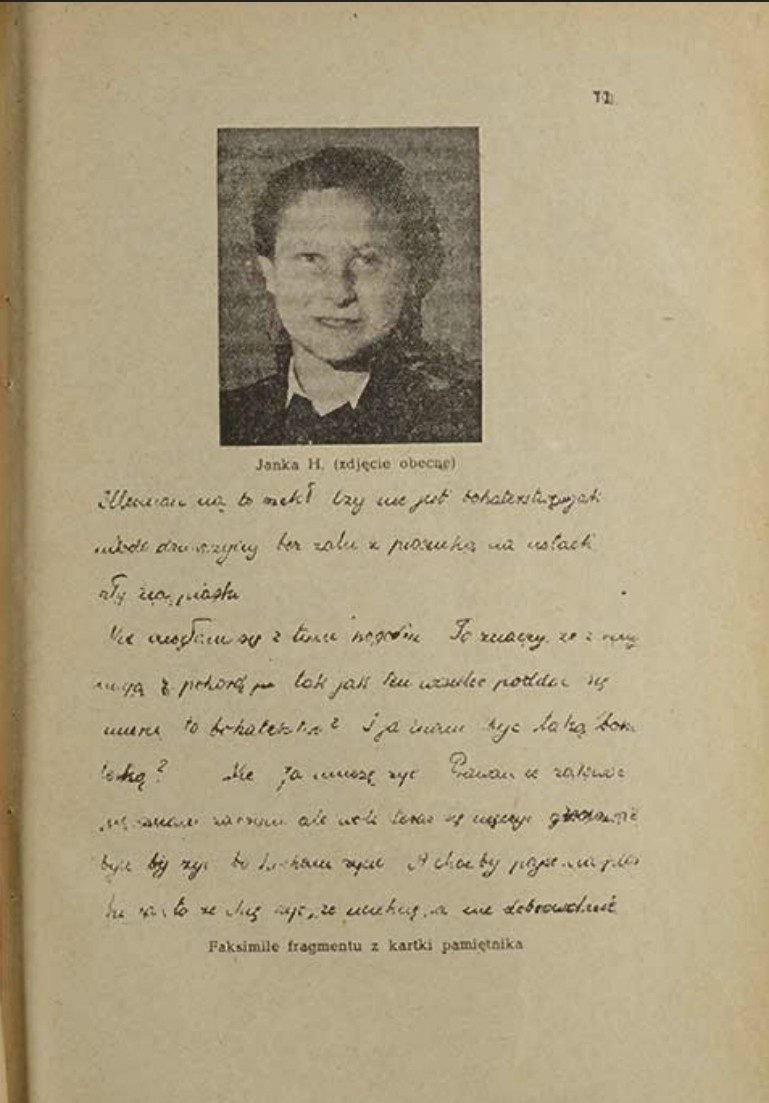
This is the handwriting of a thirteen-year-old: uneven, slanting, written in pencil, without punctuation where the thought runs too fast. And the content of that page is one of the hardest passages of the whole book. The girl wonders whether it is heroism that a young girl goes to her death without regret, with a song on her lips. And she answers herself that it is not — for that would mean one must submit to death with humility. She asks whether she is to be such a heroine. And she answers herself: no — that she must live, that she would rather suffer hunger now, so long as she lives, because I love life. And even if she did something that is wrong — it is better that she escapes than that she should go voluntarily.
The notebook with her poems has survived as well — the same letters, the same slanting lines, written in the camp and in hiding.
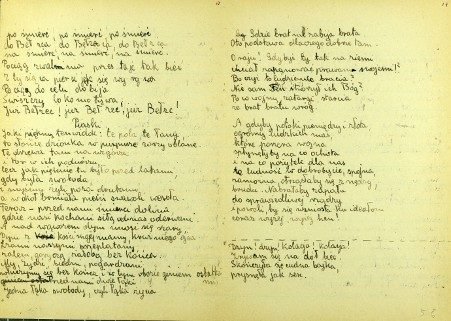
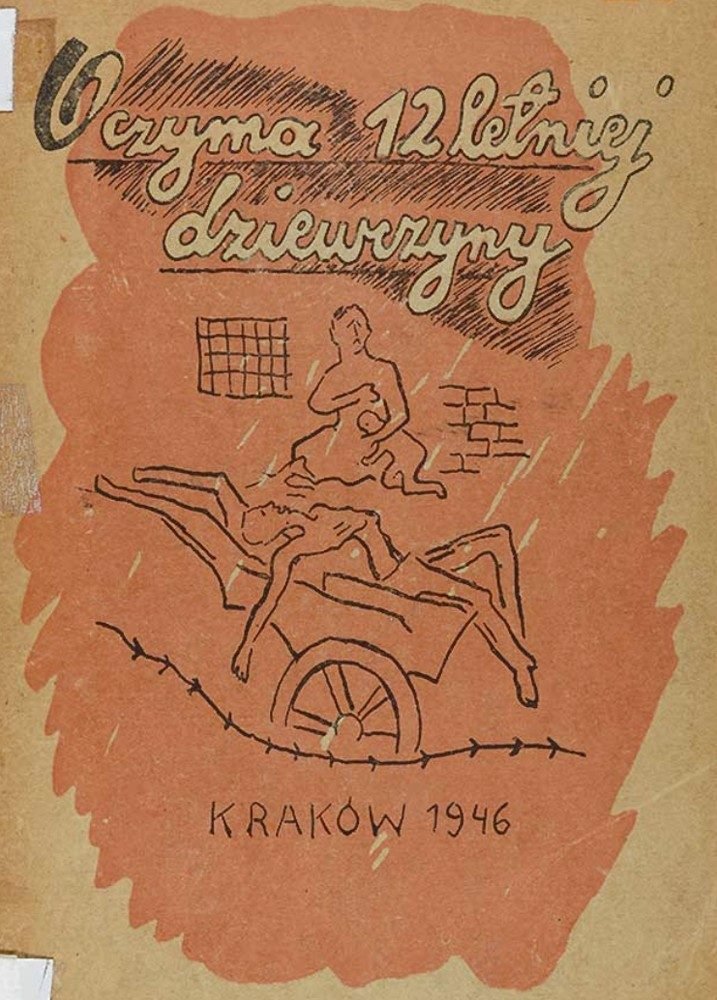
The notes were later published in Hebrew, French, Catalan and English. Doctor Kurzrok returns in them again and again — and it is mainly thanks to that girl, today Janina Altman, living in Haifa, that we know anything about him beyond the date of birth and the entry in the register of victims.
Of the Kurzroks not a single photograph remains. There is no grave, no name on any cemetery. What remains: an entry in the birth book in Skole, an entry in the marriage book, an entry in the birth book in Kozowa, an enrolment card of the Lwów university with a signature in his own hand, seven texts in the press and one treatise, a talk on Polish Radio, two practice announcements, four lines in the telephone books of Warsaw and Lwów, one line in the telephone book of Chodorów, one hundred and seventeen names on a hospital list — with his under number one — half a page in Philip Friedman and a dozen or so sentences written down by a child.
And there remains the house at 7 Złota Street — the home where he lived among the first residents and from which he left for the last season of his life. Passing this gateway, it is worth remembering that here lived a physician who founded three hospitals in a city condemned to annihilation, convened a scientific conference in a ghetto, negotiated with the Germans the protection of hundreds of people, smuggled medicines into a concentration camp, led people out of the „actions", hid the older staff in a cellar and got false papers for the younger — and in doing so saved neither himself nor anyone of his own family.
Timeline
| Date | Event |
|---|---|
| Nov 1903 | Marriage of Szaja (Ozjasz) Kurzrock of Kozowa and Chawa (Ewa) Adlersberg of Synowódzko Wyżne, Skole registration district. |
| 7 Jun 1905 | Birth of Maksymilian in Synowódzko Wyżne, Stryj district. |
| Jun 1909 | Birth of his brother Artur in Kozowa. |
| before 1924 | Studies at the Faculté des Sciences in Toulouse. |
| 1924/25 | Enrolment at the Medical Faculty of the Jan Kazimierz University in Lwów, student book 6840. |
| 1928 | Vice-president of the Executive Committee of the Jewish student associations of the university. |
| May 1929 | The article „Photography and Experience" in „Medycyna i Przyroda" no. V; byline „Physician M. Kurzrok (Warsaw — Truskawiec)". |
| 1932 | Review in the „Miesięcznik Żydowski". |
| 22 Nov 1933 | Warsaw: the organising committee of the Pro-Palestine Committee of the Young and the Bureau of Polish-Jewish studies, at the initiative of „Myśl Mocarstwowa"; among the members Jerzy Giedroyc and Mieczysław Pruszyński. |
| 1934 | The treatise „Therapeutics in Truskawiec and at Pomiarki…". |
| n.d. | The articles „A Storm in a Teacup" (no. 2–3, p. 18) and „The Blind Track of Academic Self-Help" (no. 1/121, p. 3) in the „Trybuna Akademicka". |
| Oct–Nov 1934 | The article „Maturzyści" in the „Trybuna Akademicka" no. 119–120. |
| 30 May 1936 | The „Jednodniówka Truskawiecka" — editorial committee and responsible editor; two texts of his own. |
| 1937 | Publications in the „Głos Położnej" and a mention in „Wschód"; the Warsaw address. |
| May 1938 | Seasonal announcement in „Medycyna i Przyroda" no. 5: practises from the beginning of May to the end of September, villa „Słońce", tel. 8. |
| 1 Jan 1938 | Practice announcement (Truskawiec, villa „Słońce") in the Warsaw „Nowy Głos". |
| 1932 | Medical diploma (per the Medical Yearbook: „1905, 1932"). |
| 5 Sep 1937 | Talk on the „Barbara" spring on Polish Radio in Lwów; printed in the „Polska Gazeta Lekarska" no. 36 and as an offprint. |
| 1938 | Medical Yearbook of the Republic: „Kurzrok Maksymilian (1905, 1932) gen., 1 Hipoteczna St., tel. 3-86-76 (in summer Truskawiec)". |
| 1939 | Warsaw telephone subscriber directory: „3 22 10 Kurzrok Maksymilian, dr, physician, Złota 7". |
| 1939 | Report from the Military Sanatorium in Otwock. His brother Artur — a clerk of the Municipal Board in Chodorów. |
| 1939–1941 | Lwów under Soviet occupation. |
| 30 Jun 1941 | The Germans enter Lwów; in the first days Henryk Hescheles perishes. |
| 2nd half of 1941 | He organises hospitals on Alembeków Street, then at 5 Kusiewicza and on Zamarstynowska. Director of the Jewish General Hospital. |
| Oct 1941 | The ghetto proclaimed in Zamarstynów and Kleparów; resettlement 16 XI – 15 XII through the control point on Pełtewna („the bridge of death"). |
| 1 Nov 1941 | The board „Zwangsarbeitslager" above the gate of the camp on Janowska Street. |
| Mar 1942 | The first deportations from Lwów to Bełżec; the action ends 1 IV 1942 — over 15,000 victims. |
| 26 Jun 1942 | Action of the flying SS liquidation brigade; 6,000–8,000 people shot at the Piaski. |
| 10–23 Aug 1942 | The „great action": 50,000–60,000 people deported to Bełżec. On 9 VIII Kurzrok moves his father, his cousin and the Labiner family to the camp hospital. |
| 20 Aug 1942 | Execution of the patients and staff of the emptied hospitals and orphanages of the ghetto. |
| 7 Sep 1942 | Katzmann's decree on the hermetic closure of the ghetto; the death penalty for leaving it. |
| 4–5 Sep 1942 | The destruction of the Jews of Chodorów — the town of his brother Artur. |
| 21 Sep 1942 | Deportation of the Jews of Kozowa to Bełżec. |
| Oct 1942 | The hospital staff list „Krankenhaus, Oktober, Gruppe «U»" — 117 names, Kurzrok under no. 1; under no. 77 Kurzrok Emma. |
| 4 Dec 1942 | The SS takes Fleck and his team with their families to the „Laokoon" factory. |
| end Sep 1942 | Head of the hospital block in the Janowska camp; smuggles medicines between the ghetto and the camp. |
| Dec 1942 | Deportation of the Jews of Skole and the district to Stryj. |
| Jan–Feb 1943 | The ghetto transformed into the Julag; SS-Hauptsturmführer Josef Grzymek commandant. |
| 1 Jun 1943 | Start of the final liquidation of the Lwów ghetto; resistance, flamethrowers, c. 20,000 victims. |
| Jun 1943 | Death of Maksymilian Kurzrok. Collective suicide of the older hospital staff in the bunker. |
| 5–7 / 12 Jun 1943 | Liquidation of the ghettos in Stryj and in Kozowa. |
| Nov 1943 | The destruction of the remaining Jewish prisoners of the Janowska camp (19 or 23 November). |
| 1946 | First edition of Janina Hescheles's notes: „Through the Eyes of a Twelve-Year-Old Girl", Kraków. |
A Note on Sources
The account rests on sources: the civil-status books of the Skole district (the entry of Maksymilian's birth of 1905 and the entry of his parents' marriage of 1903) and the birth book of Kozowa (Artur's entry of 1909), project collection; the enrolment card of the student of the Jan Kazimierz University in Lwów (State Archive of the Lviv Oblast, f. 26, op. 15, spr. 885, fol. 327 and 327v); the article „Photography and Experience" in „Medycyna i Przyroda" no. V of May 1929 (copy with shelfmark V-10121); the „Miesięcznik Żydowski" year 2, fasc. 9/10, of September–October 1932, p. 368; the practice announcements in Truskawiec (villa „Słońce", Rajmund Jarosz Street, tel. 8); M. Kurzrok's treatise „Therapeutics in Truskawiec and at Pomiarki in the light of clinical-experimental research" (Lwów 1934, collections of the National Library / Polona); the „Jednodniówka Truskawiecka" of 30 May 1936; the „Głos Położnej" no. 6(7) of 20 June 1937; „Wschód" no. 53 of 10 July 1937; the index of the „Polska Gazeta Lekarska" for 1937; the Medical Yearbook of the Republic of Poland of 1938; the subscriber directory of the telephone networks of the Republic of Poland of 1939; the articles in the „Trybuna Akademicka": „Maturzyści" (no. 119–120, X–XI 1934), „A Storm in a Teacup" (no. 2–3, p. 18) and „The Blind Track of Academic Self-Help" (no. 1/121, p. 3); the note „Palestine committees of the young in the university cities" in the „Express Poranny" of 24 November 1933; the offprint „Barbara of Truskawiec — a new Polish bitter spring" from the „Polska Gazeta Lekarska" no. 36 of 5 September 1937 (National Library, shelfmark II.653.109); the Medical Yearbook of the Republic of Poland (sections „Warsaw" and „Truskawiec, Drohobycz district"); the subscriber directory of the telephone network of the capital city of Warsaw of 1939 and the Lwów subscriber directory; the report from the Military Sanatorium in Otwock (1939); the practice announcement at the villa „Słońce" in the „Nowy Głos" of 1 January 1938; the study of the Military Sanatorium in Otwock („Informator Kulturalny" no. 11, 2024).
The description of the Lwów pogroms from the Ringelblum Archive, vol. 3, Accounts from the Borderlands, transl. Sara Arm et al., edited by Andrzej Żbikowski, Jewish Historical Institute IN-B, Warsaw 2000, p. XXII.
The description of the Lwów ghetto and the Janowska camp rests on the volume „Michał Maksymilian Borwicz, Uniwersytet zbirów. Rzecz o obozie janowskim we Lwowie 1941–1944" (Wysoki Zamek, Kraków 2013) — on Borwicz's own memoirs and on the historical study contained in that edition, drawing on the works of Jakub Honigsman („Zagłada Żydów lwowskich 1941–1944" and „Янівське пекло"), Eliyahu Jones, Filip Friedman and Tatiana Berenstein, as well as on the report of SS-Gruppenführer Fritz Katzmann „The Solution of the Jewish Question in the District of Galicia" (publ. IPN, ed. A. Żbikowski, Warsaw 2001).
The wartime part of the account rests moreover on the notes and epilogue of Janina Hescheles-Altman (the French edition „Les cahiers de Janina", Classiques Garnier 2017, and the Catalan edition), on the memoirs of Tadeusz Kielanowski cited in J. Halasz's study „A physician in the face of war and national tensions", on the memoirs and studies gathered in Michał M. Borwicz's volume „Uniwersytet zbirów" (including the findings of F. Friedman, E. Jones and J. Honigsman and the report of Gen. F. Katzmann), on the literature on the Janowska camp (D. Pohl, T. Sandkühler, „Encyclopedia of Camps and Ghettos"), on Philip Friedman's book „Zagłada Żydów lwowskich" (Łódź 1945, p. 30) and on the Yad Vashem Pages of Testimony (Item 9030082 and 9432567). The facsimile of the diary page and the author's photograph come from the first edition of Janina Hescheles's notes („Oczyma 12-letniej dziewczyny", Voivodeship Jewish Historical Commission, Kraków 1946).
The thread of the vaccine, the conference of 31 January 1942 and Kurzrok's role in the negotiations with the „Laokoon" factory rests on the book by Anna Wacławik and Maria Ciesielska „Fleck. Ocalony przez naukę" (Agora 2025) and on the documents cited there: the communiqués of the Lwów Judenrat, the „Gazeta Żydowska" of 27 May 1942 and the post-war memoirs of Ludwik Fleck. The hospital staff list („Krankenhaus, Oktober, Gruppe «U»") comes from the project's collection.
The data on the destruction of the Jewish communities of Skole, Kozowa, Chodorów and Stryj come from the database „Operation «Reinhardt» — in the circle of the Holocaust" of the Grodzka Gate — NN Theatre Centre, compiled on the basis of „The Yad Vashem Encyclopedia of the Ghettos During the Holocaust" and „The United States Holocaust Memorial Museum Encyclopedia of Camps and Ghettos, 1933–1945". The student background — K. Rędziński, „Towarzystwo Żydowskich Studentów Filozofii…"; the Truskawiec background — D. Zając, „Quart" 60. The entry on the change of name of Jonas Kurzrok to Jan Kulicz comes from a compilation of post-war announcements („Monitor Polski", 13 July 1946). The genealogical records of Geni and MyHeritage were used only as auxiliary material and always with reservation. The context of the Truskawiec spa (the journey, the springs, the guests, Jarosz's rebuilding from 1911, Pomiarki) — on the basis of the article by Kamil Janicki — a historian, editor-in-chief of the WielkaHISTORIA portal — „The spa in Truskawiec. The most famous resort of pre-war Poland" (WielkaHistoria.pl), based on the pre-war press („Łowiczanin", „Ilustrowana Republika" and others) and on „Kresowa Atlantyda" by Stanisław S. Nicieja, vol. 2.
Opracowanie w ramach projektu upamiętnienia mieszkańców kamienicy przy ul. Złotej 7 i 9 w Warszawie — prepared as part of the project commemorating the residents of the house at 7 and 9 Złota Street in Warsaw · www.zlota7-9.com