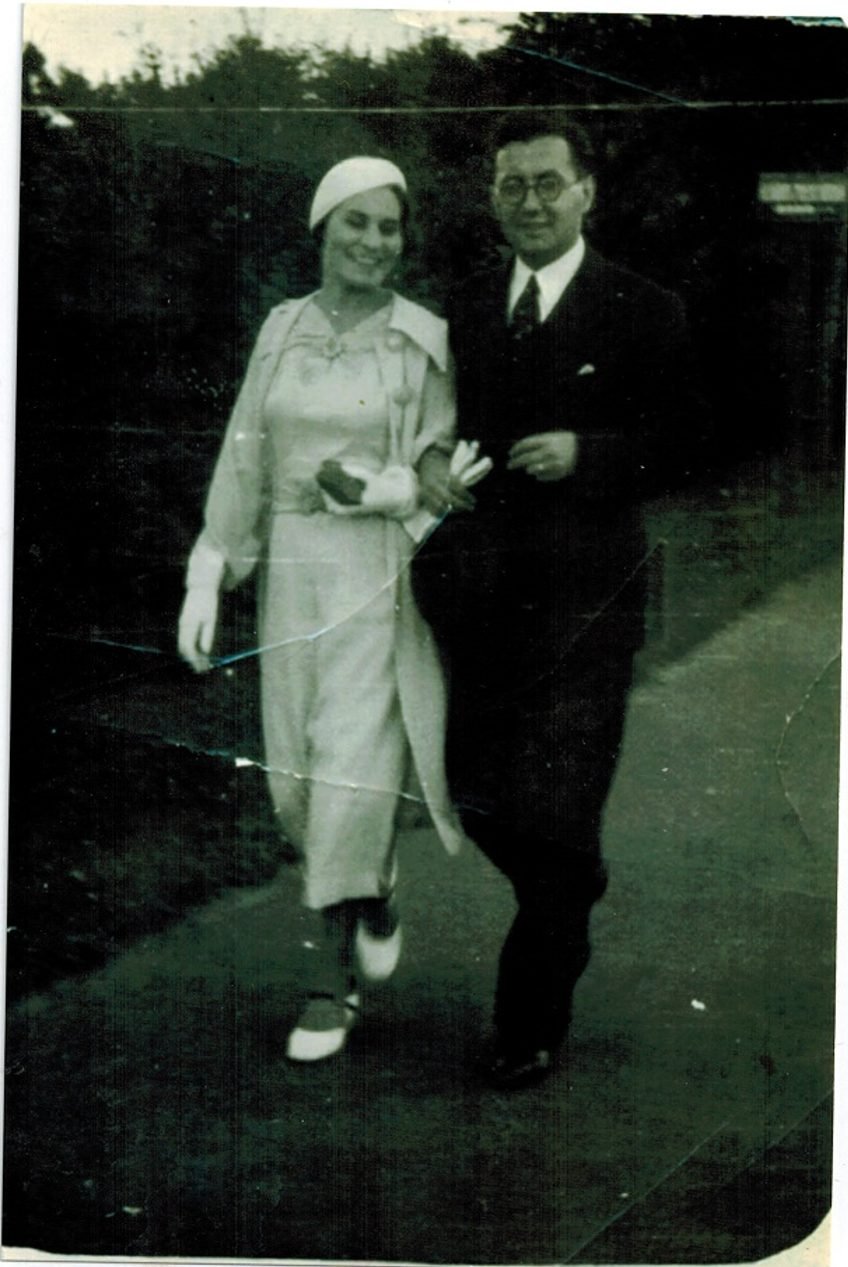
„There are few people in this world I would mourn as sincerely and as warmly."
They were a childless married couple. He — a mathematician and actuary, a man who professionally calculated the probability and length of human life. She — a woman of two names: Sari for Warsaw, Charlotte for the family across the ocean. They lived in the modern house that his firm, the Italian insurance company Assicurazioni Generali, had built for itself at 7 Złota Street. The war separated them in September 1939 and never let them meet again, though both tried to the end. They died apart: she in the camp at Trawniki, he in Pawiak — two kilometres from the house where they had been at home.
This account gathers everything that is known about them. Every fact comes from a source: from the registers of a Galician town, from a policy, from a postcard, from letters, from telephone directories, from pages of testimony. Where the sources are silent, it is silent too.
I. Nadwórna — roots
The story begins far from Warsaw — in Nadwórna, a Galician town at the foot of the Carpathians, then in the Austro-Hungarian monarchy, today in Ukraine. Jews made up a considerable part of its population; in the vital records of the Nadwórna district, kept today in the Central Archives of Historical Records in Warsaw, are recorded the births, marriages and deaths of several generations of the two families whose threads meet in this story: the Jacobs and the Jekels.
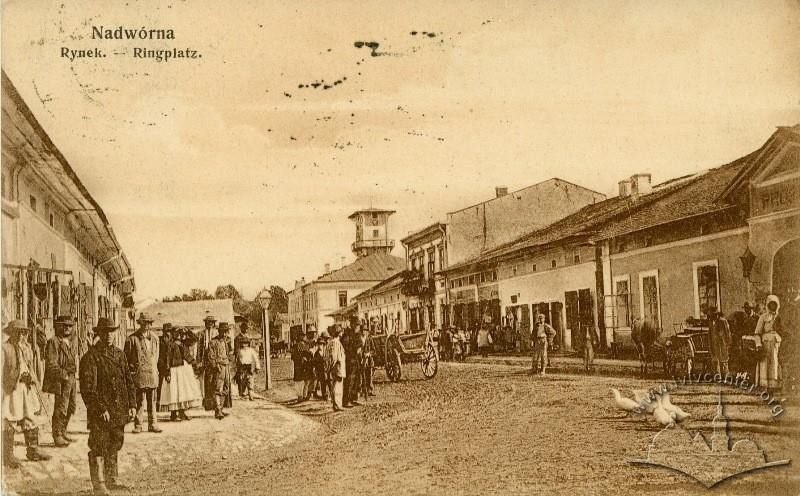
In the second half of the nineteenth century, Juda Jekel lived in Nadwórna with his wife Rechel née Wolfram, daughter of Nuta Schmiel and Gittel Wolfram. The registers note their children: Hersch (1867), Josef Osias (born 12 March 1869, later a merchant), Dawid Chaim (1875), Ettel (1877) and Chaje (1879); the family history written down by Aron in 1978 mentions one more brother — Mandel, whose birth record has not yet been found in the books. Rechel Jekel died in Nadwórna in the spring of 1907, aged sixty-three.
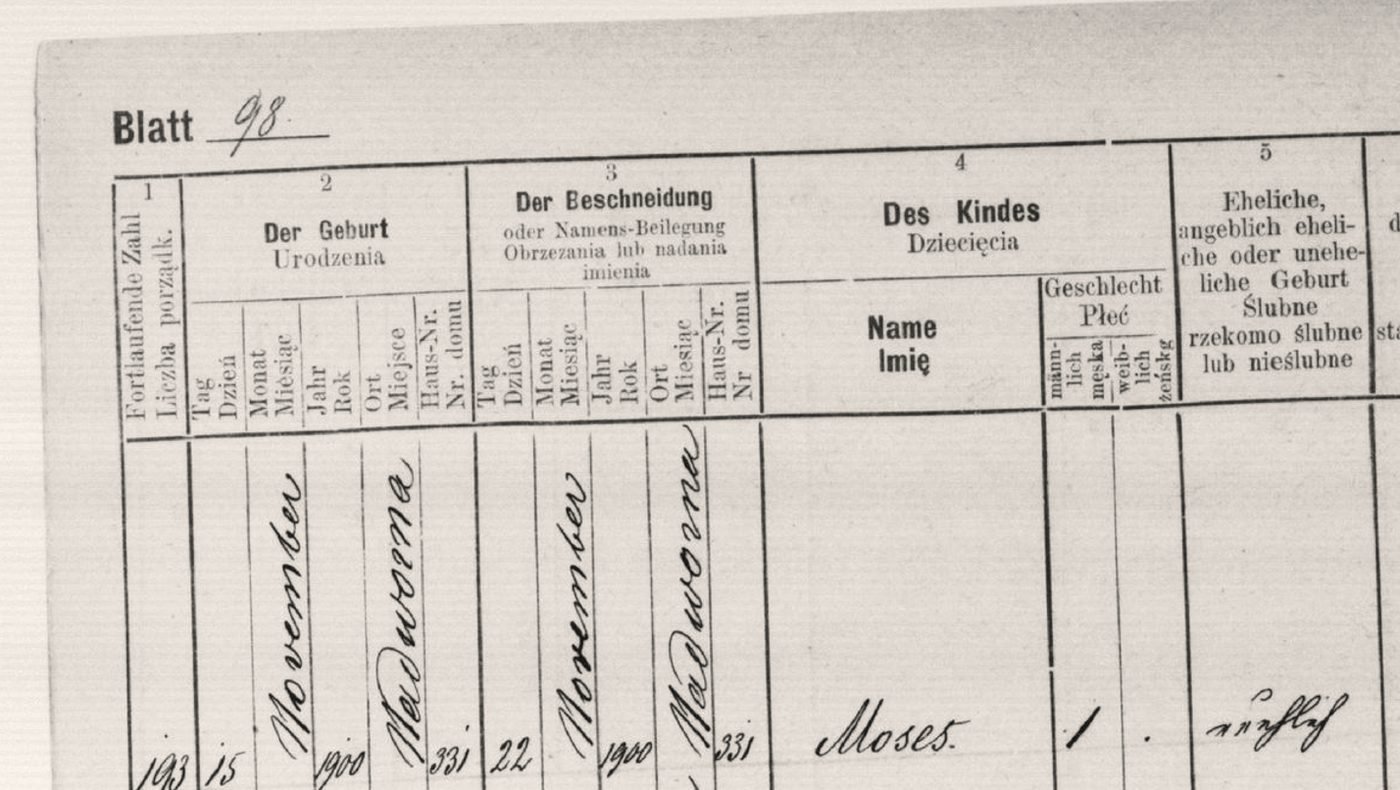
Ettel Jekel married Hersch Jacob. The eldest of their five children was the subject of this story: Mosze Jacob, born on 15 November 1900 in Nadwórna. After him came Aron (10 February 1905), Nathan — who died in early childhood, most likely before the age of three — Albert (Abraham), born on 14 March 1908, and the youngest sister Rachela, born on 23 May 1910 — known in the family as Recha; their birth records, with the names of both parents, have survived in the Nadwórna registers. The family lived there until the outbreak of the Great War.
In the summer of 1914 the Great War reached Nadwórna: the town lay right by the Russian front, and Cossack raids drove thousands of Galician Jews from their homes. The Jacobs fled too. Aron, writing down the family history in 1978, put it in a single sentence: „Together we escaped to Vienna, where we lived in a three-room apartment." Mosze was fourteen at the time, Aron nine. Like tens of thousands of refugee families from Galicia, the Jacobs put down roots in the imperial capital: Albert's Viennese Heimatschein survives — entered in the municipal register in 1928, and in 1931 still a student in Vienna. It was as a wartime refugee that Mosze first came to the city where one day he would defend his doctorate.
The wider family was not spared. Among the brothers and nephews of Mosze's mother — the Jekels of Nadwórna, whose paths Aron traced in his notes — the Holocaust took uncle Josef Osias, a textile merchant who had rebuilt his business in Nadwórna after the Great War („Hitler got him," Aron wrote); uncle Mandel; Mandel's son Joseph, a clerk in a Viennese department store; and cousin Zenek Balaban. Uncle David, deported by the Russians to Siberia during the Great War, died in Kraków on his way home. The survivors scattered across the world — from Israel and the United States to Montevideo and Hong Kong. Out of that whole branching tree, this account follows one couple.
The wider family fate did not spare. Of the brothers and nephews of Mosze's mother — the Jekels of Nadwórna, whose paths Aron traced in his notes — the Holocaust took uncle Josef Osias, a textile merchant who after the Great War rebuilt the business in Nadwórna („Hitler got him" — Aron wrote); uncle Mandel; Mandel's son Joseph, a clerk of a Viennese department store; and cousin Zenek Balaban. Uncle David, deported by the Russians to Siberia in the Great War, died in Kraków on the way home. The survivors scattered across the world — from Israel and the States to Montevideo and Hong Kong. From this whole branching tree, this account follows one couple.
II. Vienna — Trieste — Warsaw
As a teenager Mosze left for Palestine: he was drawn by Zionism, his generation's dream of a state of their own. After the Great War, however, he returned to Europe and chose mathematics. He studied in Vienna — the city the family had known since their wartime flight — and there in 1925 he defended his doctorate.
Those Viennese years have an address today. From a surviving Austrian registration card we know that until 1929 Jacob lived at Wolfgang-Schmälzl-Gasse 10 in the second district — Leopoldstadt, the heart of Jewish Vienna. He moved out of Vienna in 1929 — the same year in which he took out a life insurance policy in Trieste. He was still a bachelor then; marriage would come six years later.
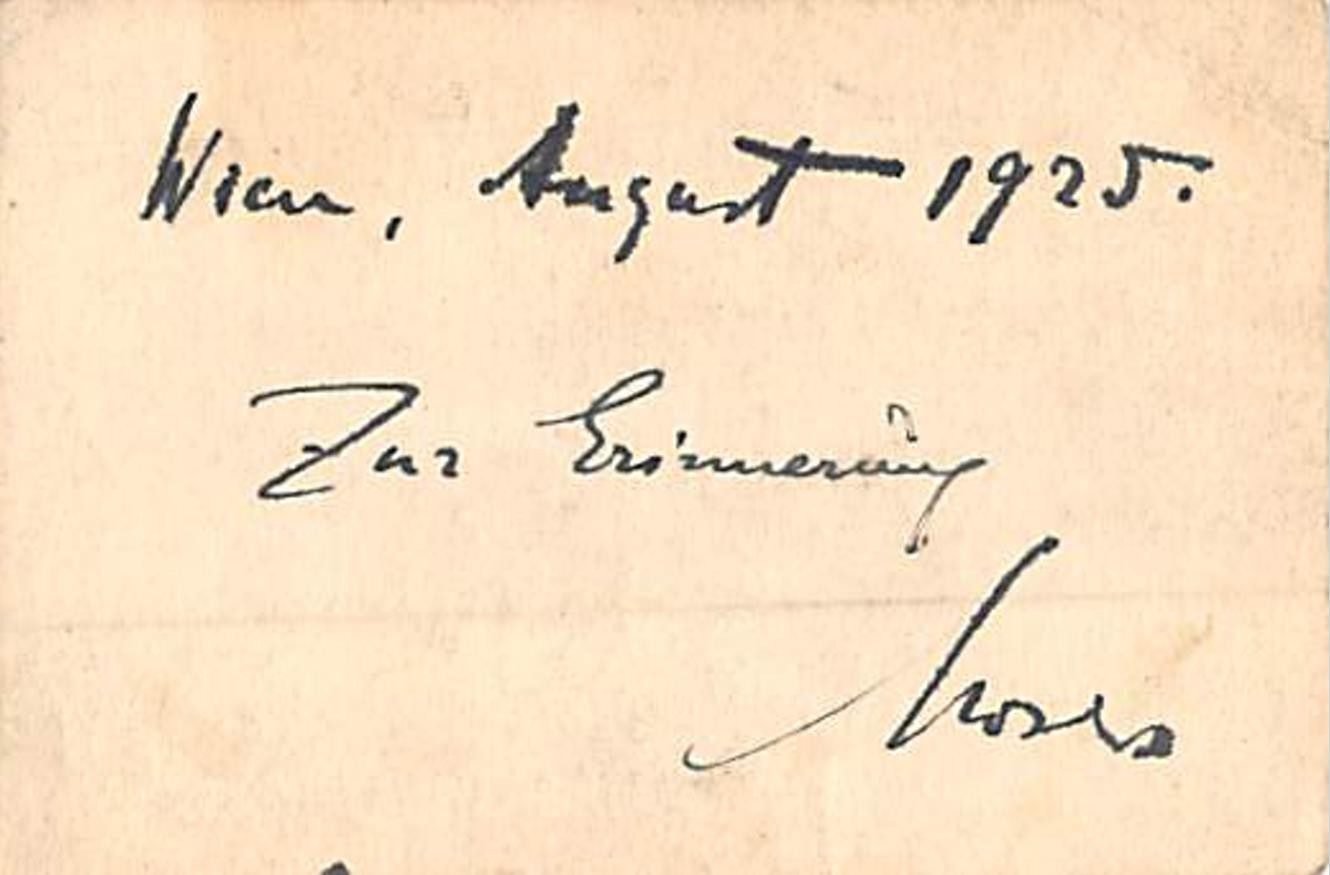
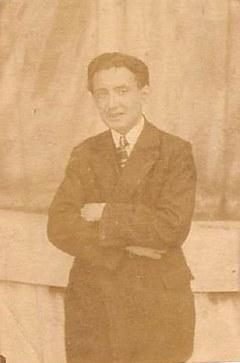
Pure mathematics could not feed a man in those days — insurance could. Jacob became an actuary of Assicurazioni Generali, one of the largest insurance companies in Europe: first at the head office in Trieste, then in Warsaw. He did not abandon scholarship: he was a member of the Polish Mathematical Society and the Polish Union of Actuaries, and took part in the Congresses of Polish Mathematicians in Lwów (1927) and Wilno (1931) — on the lists of participants he appears as „Mojżesz Jacob of Vienna." Through his shared field of research — probability theory and statistics — he is counted among the circle of the Lwów school of mathematics, one of the most brilliant scholarly communities of interwar Europe.
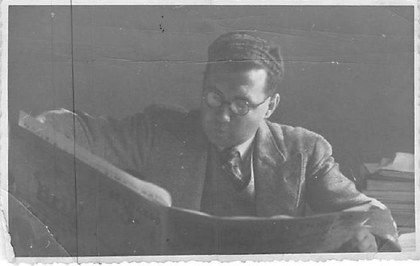
On 1 May 1929 he took out an endowment policy in Trieste: 25,000 złoty in gold, payable no later than 1 May 1959. A man who calculated risk for a living insured his own life thirty years in advance. When he renewed the policy in Trieste in 1936, by then a married man, he named his wife as beneficiary. The renewal documents record her in words that ninety years later proved priceless: „His wife Sari née Epstein Jacob."
III. The house at 7 Złota Street
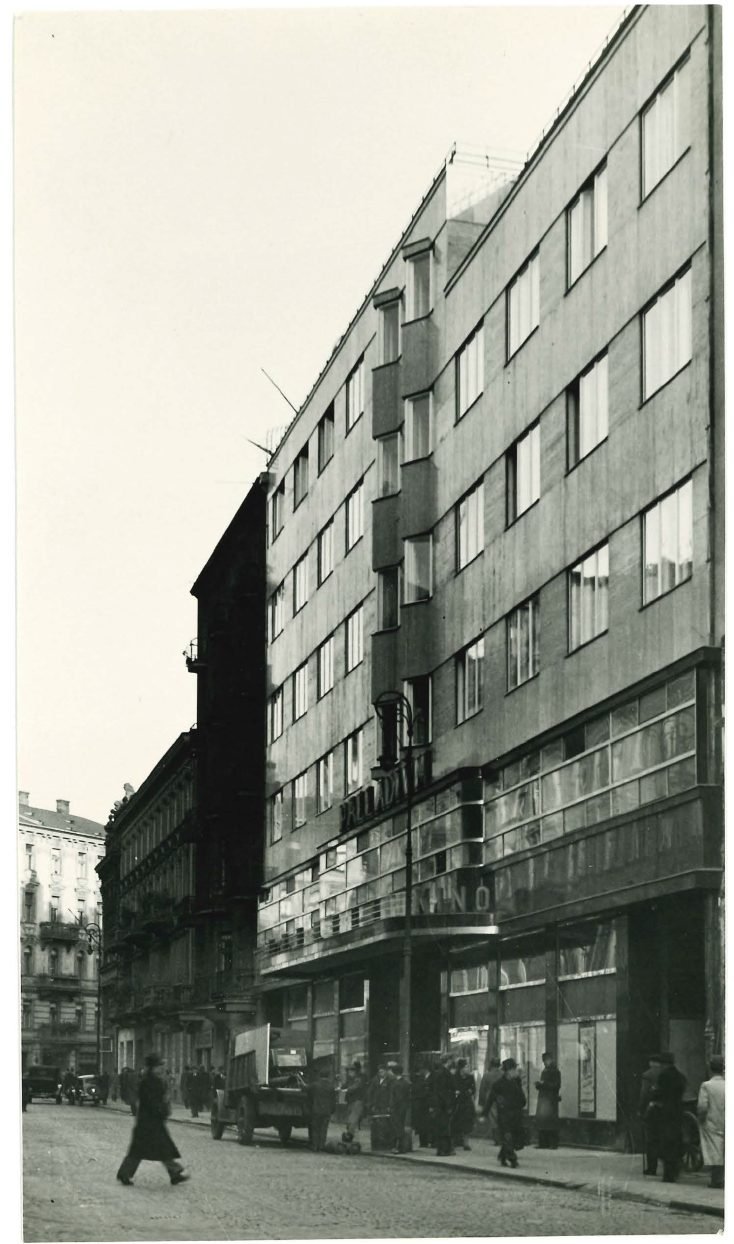
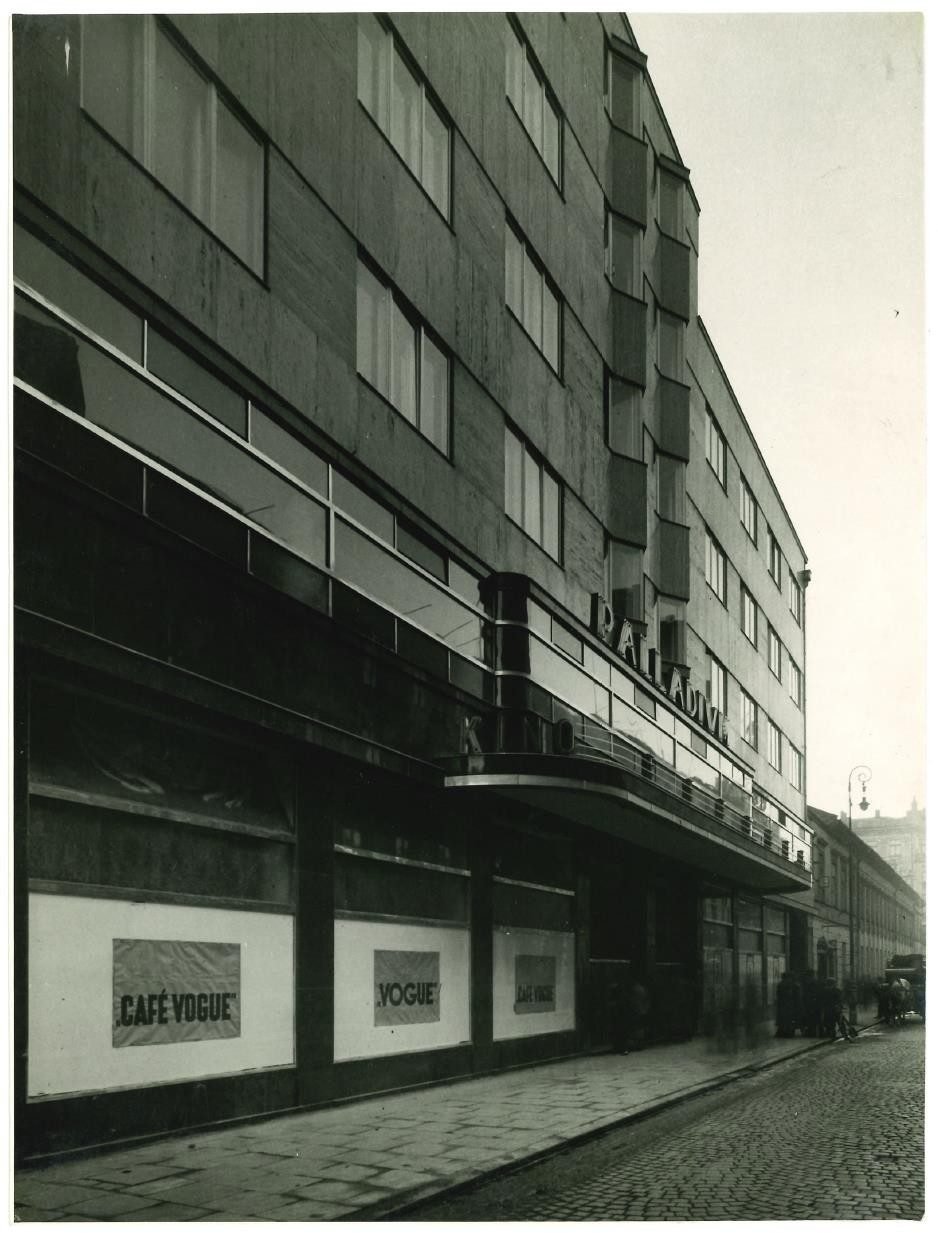
Between 1935 and 1937 Assicurazioni Generali erected a modern building at 7 Złota Street in Warsaw, designed by Edward Eber — with the Palladium cinema below and apartments above, some of them occupied by the company's officials and specialists. Mosze Jacob, an actuary of Generali, came to live in Generali's Warsaw house: employer and landlord in one, the walls of his own firm over his head.
They moved to Warsaw from Trieste in the second half of 1936.
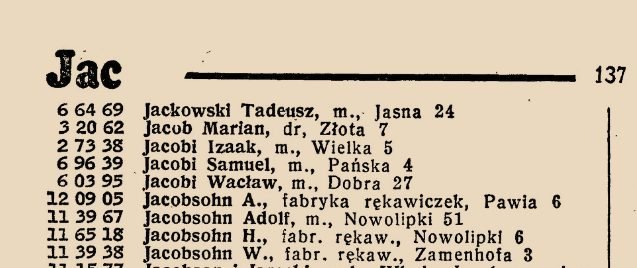
The trace of residence is prosaic and therefore beyond question: one line of print in the subscriber directory of the Warsaw telephone network. Under the number 3-20-62 stands the entry: „Jacob Marian, dr, Złota 7". It repeats in the following annuals — 1938/39 and in the last pre-war one, for 1939/40.
Earlier, in the directory for 1936/37, the Jacobs still figure at the address 7 Narbutta Street. „Marian" was the name Mosze used in Poland; under it he was known to the firm, the neighbours and the Warsaw telephone book. His family spoke of Mojżesz.
The Polish sources break off at the house number. The apartment number survived — paradoxically — in Austrian records: on a Viennese registration card from 1938, Doctor Jacob's permanent residence is given as „Warsaw, Złota 7, apt. 24." Behind that door lived Sari and Mosze.
IV. June 1938 — a journey through a darkening Europe
In March 1938 Germany incorporated Austria into the Reich. Within a few weeks Vienna became a place of open persecution: Jews were thrown out of their apartments and their jobs, humiliated in the streets; tens of thousands sought any road of escape.
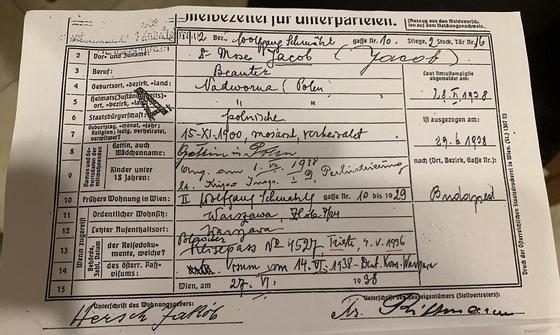
It was precisely then that Mosze Jacob went to Vienna. His police registration card has survived — a document that allows the journey to be reconstructed almost day by day. On 14 June 1938 he collected a visa at the German consulate in Warsaw. On 27 June he registered in Leopoldstadt, at 10 Wolfgang-Schmälzl-Gasse — at the address where he himself had lived until 1929. The card was signed, as the person providing lodging, by Hersch Jakob — his father. Mosze's parents were thus still living in Vienna then, three months after the Anschluss; from there, already as fugitives from the Reich, they later made their way to America — in 1941 they were living in Brooklyn.
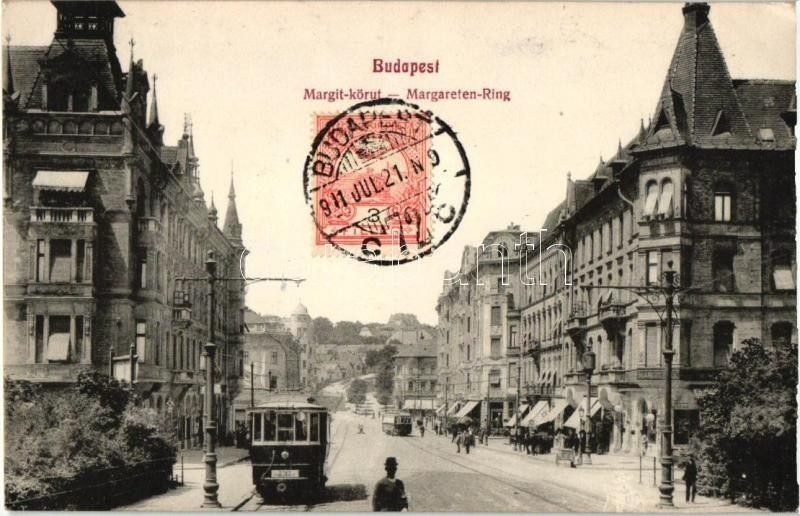
In the column marked „wife" the Viennese clerk noted three words: „Gattin in Polen" — wife in Poland. Sari had stayed in Warsaw. Two days later, on 29 June, Mosze deregistered; as the destination of his onward journey the card gives a single word: Budapest. There, on Margit körút, lived Sari's widowed mother — he was travelling to the city where he had married three years earlier, most likely to his wife's family.
A week after he left Vienna, at the beginning of July 1938, delegates of thirty-two states gathered at Évian on Lake Geneva to deliberate on the fate of Jewish refugees from the Reich — and almost all of them refused to take them in. In precisely that world, Mosze Jacob had everything one needed to escape: a passport, visas, a post in an international corporation, a brother in America, parents making their way to America. He went back to Warsaw, to Złota Street. Six years later, in the blackest night of the occupation, he would repeat that movement — returning to Warsaw from Lwów.
V. Sari
Of her life, through two years of searching, we knew only this much: the maiden name Epstein and the two first names she used — Sari for Warsaw, Charlotte for the family across the ocean. In the summer of 2026 the Hungarian civil records returned her whole identity. Her name was Epstein Sarolta Zsuzsánna — and the Hungarian Sarolta is precisely Charlotte, while Sári is its domestic diminutive: the two „names" turned out to be one. She was born in Nagyszeben — the Transylvanian Hermannstadt, today Sibiu in Romania — a German-speaking city of the Transylvanian Saxons; hence the impeccable German in which, years later, she would write from the ghetto to her parents-in-law. She was the daughter of Dr László Epstein and Ilona née Eisenstädter.
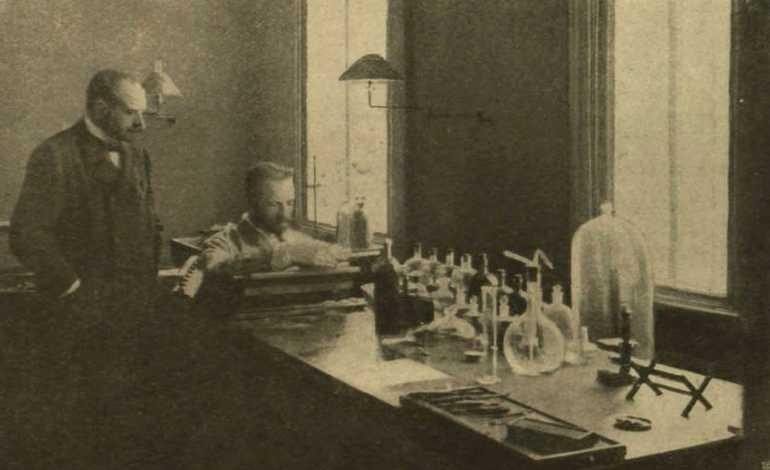
Her father was no ordinary „doctor." László Epstein (1865–1923), a native of Nagyszombat — today's Trnava — was a well-known Budapest psychiatrist and neurologist: he directed a succession of state psychiatric hospitals, among them the hospital in Nagyszeben — and it is from the time of that directorship that his daughter's Transylvanian birthplace comes — and then, until his death, the great psychiatric-neurological hospital in Angyalföld in Budapest; he was a university lecturer and the author of scholarly works, among them on the mental health of emigrants. He died in 1923, long before his daughter's wedding; he rests in the Jewish cemetery on Kozma utca in Budapest. Medicine was the very air of that household: Sari's brother Ottó also became a physician.
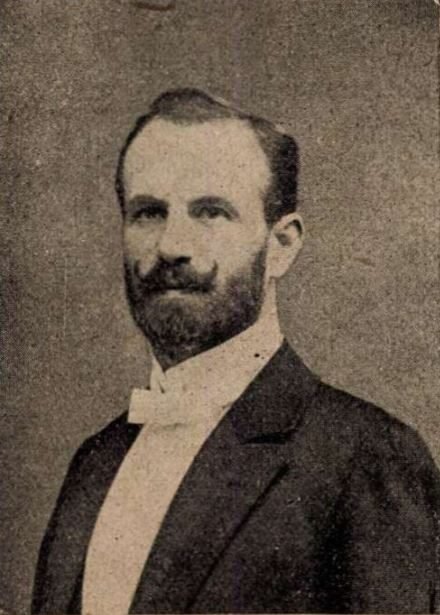
The family became bound to Budapest; Sarolta lived there at Margit körút 2. Her father died before her wedding — in the marriage record he already figures as „néhai", of blessed memory; her widowed mother remained at the same address and appears in the Budapest directories still at the beginning of the 1940s.
The Epstein line itself went no further: the elder brother Kornél died as a child, Sari died childless, and Ottó and his wife — buried in a shared grave at the Rákoskeresztúr cemetery, where their father also rests — left no known descendants. The memory of that family is carried today by the Jacobs alone — and by this account.
The wedding took place in Budapest on 2 September 1935. Marriage record number 394 has survived in the registers: the groom — „Dr Jacob Mózes, official of an insurance company", born 15 November 1900 in Nadwórna, a Polish citizen, resident in Trieste; the bride — Epstein Sarolta Zsuzsánna of Margit körút. Beneath the record they placed their own signatures: „Dr Jacob Mózes, husband" and „Epstein Sarolta, wife" — the second known autograph of Sari and the only one she signed with her maiden name. Soon after the wedding the young couple moved by way of Trieste to Warsaw, to Złota Street.
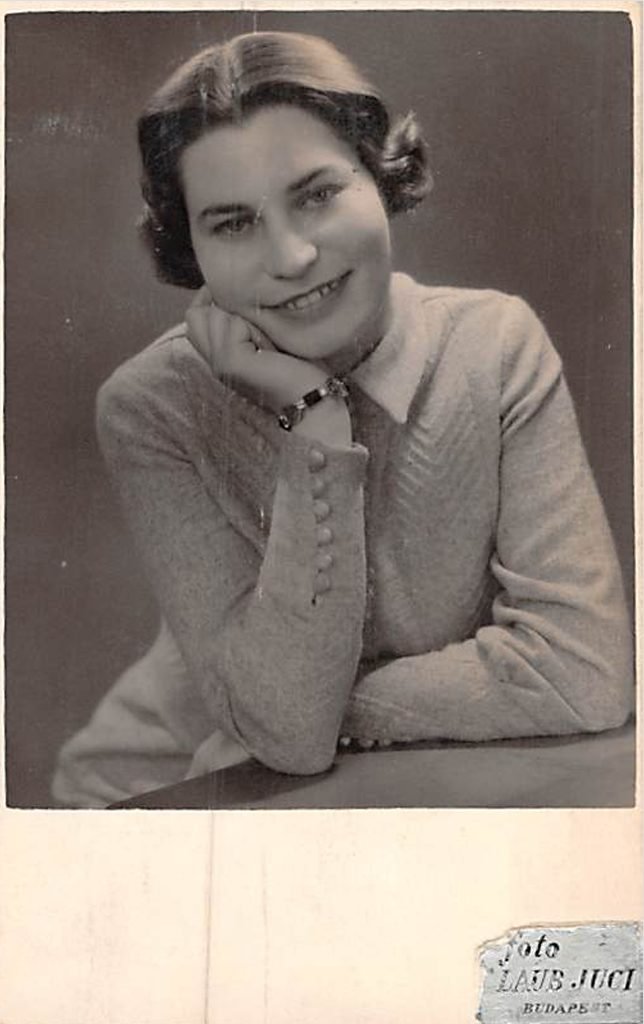
From Budapest comes her studio photograph: a young, smiling woman in a light suit — a picture from the city where she grew up and married.
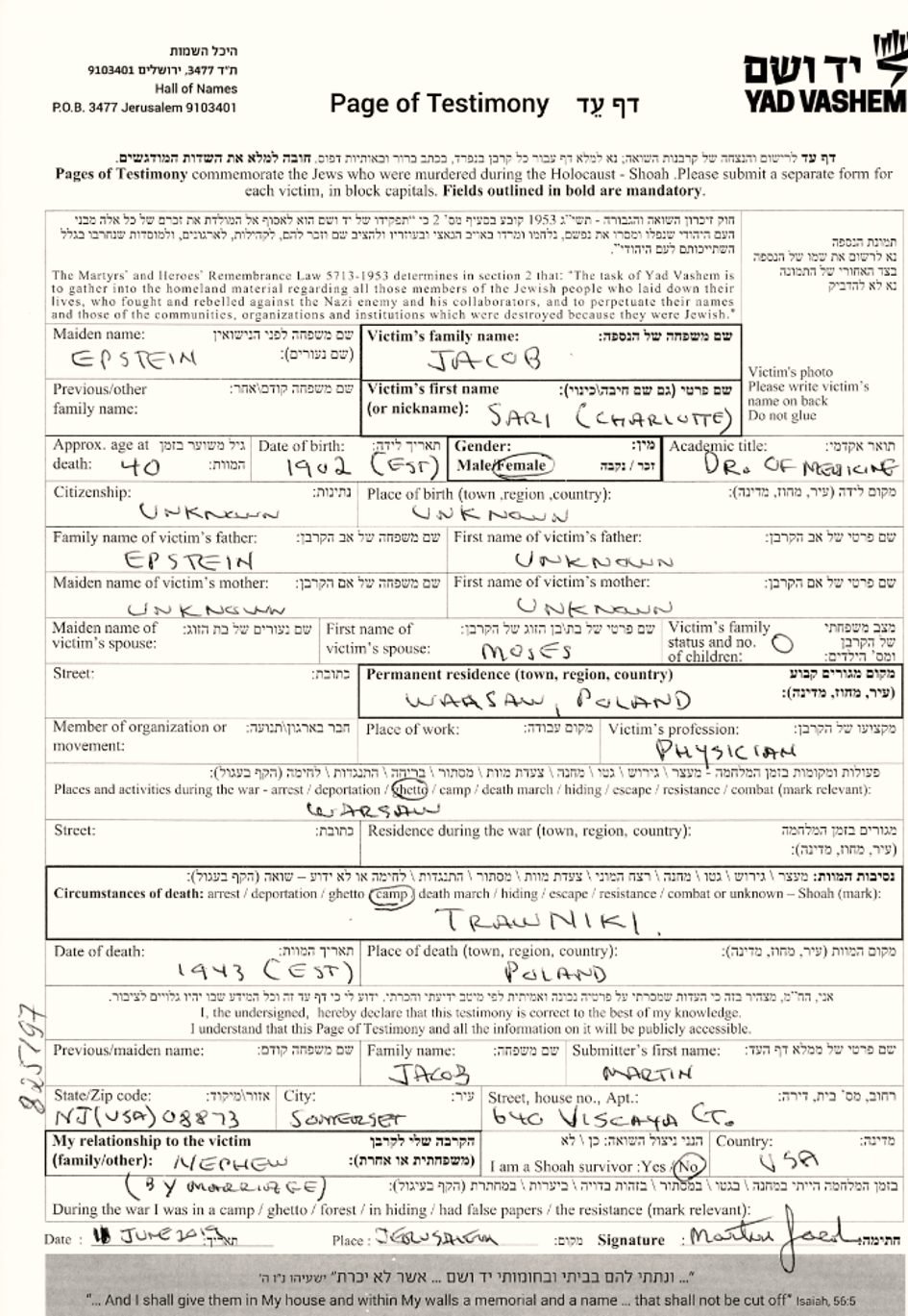
Of her profession one more source speaks — written down years later, but by the family. In June 2019, during a family visit to Yad Vashem in Jerusalem, Martin Jacob submitted a Page of Testimony for Sari as well, entering what had survived in the memory of the house: the title „Dr. of Medicine", profession — physician. A page written from memory after seventy years has the weight of testimony, not of a birth record — but it is the only known trace of her professional road, still awaiting confirmation in documents; the searches continue.
VI. September 1939
„Sari remained in Warsaw, where she lived through the bombardment of the city. She never saw her husband again."
On 1 September 1939 Germany attacked Poland; on 17 September the Red Army entered from the east. Generali evacuated part of its staff eastward — Mosze left with a group of colleagues from the firm and reached Lwów, which soon found itself under Soviet occupation. Sari stayed in bombarded Warsaw. It was the last time they were in the same city. From then on their fates run in two lines that will not cross again.
Everything we know of those years we owe to two witnesses and one postcard: to Alicja Jungowa — a colleague from the Generali office and Sari's friend, who in 1949 wrote down their story for Albert, Mosze's brother; to Truda Rosenberg — a survivor related by marriage to the Jekel family; and to the card Sari sent from the ghetto to Brooklyn.
VII. Mosze's Lwów
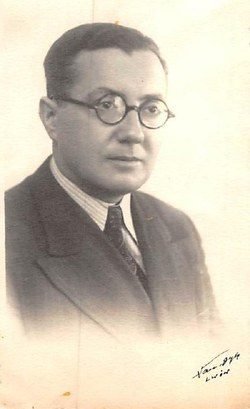
Under Soviet occupation Mosze fared — as Jungowa writes — „relatively well." He became a professor in the Chair of Probability Theory at the Faculty of Mathematics of the university in Lwów, renamed the Ivan Franko University; he taught classes and travelled to conferences. Stefan Banach and Hugo Steinhaus — great names of Lwów mathematics — worked in the same faculty at the time.
The Lwów of those two years was a city overcrowded and lined with fear. Before the war about a hundred and ten thousand Jews lived here — the third largest Jewish community in Poland; now came tens of thousands of refugees from beyond the German demarcation line, and the number grew to about a hundred and fifty thousand. The Soviet power took away the shops, the tenement houses and the practices, dissolved the communities, associations and parties, and by night deported the „uncertain element" — among those deported east were thousands of Jewish refugees. And yet it was an occupation without racial laws: rapacious and full of fear, but not murderous. That distinction was soon to prove an abyss.
Everything collapsed on 22 June 1941, when Germany struck the Soviet Union. They took Lwów in the last days of June — and the retreating NKVD left behind prisons full of the murdered. The Germans and the Ukrainian militia laid the blame for the Soviet crime on the Jews. In the first days of July they were herded into the courtyards of the Brygidki and the prison on Łąckiego Street, beaten and murdered before the eyes of the crowd; within a few days several thousand people perished. At the end of July a second wave rolled through — a three-day pogrom named the „Petliura days", with about two thousand victims. And on the night of 3 to 4 July the Germans shot on the Wuleckie Hills a group of professors of the Lwów universities together with their families; among the victims of this action was also the mathematician and former prime minister Kazimierz Bartel, murdered a few weeks later. The world in which Jacob had still been lecturing in the spring ceased to exist within a few days.
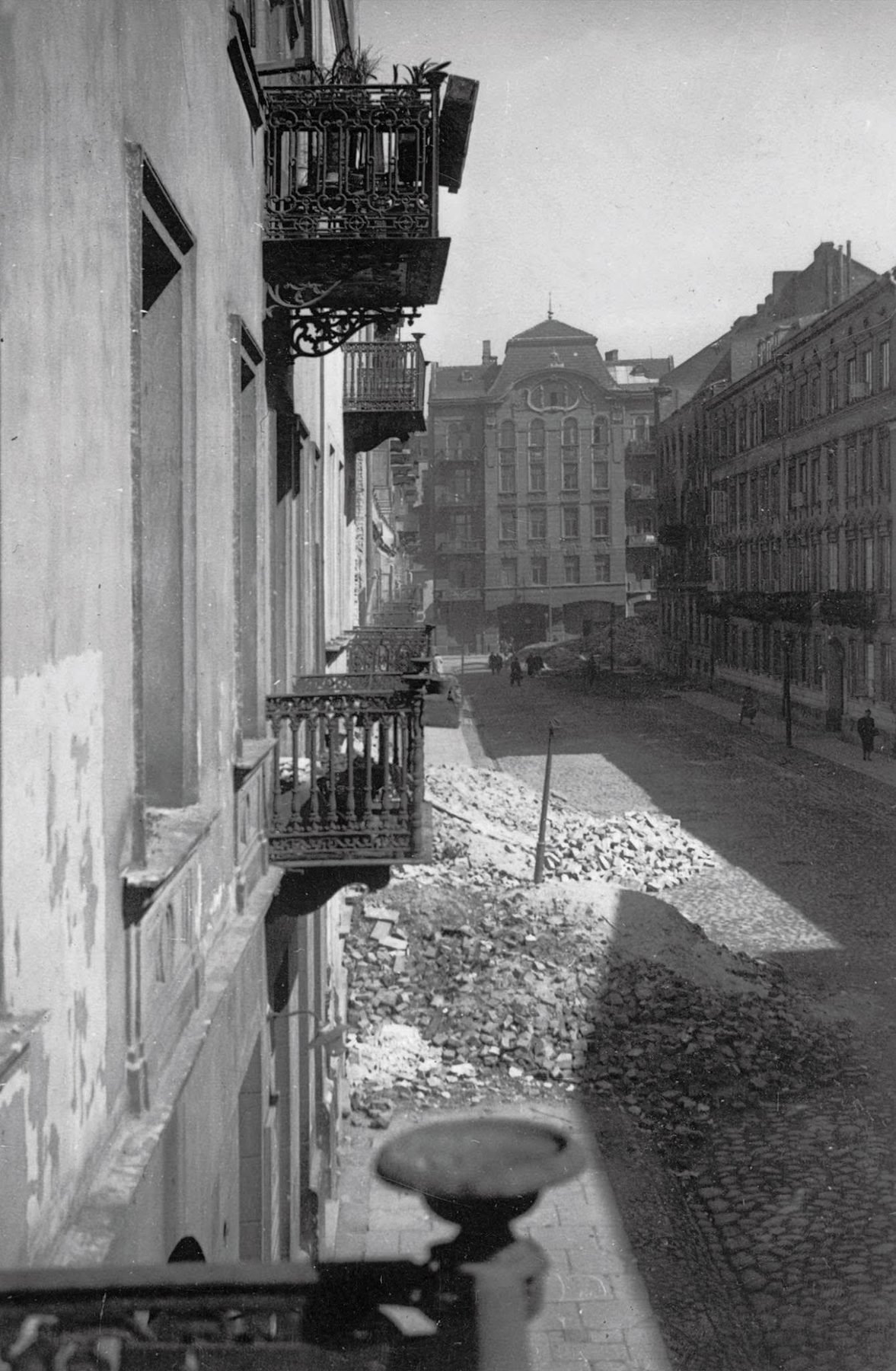
Then came the decrees: armbands with the Star of David, an enormous levy, expulsion from professions and apartments, forced labour, hostages. Streets along which one had walked to university lectures not long before became hunting ground.
In the autumn of 1941 the Germans closed the Jews of Lwów in a ghetto. For the „Jewish district" Zamarstynów was designated — the poorest part of the city, beyond the railway tracks. The resettlement led under the railway viaduct on Pełtewna Street, which the Jews of Lwów christened the „bridge of death": the German police picked out the old and the sick there, and during the move itself more than a thousand people were murdered. Beyond the viaduct more than a hundred thousand people were crammed — the Lwów ghetto was the third largest in occupied Poland, after Warsaw and Łódź.
The extermination came in stages. In March 1942 the first great „action" took some fifteen thousand people to the gas chambers of Bełżec; in August — several tens of thousands more. Alongside it operated the notorious camp on Janowska Street: slave labour and place of execution at once. At the beginning of 1943 the shrunken ghetto was renamed „Julag" — a camp in which only a work stamp still granted the right to live. The final liquidation came in the first days of June 1943: houses were set on fire and blown up, thousands of people were murdered on the spot, the rest deported to Janowska and to death. Of the Jews of Lwów, between a few hundred and a few thousand — estimates vary — lived to see the liberation.
In that world Jacob tried to save himself by the means by which thousands tried: work. In the ghetto he drew up lists of Jews fit for labour and was employed by the Todt Organisation. Then he escaped from the ghetto and hid in Lwów until February 1944 — on the „Aryan" side of a city where hiding a Jew was punishable by death — and outlived the ghetto, which had ceased to exist half a year before his return to Warsaw. Throughout that time he was not alone: every month money and letters reached him, sent from Warsaw by Alicja Jungowa through a Ukrainian courier. The money came from the sale of belongings that Sari had prudently distributed around Warsaw. Husband and wife, separated by the walls of two ghettos, were kept alive from a single source, by the same hands.
From this period come the only surviving words of Mosze's own. When Truda Rosenberg's mother was deported, he wrote to her from Lwów a sentence she remembered all her life:
„Your Mother has gone the way of sacrifice, and a terrible emptiness has remained."
VIII. Sari — Warsaw, the ghetto
In Warsaw meanwhile the noose was tightening. In November 1940 the Germans closed the walls of the ghetto, cramming behind them about four hundred thousand people on a few per cent of the city's area. Sari lived at first on the so-called Aryan side. Friends proposed various ways out: hiding, settling elsewhere, finally — with a colleague from Generali who had seen Mosze in Lwów — making her way to her husband. She refused; Jungowa writes that her fear of a life in hiding was too great. Against all persuasion she entered the ghetto herself, voluntarily. She settled at 7 Śliska Street, apt. 33, within the bounds of the so-called small ghetto.
From there comes the most moving document of this history. On 24 August 1941 Sari wrote a postcard to her parents-in-law — Hersch and Ettel Jacob, who had managed to emigrate and lived on Union Street in Brooklyn. The card, with the stamp of the Judenrat and the seal of the German censorship, travelled via Lisbon across the ocean — and has survived with the family to this day:
„My Dear Ones, I have just received a letter from Mosze. He is, thank God, well — and that is the most important thing; only I have not a moment's peace now, because I absolutely must be with him, and that does not go as easily as one might think. Let us hope that the dear God will help us this time too, as He has helped so many times already. […] Let us hope, then, that soon I shall be writing to you from Lwów. Most affectionately, your Sári."
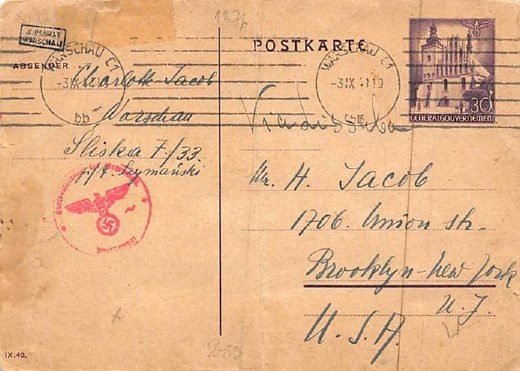
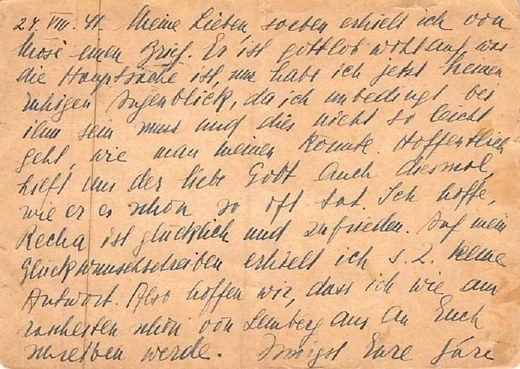
This card says things found in no other source: that in August 1941 letters between Mosze and Sari were still passing through the walls of two ghettos; that Sari did not intend to wait — she wanted to go to her husband and believed her next letter would be sent from Lwów. She never sent it. In the card she also asked after „Recha" — Mosze's youngest sister, Rachela; her good wishes went unanswered at the time.
In the summer of 1942 came the Great Deportation: from 22 July to mid-September the Germans deported from the Warsaw ghetto about three hundred thousand people, the vast majority to the gas chambers of Treblinka. Sari survived the action. Jungowa visited her in the ghetto five times; then contact was kept by her husband, who worked in a factory within the ghetto and had a pass. Until one day Sari demanded — through him — a large sum: she wanted to get out of the ghetto. The money was delivered. Then for half a year there was silence.
„Until I received one single card from the Jewish camp at Trawniki. It will remain a great mystery whether she paid that money in order to get into the Trawniki camp, in the groundless hope that in a camp she would manage to save herself — or whether her escape simply failed."
IX. Trawniki. 3 November 1943
Trawniki is a village about forty kilometres south-east of Lublin. On the grounds of a former sugar factory the SS set up a camp with several faces at once: a training camp for auxiliary guards — the infamous „Trawniki men", sent to the extermination camps of Operation „Reinhardt" and to the liquidations of the ghettos — and from 1942 also a forced-labour camp for Jews. After the suppression of the Warsaw ghetto uprising in the spring of 1943 thousands of Warsaw Jews were deported there together with the machinery of the workshops in which they were forced to labour. In the summer of 1943 the labour camp numbered about six thousand prisoners, mostly from Warsaw.
For a Warsaw Jew in 1943, Trawniki passed for a „labour camp" — a place where work seemed to promise survival. That is exactly the hope Jungowa describes. And for a time that hope seemed to be coming true: a card came from the camp from Sari, and afterwards a German officer called at Jungowa's office with greetings — Sari worked in the camp office and was very well liked.
In August 1943 the prisoners' revolt broke out at Treblinka, in October at Sobibór. Alarmed at the prospect of further Jewish resistance, Heinrich Himmler ordered the murder of nearly all the Jews still alive in the Lublin district — including the entire labour force from whose work the SS itself was profiting. The operation was given a cynical code name: „Aktion Erntefest" — „Harvest Festival."
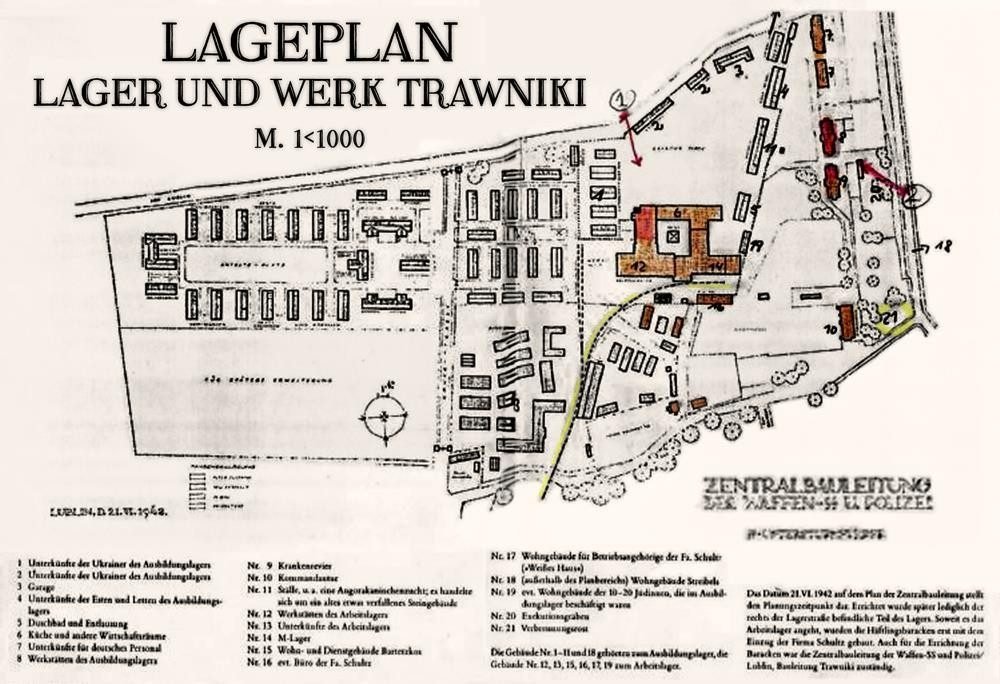
On the morning of 3 November 1943, SS and police units surrounded Majdanek and Trawniki simultaneously, and Poniatowa the following day. At Trawniki the prisoners were led out in groups onto the grounds of the adjoining training camp, forced to undress and driven into zigzag trenches dug in the preceding days under the pretext of „anti-aircraft" works. There they were shot, group after group, throughout the day. Music played from loudspeakers to drown out the gunfire. At Trawniki and the Dorohucza subcamp at least six thousand Jews were murdered on that single day — almost the entire population of the camp. In the whole „Erntefest" operation, over two days, about forty-two thousand people were killed. It was the largest single German massacre of the entire Holocaust.
Complete name registers of the Trawniki prisoners have not survived; only individual documents remain — such as the list drawn up by the SD in Lublin of forty employees of the camp office dated 3 November 1943, every one of them murdered that day; Sari's name is not on it. The evidence for Sari's fate is therefore circumstantial, but — taken together — irresistible: she was in the camp; the entire Jewish population of the camp was murdered on 3 November 1943; after the news that „the camp had been liquidated", no one ever heard of her again. Jungowa, writing in 1949, left no room for doubt:
„There can be no doubt that she died there. I must confess that there are few people in this world I would mourn as sincerely and as warmly."
Unless some future archival discovery proves otherwise, 3 November 1943 must be taken as the day of Sari Jacob's death — one of at least six thousand victims of Trawniki, one of the forty-two thousand victims of the „Harvest Festival." And one of the very few among them whose voice reaches us at all: a woman who two years earlier had written to her family that she must be at her husband's side, and hoped that her next card would be sent from Lwów.
X. February 1944. Pawiak
Before Sari left the ghetto, she had time to ask Jungowa for one thing: to look after „the Doctor." Jungowa kept her word — but fate could no longer be turned aside.
Mosze might have survived had he stayed in Lwów to the end. „He lost his nerve" — Jungowa writes. At the beginning of February 1944 he came to Warsaw, „fleeing by roundabout roads", as Truda Rosenberg remembered. Everyone considered it madness. Without papers and without means of support he drifted through small hotels, lived in a boarding house on Moniuszki Street. Fate added a bitter parenthesis to that address: over the little street towered the building of the Trieste insurance company Riunione Adriatica di Sicurtà, raised to a design by Edward Eber — the same architect who had designed the Generali house at 7 Złota Street. The actuary from Trieste hid in the shadow of the palace of Trieste insurance, a few hundred metres from his own home. Jungowa and two colleagues from Generali obtained a Kennkarte and money for him, made efforts for a work card and rented a room. He also found Truda, who was hiding in Warsaw as a nanny; he helped her carry down the pram with the child. His last words to her were: „If you survive the war, find my family in the States".
How dramatic those weeks were is attested by a document found in the archive of the Ghetto Fighters' House in Israel. On 19 February 1944 Władysław Bartoszewski, working under the pseudonym „Ludwik", wrote to Adolf Berman („Borowski") of the Jewish National Committee with a request for help for „docent Dr Mojżesz Jacob, reportedly an outstanding mathematician of European renown" — a man „without means of support, without any papers." The Polish and Jewish underground tried to save him — literally weeks before the end.
![Typescript of Władysław Bartoszewski's letter („Ludwik") to Adolf Berman („Borowski"), Warsaw, 19 February 1944: „…there is at present in Warsaw docent Dr Mojżesz Jacob, reportedly an outstanding mathematician of European renown […] without means of support, without any papers, camping in some fantastical little hotels." Ghetto Fighters House Archives, fonds 6135 (Berman collection).](../../img/jacob/img20.jpg?v=3e2f9b2c)
One night a „hotel commission" came to the boarding house — blackmailers who routinely made the rounds of the hotels in search of victims. They took him. In the car — to his misfortune — he admitted he was a Jew; then the blue policemen had to hand him over to the Germans.
„Had he not admitted it at once, we could probably have saved him by paying for his release. Unfortunately we had no access to the Germans, and from that moment we lost his trace."
The trace was found again at Pawiak — the largest German political prison in occupied Poland, through which some hundred thousand prisoners passed between 1939 and 1944; about thirty-seven thousand of them were murdered. Three independent testimonies say the same thing. A student told Truda: „Professor Jakub was tortured to death in Pawiak." Hugo Steinhaus noted the same. The same, sixty years later, his nephew wrote on the Yad Vashem page: „TORTURED & KILLED IN PAWIAK PRISON, WARSAW, POLAND." The exact date is unknown — all that is certain is that it happened after 19 February 1944, two kilometres from the house at 7 Złota Street.
The Jacobs' furniture, stored with Jungowa's brother-in-law, and the porcelain standing in her house burned in the Warsaw Uprising. „Nothing is left as a keepsake of Sari or of your brother, though I had so many things" — Jungowa wrote in a letter of 10 May 1949 to Albert, Mosze's brother. And she asked for a photograph of Sari: in all Warsaw there was no longer a single one.
XI. Memory
On 27 September 1945 Wacław Sierpiński sent from Kraków to Paul Montel, dean of the Paris Faculty of Sciences, a letter with a list of Polish mathematicians murdered by the Germans — beside Ruziewicz, Łomnicki, Stożek, Bartel, Saks, Schauder and Auerbach he named in it also Jacob, lecturer of the university in Lwów, killed by the Gestapo in Warsaw. Montel read the letter on 8 October 1945 at a session of the French Academy of Sciences, and the Academy unanimously resolved to print it in its Comptes rendus — so that in its archives a lasting trace of this crime against thought should remain. The name of the tenant of Złota 7 was thus written into the records of the Paris Academy of Sciences. A short notice of his death appeared at the same time also in the American scientific press.
In 2003 his nephew, Martin Jacob of Pennsylvania, submitted a Page of Testimony for his uncle at Yad Vashem; sixteen years later, in June 2019, during a family visit to Jerusalem, he filled in a second — for Sari. Truda Rosenberg survived the war and became a respected psychologist in Canada; years later, driving through Pennsylvania, she saw by the roadside a name she had remembered from Mosze's words — Wilkes-Barre. She telephoned from a call box. The professor's brother, Aron, answered: „We have been waiting for you! We didn't know how to find you!" Mosze's last request had been fulfilled.
Today the names of them both — Mosze Jacob and Sari Charlotte Jacob — stand on the memorial tablet of the first residents of the house at Złota 7/9 in Warsaw. Sari has no grave; her ashes lie in the trenches of Trawniki. Mosze has no grave; Pawiak was blown up in August 1944. All that remains of them is memory — and this house.
Timeline
| Date | Event |
|---|---|
| 15 Nov 1900 | Mosze Jacob is born in Nadwórna, son of Hersch Jacob and Ettel née Jekel. Siblings: Aron (1905), Nathan (died in childhood), Albert (1908) and Rachela „Recha" (1910). |
| 1914–1915 | Fleeing the Russian front, the Jacobs leave Nadwórna and settle in Vienna (after Aron's notes of 1978). |
| 1925 | Doctorate in mathematics at the University of Vienna. |
| 1 May 1929 | Generali policy concluded in Trieste (25,000 złoty in gold). |
| 2 Sep 1935 | Marriage of Mosze and Sarolta in Budapest (record no. 394); the groom resident in Trieste. At the policy's renewal in 1936 the beneficiary becomes his wife. |
| 1935–1937 | Assicurazioni Generali builds the house at 7 Złota Street (des. Edward Eber, Palladium cinema). |
| 1937–1939 | The Jacobs live at Złota 7, apt. 24 (tel. 3-20-62) — until the outbreak of war. |
| 27–29 Jun 1938 | Mosze's journey through already Nazi Vienna (two nights at his father's) to Budapest. |
| Sep 1939 | Mosze evacuated with Generali to Lwów; Sari stays in Warsaw. They will never see each other again. |
| 1939–1941 | Mosze professor in the Chair of Probability Theory of the university in Lwów. |
| Nov 1940 | Closure of the Warsaw ghetto. Sari — in time voluntarily behind the walls, Śliska 7, apt. 33. |
| Jun 1941 | The Germans take Lwów. Mosze in the Lwów ghetto, then in hiding. |
| 24 Aug 1941 | Sari's postcard from the ghetto to her parents-in-law in Brooklyn: „I must be with him". |
| 1943 | Sari leaves the ghetto and ends up in the camp at Trawniki. From there one single card. |
| 3 Nov 1943 | „Aktion Erntefest" — the liquidation of Trawniki. Sari perishes most probably on that day. |
| Feb 1944 | Mosze returns to Warsaw. 19 Feb 1944 — Bartoszewski's letter to Berman asking for help for him. |
| 1944 | Taken by blackmailers, handed over to the Germans. Tortured to death in Pawiak. |
| 8 Oct 1945 | Jacob's name read out at a session of the Academy of Sciences in Paris (Sierpiński's letter). |
| 10 May 1949 | Alicja Jungowa's letter — the principal account of the fate of them both. |
| 6 Jan 2003 | Yad Vashem Page of Testimony submitted by his nephew, Martin Jacob. |
| Jun 2019 | Second Page of Testimony — for Sari (Jerusalem): profession „physician". |
A Note on Sources
This account rests exclusively on sources: the registers of the Nadwórna and Stanisławów districts (Central Archives of Historical Records, JRI-Poland indexes); the Assicurazioni Generali policy with the documents of 1936; the marriage record of Mosze and Sarolta (Budapest, 2 Sep 1935, entry no. 394 — Hungarian civil registration, via FamilySearch); Sari's postcard from the Warsaw ghetto (24 Aug 1941) and Alicja Jungowa's letter of 10 May 1949 — both in the collection of the Jacob family; the letters of Władysław Bartoszewski to Adolf Berman (Ghetto Fighters House Archives, fonds 6135); the Yad Vashem Pages of Testimony (2003 — Mosze; 2019 — Sari); the memoirs of Truda Rosenberg (H. Fedorowicz, „Doznać cudu", Sopot 2012); photographs and accounts passed on by the Jacob family (2024–2026); the history of the Jekel family written down by Aron Jacob in 1978 and Albert Jacob's Viennese Heimatschein of 1931 (both in the family's collection); the Viennese registration card of June 1938 (in the family's collection); the pre-war telephone subscriber directories; the Sierpiński–Montel correspondence (Organon 53, 2021; Comptes rendus vol. 221, 1945) and the literature of the subject (A. Grędzik-Radziak, R. Duda, M. Urbanek, H. Steinhaus). The historical context of the Warsaw and Lwów ghettos, the camp at Trawniki and Operation „Erntefest" — after the studies of the United States Holocaust Memorial Museum and the scholarly literature (among others R. Kuwałek, D. Libionka, „Przybyli do getta… Odeszli w nieznane…", State Museum at Majdanek, Lublin 2013). The identity of Sari — Epstein Sarolta Zsuzsánna of Nagyszeben, daughter of László Epstein and Ilona Eisenstädter — was established in July 2026 on the basis of the Budapest marriage record; further register searches continue.
Opracowanie w ramach projektu upamiętnienia mieszkańców kamienicy przy ul. Złotej 7 i 9 w Warszawie · www.zlota7-9.com