„…to make such a great, world-class firm as… well, as Szaja Prywes in Warsaw."
Heir of a family whose firm was a byword in Warsaw: the fifth generation of an iron dynasty, co-owner of the trading house on Grzybowski Square, husband of Anna, resident of the most modern house of pre-war Warsaw at 7 Złota Street. It is his stone that will be set before this house. This account leads through a hundred and twenty years — year by year, document by document. Every fact comes from a source: from the registers of the Warsaw Jewish community, from the commercial registers, from the press of 1902–1938, from the telephone directories, from court files and from the inscriptions on the stones that stand on Okopowa to this day. Where the sources are silent, this account is silent too.
I. A house of iron — 1825–1903
The story begins around 1825, in the Warsaw of the Congress Kingdom. Abraham Szmulowicz Prywes vel Ajzenman (1799–1855) — the family, of the Levite line HaLevi, used the two surnames interchangeably — founds an iron warehouse that will become the economic backbone of the family for five generations. The business is inherited by his son, Reb Szaja Prywes: it is from his name that the firm will be called „S. Prywes", and the name itself will return twice more in this story. In his time the family became a power: it was the registered owner of four properties right by Grzybowski Square — Graniczna 1 and 3, Grzybowska 1 and 3 — and of two neoclassical tenement houses on the north-western edge of the square, which still stand today as one of the last surviving fragments of Jewish Warsaw. From 1882 the family also owned a copper rolling mill at Głowno-Osiny near Łódź.
And it was there, on 18 April 1900 — as researchers of the works' history have established — that a young French engineer, André Citroën, arrived with his Warsaw brother-in-law. In the Prywes water-driven rolling mill he saw for the first time wooden gear wheels with herringbone teeth, whose patent he would later buy. The imprint of the herringbone teeth — the double chevron — would become Citroën's trademark. In every car of that make there rides today an echo of the Prywes works.
On 27 November 1902, a few months before his death, the aged Reb Szaja put his succession in order. The „Kurjer Warszawski" reported in its „Information" column:
„Mr Szaja Prywes has ceded his iron warehouse by notarial deed to his sons. The firm, we hear, is to be changed. The right to sign for the firm will reportedly pass to Messrs Abram and Luzer Prywes."

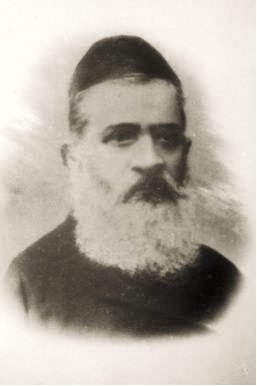
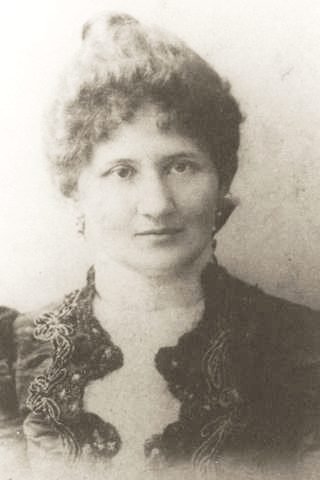
In the family genealogical trees, maintained to this day by descendants scattered across the world, the faces of the couple with whom this story begins have survived:
These faces are worth remembering twice over. Reb Szaja and Szejwa are the great-grandparents not only of Szaja Chaskiel but also of Beniamin Horowitz — Mendel and Tojba Sara were siblings, and their sons first cousins. The descendants of Beniamin, who on 21 August 2026 will come from Israel to the ceremony, will thus see their own ancestors in these portraits.
Reb Szaja dies on 20 March 1903, having lived 78 years. His matzevah — „Yeshayahu, son of Avraham Halevi" — stands in the family plot in the cemetery on Okopowa to this day. The firm is taken over by his sons; at its head stands Luzer Prywes (1852–1924) — soon not only president of the board but also vice-president of the Board of the Jewish Community in Warsaw, the leadership of the largest Jewish community of Europe, and a delegate to the structures of the American Joint.
II. Birth — 8 February 1904
In Warsaw Szaja Chaskiel Prywes comes into the world — son of Mendel, the younger of Luzer's sons, and Mariem née Gitys. The boy is named after the patriarch great-grandfather who died a year earlier; the second name, Chaskiel (Ezekiel), distinguishes him from the numerous namesakes in a branching family in which every branch in every generation has its own Szaja. He grows up in the manufacturer's house at 18 Wielka Street — a few minutes' walk from Grzybowski Square, where the family has been weighing iron for eighty years.
III. The world of childhood — 1904–1917
The world in which Szaja grew up was a world of expansion. On 10 October 1907 the „Nowa Gazeta" announced that his grandfather and uncle were founding a factory:

When Szaja is thirteen, the family's name is already a byword in the city — and doubly so. In the street people say that someone plays the main role „like a nail at Prywes's". And the satirical weekly „Mucha", making its fictional hotelier Abraham Macher look for the model of a great, worldwide business, writes:
„If they were clever and took example from us, they would be able to make such a great, world-class firm as… well, as Szaja Prywes in Warsaw."
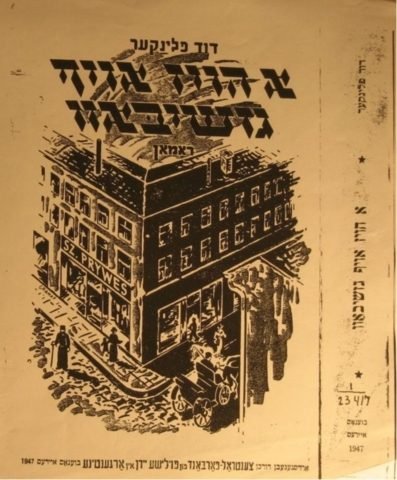
The saying would outlive even the world that created it. In 1947, two years after the Holocaust, the surviving Warsaw Jewish journalist Dawid Flinker published in Buenos Aires the novel „A hojz ojf Gżybow" — „A House on Grzybów". The cover illustrator, wishing to evoke in a single drawing the Jewish Grzybowski Square that no longer existed, put on the corner of a tenement house a shop sign: „Sz. PRYWES".
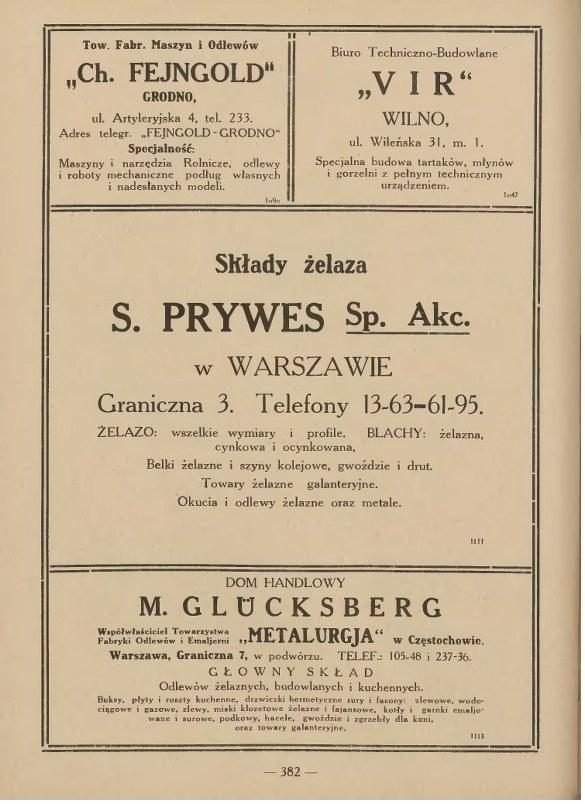
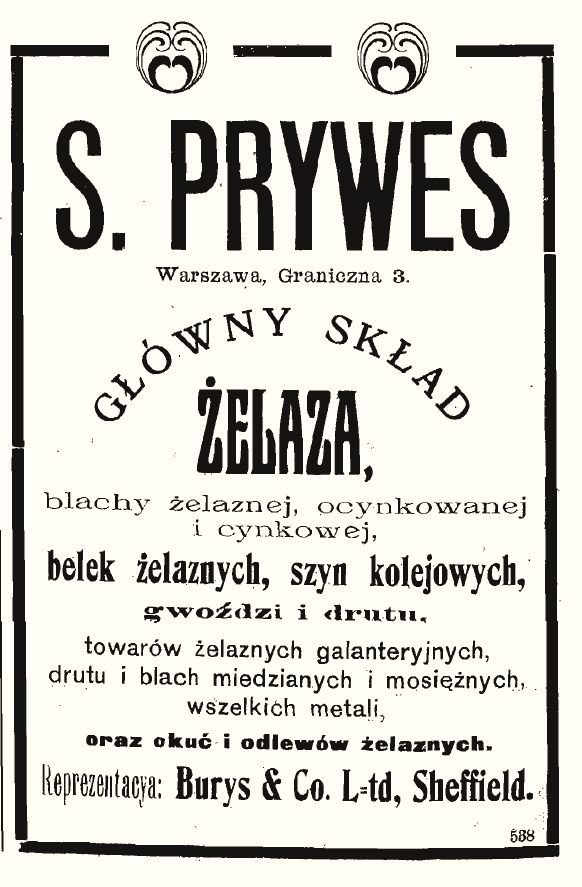
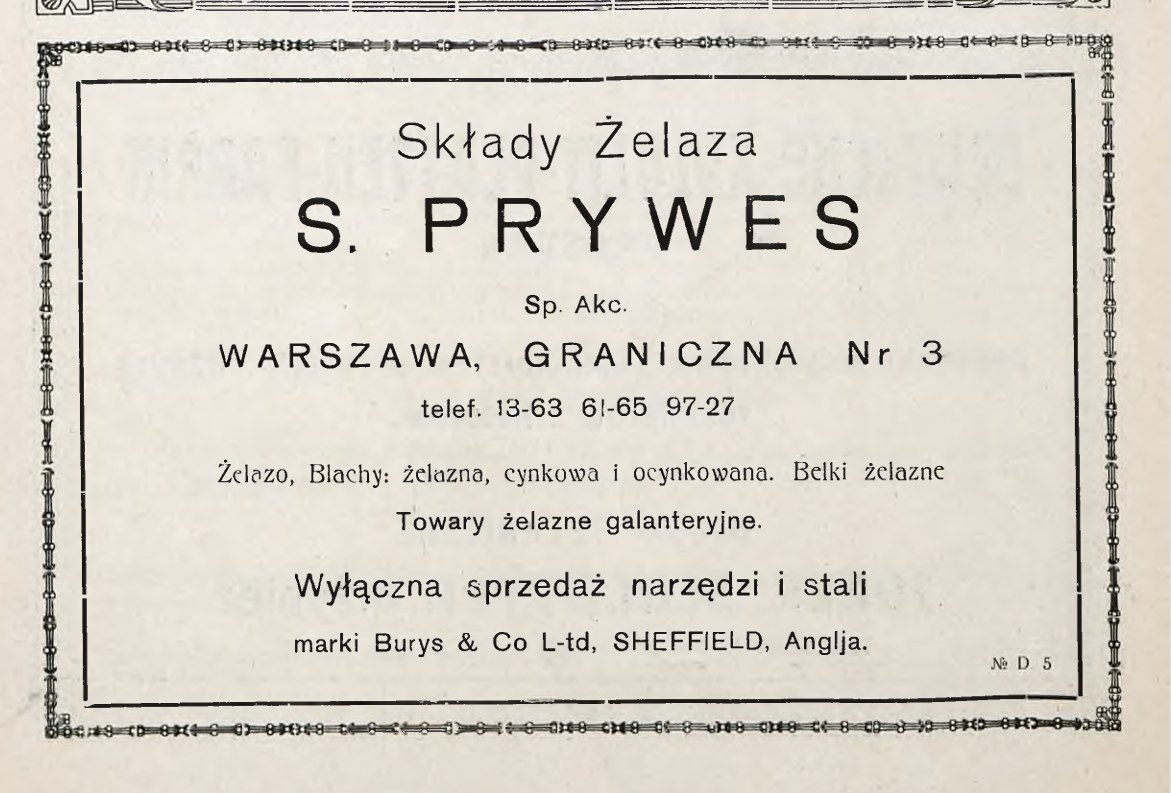
The parent firm advertised in the best technical press as the exclusive representative of the Sheffield brand Burys & Co. Ltd — steel from England, iron from domestic mills, all at the address Graniczna 3.
IV. Luzer — president of two worlds. 1918–1924
To understand the world in which Szaja grew up one must pause at his grandfather — for Luzer Prywes was someone more than an industrialist. Born in 1852 (birth record no. 667 survived in the registers: son of Szaja and Szejna née Ejzenman), from 1902 he stood at the head of the family firm — and in parallel climbed to the very summit of the Jewish public life of the capital: he became vice-president of the Board of the Jewish Community in Warsaw, the leadership of the largest Jewish community of Europe, numbering more than three hundred thousand faithful. The hardest years imaginable fell to him: the great war, hunger, epidemics, waves of refugees, then rebuilding in the young state. It was then that he also became the community's delegate for cooperation with the American Joint — the organisation that was then saving Jewish Europe from hunger. Few in that Warsaw joined two worlds as he did: in the morning the iron exchange, in the afternoon the affairs of a community of three hundred thousand souls.
In 1918, on the threshold of independence, a new enterprise arises in the family: the trading house „I. M. (Abr.) Prywes" at 10 Grzybowski Square — founded by Icko-Majer, Luzer's nephew. It is in this firm that the then fourteen-year-old Szaja will one day find his road. The crowning of Luzer's presidency is the transformation of the family business into a joint-stock company. On 20 December 1921 the „Kurjer Warszawski" prints on its front page the founding announcement: the statute of the „S. Prywes Iron Warehouses in Warsaw Joint-Stock Co." was confirmed by the ministers of industry and trade and of the treasury back on 28 September 1920, and the first organisational General Assembly of Shareholders took place on 31 July 1921. The company — as the announcement proclaims — carries on „the Iron Trade Warehouse hitherto existing in Warsaw under the firm: Main Iron Warehouse S. Prywes". Managing Director becomes Luzer — as the only one „with the right to sign independently documents of every kind"; the other members of the board sign only jointly. It would be hard to find a clearer picture of the place he occupied in the firm and in the family.
On 24 March 1924 Luzer dies — „after long and heavy sufferings, having lived 73 years". The cortège sets out from the family house at 10 Grzybowski Square, and the pages of „Nasz Przegląd" fill with obituaries whose very list is a portrait of the deceased: the company's board takes leave of its president; the „Brijus" health society and the Old People's Home take leave of a benefactor; and the firm's staff — at their own expense, in two separate insertions — take leave of a man:
„In the deceased we lose a worthy Superior, whose memory we shall keep forever. Honour to his memory!"
A firm whose employees themselves pay for the owner's obituaries is a firm of true greatness. A year later, on 19 March 1925, the family unveils a monument on Okopowa — and the stonemason carves on it a title that says everything: „chairman of the Jewish Community in Warsaw". That matzevah stands in the family plot to this day — and on 21 August 2026 the guests of the ceremony will be able to stand at it. The company's new board after Luzer's death is a confederation of the whole family: beside two directors from outside the family sit on it two sons of Reb Szaja and a son of Luzer — the uncles of the then twenty-year-old Szaja Chaskiel. The grandfather left his grandsons not only a firm: he left the model that this name obliges towards something more than the trade ledgers.
V. A centenary — 1925–1933
In 1925 the firm celebrated its centenary, and the trade journal „Polski Przemysł Budowlany" printed a jubilee article:
„A hundred years of the firm's existence — that is a detail that speaks for itself. […] The great-grandfather laid the foundations, the grandfather raised the frame, the father strengthened it, and the present owners of the firm strive to enlarge and enrich that century-old achievement and inheritance of their forefathers on the same principles, so as to pass it to posterity in all its splendour."
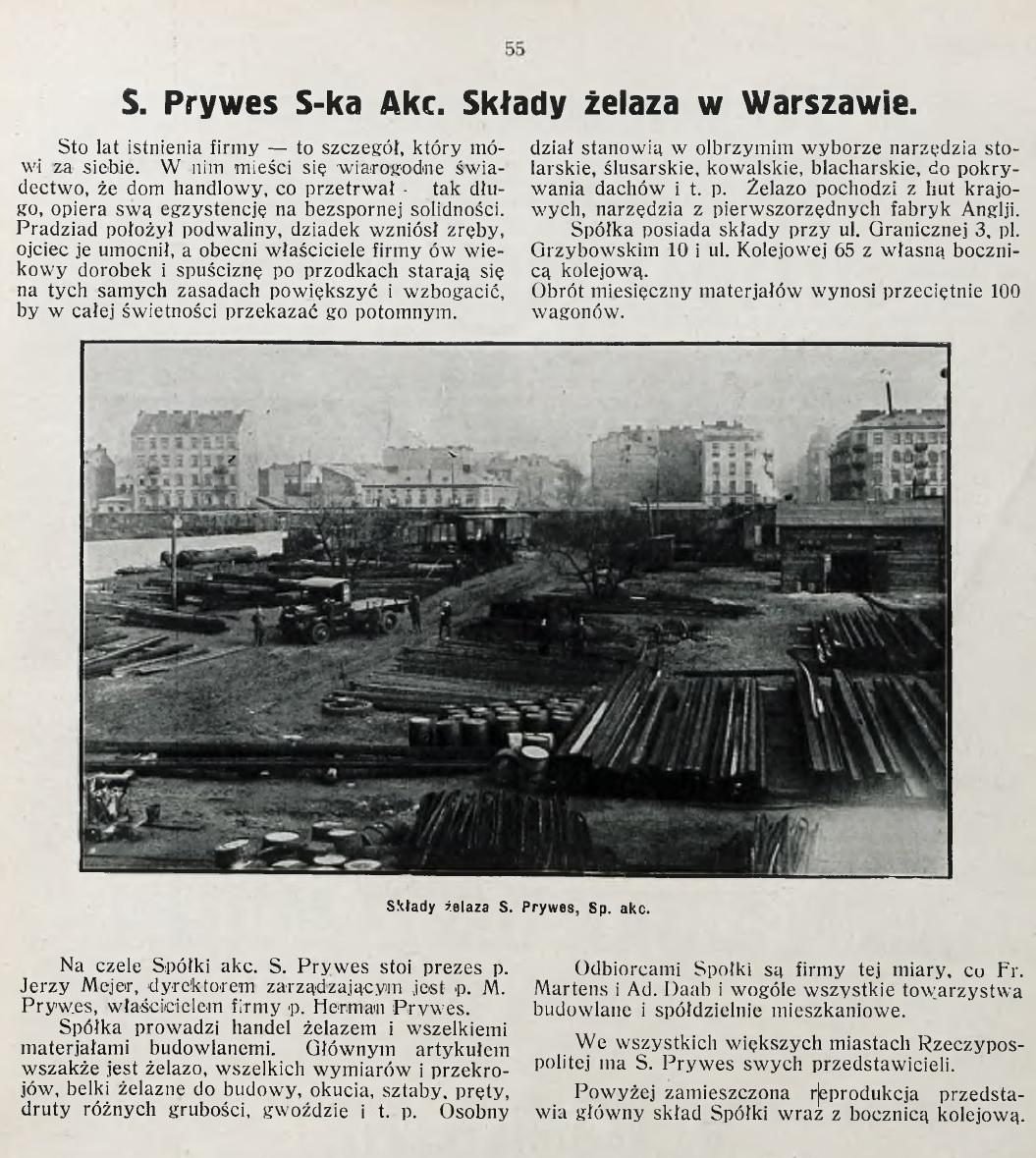
The figures in the article speak for themselves: warehouses at Graniczna 3, 10 Grzybowski Square and 65 Kolejowa Street with its own siding; a hundred wagons of iron in monthly turnover; tools „in an enormous selection" from first-class English factories; customers — „all the building societies and housing cooperatives."
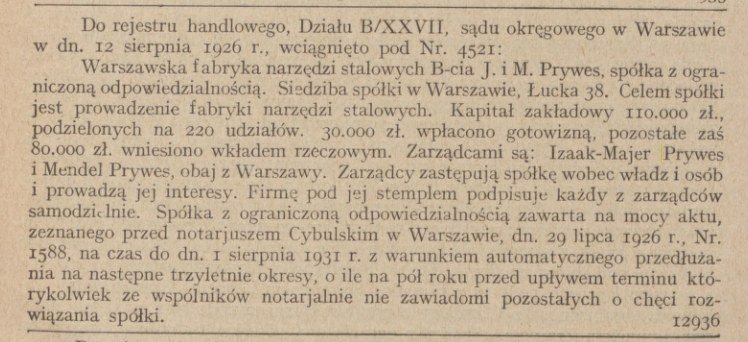
In 1926 Szaja's father and uncle registered their own factory — the Warsaw Steel Tool Factory at 38 Łucka Street, with capital of 110,000 złoty:
In 1929 grandmother Cyrla, Luzer's widow, died. And on 7 October 1933 — Icko-Majer, founder of the trading house. He rests on Okopowa beside his father Abram, in the same family plot. His firm passed to a new generation.
VI. The brothers M. and Sz. — 1934–1935
On 1 January 1934 „Polska Gospodarcza" published a register entry:
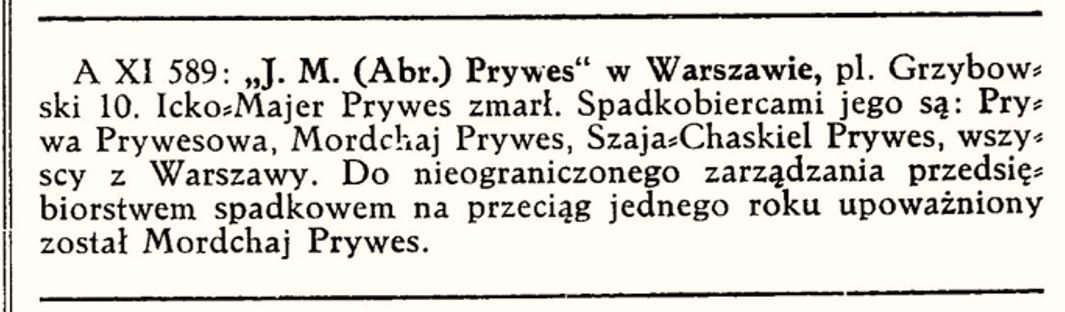
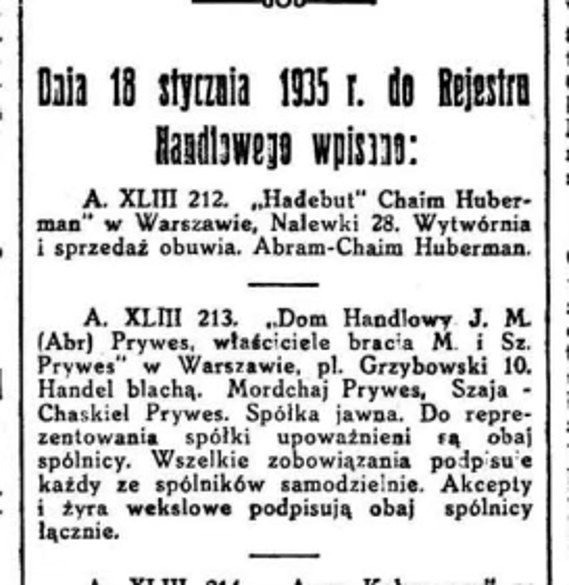
For a year the inherited business was managed by the elder brother, Mordechaj. Exactly a year later the succession was completed — the „Monitor Polski" of 30 January 1935 printed two entries at once: the closing of the old register and the birth of the new partnership.
From then on the thirty-one-year-old Szaja Chaskiel was co-owner of the family trading house — the fifth generation behind the same counter at 10 Grzybowski Square, at the address where his grandfather Luzer had lived and died.
VII. „Prima Warszawa". Anna. Złota 7 — 1936–1939
The Yearbook of Polish Industry and Trade describes the brothers' firm in figures that still impress today: capital of 100,000 złoty — and an annual turnover approaching a million. Sheet metal from English to boiler plate, tin, lead; accounts at the Commercial Bank and the General Credit Bank; membership of the Central Union of Merchants. And the firm's telegraphic address was short and immodest: „Prima Warszawa."
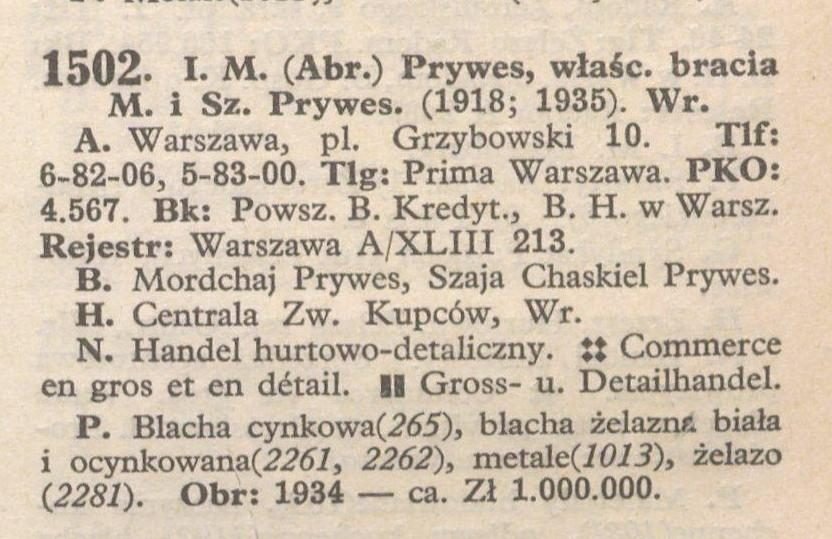
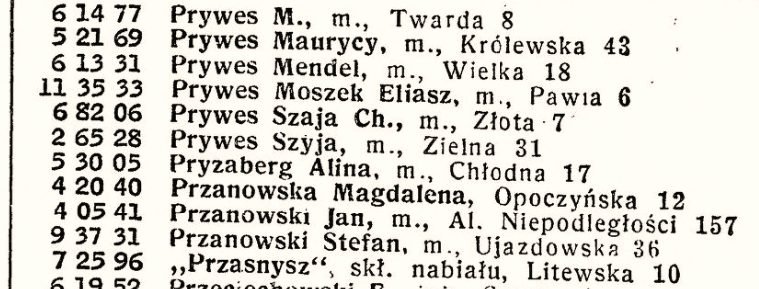
Szaja's wife is Anna — a Warsaw schoolteacher, born 1910, daughter of the merchant family of the Hartglases. In the telephone directories of these years Szaja figures under the number 6-82-06 — the same one the firm gives as its contact telephone: the partner's private line is the enterprise's visiting card.
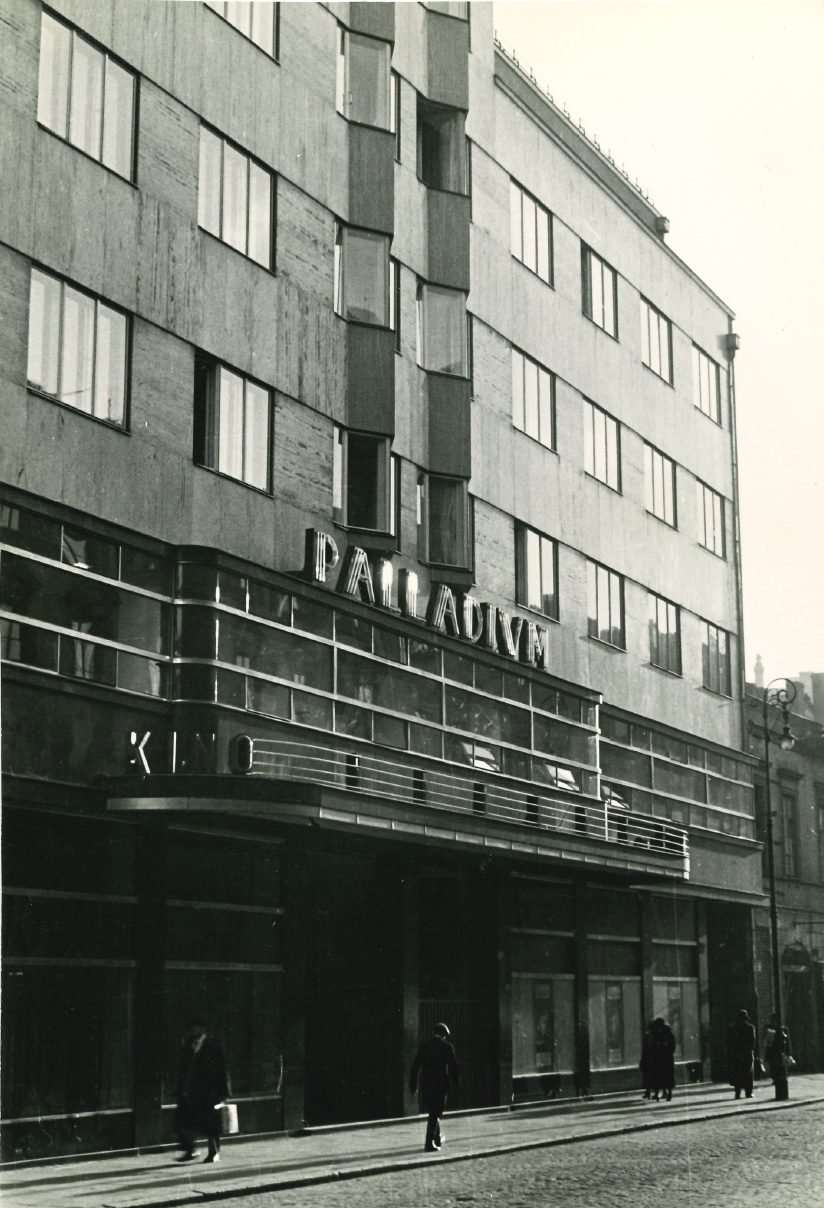
In 1938 the number 6-82-06 began to ring at a new address. Szaja moved — as one of the first tenants — into the newly completed building of the Italian insurance company Assicurazioni Generali at 7 Złota Street, designed by Edward Eber, with the Palladium cinema in the courtyard: the most modern address in pre-war Warsaw.
VIII. War. The ghetto. 6 September 1942
On 1 September 1939 Germany attacked Poland; Warsaw defended itself under bombs until the end of the month. In November 1940 the occupiers closed the walls of the ghetto, packing some four hundred thousand people behind them into a few per cent of the city's area; starvation rations, overcrowding and typhus killed tens of thousands before the deportations even began. The Prywes family found itself within the closed district: Szaja's father, Mendel, last lived at 13 Przejazd Street, his uncle Izaak Majer at 8 Smocza Street.
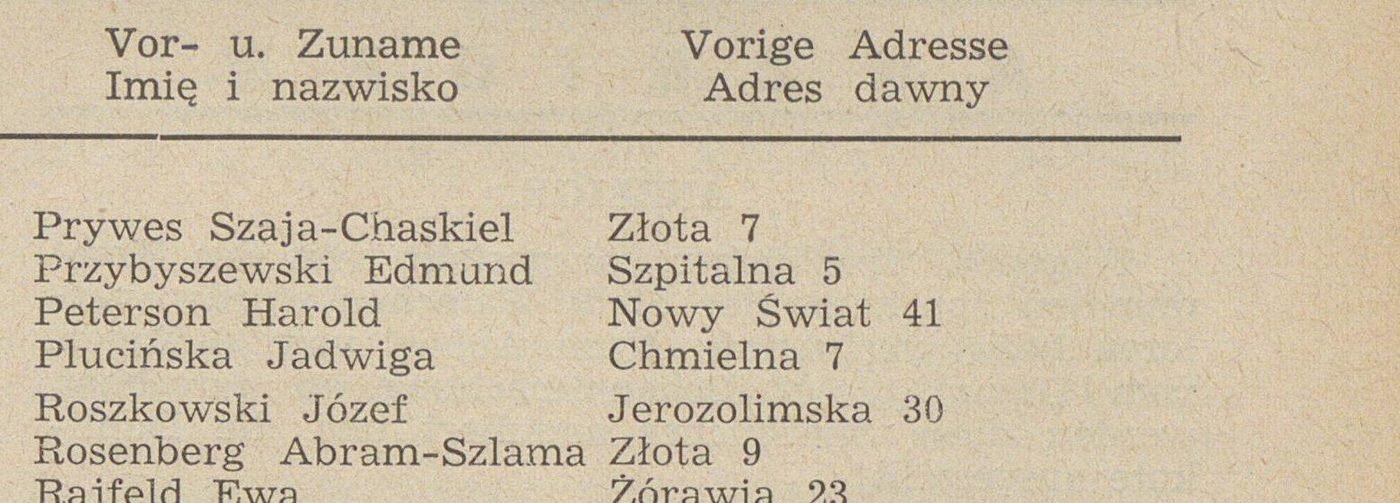
Szaja's trace in the documents breaks off where his stone will stand. As late as July 1940 — a few months before the closing of the ghetto — the official „Gazette of Announcements of the City of Warsaw", published in German and Polish, notes in its list of residents: „Prywes Szaja-Chaskiel — Złota 7". It is the last pre-war address under which the city administration recorded him — the same threshold into which, on 21 August 2026, the brass stone with his name will be set.
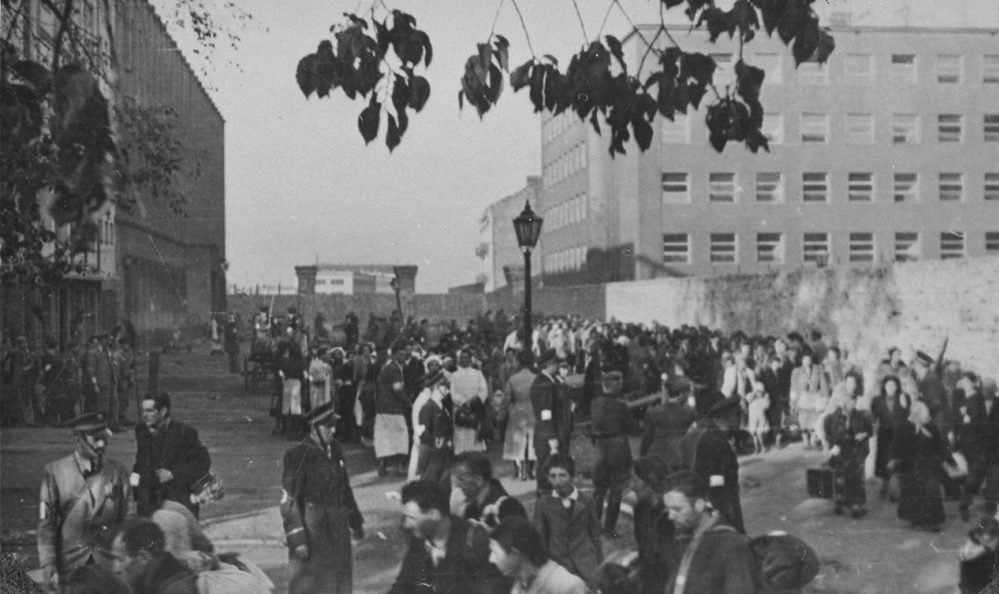
On 22 July 1942 the Great Deportation begins: for two months, day after day, transports leave the Umschlagplatz for the gas chambers of Treblinka — about three hundred thousand people are deported.
The Umschlagplatz during the Great Deportation, 1942
On 6 September 1942 the Germans order the finale: all those still alive are to report in the rectangle of streets around Miła — the so-called cauldron — for the last great selection, for the „numbers for life".
On that very day Mendel Prywes takes his own life. He prepared for death with the same scrupulousness with which the family had run its business: he had earlier handed his nephew, Beniamin Horowitz, money „for his eventual funeral". Beniamin managed to bury his uncle on Okopowa — in the same cemetery where the family's matzevot stand. After the war he will testify before the court:
„On 8 September 1942 the funeral establishment informed me that on 6 Sep 1942 Mendel Prywes had taken his own life. I was at the funeral, I saw the body."
A death certificate, „owing to the conditions prevailing for the Jewish population under the German occupation", was not drawn up.
IX. The last road — 1943
From the closing of the ghetto the Jews of Warsaw are forbidden to live outside its walls; from October 1941 the penalty for it is death. Szaja hides on the „Aryan" side. In mid-January 1943 the Germans carry out in Warsaw and on the approach routes a wave of great round-ups; thousands of the detained go straight to the concentration camp at Majdanek. On the night of 15 to 16 January 1943 Szaja is taken in a round-up from the Częstochowa–Warsaw express train and imprisoned in Piotrków Trybunalski. Two days later the second deportation action begins in the ghetto.
On 9 February 1943 he is deported to the camp at Majdanek. KL Lublin — for that is its official name — is the only great concentration camp of the Third Reich lying in full view of a large city: concentration camp, POW camp and extermination centre with gas chambers at once; primitive barracks, hunger, hours-long roll-calls and epidemics kill as surely as the executions. About eighty thousand people will perish in it. For more than three months Anna keeps contact with her husband — she knows where he is. On 21 May 1943, as she will establish, Szaja is murdered by the camp guard. He is thirty-nine years old. There is no grave; the ashes of Majdanek's victims lie under the dome of the mausoleum on the camp's grounds.
X. Anna. A widow's road — 1943–1948
Anna survived on the „Aryan" side — on documents in the name Szczepanko, hiding with her mother near Warsaw; the mother was taken by the Gestapo in 1944. After the war Anna settled in Gdańsk and from there, on 28 April 1947, applied to the Municipal Court in Warsaw for the official declaration of the deaths of her father-in-law and her husband — for after the Holocaust even death had to be proved before a court.
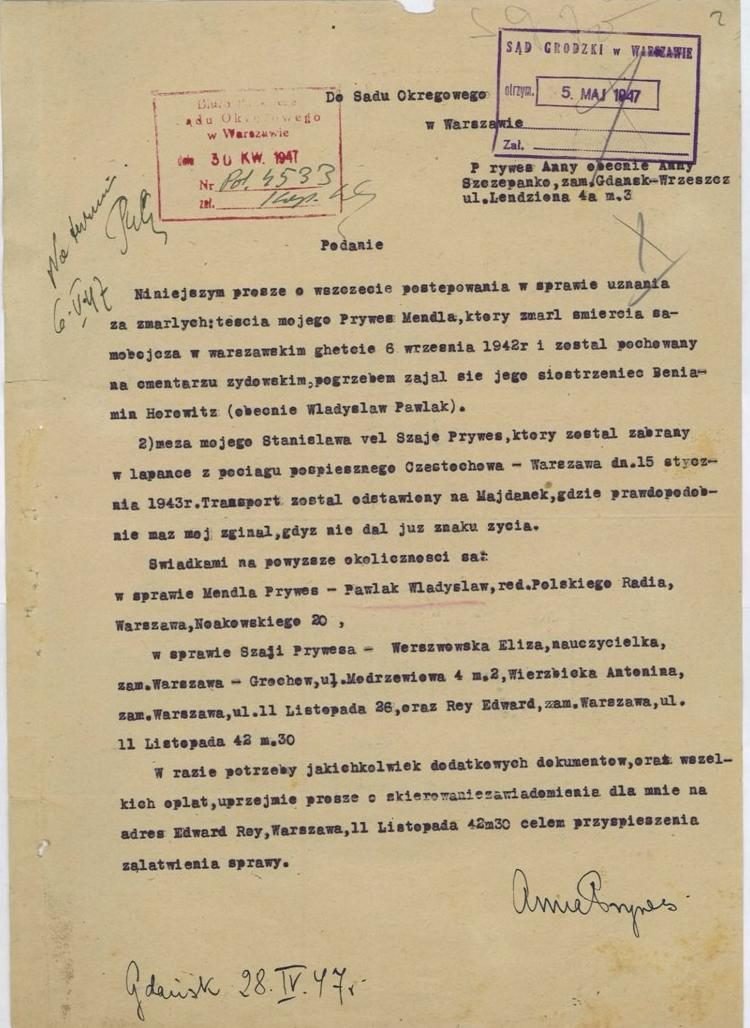
The case is conducted by the advocate Dr Maurycy Karniol. The chief witness is the Polish Radio editor Władysław Pawlak — under this name lives after the war Beniamin Horowitz, Mendel's nephew, the same who buried him in the ghetto. By a decision of 2 October 1947 the court declares Mendel's death.
XI. A family that endures
Beniamin Horowitz — son of Tojba Sara née Prywes, Mendel's sister — remained in Warsaw after the war as Władysław Pawlak and died here in 1986. His son Abraham, born during the war, was saved as a small child by Stanisław and Regina Świda, recognised by Yad Vashem as Righteous Among the Nations. Abraham lived until 2018 in Israel; there live his wife Batia and their children — Nadav, Yuval and Hagit — with their grandchildren. The family remains in close contact with the granddaughter of their Righteous, Małgorzata Gronek.
XII. The stone — 21 August 2026
At 9:00 before the house at 7 Złota Street twelve Stones of Remembrance of the residents of the houses Złota 7 and Złota 9 will be set — among them the stone of Szaja Chaskiel Prywes. Taking part in the ceremony will be the great-grandchildren of Beniamin Horowitz, come from Israel, and a granddaughter of the Righteous. At one stone will meet the descendants of the victims, of the saved and of the rescuers.
Szaja has no grave. He has instead three points on the map of Warsaw: the family plot on Okopowa — with the matzevot of his great-grandfather Reb Szaja and his grandfather Luzer — which survived everything; Grzybowski Square, where for a hundred years the family weighed iron; and the threshold of the house at 7 Złota Street, into which the brass stone with his name will be set. From then on everyone who walks down Złota will know that here lived Szaja Chaskiel Prywes — heir of a family whose firm was a byword in Warsaw, husband of Anna, murdered at Majdanek at the age of thirty-nine.
Timeline
| Date | Event |
|---|---|
| c. 1825 | Abraham Szmulowicz Prywes vel Ajzenman founds an iron warehouse in Warsaw — the beginning of the firm „S. Prywes". |
| 1852 | Luzer Prywes is born, son of Reb Szaja (birth record 667/1852) — Szaja Chaskiel's grandfather. |
| 1882 | The family takes over the copper rolling mill at Głowno-Osiny near Łódź. |
| 18 Apr 1900 | André Citroën visits the Prywes rolling mill — here he sees the herringbone gear wheels whose imprint (the double chevron) will become the logo of his make. |
| 27 Nov 1902 | Reb Szaja notarially hands the iron warehouse to his sons — Abram and Luzer („Kurjer Warszawski"). |
| 20 Mar 1903 | Reb Szaja Prywes dies, aged 78; his matzevah stands in the family plot on Okopowa to this day. |
| 8 Feb 1904 | Szaja Chaskiel Prywes is born in Warsaw, son of Mendel and Mariem née Gitys — named after his great-grandfather. |
| 1907 | Luzer and Izaak-Majer register a factory of iron goods (capital 80,000 roubles); the house register lists the family as owner of four properties on Grzybowski Square. |
| 1912 | Advertisements in the „Przegląd Techniczny": exclusive agency of Burys & Co. Ltd, Sheffield. |
| 13 May 1917 | „Mucha" makes the firm a byword: „…such a great worldwide firm as Szaja Prywes in Warsaw". |
| 1918 | The trading house „I. M. (Abr.) Prywes" arises at 10 Grzybowski Square. |
| 20 Dec 1921 | Founding announcement of the joint-stock company „S. Prywes Iron Warehouses" (statute confirmed 28 Sep 1920; Luzer Managing Director with independent signature). |
| 24 Mar 1924 | Luzer Prywes dies — president of „S. Prywes" S.A., vice-president of the Board of the Jewish Community (the largest Jewish community of Europe), delegate to the Joint; on the monument on Okopowa (unveiled 19 Mar 1925, standing to this day) was carved: „chairman of the Jewish Community in Warsaw". |
| 1925 | The firm's centenary; warehouses with a railway siding, turnover c. 100 wagons of iron a month. |
| 1926 | Szaja's father and uncle register the Warsaw Steel Tool Factory, 38 Łucka Street. |
| 7 Oct 1933 | Icko-Majer, founder of the trading house, dies; the enterprise passes to the brothers Mordechaj and Szaja Chaskiel. |
| 18 Jan 1935 | The brothers register the general partnership „I. M. (Abr.) Prywes, owners the brothers M. and Sz. Prywes" („Monitor Polski", 30 Jan 1935). |
| 1936 | Industry yearbook: the firm's turnover for 1934 — c. 1,000,000 złoty; telegraphic address „Prima Warszawa". |
| 1938 | Szaja moves into the freshly completed Assicurazioni Generali house at 7 Złota Street (des. E. Eber, Palladium cinema); subscriber directory 1938/39: „Prywes Szaja Ch., apt., Złota 7". |
| 26 Jul 1940 | The official „Gazette of Announcements of the City of Warsaw" notes: „Prywes Szaja-Chaskiel — Złota 7". |
| Nov 1940 | Closure of the Warsaw ghetto — c. 400,000 people behind the walls. |
| 22 Jul – Sep 1942 | The Great Deportation: c. 300,000 Jews deported from the ghetto, mainly to the gas chambers of Treblinka. |
| 6 Sep 1942 | The day of the „cauldron" on Miła. Mendel Prywes and Izaak Majer Prywes take their own lives; Mendel is buried by his nephew Beniamin Horowitz. |
| 15/16 Jan 1943 | The wave of January round-ups: Szaja taken from the Częstochowa–Warsaw train; prison in Piotrków Trybunalski. |
| 9 Feb 1943 | Deported to the concentration camp at Majdanek (KL Lublin). |
| 21 May 1943 | Murdered by the camp guard — as Anna established. He was 39. |
| 28 Apr 1947 | Anna Prywes (Gdańsk) files the application for the declaration of the deaths of her father-in-law and husband (case VII Zg. 1138/47). |
| 2 Oct 1947 / 21 Oct 1948 | The court declares Mendel's death; after announcements in the „Obwieszczenia Publiczne" (25 Feb 1948) it declares Szaja dead. |
A Note on Sources
This account rests exclusively on sources: the files of the Municipal Court in Warsaw (case VII Zg. 1138/47, State Archive in Warsaw) with Anna Prywes's application, the testimony of Władysław Pawlak and the decisions of 1947–1948, together with the copy of the „Obwieszczenia Publiczne" of 25 Feb 1948 filed in the case; the registers of the Warsaw Jewish community (among them Luzer Prywes's birth record no. 667/1852; JRI-Poland indexes); the commercial registers of the District Court in Warsaw (1924, 1926, 1934, 1935); the press of 1902–1938: „Kurjer Warszawski" (27 Nov 1902), „Nowa Gazeta" (10 Oct 1907), „Przegląd Techniczny" (1912), „Mucha" (13 May 1917), „Polski Przemysł Budowlany" (1925), „Obwieszczenia Publiczne" (1924, 1926, 1948), „Nasz Przegląd" (obituaries 1924–1936), „Polska Gospodarcza" (1934), „Monitor Polski" (30 Jan 1935); the Yearbooks of Polish Industry and Trade 1936 and 1938; the subscriber directories of the Warsaw telephone network 1935/36–1939/40; the documentation of the Jewish cemetery on Okopowa (FDJC database — family plot 47); personal files (AIPN Gd); research on the history of the rolling mill at Głowno-Osiny; and the accounts and letters of the Horowitz family (2024–2026). The historical context of the Warsaw ghetto and KL Lublin is given after the findings of the literature and the museums of memory.
Opracowanie w ramach projektu upamiętnienia mieszkańców kamienicy przy ul. Złotej 7 i 9 w Warszawie · www.zlota7-9.com