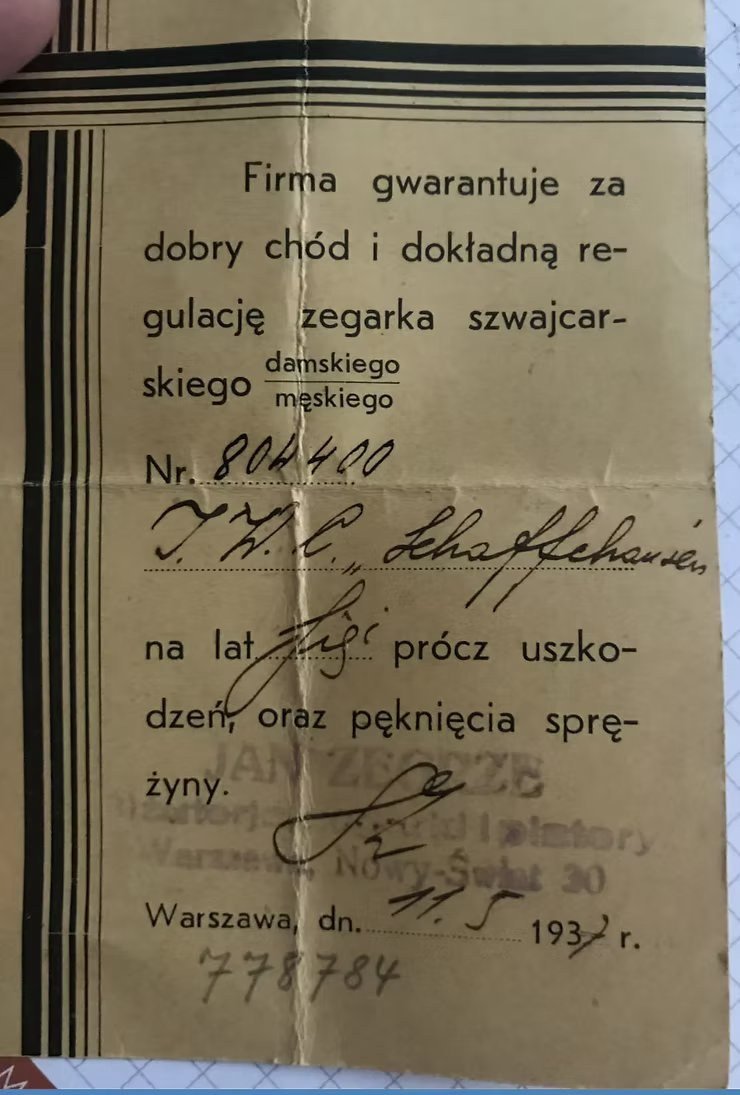
„The firm guarantees the good running and precise regulation of the Swiss watch…"
He was one of the best-known watchmakers and jewellers of pre-war Warsaw. His salon stood on one of the finest corners of the city — 30 Nowy Świat, at the mouth of Foksal Street — and watches bearing his name on the dial still circulate through antique shops and lie in the display cases of the Museum of Warsaw. He lived with his family at 7 Złota Street: with his wife Eryka, his daughter Urszula and his son Jan Władysław. In September 1939 a German bomb swept away the corner of the building together with his shop. A few months later — so the family says — Jan Zegrze was shot dead by the Germans in the street. Where is not known, nor when. There is no grave. His wife and children survived the war at three ends of Europe.
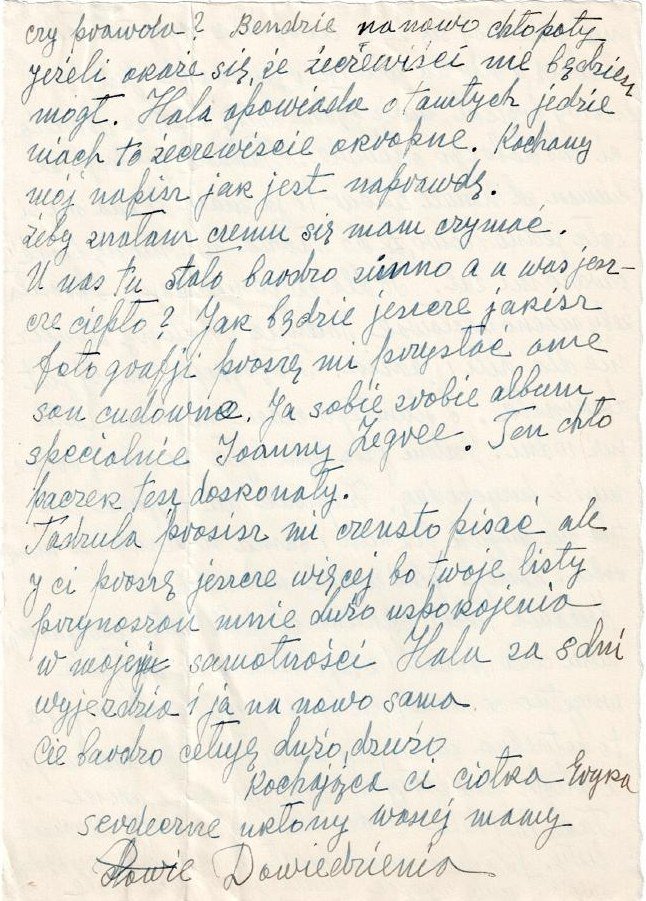
This account gathers everything that is known about them. Every fact comes from a source: from pre-war telephone directories and press advertisements, from photographs of Nowy Świat, from surviving watches and documents of the firm, from the visa register of the Portuguese consul in Bordeaux, from British naturalisation files and the „London Gazette", from a tombstone in Zagreb's Mirogoj cemetery — and from a letter which Eryka Zegrze wrote in November 1946 from Montreux to her husband's nephew, and which, together with family recollections, was given to us by Joan Zegree of Seattle, the granddaughter of Jan's brother.
I. The Zegrze family — one name, two worlds
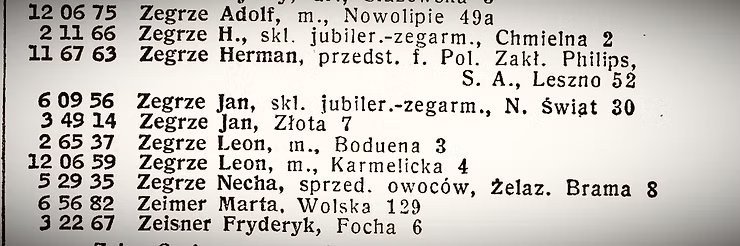
Zegrze is a rare surname in Warsaw — and a telling one. The 1938 directory of subscribers of the Warsaw telephone network lists eight Zegrzes, and their addresses form a map of the two worlds of Jewish Warsaw. In the north, in the traditional Jewish quarter, lived Adolf at 49a Nowolipie and Leon at 4 Karmelicka, and Necha Zegrze sold fruit at 8 Żelazna Brama. In the city centre, in prestigious apartment houses, lived the assimilated branch: Leon at 3 Boduena, Jan at 7 Złota, Herman — a representative of Polish Philips Works — at 52 Leszno. Two of them ran jewellery-and-watchmaking shops: Jan at 30 Nowy Świat and the mysterious „H. Zegrze" at 2 Chmielna — a stone's throw from Jan's salon, on the other side of Nowy Świat — of whom the family today knows nothing.
Jan was the son of Josef Zegrze. He had a brother, Leon — Lieb-Ber, born on 21 January 1881 — and a sister, Helena. Leon, resident at 3 Boduena Street, was twice married: to Balbina née Marienstrasz, who died young — the family supposes during the Spanish flu epidemic — and to a second wife whose name the family has to this day been unable to establish. From the first marriage he had a son, Tadeusz, born on 31 May 1914, from the second — Ryszard Jerzy, born on 18 May 1926. Helena married Ilja Lewinstein and had two daughters, Roma and Maria. It is this Tadeusz, the sole survivor of Boduena 3, who after the war will be the addressee of Eryka's letter — and his daughter Joan, born in America, who eighty years later will find in Warsaw the traces of her great-uncle.
II. Nowy Świat 30 — the salon on the corner
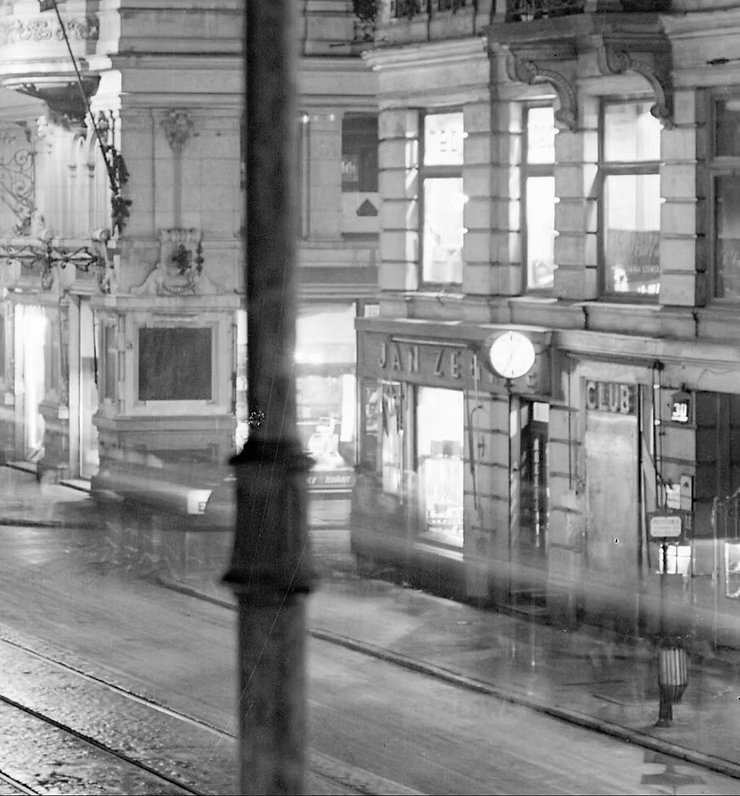
The building on the corner of Nowy Świat and Foksal — Nowy Świat 30, Foksal 21 — was raised around 1898–1901 by the architect Artur Spitzbarth — with a richly ornamented façade and balconies, at the best point of the Royal Route, between Three Crosses Square and Aleje Jerozolimskie. Its corner ground floor, with shop windows facing both streets, was taken by the salon of Jan Zegrze. Above the entrance hung the sign with his name and the round firm's clock — the hallmark of Warsaw watchmakers, by which passers-by checked the time.
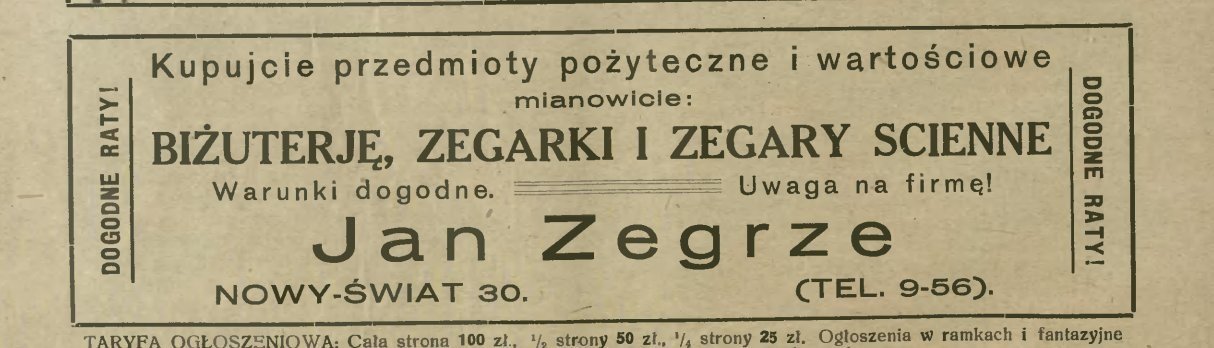
The firm advertised widely and — for a jeweller — in unexpected places. In 1928, in the „Przegląd Więziennictwa Polskiego", a monthly „devoted to criminological, penitentiary and educational-vocational questions", it urged readers: „Buy useful and valuable objects, namely jewellery, watches and wall clocks. Convenient terms. Note the firm! Jan Zegrze, Nowy-Świat 30 (tel. 9-56). Convenient instalments!".
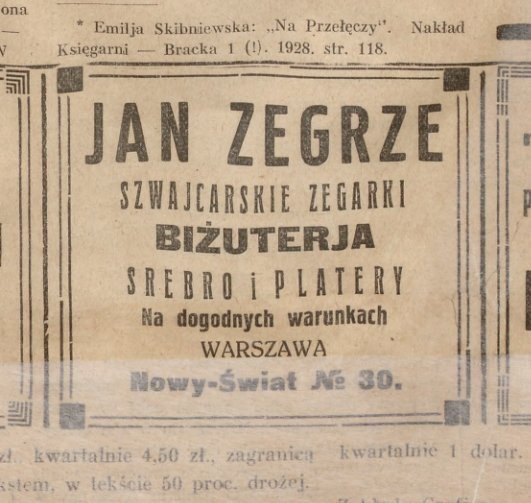
A year later, in October 1929, in the literary fortnightly „Głos Literacki" — beside a self-portrait of Panait Istrati and an interview with Fernand Léger — it announced: „Swiss watches, jewellery, silver and plate. On convenient terms".
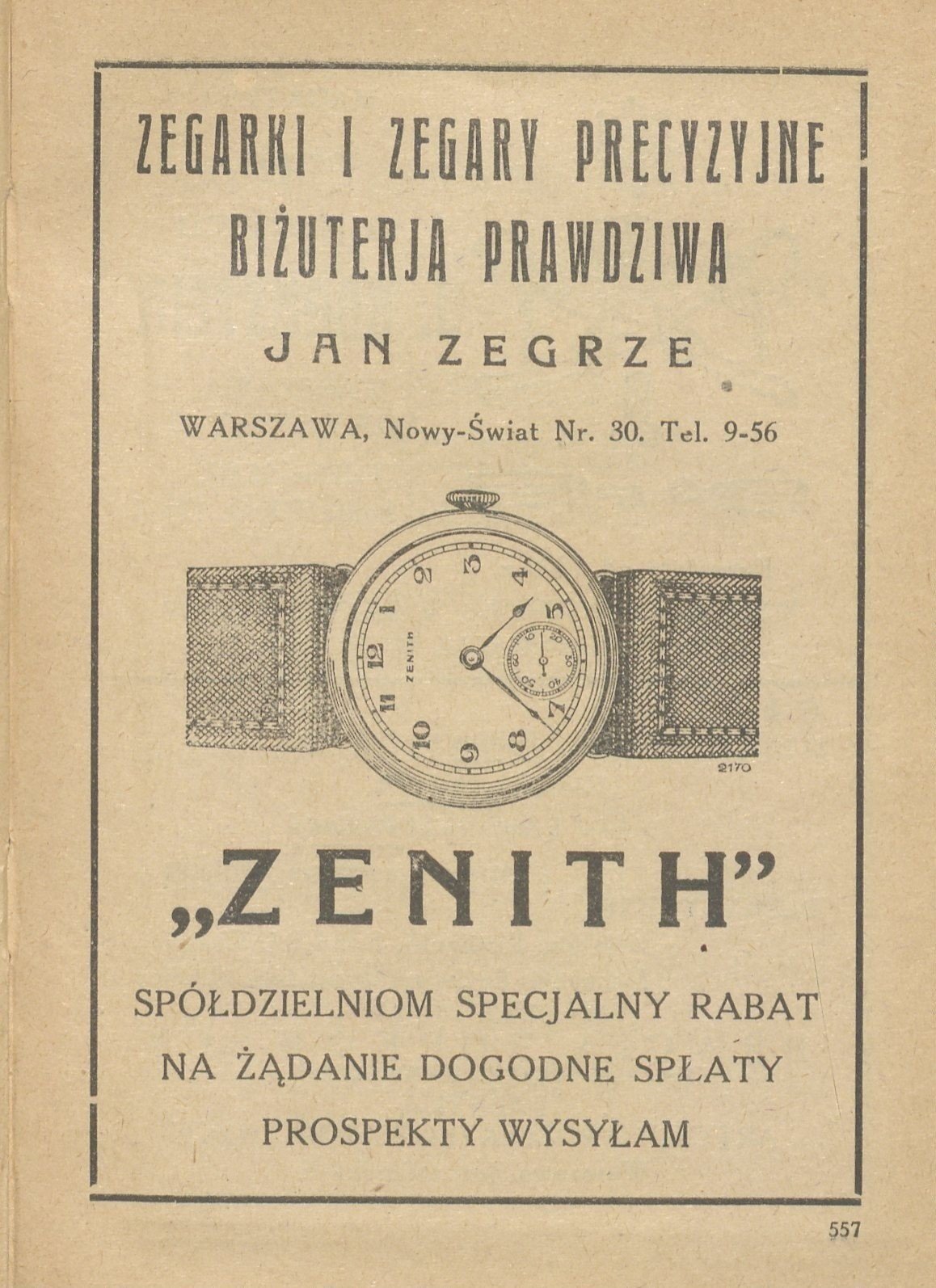
A full-page advertisement with a drawing of a watch on a leather strap — „Precision watches and clocks. Genuine jewellery. Jan Zegrze, Warsaw, Nowy-Świat No. 30, tel. 9-56. »Zenith«. Special discount for cooperatives, convenient repayment on request, prospectuses sent" — shows that the firm was an official representative of Zenith, sold by mail order and aimed at a cooperative clientele.
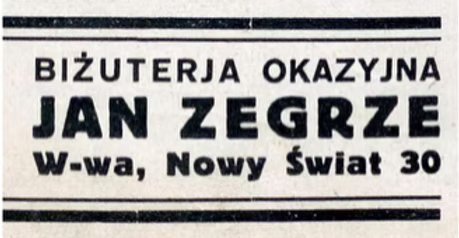
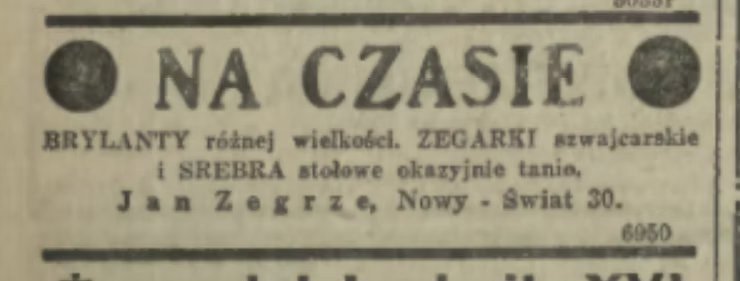
Small notices in the daily press offered „diamonds of various sizes, Swiss watches and table silver at bargain prices" and „bargain jewellery" — Jan Zegrze thus also dealt on commission and in antiques, and sale by instalments, repeated in every advertisement, opened his salon to a clientele beyond the narrow circle of the wealthy.
III. Watches with a name
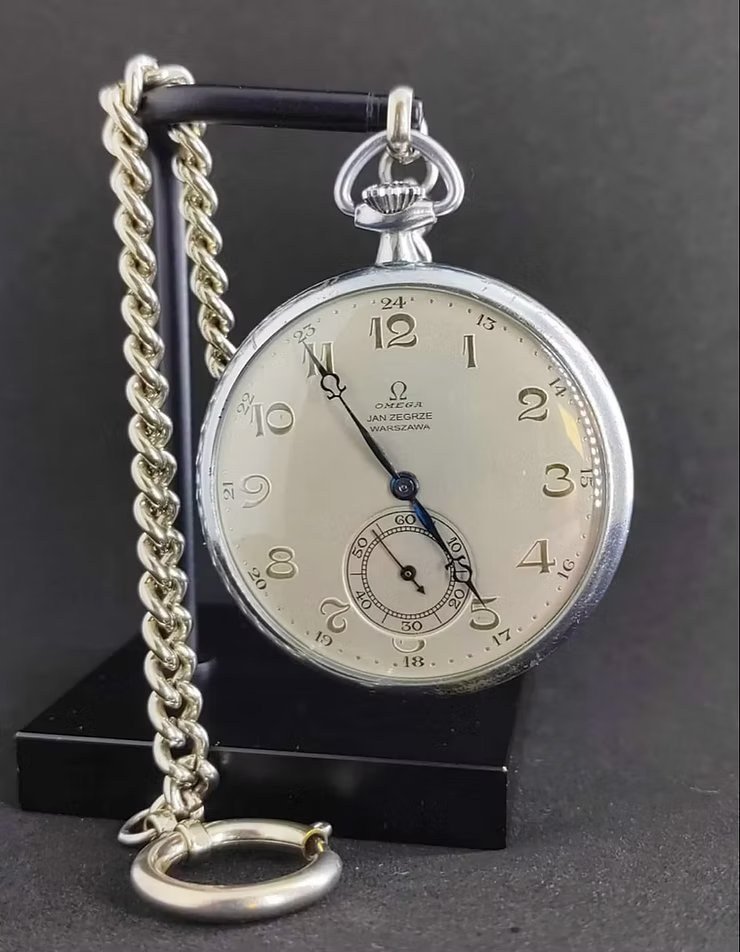
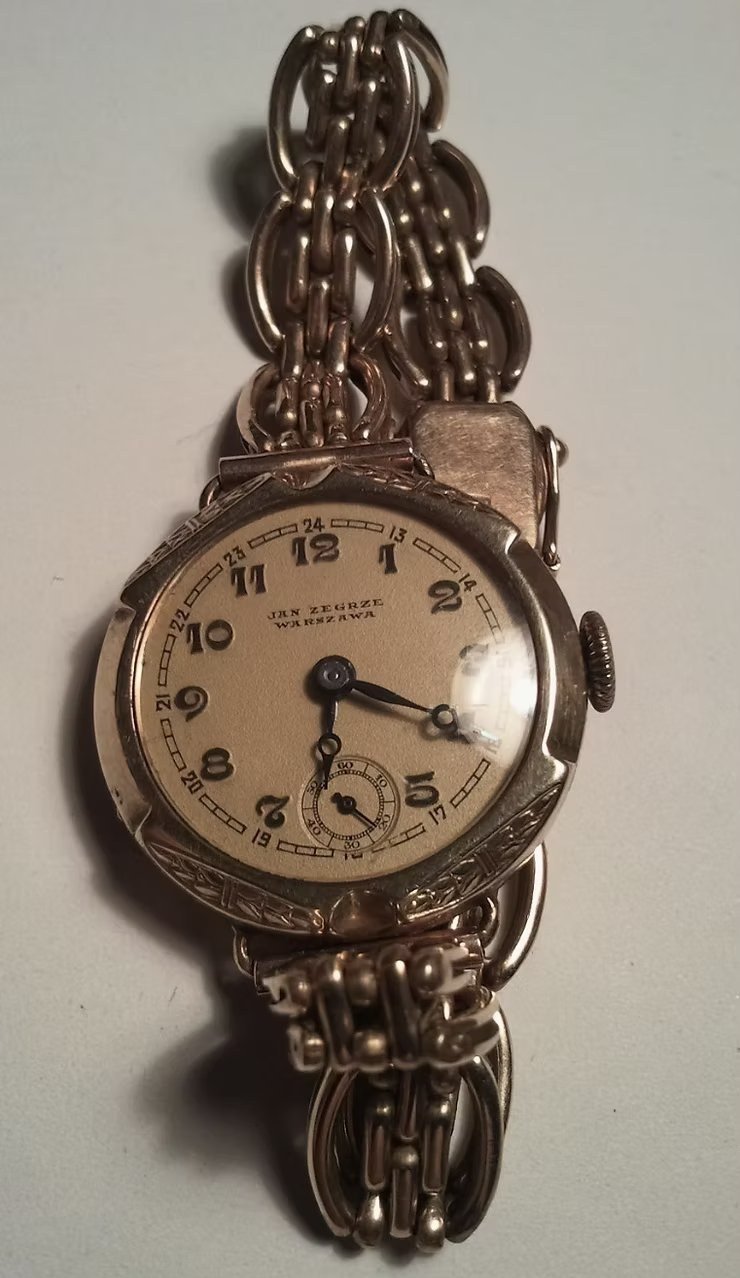
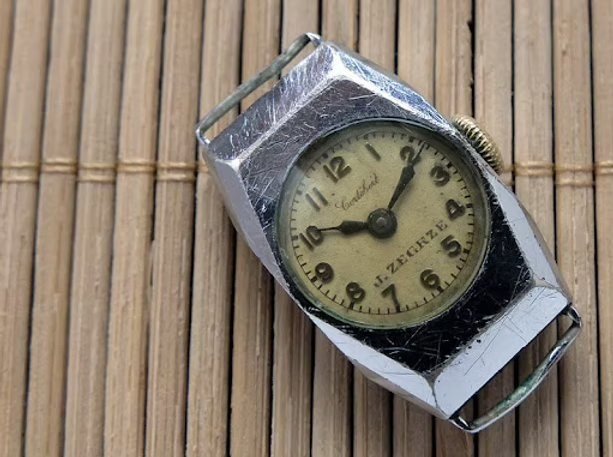
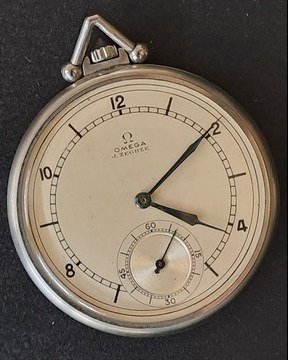
He sold watches of the best Swiss firms — Zenith of Le Locle, Omega of Biel, IWC of Schaffhausen, Cortébert — on whose dials, instead of the maker's brand or beside it, stood the inscription „JAN ZEGRZE WARSZAWA".
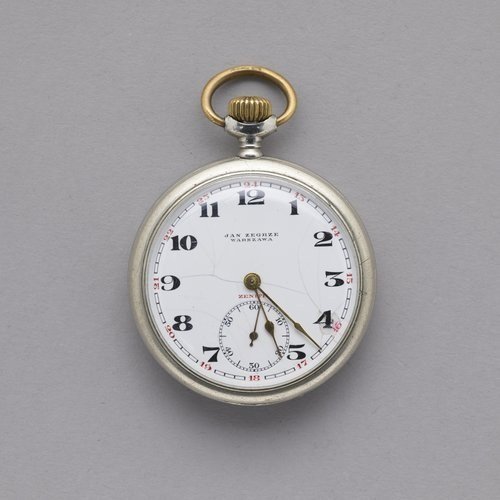
It was the custom of the era: a reputable retailer ordered from the manufacturer series of watches with his own signature and put his name to the goods, a name that meant more to the customer than a foreign brand. Today it is precisely this signature that allows the watches from Nowy Świat 30 to be recognised at auctions and in antique shops — from Warsaw to Geneva.
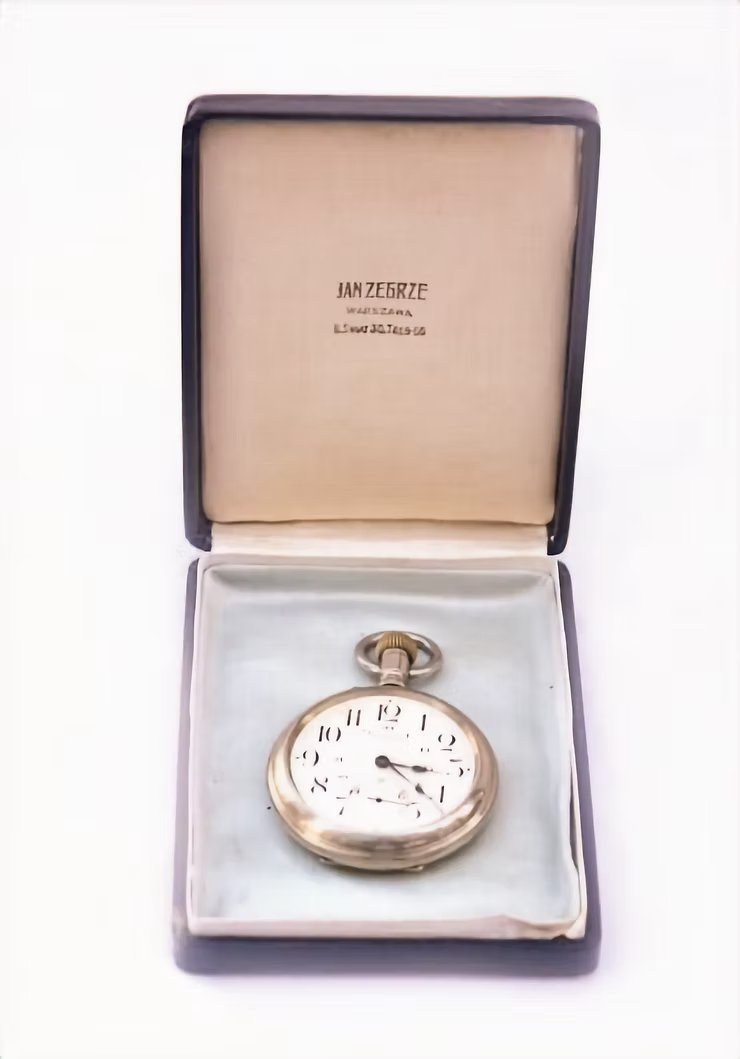
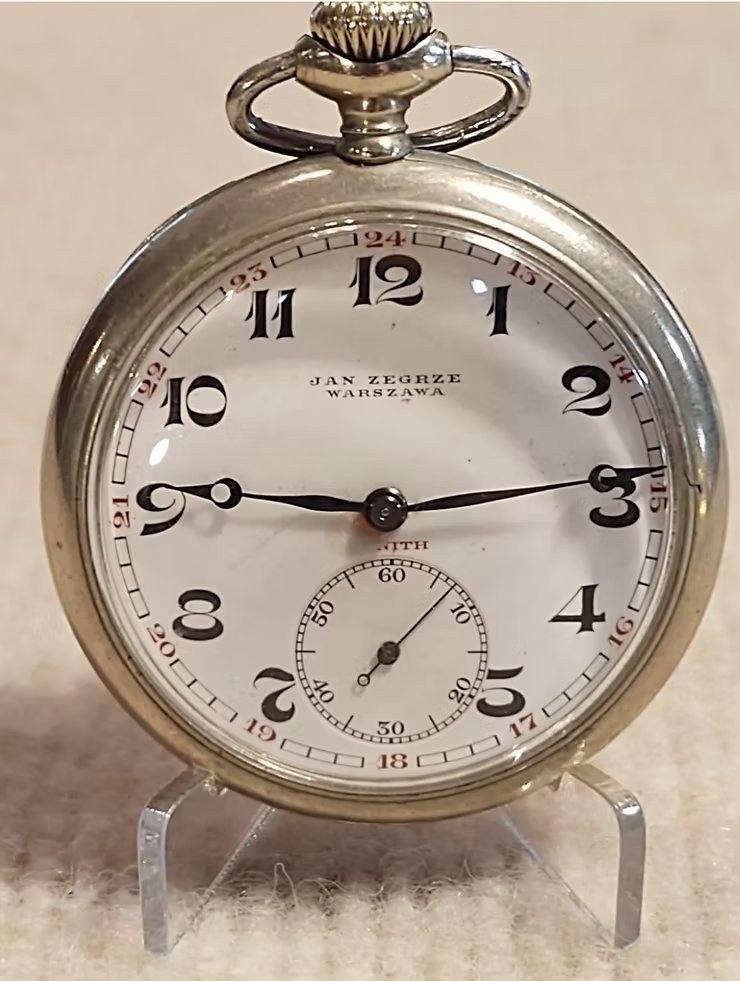
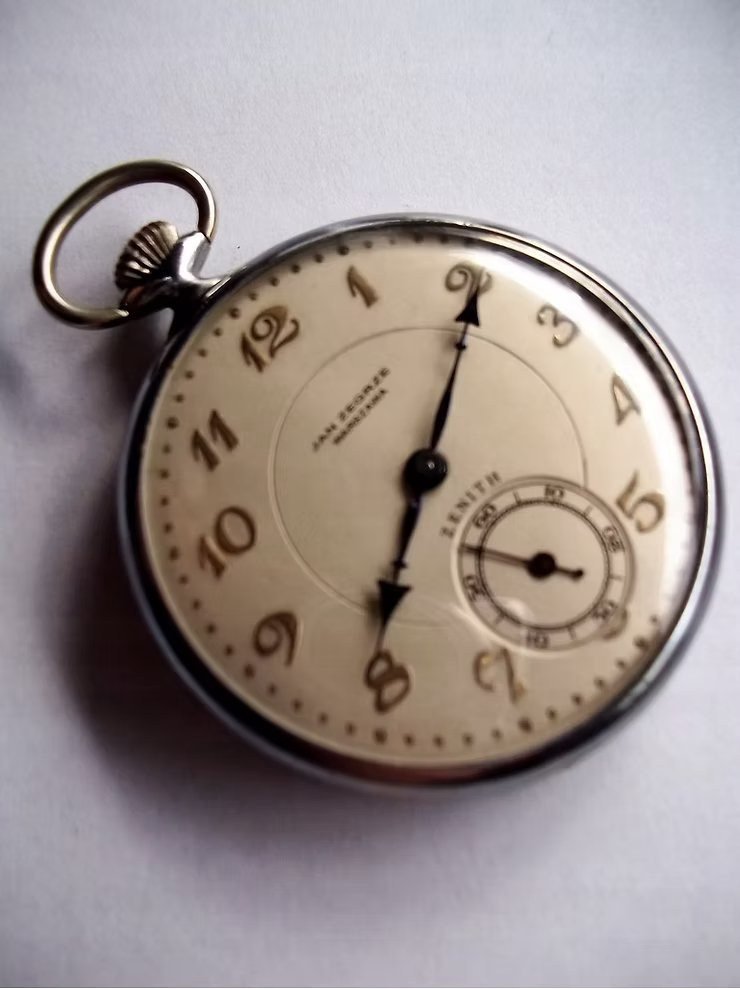
The simplest and probably the most numerous was the firm's Zenith model: a nickel-plated case, a white enamel dial with black Arabic numerals, a red outer scale of hours from 13 to 24 — useful since the railways and public offices had gone over to the twenty-four-hour day — a small seconds hand and the name „JAN ZEGRZE WARSZAWA" beneath the twelve, and above the seconds dial, in smaller letters, „ZENITH". One such watch, in its original navy-blue case stamped „Jan Zegrze, Warszawa, N. Świat 30, Tel. 9-56", is today in the Cabinet of Warsaw Clocks of the Museum of Warsaw. A second, with an identical dial, was recently sold by a Warsaw antique dealer. A third, in a chrome-plated case, already has a more modern metal dial with gilt numerals in the art déco style — testimony to a second generation of orders, from the 1930s.
For demanding customers there was Omega — with a dial on which, above the name Zegrze, stand the Greek letter and the name of the factory — and IWC Schaffhausen. For ladies: gold watches on openwork bracelets, with engraved cases, and cheaper, chrome-plated, rectangular Cortébert watches, on which the name was shortened to „J. ZEGRZE". Today's auctions show this whole range — from a watch for a few hundred złoty to gold.
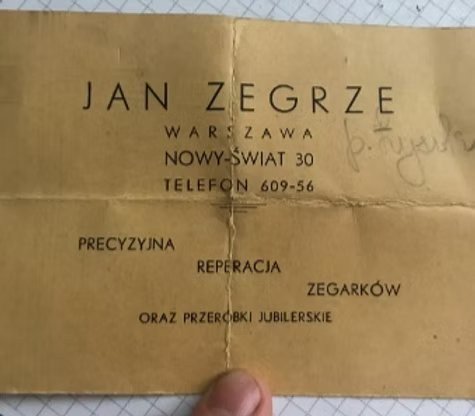
Behind the salon lay the workshop. The firm's business card from the 1930s — with the new six-digit telephone number 609-56 — promised „precision watch repair and jewellery alterations": Jan Zegrze was not only a merchant but also a craftsman who repaired movements and remade old jewellery into new. A guarantee card of 11 May 1937 has also survived, issued for a gentleman's IWC Schaffhausen watch no. 804400: „The firm guarantees the good running and precise regulation of the Swiss watch […] except for damage and breakage of the mainspring". Beneath the text — the owner's handwritten signature. It is the only known autograph of Jan Zegrze today.
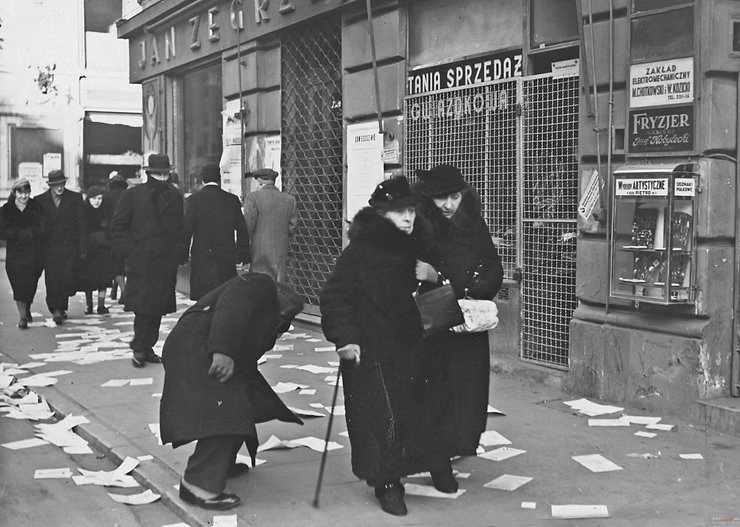
One of the surviving photographs shows the salon in an unusual setting. It is 18 December 1938, a Sunday — the day of the elections to the Warsaw City Council, the first since 1927, in which the Sanacja camp, the socialists, the National Democrats and the Jewish groupings faced one another. Beside the entrance stands a board „Cheap Christmas sale", but the windows are covered by a grille — on election day the shops did not trade — and the pavement and roadway of Nowy Świat are strewn with hundreds of election leaflets; a passer-by in an overcoat bends to gather them, two elderly women walk across this carpet of paper. On the wall, beside the display case, a leaflet of the National Radical Committee with the emblem of the Falanga has been pasted. Next door the signs of the neighbours: the electromechanical workshop of M. Chotkowski and W. Kozicki and the ladies' hairdresser Józef Kobyłecki. It is one of the few photographs in which the door of Jan Zegrze's salon can be seen from street level — and the last known photograph of the salon before the war.
IV. Złota 7 — home
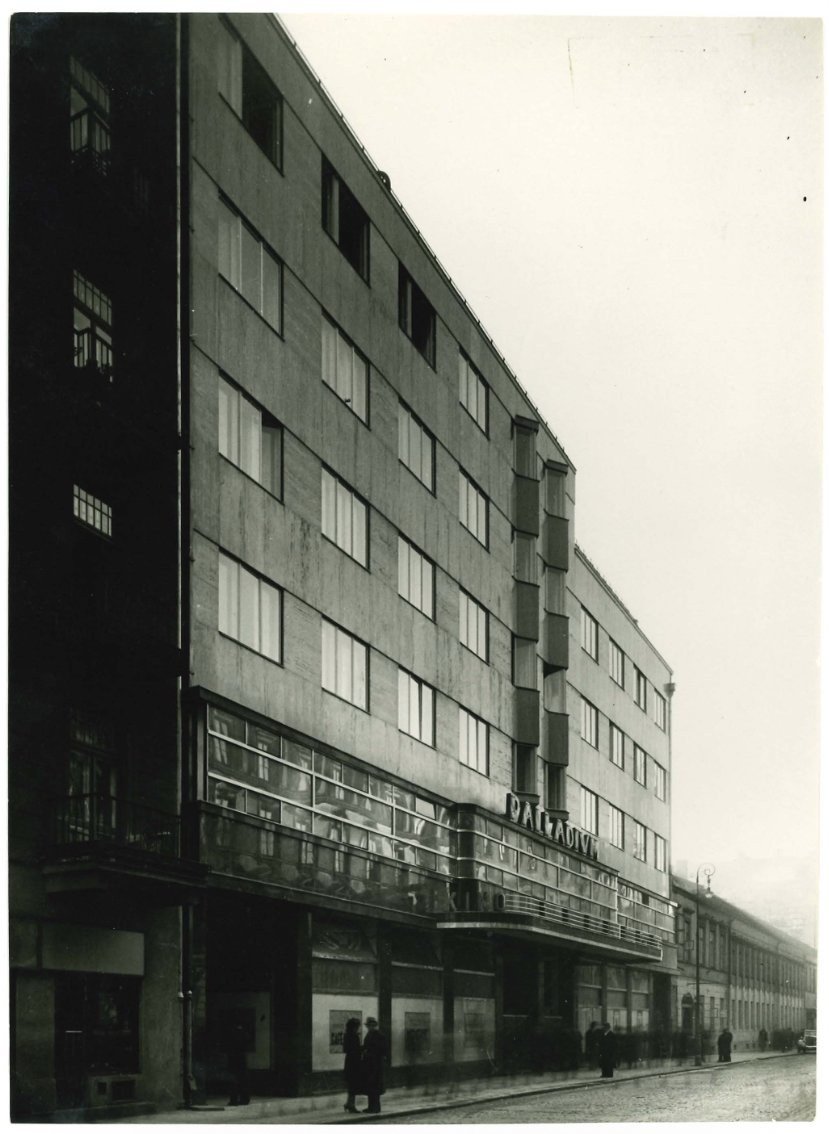
The family lived at 7 Złota Street. The house that stands there today — the modernist building of the Italian insurance company Assicurazioni Generali Trieste, raised in 1935–1937 to a design by E. Eber, with the „Palladium" cinema on the ground floor, Stigler lifts, central heating and mechanical laundries — was one of the most modern residential buildings of pre-war Warsaw. The Zegrzes, recorded at this address in the 1938 directory, were among its first tenants; whether the family had earlier lived in the older buildings under the same number or elsewhere — the sources do not say. In the 1938 directory under Złota 7 appears „Zegrze Jan" without addition — father or son, both Jans — and the family remembers this address as the home of the „patriarch" and the home in which his son grew up. Eryka, Jan's wife, was born on 14 October 1883 as Eryka Genken. Her Polish, full of Russian turns of phrase — „tut" for „tu", „nie znam" for „nie wiem", „ja myślę tak będzie bezpieczniej" — betrays that she grew up in a Russian-speaking home, probably deep in the Empire; after the war in Switzerland she would lodge „with a Russian couple". The children were born in Warsaw: Urszula on 11 December 1910, Jan Władysław — in the family Władek — on 8 November 1913.
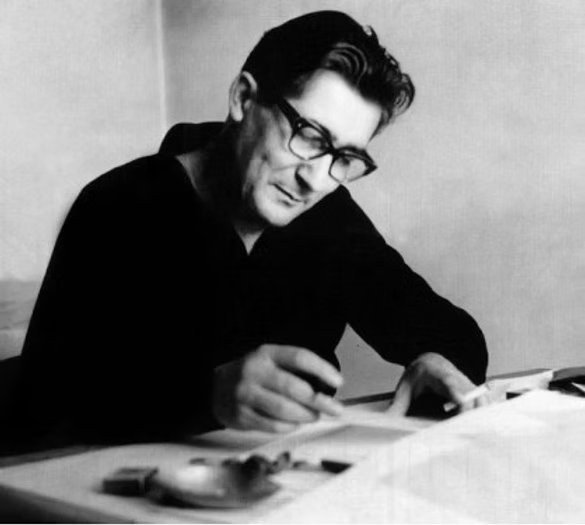
In November 1934 Władek married Hala — a young woman who wrote excellent English and whose book, published after the war in England, would become the only literary trace of this family's fate. In 1936 Urszula married Božidar Rašica, an architecture student from Yugoslavia, born in Ljubljana on 28 December 1912 into a Serbian family, who after studies in Rome and Belgrade was then studying in Warsaw. After the war he would become one of the most important architects of Croatia: a co-founder of the avant-garde group EXAT 51, designer of the Zagreb hippodrome and the pavilions of the Zagreb Fair, author of the rebuilding of the Croatian National Theatre in Zagreb and Split, professor of the Faculty of Architecture, painter and stage designer who designed sets for Covent Garden in London, Rockefeller Center in New York and the Schiller Theater in Berlin, laureate of the Vladimir Nazor Award.
By the 1938 directory Jan Zegrze's firm already had a dozen or more years on Nowy Świat behind it, two telephone numbers — the old „9-56" and the new „609-56" — and an established position. Jan had grown-up children, an architect son-in-law and a daughter-in-law who wrote. He was in his fifties. It was the last quiet year.
V. September 1939 — a bomb on the corner
In September 1939, during the German air raids on Warsaw, a bomb struck the corner of Spitzbarth's building. It destroyed the corner of the building down to the foundations — together with the salon of Jan Zegrze.
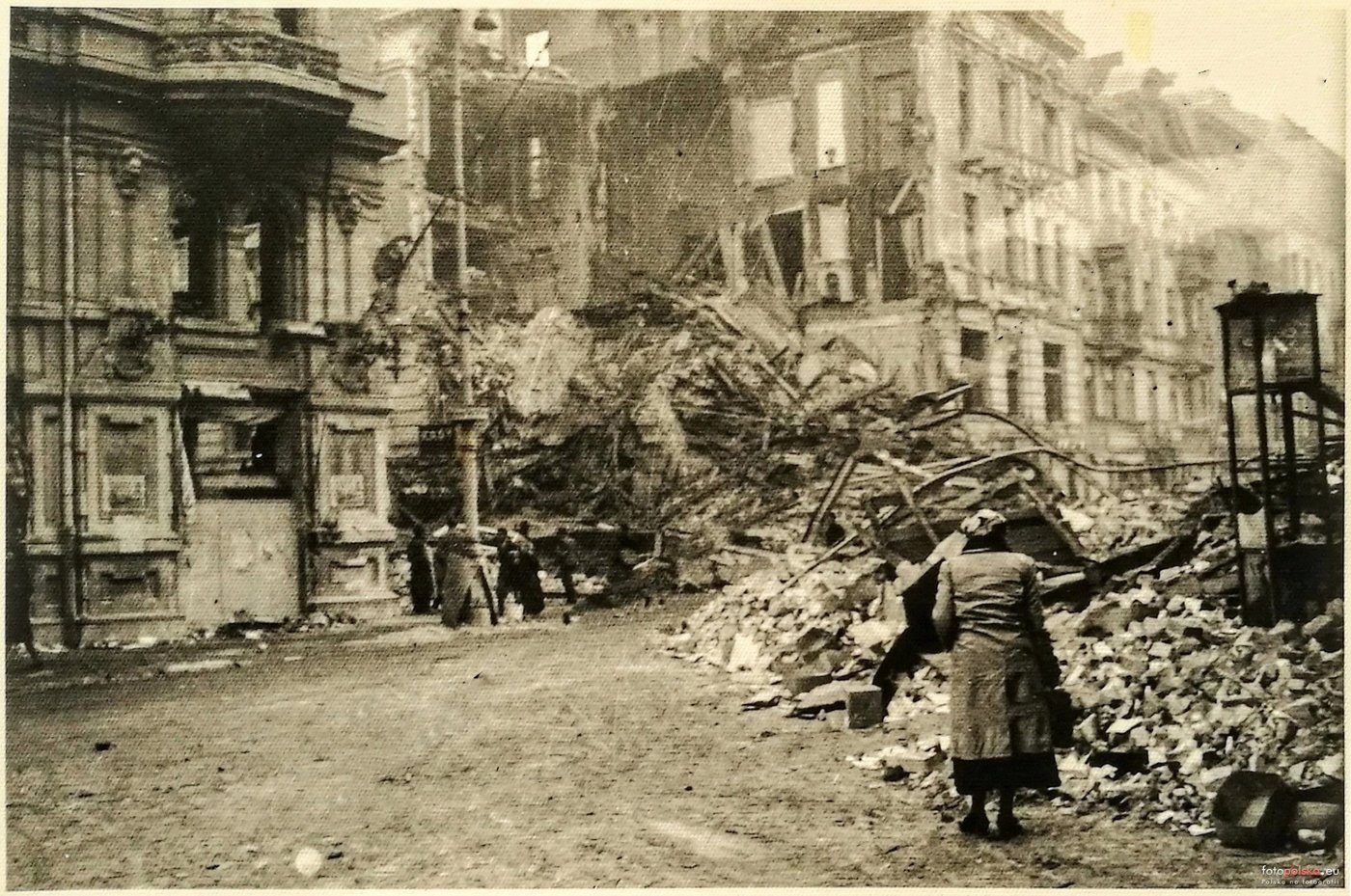
In a single moment everything that for twenty years had made up the firm „Jan Zegrze, Nowy Świat 30" ceased to exist: the shop windows and the sign, the clock over the entrance, the display cases with Zenith, Omega and IWC watches, the diamonds „of various sizes", the table silver and plate, the jewellery taken on commission, the workshop with its tools and the customers' watches left for repair, the ledgers, the guarantee card-index, the stock of the firm's cases. A life's work turned into a heap of bricks, beams and sheet metal, which a photograph of October 1939 shows lying across the pavement and the roadway — with the exposed interiors of the flats on the upper floors, the walls of rooms and windows without panes, and a crowd of Varsovians in hats gazing at the ruin.
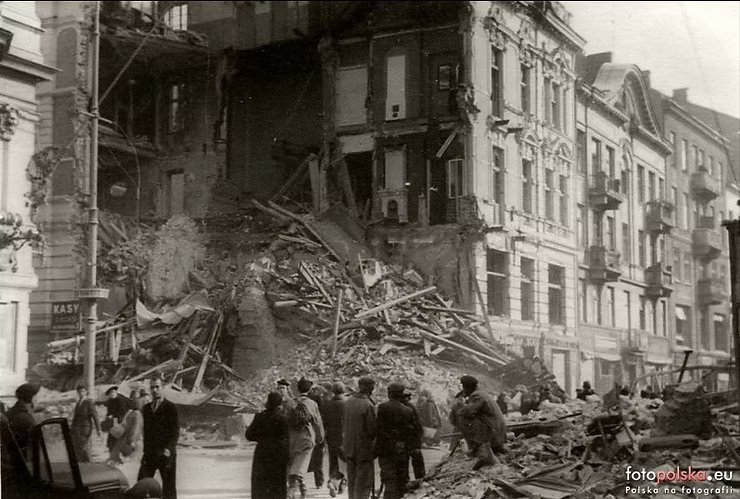
It is not known whether Jan Zegrze managed to salvage anything, or whether anyone paid him compensation; in occupied Warsaw a Jewish merchant no longer had anyone to turn to for it. The building finally burned in 1944; after the war its surviving walls were rebuilt and raised. Today a café occupies the site of the former salon.
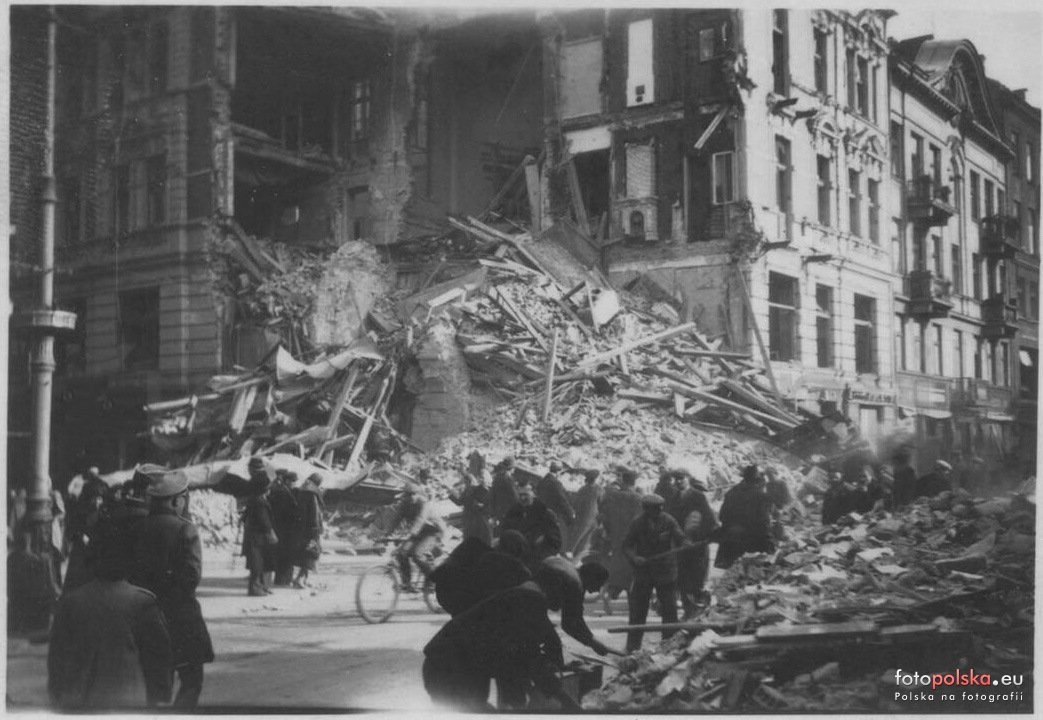
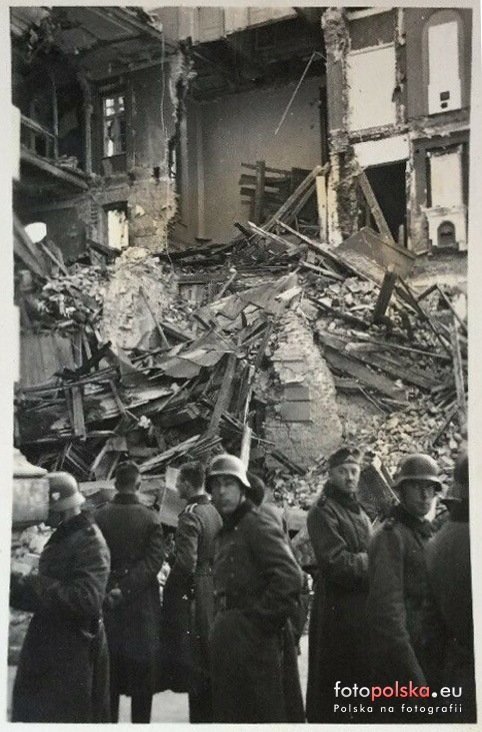
A ruin on the city's most prestigious street drew onlookers and photographers — including those in uniform. Varsovians cleared Nowy Świat with their own hands, picking bricks and boards from the heap, while cyclists rode past. German soldiers photographed the bombed corner like a curiosity: first standing on the rubble, with the exposed interiors of flats above their heads, then — when the roadway had been cleared and the traffic of horse-cabs, carts and pedestrians had returned to the street — marching in a group of five down the middle of Nowy Świat against the backdrop of the gutted building. On the post by the corner the pre-war sign „Kasy" still hung, directing to the ticket offices at 3 Kopernika Street. The place where Jan Zegrze's firm clock had stood is, in these photographs, an empty gap.
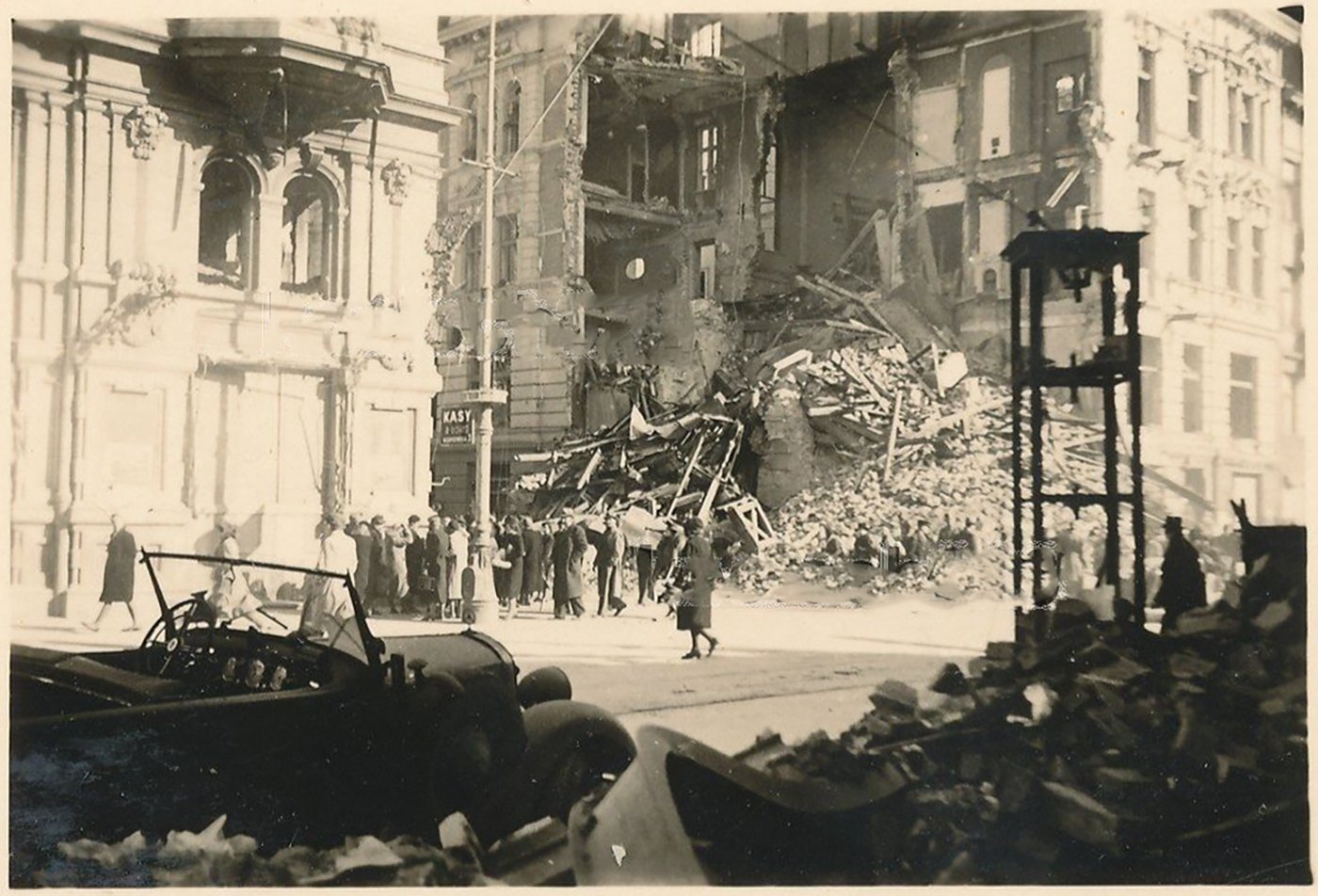
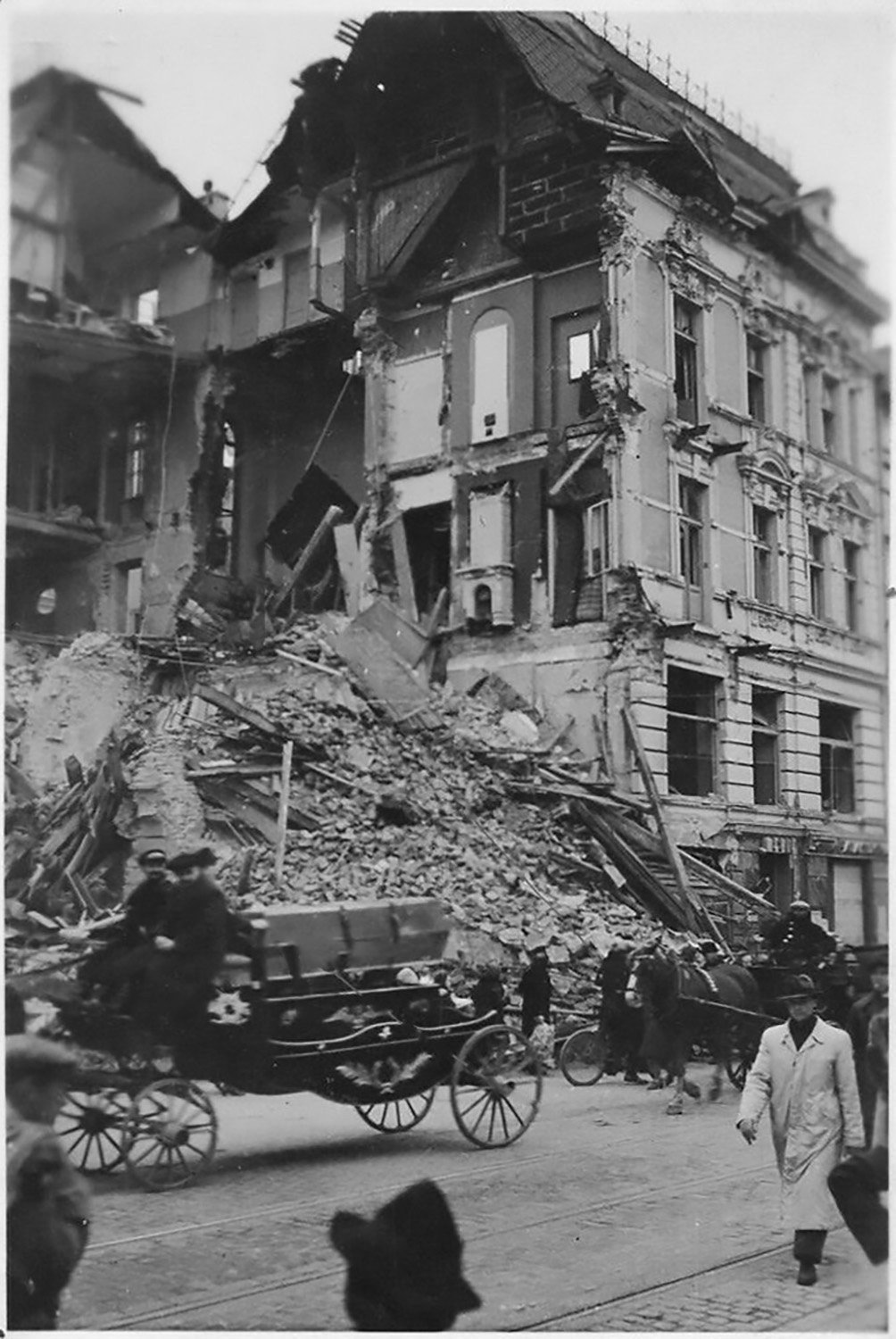
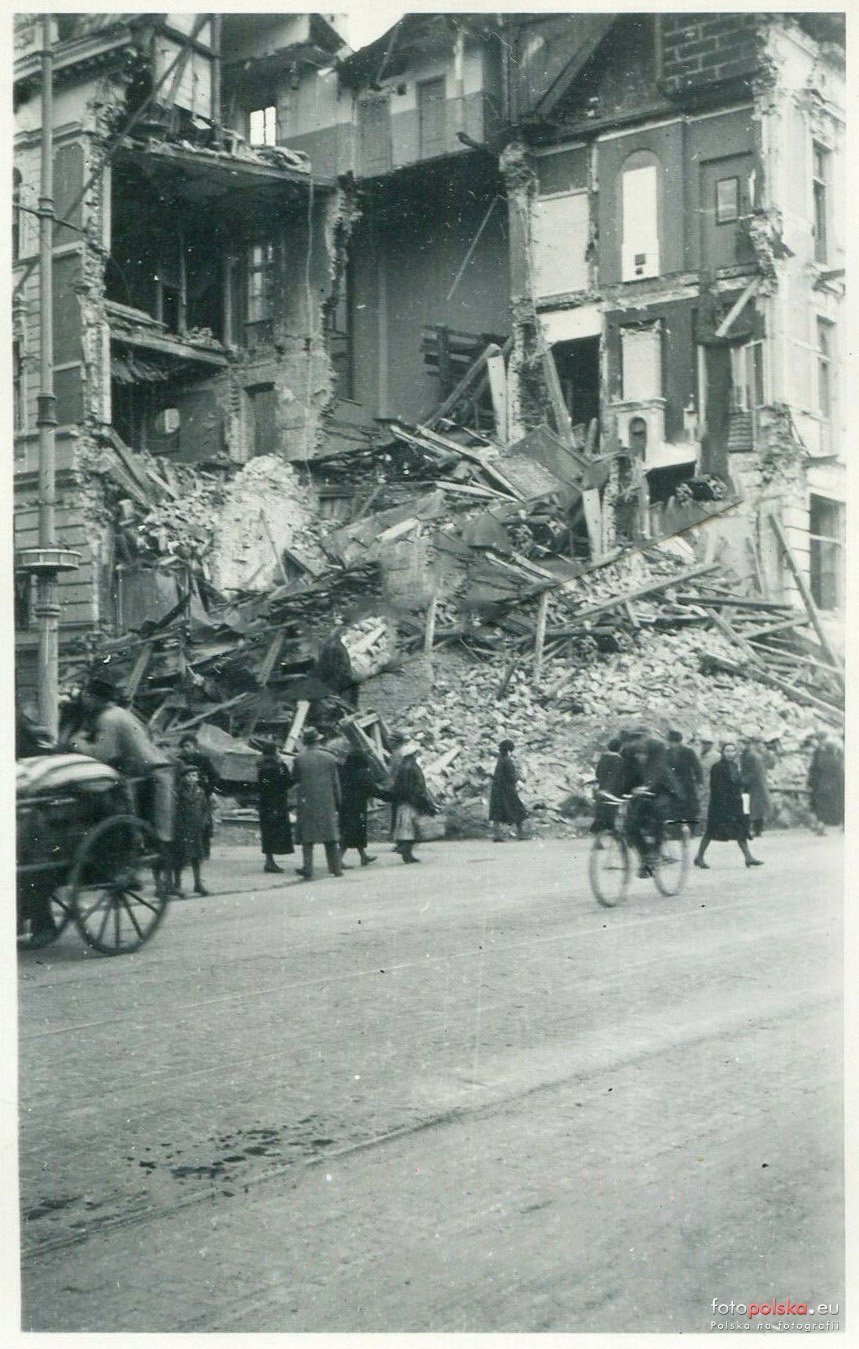
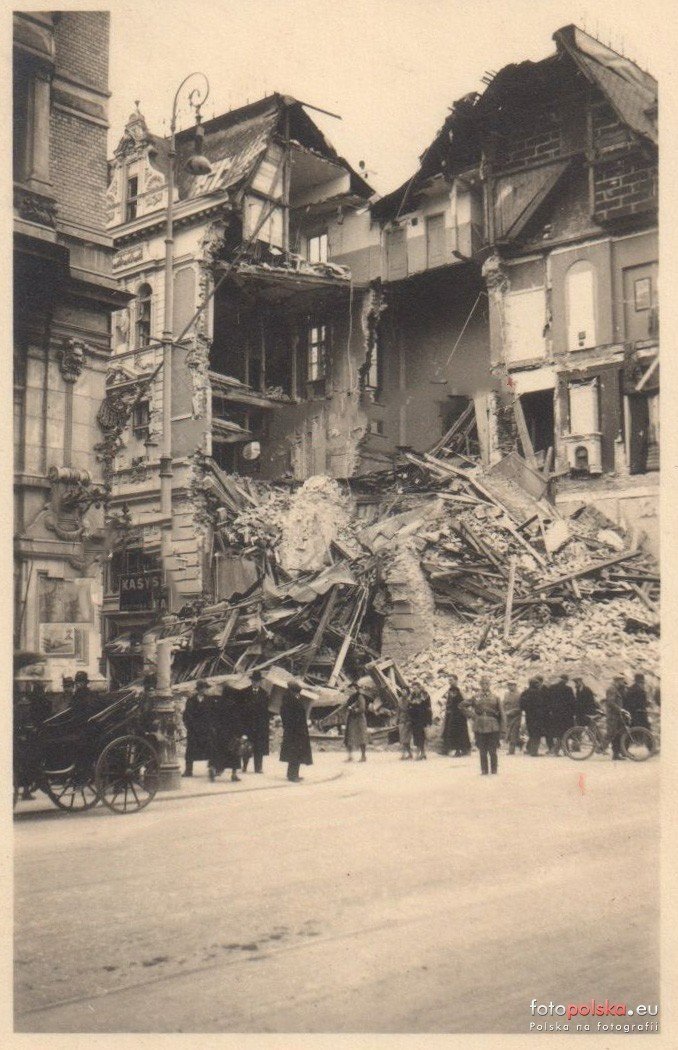
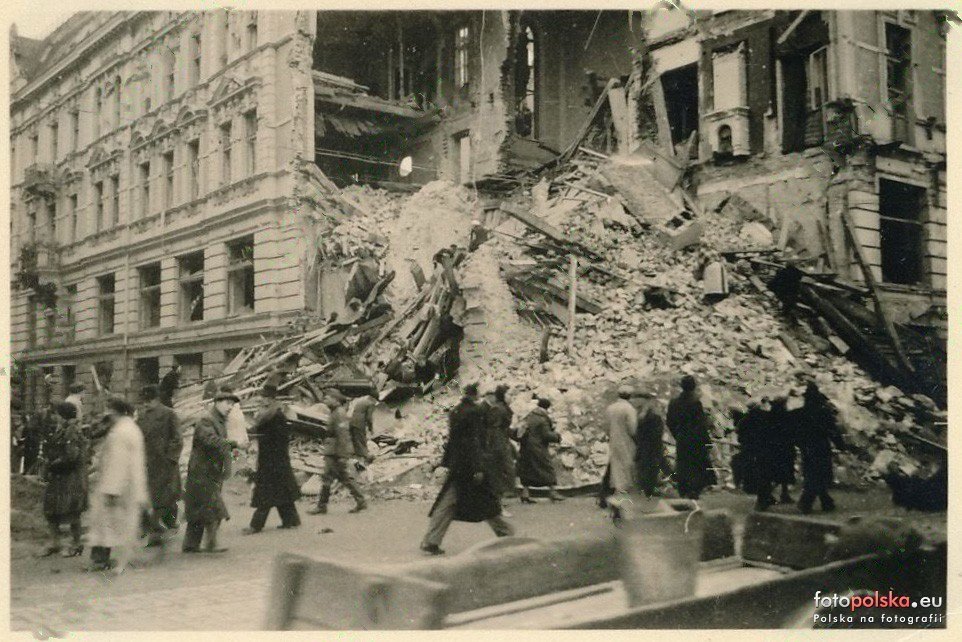
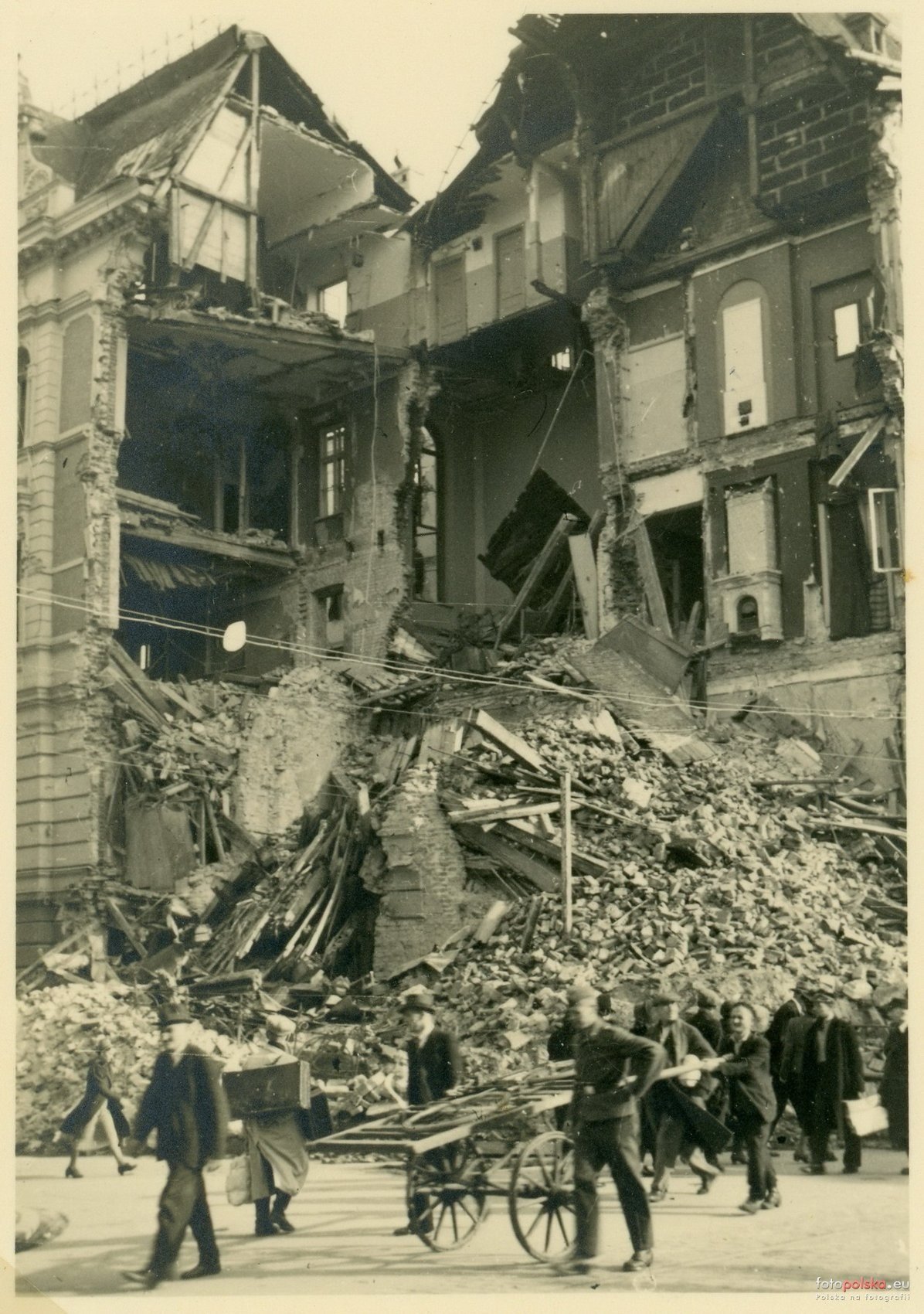
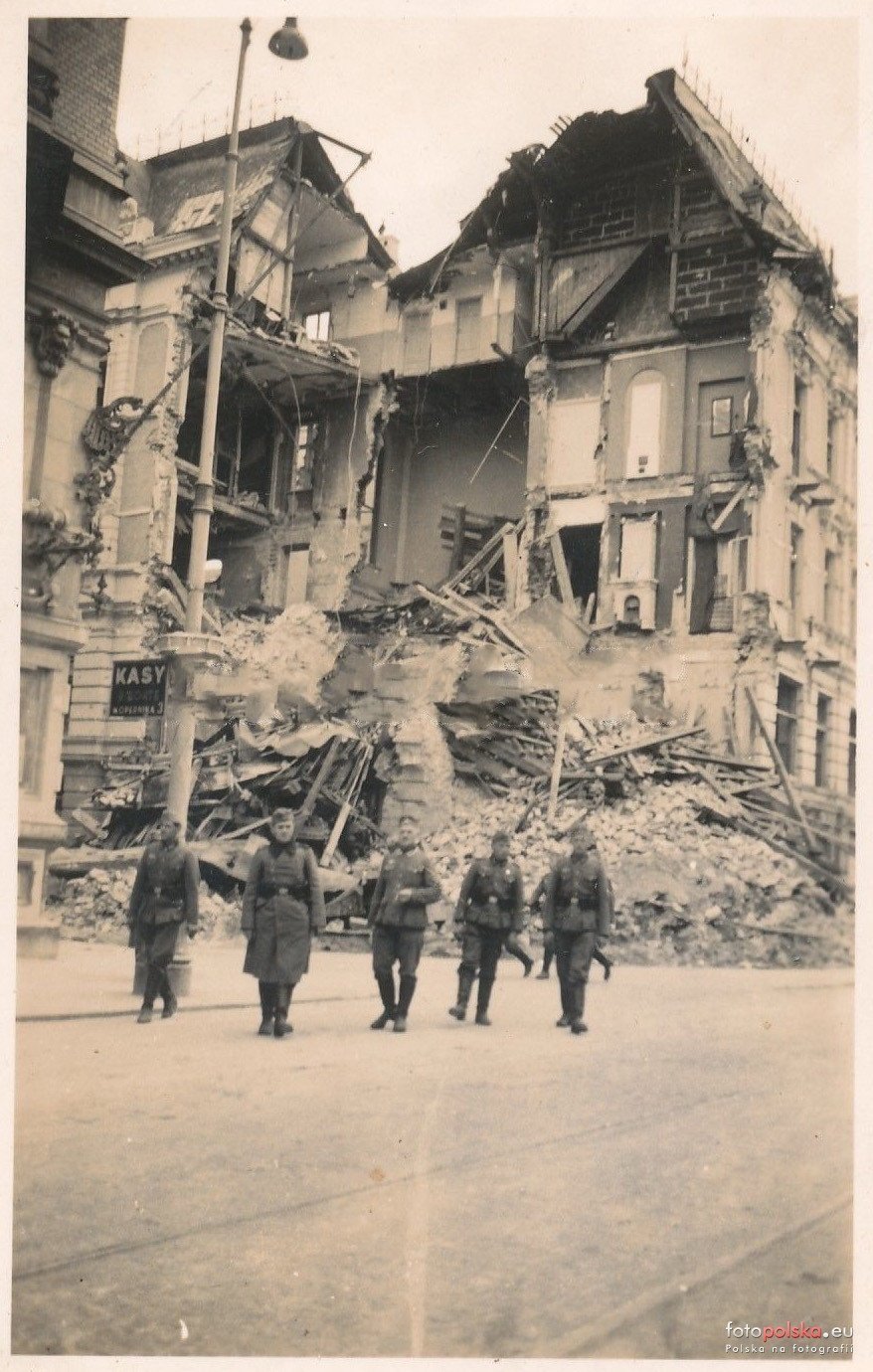
With the shop ended everything that Jan Zegrze had built over twenty years. What became of the man himself we know only from family tradition — and that tradition, repeated independently by two branches of the family, in America and in Geneva, agrees: he was shot dead by the Germans in the street, at the beginning of the occupation. We do not know the day or the place. No one recorded his name in any register of victims, no one submitted a testimony about him to Yad Vashem. When Eryka wrote in November 1946 of „her loneliness", she did not mention her husband with a single word — as one whose loss had long been self-evident.
VI. 19 June 1940 — Bordeaux
In the visa register of the Portuguese consulate in Bordeaux, under the date 19 June 1940, stand two consecutive names: number 2237 — Zegrze Jan, number 2238 — Zegrze Helena. The neighbouring entries — Polakov, Ehrlich, Laufer, Popperová, Zwillinger, Székely — are refugees from Poland, Czechoslovakia and Hungary who in those days, as the Wehrmacht was occupying Paris, converged on Bordeaux from all over France. The visas were issued by Aristides de Sousa Mendes — the consul who in those days, against the express orders of Salazar's government, was signing transit visas for thousands of people fleeing the advancing German army.
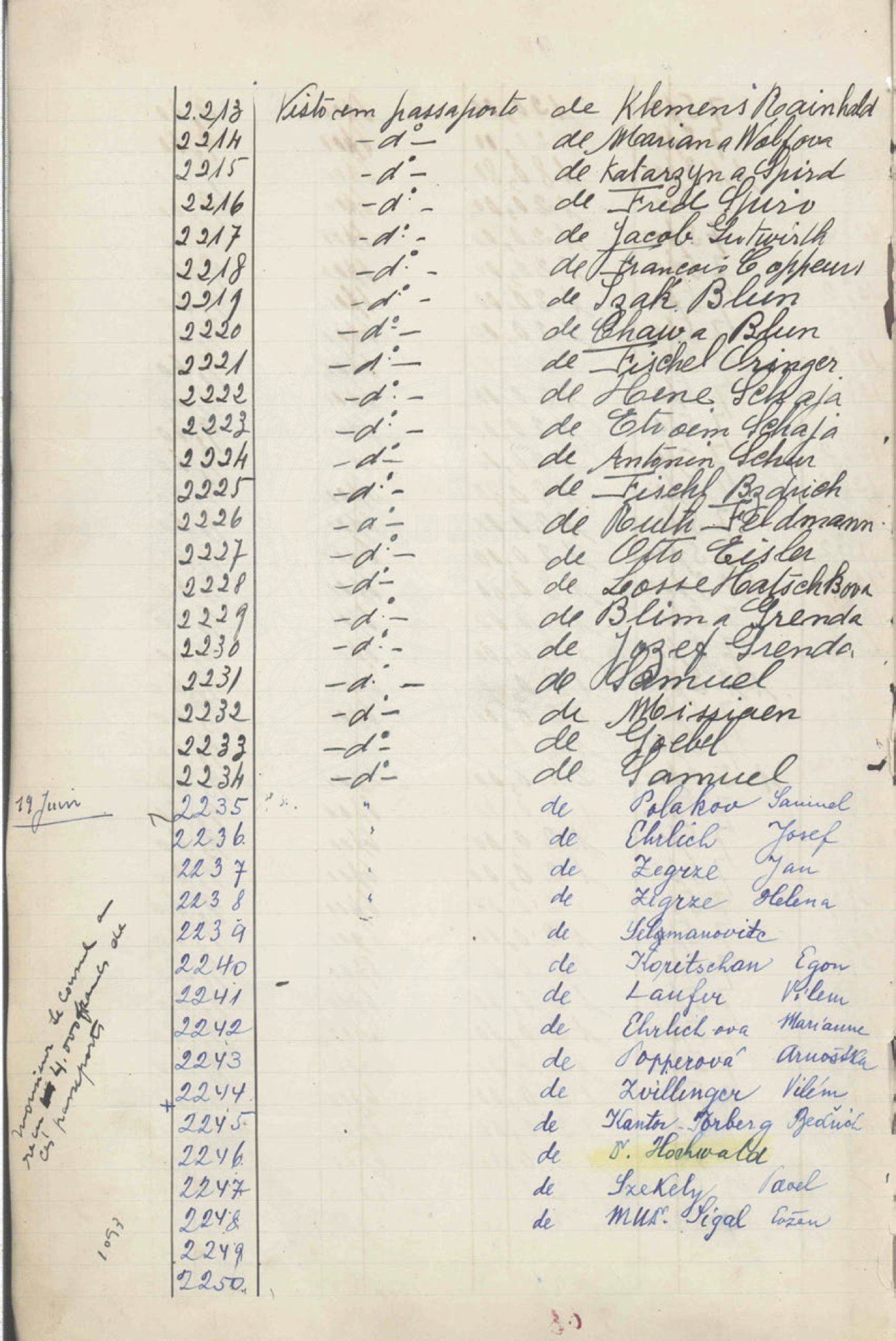
Who were „Jan and Helena"? For a long time it was thought they were Jan Zegrze and his sister. Everything, however, points to someone else. The sister Helena had for years borne the name Lewinstein, had grown-up daughters and stayed in Warsaw — she survived the war and died in Warsaw in 1966. Whereas „Hala", Władek's wife, is a diminutive of Halina or Helena. Two consecutive visas for a Zegrze married couple — twenty-six-year-old Jan Władysław and his wife — fit coherently with what followed: Hala's book about the flight from Poland and Władek's London address. The father, as the family says, perished in Warsaw. The son — with a Portuguese visa in his passport — reached England by way of Spain and Lisbon.
VII. Aristides de Sousa Mendes — the consul who did not obey
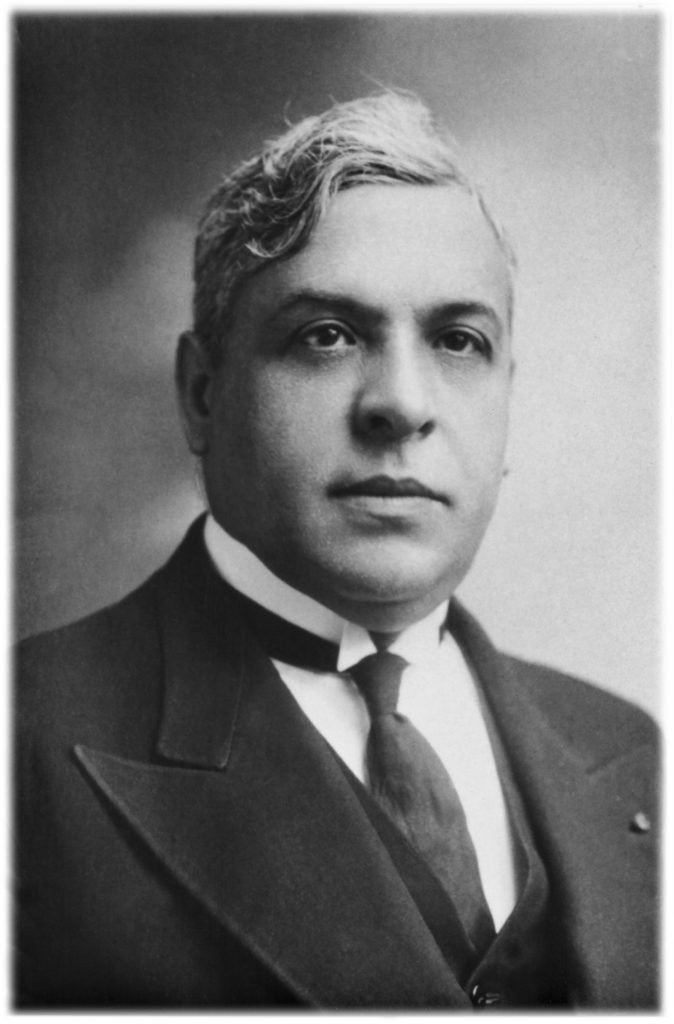
Aristides de Sousa Mendes do Amaral e Abranches was born on 19 July 1885 in Cabanas de Viriato in central Portugal, into a landowning and deeply Catholic family, together with his twin brother César. Their father was a judge of the court of appeal in Coimbra. Both brothers graduated in law from the University of Coimbra in 1908 and both entered the diplomatic service. Aristides represented Portugal for three decades in British Guiana, Zanzibar, Brazil, San Francisco, Spanish Vigo and Antwerp; with his wife Angelina he had fourteen children. César was minister of foreign affairs in Salazar's first government in 1932, and in 1939 became consul in Warsaw — in the city from which the Zegrze family was fleeing.
In 1938 Aristides took over the consulate general in Bordeaux, with jurisdiction over the whole of south-western France. On 11 November 1939 Salazar's government sent to its missions „Circular No. 14": without Lisbon's consent no visas were to be issued to „Jews expelled from their countries of origin", to stateless persons or to anyone who could not freely return whence he came. Sousa Mendes broke this prohibition almost from the start — the first visa against the circular he issued as early as 28 November 1939, to an Austrian historian stripped of his citizenship by the Nuremberg laws — and received from Lisbon a written warning that a further offence would end in disciplinary proceedings. In the spring of 1940, as the Wehrmacht marched on Paris, Bordeaux was flooded by a wave of refugees from Belgium, the Netherlands, Luxembourg, France and Poland; thousands of people camped before the consulate on the Quai Louis XVIII.
The turning point came in mid-June. The consul met in the street the Hasidic rabbi Chaim Kruger — a native of Nasielsk, a fugitive from Brussels — and offered him a visa for his wife and five children. Kruger refused: he would not accept a rescue that was denied to his „brothers and sisters" in the streets of Bordeaux. Sousa Mendes shut himself for several days in his flat; his son Pedro Nuno recalled that his father lay in bed as if broken. Then he rose and declared to the family: „From now on I am giving visas to everyone. There will be no more nationalities, races or religions". His son-in-law and daughter begged him not to do it. He answered: „I would rather stand with God against men than with men against God". In the consulate he organised an assembly line: he signed, his wife, his sons, the secretary José Seabra and Rabbi Kruger himself filled in and stamped. When the forms ran out, passports and loose sheets were stamped. The day on which Jan and Helena Zegrze were entered in the register under numbers 2237 and 2238 — 19 June — fell in the middle of this operation; that same night German aircraft bombed Bordeaux.
After the bombing the consul drove to Bayonne, where the local consul was refusing visas, and began issuing them there himself, and then on to Hendaye on the Spanish border. The Portuguese ambassador in Madrid, Salazar's envoy, telegraphed to Lisbon that Sousa Mendes „had lost his mind", and annulled his signature; the Spanish border guards were ordered not to honour visas from Bordeaux. The consul then led a group of refugees turned back with nothing to a distant frontier post that had no telephone yet, and brought them across the border behind his car with its diplomatic plates. On 24 June Salazar recalled him to Portugal.
How many people he saved — historians argue to this day. The surviving Bordeaux register records 2,862 visas from January to July 1940; to these are added the countless visas from Bayonne, Hendaye and Toulouse. The Sousa Mendes Foundation has established the names of more than 3,900 recipients and estimates their total number in the tens of thousands; the historian Yehuda Bauer called it „perhaps the largest rescue operation carried out by a single individual during the Holocaust". Among those saved were Otto Habsburg and his family, Salvador Dalí, the „Casablanca" actors Marcel Dalio and Madeleine Lebeau, Hans and Margret Rey — the creators of „Curious George" — and a substantial part of the Polish emigration: Julian Tuwim with Stefania, Antoni Słonimski, Grzegorz Fitelberg, Witold Małcużyński, Ludwik Rajchman, the future founder of UNICEF, Marian Dąbrowski. Portugal — neutral, with the port of Lisbon — was for all of them the gateway to England and America.
In Lisbon disciplinary proceedings awaited him. The charges: breach of Circular 14, issuing visas free of charge, the order to the consulate in Bayonne, „conduct bringing discredit on Portugal in the eyes of the Spanish and German authorities". In his reply of 12 August 1940 he wrote: „My aim was to save all those people, whose suffering was indescribable […]. I could not make distinctions between nationalities, because I obeyed the command of humanity, which knows neither race nor nationality". On 30 October 1940 Salazar personally meted out the punishment: a year's suspension on half pay and forced retirement; the case file he ordered sealed. The unofficial punishment was heavier — a ban on practising as a lawyer and social ostracism; the children could not find work in Portugal and scattered across the world. The family ate in the soup kitchen for the poor of the Lisbon Jewish community. When it was pointed out to him that the kitchen was for refugees, he replied: „We too are refugees". The family home in Cabanas de Viriato, Casa do Passal, was sold to creditors. Aristides de Sousa Mendes died on 3 April 1954 in the Franciscan hospital in Lisbon, in poverty and disgrace; he was buried in a Franciscan habit because he had no suitable clothing of his own. He never regretted it: „I could not have acted otherwise, and therefore I accept with love all that has befallen me". He charged his children to clear his name.
Justice came late. In 1966 Yad Vashem recognised him as Righteous Among the Nations — the first diplomat so honoured; in Salazar's Portugal, however, his name still did not exist. Only after the Carnation Revolution did democratic Portugal award him the Order of Liberty in 1987, and on 18 March 1988 parliament unanimously dismissed all the charges and restored him to the diplomatic corps, rising from its seats. President Mário Soares called him „the greatest Portuguese hero of the twentieth century". In 2017 the Bordeaux visa registers — the same in which the Zegrze family appears — were inscribed on the UNESCO „Memory of the World" register. In 2020 Sousa Mendes received the honours of the National Pantheon in Lisbon, in 2022 the President of Poland decorated him posthumously with the Virtus et Fraternitas medal for rescuing Polish citizens, and on 19 July 2024, on the anniversary of his birth, his museum was opened in the rebuilt house in Cabanas de Viriato. His twin brother César, who in Warsaw in 1939 helped refugees and who after the war vainly petitioned Salazar to lift the punishment, was honoured with the Virtus et Fraternitas medal by the Pilecki Institute.
VIII. 1940–1943 — Boduena 3
As Władek and Hala were crossing the Pyrenees, in Warsaw the ring was tightening around the rest of the family. In the autumn of 1940 the Germans closed the ghetto. Leon Zegrze, his second wife and their son Ryszard found themselves behind the walls. Ryszard — a fifteen-year-old — attended drawing courses in the ghetto; his name has survived in the documents of those courses, as the trace of a boy who in spite of everything wanted to learn. In 1943 all three were deported to an extermination camp and perished. Maria, Helena's daughter, perished too, murdered in Treblinka in 1943. The building at 3 Boduena Street did not survive the war; in the 1980s there was an empty plot on the site, today the building of the Supreme Administrative Court stands there.
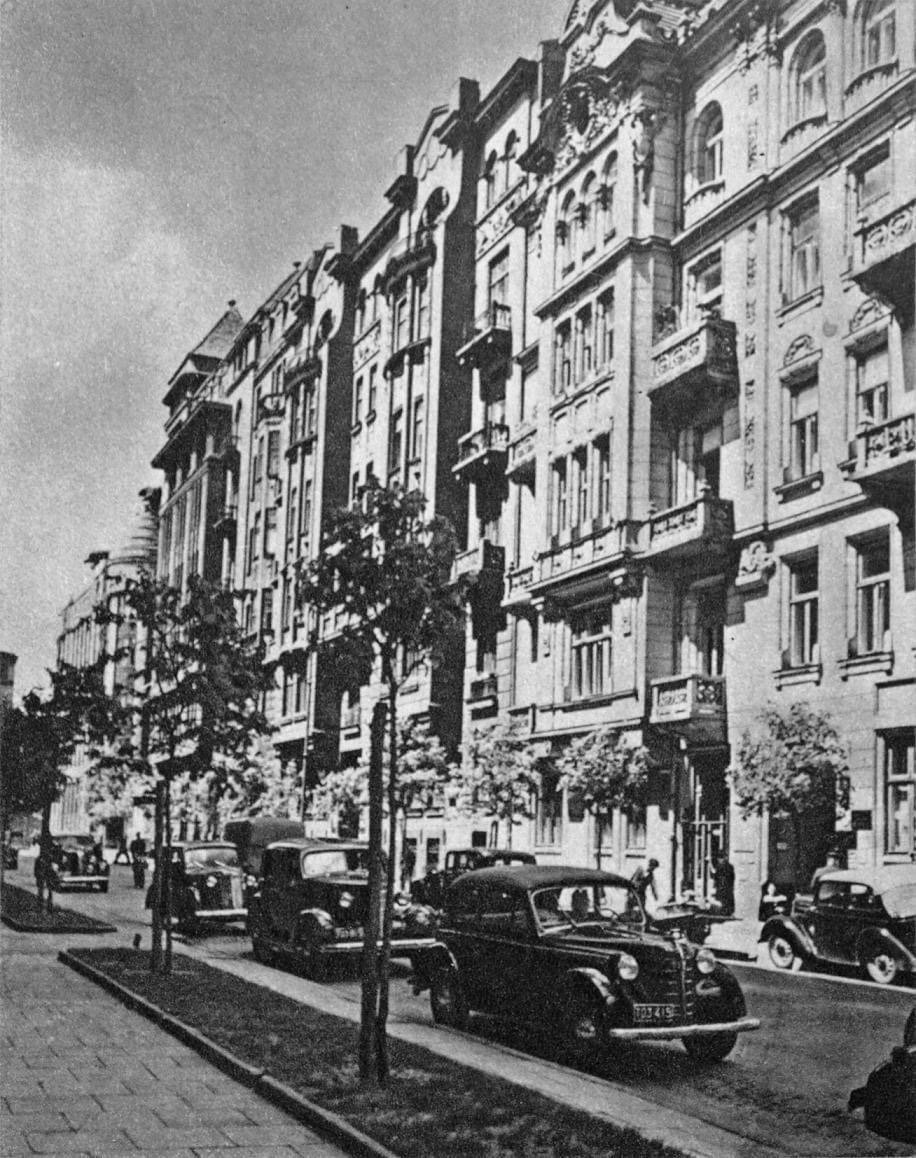
Tadeusz survived — a student in France who escaped from an internment camp and by way of Portugal reached Canada, because the United States refused him entry; he came to Poland for the first time only in the 1980s. All his life he kept the letters from his younger brother Ryszard and a letter from the housekeeper who after the war described to him the family's fate. Helena survived, who after the war lived in Warsaw with her daughter Roma and granddaughter Joanna — and who, as the family recalls, often spoke of her beloved brother Jan of Złota 7. She died in Warsaw in 1966.
IX. January 1946 — „Escape"
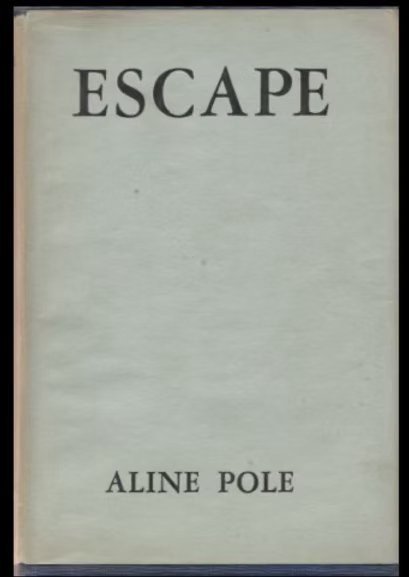
In January 1946 a book appeared in England: „Escape". On the modest grey-green cover, typical of the years of paper rationing, stood only the name Aline Pole: Halina, a Pole. Under this pseudonym Hala Zegrze described, with the names changed, her family's road from Poland to the West — through the France of the summer of 1940, the same road taken by thousands of people with visas from Bordeaux. Joan Zegree's father, Tadeusz, searched for this book for years, before the internet age; his daughter found it online after his death and bought it. To this day it is not known who published it, or how much of it is literature and how much testimony.
X. 17 November 1946 — a letter from Montreux
In November 1946 Hala was in Switzerland, at Chillon near Montreux, with her mother-in-law. From there on 17 November she sent to Tadeusz Zegrze — her husband's cousin, who already lived with his wife Lila in America — a letter in two parts. The first, in English, she wrote herself. She thanked him for the wishes on the twelfth anniversary of her wedding — „yes, twelve years have already passed!" — and explained that this was „a business letter", written on behalf of her mother-in-law: at a bank in Lausanne Eryka had been told that her jewellery could be transferred to a branch in America. Could she then obtain an affidavit for herself? Could that deposit serve as a guarantee „for Urszula and Boško"? How much had to be deposited per person to obtain entry to the States? Hala was leaving at the end of the month for London, to her husband; from 1 December Eryka was to live in Lausanne, at 10 Avenue Juste-Olivier, with a Russian couple she had met there.
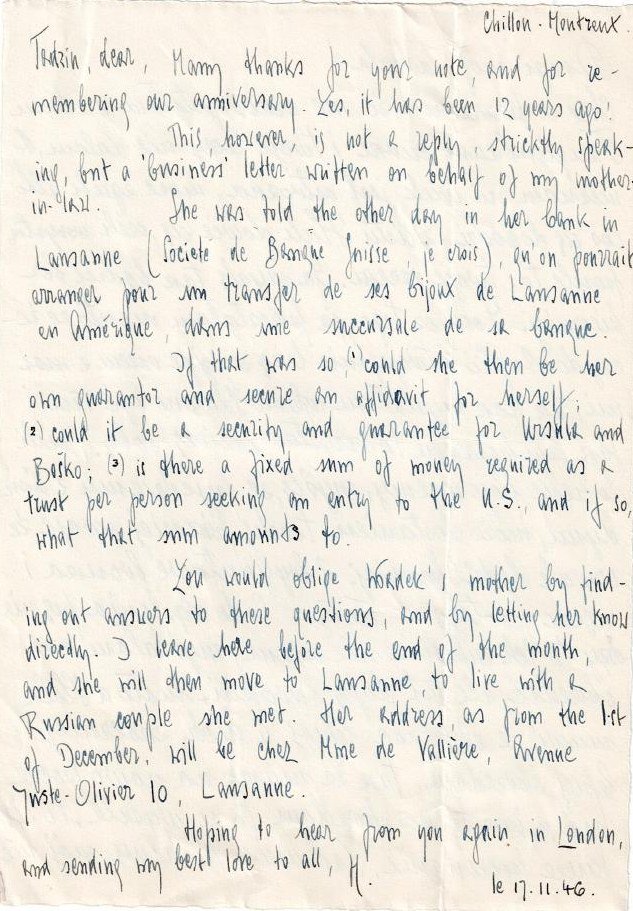
The second part, in Polish, was written by Eryka — three pages in a small, even hand. It is the letter of a woman who has lost everything but a few jewels and who waits for news of her scattered children. She explains why she did not send Tadeusz his things through an acquaintance: „because I don't know how careful she is, she may lose them". Some of the valuables — „2 diamond brooches and a gentleman's gold cigarette case" — she had already sent to a safe in England and would hand over when she went there herself: „if we go to you, I think we will go from London". She has no money: „I thought of selling something, but here they give terribly little, and Hala says it's better to sell over there". Of her daughter: „That you have no letters from Urszula, I know, because she wrote me a single word: that I cannot write to Tadzio. I am very sorry. And why — I don't know. […] And since then I have had no letter for 10 days now. I am as if on fire, all sorts of thoughts come". Of her son: „Władzio wrote me that he doesn't know whether he will be able to send me food parcels" — Władek from London, himself living in a country of ration cards, was sending his mother parcels; „Hala told me about the food there — it really is terrible".
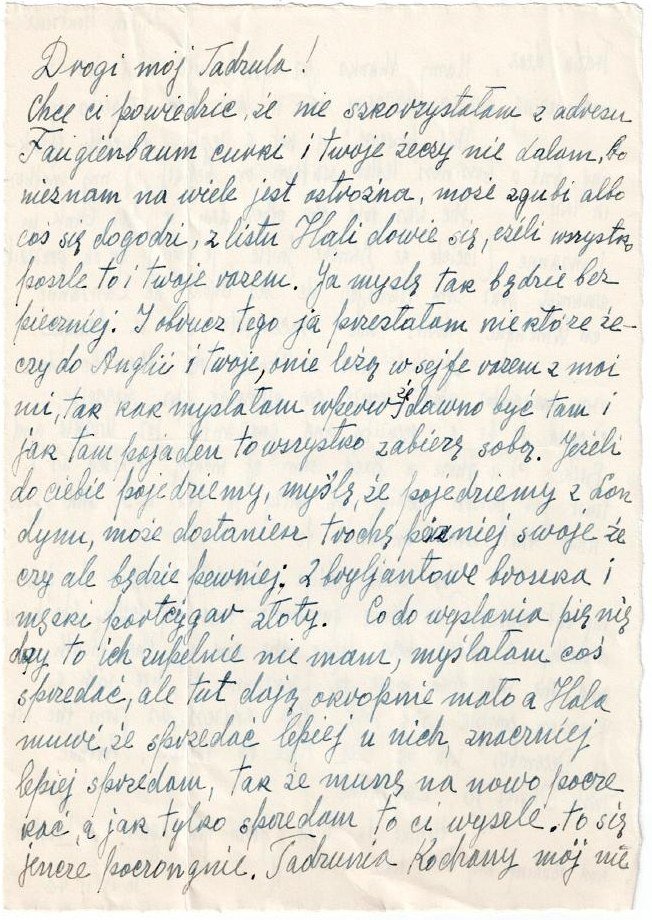
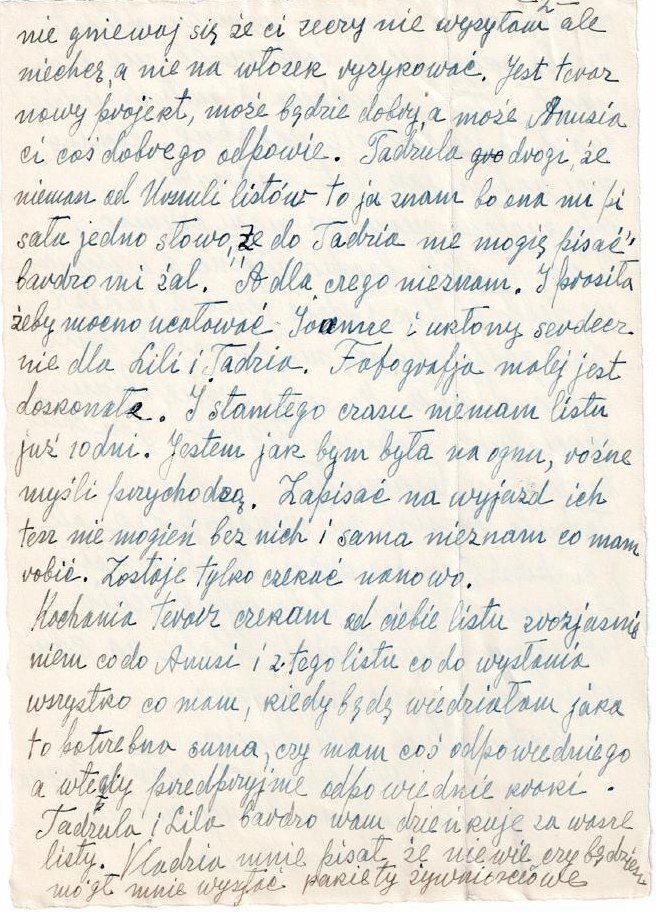
There are bright moments in this letter too. Eryka thanks him for the photographs of little Joanna — today Joan Zegree — „the photograph of the little one is perfect", „that little boy is perfect too"; she is making herself „an album specially of Joanna Zegree" and asks for more pictures. „Tadziula, please write to me often, but I ask you even more, because your letters bring me much comfort in my loneliness. Hala leaves in 8 days and I shall be alone again". And the signature: „Your loving aunt Eryka". Of her husband — not a word.
XI. 1947 — John Zegre Ashlyn, watchmaker
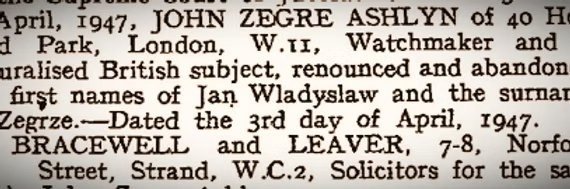
On 19 March 1947 Jan Władysław Zegrze received British citizenship (certificate of naturalisation no. AZ24233). Two weeks later, on 3 April, by deed poll he renounced his former names and surname. The „London Gazette" announced on 15 April 1947: „John Zegre Ashlyn, of 40 Holland Park, London W.11, watchmaker and a naturalised British subject, has renounced the forenames Jan Władysław and the surname Zegrze". In the new name he kept the root of the old — and in the occupation column his father's trade. The son of the watchmaker of Nowy Świat was a watchmaker in London.
The marriage with Hala did not survive the war and emigration. In the last quarter of 1948 John Ashlyn married Janine Coisne in Chelsea. They had two children: Nils and Pascale. The family finally settled in Geneva. John Zegre Ashlyn died on 17 June 1995 in San Diego, California. To Joan Zegree, Tadeusz's daughter, he was „Uncle John" — a cousin of her father's age, the mentor of her youth. His son Nils lives in Geneva; he keeps a pocket watch with the dial „Jan Zegrze Warszawa" which he received from his father — the only object from Nowy Świat 30 that has passed from hand to hand through three generations.
XII. Zagreb
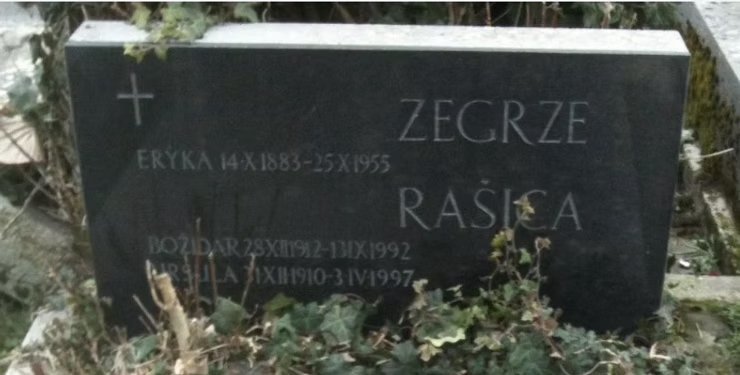
Eryka did not go to America. She settled in Zagreb, with her daughter. Urszula and Božidar Rašica had no children; he designed, painted and taught, she shared his life in communist Yugoslavia, from which in 1946 she „could not write to Tadzio". Eryka Zegrze died on 25 October 1955, eleven days after her seventy-second birthday. Božidar Rašica died on 13 September 1992, Urszula — on 3 April 1997; she was buried on 11 April. All three rest in one grave in Zagreb's Mirogoj cemetery — field 19A, grave 89 — under a black slab with two names: ZEGRZE and RAŠICA. Jan's name is not on the slab.
XIII. Life prevailed
Jan Zegrze has no grave, his brother, sister-in-law and nephew perished in the Holocaust, his house on the corner of Nowy Świat was smashed by a bomb. And yet this story does not end in 1943. It ends — or rather continues — in Seattle, Geneva, Wrocław and Zagreb, among people who bear this name or remember where they come from.
Tadeusz Zegrze, the sole survivor of Boduena 3, became in America Ted Zegree. The little girl from the photograph that Eryka pasted into her album in 1946 — Joanna, today Joan Zegree — lives in Seattle and for years, with the help of two professional researchers, searched for the family's traces; it was she who found „Escape", preserved the letter from Montreux and applied for Stolpersteine for her grandfather, her great-uncle and their families. Her brother, Stephen Zegree (1953–2015), became a musician: a pianist, arranger and professor at Western Michigan University, where for decades he led the vocal ensemble Gold Company, honoured by „Down Beat" magazine more often than any other university ensemble in the United States; he was a Steinway Artist, co-producer of Mark Murphy's Grammy-nominated album, author of the book „The Wow Factor" and teacher of a generation of jazz singers. The grandson of Josef Zegrze of Warsaw's Boduena Street taught Americans to sing.
In Geneva lives Nils Ashlyn, Jan's grandson, with his grandfather's watch; in Geneva too lives Joanna Donnier, Helena's granddaughter. There are cousins in Wrocław. In the summer of 2024 the family met in Paris for a large reunion.
Watches bearing the name of Jan Zegrze still run — in a museum, in antique shops, in a drawer in Geneva. He himself is on no list — except the one we are writing here. But there are those who remember him, and those who are only now learning his name. Life prevailed.
Timeline
| Date | Event |
|---|---|
| 21 I 1881 | Birth of Leon (Lieb-Ber) Zegrze, Jan's brother, son of Josef. |
| 14 X 1883 | Birth of Eryka Genken, Jan's future wife. |
| c. 1898–1901 | Artur Spitzbarth's building rises at Nowy Świat 30 / Foksal 21. |
| 11 XII 1910 | Birth of Urszula Zegrze. |
| 8 XI 1913 | Jan Władysław Zegrze is born in Warsaw. |
| 31 V 1914 | Birth of Tadeusz, Leon's son — the future addressee of Eryka's letter. |
| 18 V 1926 | Birth of Ryszard Jerzy, Leon's younger son. |
| 1928 | The firm's advertisement in the „Przegląd Więziennictwa Polskiego": „Jan Zegrze, Nowy-Świat 30, tel. 9-56". |
| 15 X 1929 | Advertisement in „Głos Literacki": „Swiss watches, jewellery, silver and plate". |
| XI 1934 | Marriage of Jan Władysław and Hala. |
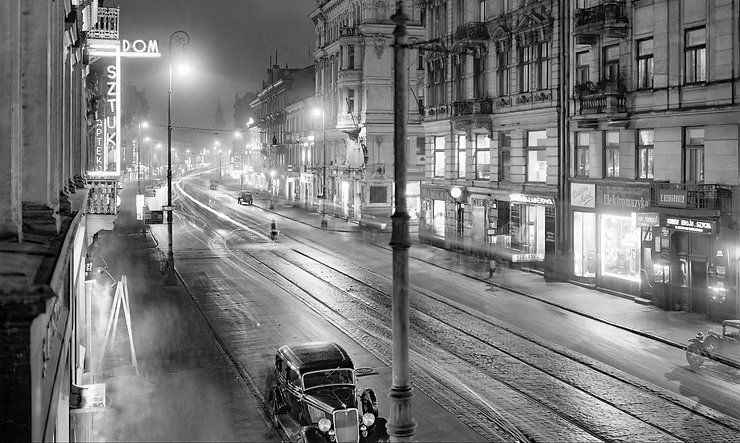
| 1935 | Henryk Poddębski photographs Nowy Świat by night with the sign of the Zegrze salon. |
| 1936 | Marriage of Urszula and Božidar Rašica, an architecture student in Warsaw. |
| 1935–1937 | Construction of the Assicurazioni Generali Trieste building, Złota 7/9, with the „Palladium" cinema; the Zegrzes among its first tenants. |
| 11 V 1937 | Jan Zegrze signs a guarantee for an IWC watch — the last known autograph. |
| 1938 | Telephone directory: the shop at Nowy Świat 30 (6 09 56), the flat at Złota 7 (3 49 14). |
| 18 XII 1938 | Elections to the Warsaw City Council; photograph of the salon behind its grille, amid election leaflets — the last known picture of the shop. |
| XI 1940 | Closing of the Warsaw ghetto; behind the walls Leon Zegrze with his wife and son Ryszard. |
| IX 1939 | A bomb destroys the corner of Nowy Świat 30 together with the salon. |
| 1939/1940 | According to family tradition Jan Zegrze is shot dead by the Germans in the street; date and place unknown. |
| 17 VI 1940 | Aristides de Sousa Mendes begins issuing visas in Bordeaux to all refugees, against Lisbon's orders. |
| 19 VI 1940 | In Bordeaux Sousa Mendes issues visas nos. 2237 and 2238 for Jan and Helena Zegrze — most probably Jan Władysław and his wife Hala. |
| 24 VI 1940 | Salazar recalls the consul; in October 1940 a disciplinary sentence and forced retirement. |
| 1943 | Leon Zegrze with his wife and son Ryszard, and Maria Lewinstein, perish in the Holocaust. |
| I 1946 | „Escape" by Aline Pole is published. |
| 17 XI 1946 | Letter from Hala and Eryka at Chillon-Montreux to Tadeusz. |
| 19 III 1947 | Naturalisation of Jan Władysław in Great Britain. |
| 3 IV 1947 | Change of name to John Zegre Ashlyn, „watchmaker", 40 Holland Park, London. |
| X–XII 1948 | Marriage of John Ashlyn and Janine Coisne, Chelsea. |
| 3 IV 1954 | Aristides de Sousa Mendes dies in Lisbon in poverty; 1966 — Righteous Among the Nations. |
| 25 X 1955 | Eryka Zegrze dies in Zagreb; buried at Mirogoj. |
| 1966 | Helena Lewinstein née Zegrze, Jan's sister, dies in Warsaw. |
| 13 IX 1992 | Death of Božidar Rašica. |
| 17 VI 1995 | John Zegre Ashlyn dies in San Diego. |
| 3 IV 1997 | Urszula Rašica dies in Zagreb. |
| 2015 | Death of Stephen Zegree, musician, Tadeusz's son. |
| 2017 | The Bordeaux visa registers inscribed on the UNESCO „Memory of the World" register. |
| VIII 2025 | Joan Zegree finds Złota 7 in Warsaw; from Seattle, Geneva and Warsaw the documents for this account flow in. |
A Note on Sources
The account rests on sources: the 1938 directory of subscribers of the Warsaw PAST telephone network (Library of Congress); the advertisements in the „Przegląd Więziennictwa Polskiego" (1928, no. 4) and „Głos Literacki" (15 X 1929), the full-page „Zenith" advertisement of the 1920s and small press notices of the 1930s; the photograph of Nowy Świat at Foksal of 18 XII 1938 (fotopolska.eu); Henryk Poddębski's photograph „Nowy Świat Street by night" (1935, Museum of Warsaw, AN 27570) and photographs of the destroyed building from the autumn of 1939 and the turn of 1939/1940 (fotopolska.eu); the Zenith pocket watch with the firm's case in the Cabinet of Warsaw Clocks of the Museum of Warsaw (MHW 22735) and watches signed „Jan Zegrze" in private collections; the guarantee card of 11 V 1937 and the firm's business card; the visa register of the Portuguese consulate in Bordeaux (Arquivo do Ministério dos Negócios Estrangeiros, Lisbon; Sousa Mendes Foundation, Zegrze family card); the biography of Aristides de Sousa Mendes (Yad Vashem; Sousa Mendes Foundation; Wikipedia; A. Milgram, „Portugal, Salazar, and the Jews", 2011; Pilecki Institute — biography of César de Sousa Mendes); the certificate of naturalisation AZ24233 (The National Archives, HO 334/174/24233) and „The London Gazette" of 15 IV 1947; the marriage register of England and Wales (Chelsea, 4th quarter 1948); the American Social Security Death Index; the tombstone and registers of the Mirogoj cemetery in Zagreb (field 19A, grave 89); the letter of Hala and Eryka Zegrze of 17 XI 1946; the accounts of Joan Zegree (Seattle), Joanna Donnier (Geneva) and Bruce MacPhail, and the biographies of Božidar Rašica (Wikipedia; Museum of Modern and Contemporary Art in Rijeka). Family photographs and documents — by courtesy of Joan Zegree.
Opracowanie w ramach projektu upamiętnienia mieszkańców kamienicy przy ul. Złotej 7 i 9 w Warszawie — prepared as part of the project commemorating the residents of the house at 7 and 9 Złota Street in Warsaw · www.zlota7-9.com