„Mr Michał Gago (16 Belgijska Street) is very well known in Mokotów."
They were a married couple. He — a chauffeur and mechanic — born in 1902, the son of Mikołaj and Michalina; she, Czesława Anna née Hakiel, four years his senior, entered in the occupation column as „supported by husband". They moved into the house at 9 Złota Street on 2 May 1938, into apartment number 22. In the spring of 1940 they moved within the same building to apartment number 9 — and it was there, in the second year of the occupation, that the whole family gathered around them: Michał's mother from Stoczek, Czesława's niece and nephew, and beside them a changing cast of lodgers: a clerk from Powiśle, an office worker from Mokotów, a girl from Grodno and a German railwayman. On 2 May 1942 — exactly the fourth anniversary of their registration — apartment number 9 emptied within a single day. Michał left for Radzyń, Czesława and the children returned to Mokotów. He survived the war; he died in 1959 in Olsztyn.
This account gathers everything that is known about them. Every fact comes from a source: from two cards of the house's residents' register, from the Warsaw daily press of the twenties and thirties, from the records of an Olsztyn cemetery. Not a single photograph or family recollection has survived — so far. All the more carefully must one read what remains: the columns, the stamps and four short press notices.
I. Stoczek and Mokotów — roots
Michał Gago was born on 15 March 1902, the son of Mikołaj and Michalina née Wrosek. The surname Gago, a rare one, is met mainly in eastern Mazovia and Podlasie — and it was precisely there, in Stoczek in the Węgrów district, that his mother was still living during the war. Michalina Gago, born on 24 September 1876, daughter of Tadeusz and Józefa, would come from there in 1940 to her son on Złota Street, and in 1942 would return. By trade Michał was a mechanic; in the army — a reservist on the rolls of the District Recruiting Office Warsaw City I.
Czesława Anna Hakiel was born on 31 July 1898; the register records her parents as Władysław and Teresa. The Hakiels were a large family and — as the later entries show — a close one: during the occupation Czesława would take in the two children of Eugeniusz and Stefania née Sompor Hakiel, in all likelihood her brother and sister-in-law: Halina Jadwiga, born on 18 July 1928, and Mieczysław, born on 11 November 1934. Both spouses were Roman Catholics, of Polish citizenship. When and where they married — we do not know.
II. The twenties — Aleja Szucha, Freta, Belgijska
Before Michał Gago found his way into the residents' register of Złota 9, he found his way three times into the newspapers — into the small-events columns of the Warsaw afternoon press, which printed daily the names and addresses of the protagonists of street incidents. None of them gives an age or a date of birth; the identification with the tenant of Złota 9 rests on the rare surname, on the description „a young man", on the occupation of driver — close to the mechanic's trade of the register — and on the fact that all the addresses lie in Warsaw; it is probable, though not certain.
The first trace is the most unexpected. In the spring of 1927 the „Express Poranny" printed the „second hundred" of readers who „for attentive reading of the Kurier Czerwony won 50-złoty prizes". Under number 120 stands: „Gago Michał, unemployed (Al. Szucha 7—3)". A twenty-five-year-old unemployed mechanic from Aleja Szucha who reads the newspaper attentively enough to win fifty złoty — a sum then equal to a dozen or more days of a labourer's wages.
![„Express Poranny", no. 66 [1927]: „The second hundred of our Readers who for attentive reading of the Kurjer Czerwony won 50-złoty prizes" — entry 120: „Gago Michał, unemployed (Al. Szucha 7—3)".](../../img/gago/img02.jpg?v=8daff648)
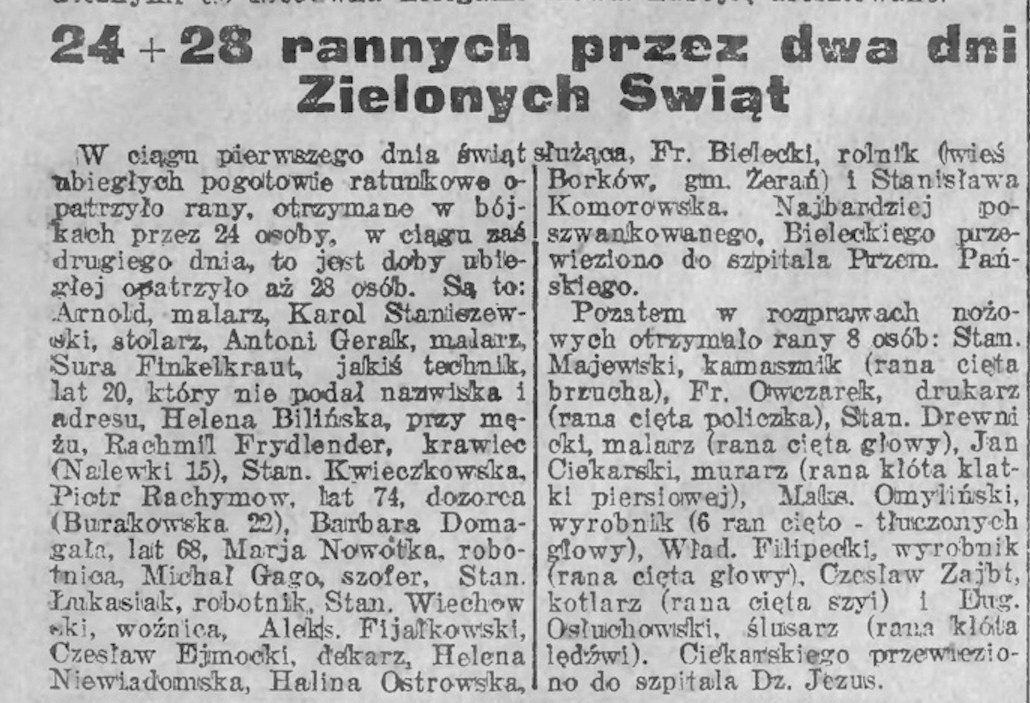
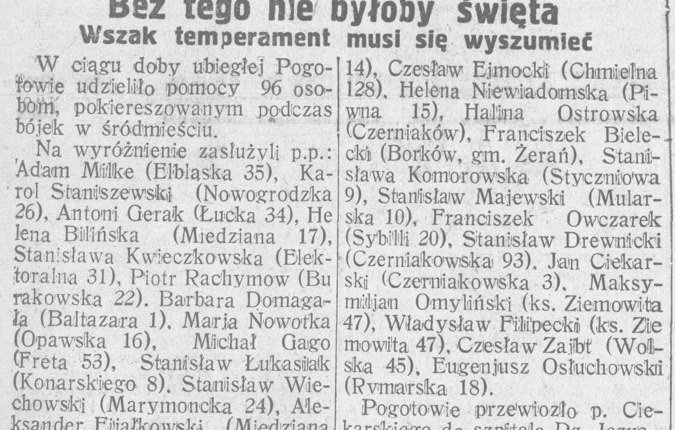
The second trace comes from Whitsun 1928 and is a double one. On 29 May two dailies of the same publishing concern described the holiday brawls, each in its own way. The „Kurjer Poranny", under the headline „24 + 28 injured over the two days of Whitsun", listed the casualties with their occupations: „Marja Nowotka, worker, Michał Gago, driver, Stan. Łukasiak, labourer…". The „Express Poranny" („Without it there would be no holiday. After all, temperament must have its fling") — the same list with addresses: „Michał Gago (Freta 53)". Put together, the two notices give the first full description: Michał Gago, driver, residing at 53 Freta Street in the New Town — a few houses from the Fiszhauts' building at Freta 16. The occupation matters: a driver in 1928 was a man who knew engines, and so the same trade that ten years later the residents' register of Złota 9 would record as „mechanic".
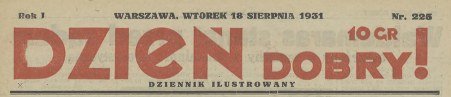
The third trace is already almost a portrait. On 18 August 1931 the illustrated daily „Dzień Dobry" ran a notice headed „The scythe met a stone. The »Terror of Mokotów« calls for police help": „Mr Michał Gago (16 Belgijska Street) is very well known in Mokotów. Another matter — not everyone would be pleased with the fame in whose glow Mr Gago walks, for this young man is known as a dangerous brawler and has already made himself felt by many an inhabitant of Mokotów. Yet Mokotów boasts another fearless citizen — Mr Jan Siedlecki (6 Wygoda Street), who got into a fight with Mr Gago. And behold — it turned out that the scythe had met a stone. Mr Siedlecki defeated Mr Gago, who, terrified, took refuge under the protective wings of the police. Mr Gago claims that his opponent fired at him five times. The police are investigating the matter".
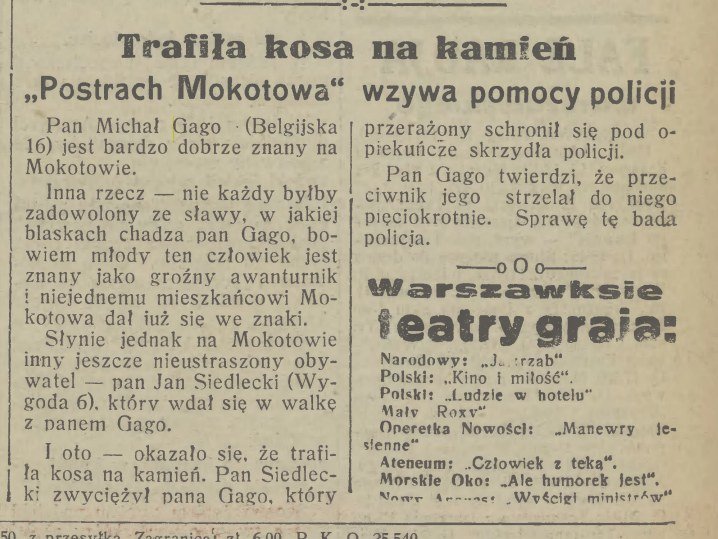
The twenty-nine-year-old „terror of Mokotów" who fled under the wings of the police from a man shooting at him five times — this is a picture from a tabloid column, written for the readers' amusement. It is worth remembering, however, that behind these notices stands a man from a specific district: pre-war Mokotów between Puławska and Belwederska, a district of workshops, tenements and working-class families. Three addresses in five years — Aleja Szucha 7, Freta 53, Belgijska 16 — and two entries of occupation, „unemployed" and „driver", form the map of the youth of a man who often changed his lodgings and his work.
III. Chauffeur — a trade with a future
To understand how the „terror of Mokotów" from Belgijska 16 could, seven years later, be registering at the address of the tallest building in Poland, one must look at his trade. Interwar Poland was a country almost without cars. In 1938 some fifty-five thousand motor vehicles ran on its roads — ten cars per ten thousand inhabitants, where France had more than five hundred and the United States more than two thousand. The cheapest car, a Fiat 500, cost 3,800 złoty in 1937 — more than a year of a clerk's salary; a litre of petrol, sixty-five to eighty-five groszy, most of it tax. A car was an object of luxury — and the state treated it as one. The monthly of the Automobile Club of Poland, „Auto", wrote bitterly in May 1934 that in Poland „the tax offices regard the possession of a car as an infallible sign of a citizen's high standard of living, assessing him correspondingly higher taxes and sometimes forcing him to part with this means of transport", whereas beyond the western border a car was to be „as necessary as a bathroom in every cultured home". In such a country a man who could both drive and repair a car was a specialist in demand.
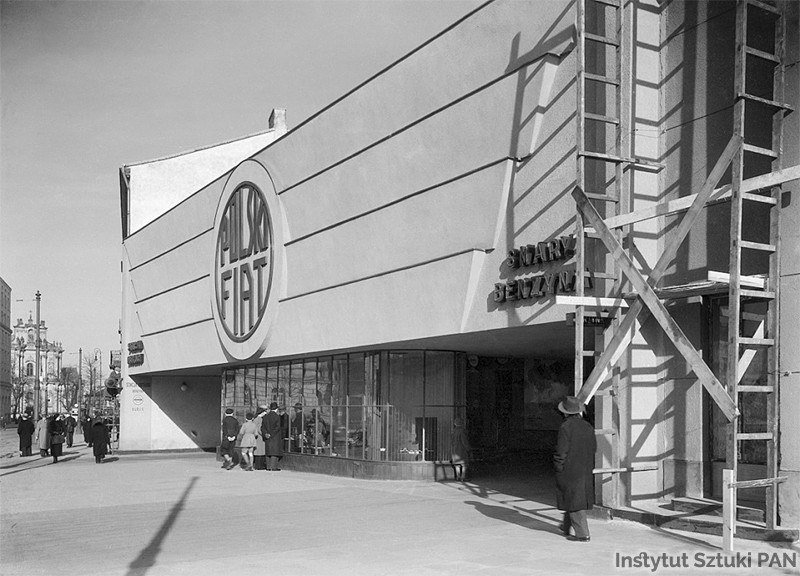
The thirties, however, brought change. In 1931 the state bought a Fiat licence; from the middle of the decade the Warsaw State Engineering Works produced the Polski Fiat 508, and from 1936 the Lilpop, Rau i Loewenstein works assembled American Chevrolets and Buicks. Showrooms, petrol stations and workshops multiplied in Warsaw; after the years of crisis, from 1936 the number of cars was rising again. A professional chauffeur with a driving licence who was also a mechanic could work for a wealthy employer, in a firm, an institution, a taxi company or a workshop — and in that world he was irreplaceable. That is the simplest explanation of Michał Gago's road: from the unemployed man of Aleja Szucha in 1927, through the driver of Freta in 1928, to the mechanic who in 1938 arrives from beneath the „Prudential" at the modern building of Złota 7/9. The sources do not say for whom he drove or where he repaired cars; they say clearly, however, that within eleven years he passed from the side streets of Mokotów to the most prestigious addresses of the city centre.
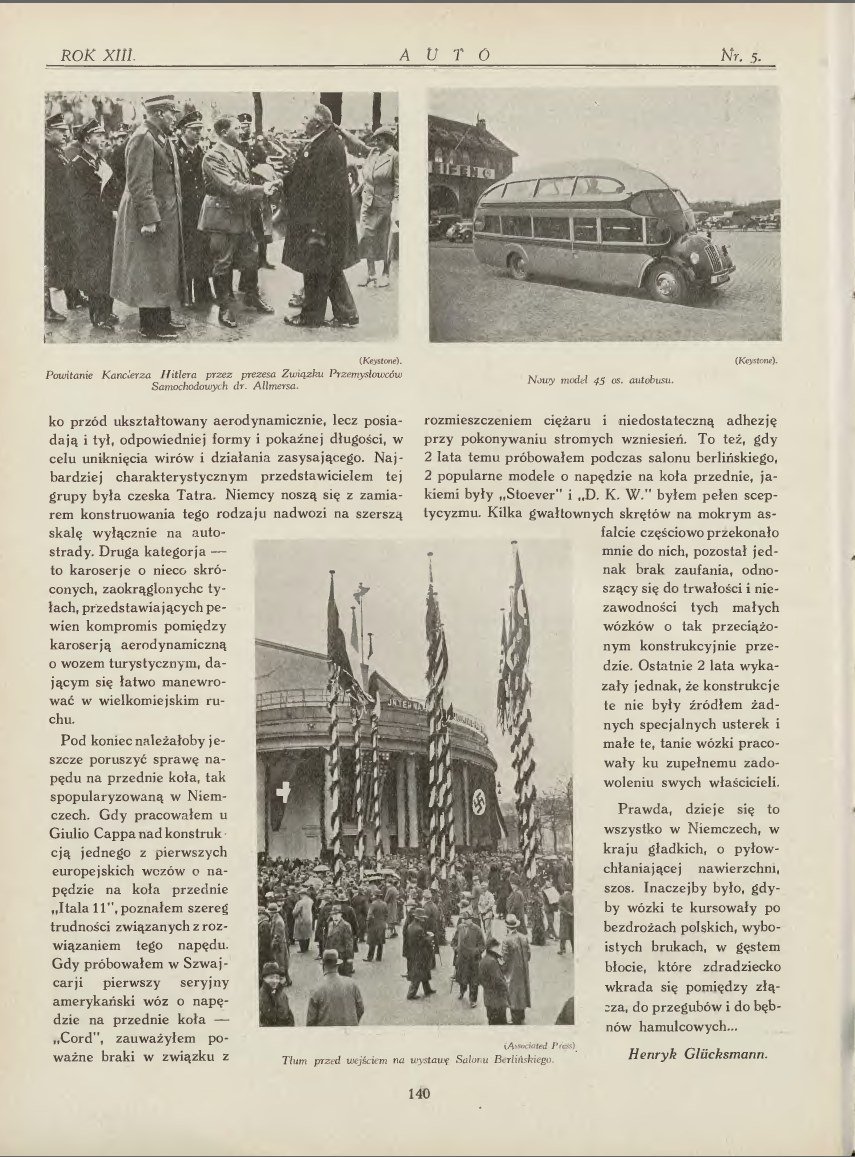
It is worth seeing the world in which this rise took place. The issue of „Auto" of May 1934, from which the quotation above comes, opens with an extensive report from the Berlin Motor Show (8–18 March 1934) under the title „The Motorisation of the Third Reich". A year after Hitler's seizure of power and four months after the signing of the Polish–German declaration of non-aggression, the Warsaw monthly of the Automobile Club described with undisguised admiration how the Chancellor „stressed the utmost privileging of motor vehicles", how the Reich was building motorways, had „entirely freed new cars from taxes" and was exerting on the citizen „a certain pressure to own a car". In the photographs: Hitler greeted by the president of the German Association of Automobile Manufacturers, a crowd beneath swastikas before the exhibition hall. The author of the report, the engineer Henryk Glücksmann, only reserved that the cheap German „little carts" would not withstand „the Polish trackless roads, the bumpy cobbles" and „the thick mud". None of those writing or reading yet knew that this same motorisation — the motorways, the Henschel, Deutz and Phänomen lorries from the Berlin photographs — would in five years roll across Poland as an instrument of war, and that in December 1941 a German railwayman would move in as a lodger in Michał Gago's apartment at Złota 9.
The same monthly shows the other face of the era too. In October 1935, in the article „In Defence of the Taxpayer", „Auto" complained that the tax offices and social insurance treated every owner of a private car as a transport entrepreneur, charging him fees „for a driver supposedly employed in motor-cab work" — and reminded readers that „private cars in Poland number barely a few thousand, and in the provinces they are a positive rarity". The complaint about the provincial policeman who stops a private car as if it were a taxi the author illustrated, however, with the sentence that „the ordinary man, and especially the ignorant provincial little Jew, is unable to tell a private car from a taxi". So — in passing, in the organ of a club of gentlemen motorists — sounded the language of the mid-thirties. It is worth remembering it when reading the residents' register of Złota 9, in which beside the Gagos stand the clerk Kiwel Klebański of Słonim, the firm of the brothers Rabinowicz and Milikowski, and the doctor Stanisław Fiszhaut of apartment number 6 — neighbours whom in November 1940 that same register would deregister to behind the walls of the ghetto.
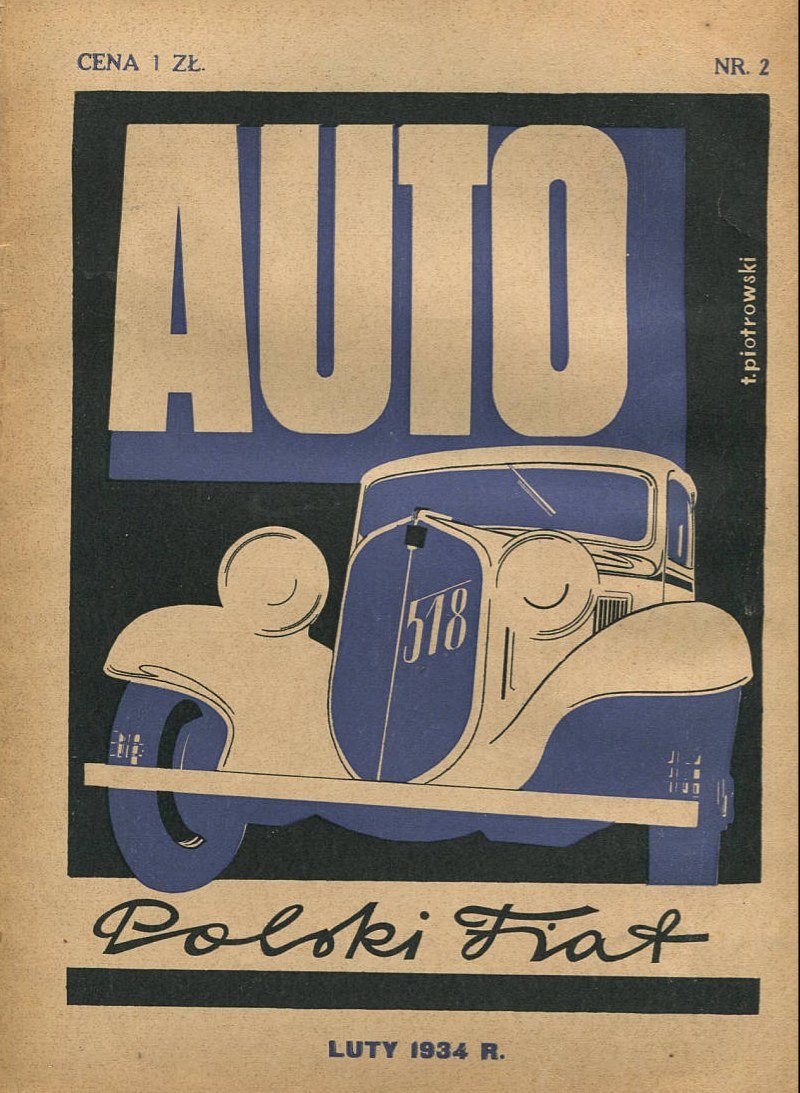
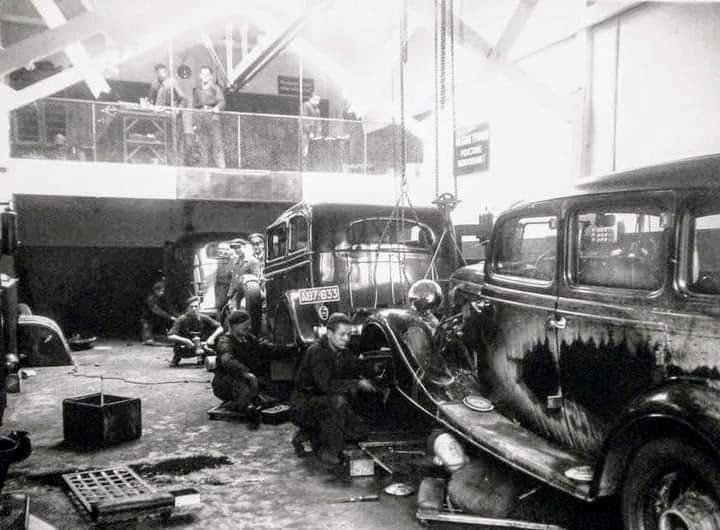
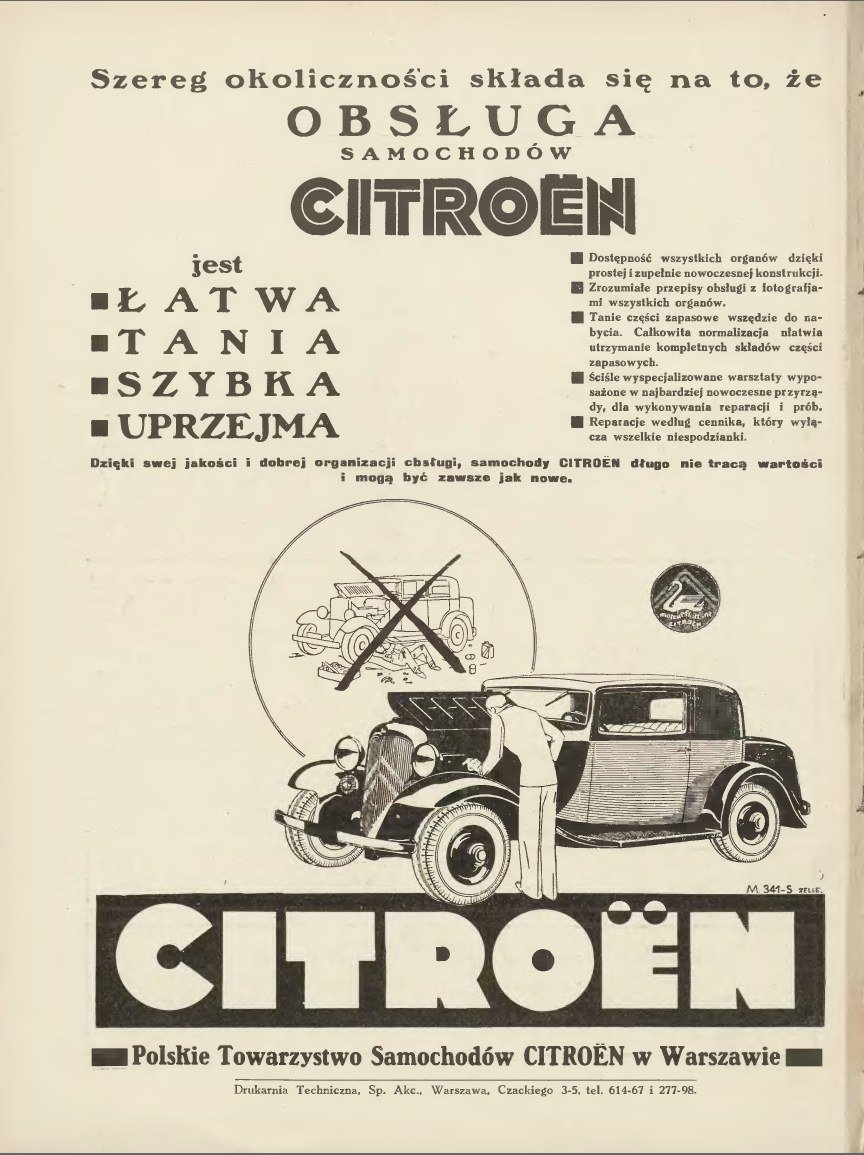
How much a competent workshop meant in that world, the advertisements themselves tell. The Polish Citroën Motor Company in Warsaw praised in „Auto" in 1934 not so much the car as its service — „easy, cheap, quick, courteous": „strictly specialised workshops equipped with the most modern instruments" and „repairs according to a price list which excludes all surprises". Behind such slogans stood men like Michał Gago — chauffeurs and mechanics, whose skill decided whether a car „kept its value for long".
IV. Plac Napoleona 9 — beneath the „Prudential"
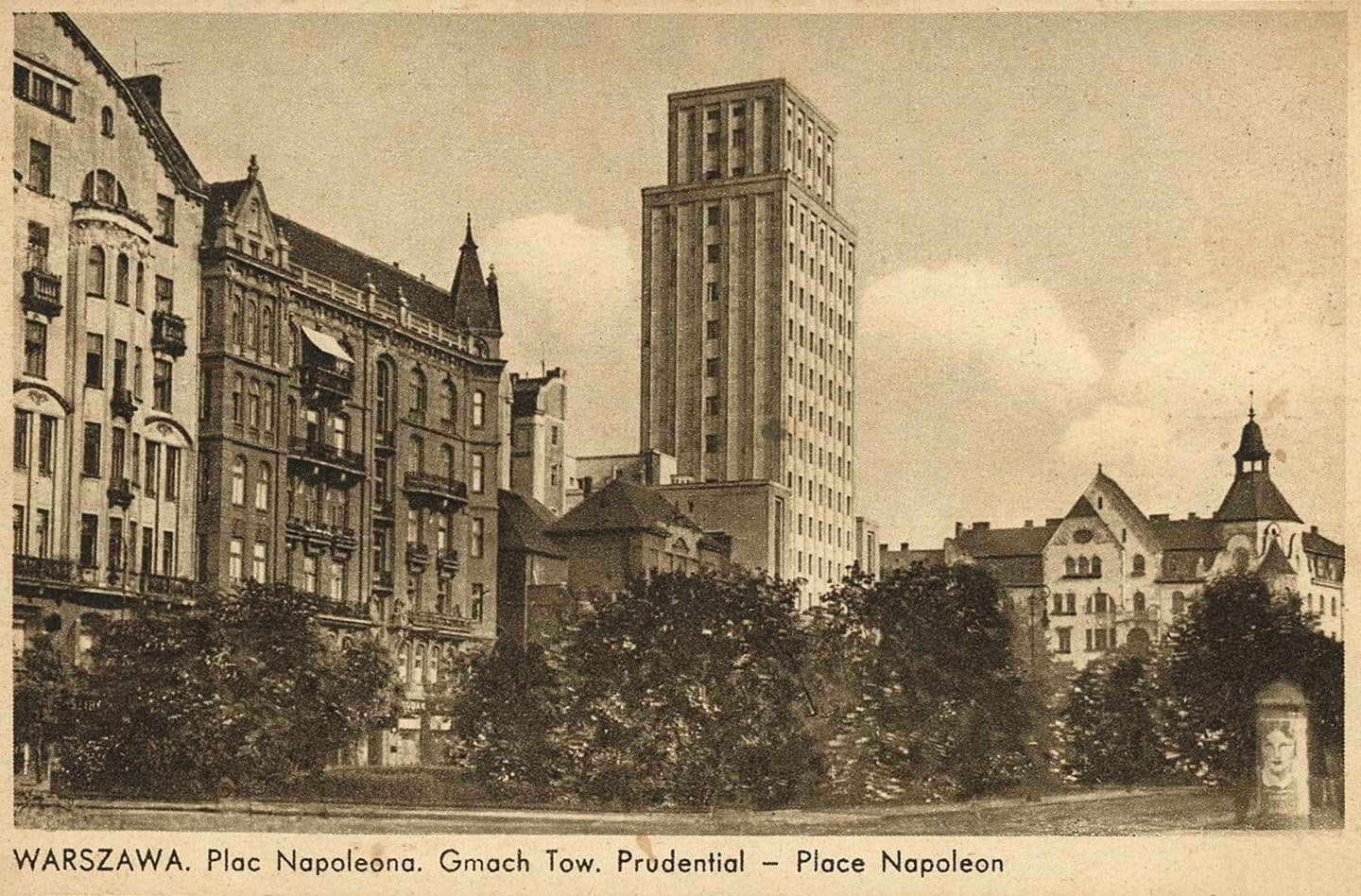
When on 2 May 1938 Michał and Czesława Gago registered at 9 Złota Street, in the column „arrived from" the clerk wrote: „from Plac Napoleona No. 9". At that address stood the tallest building of pre-war Poland — the sixteen-storey headquarters of the „Prudential" Insurance Company, completed in 1933, with the country's first experimental television station on the top floor. The skyscraper had its own boiler rooms, lifts, garages and installations that required constant technical attendance; a former driver, now recorded as a mechanic, registered at its address was most probably someone from the building's staff — or the driver of one of its wealthy tenants — though the register does not specify. The road from the unemployed man of 1927 to a resident of the two most modern buildings of the city centre is in any case clear. From Plac Napoleona to Złota Street was a few minutes on foot.
V. 2 May 1938 — Złota 9, apartment 22
Apartment number 22 had been vacated two days earlier by the clerk Stefan Wiązowski, a second lieutenant of the reserve, deregistered on 30 April 1938 to Pańska Street. On 2 May the Gagos registered in it: he as a mechanic and reservist of the Recruiting Office Warsaw City I, she „supported by husband". On the same card, under the fourth entry, one more member of the Hakiel family was recorded — her details are today only partly legible.

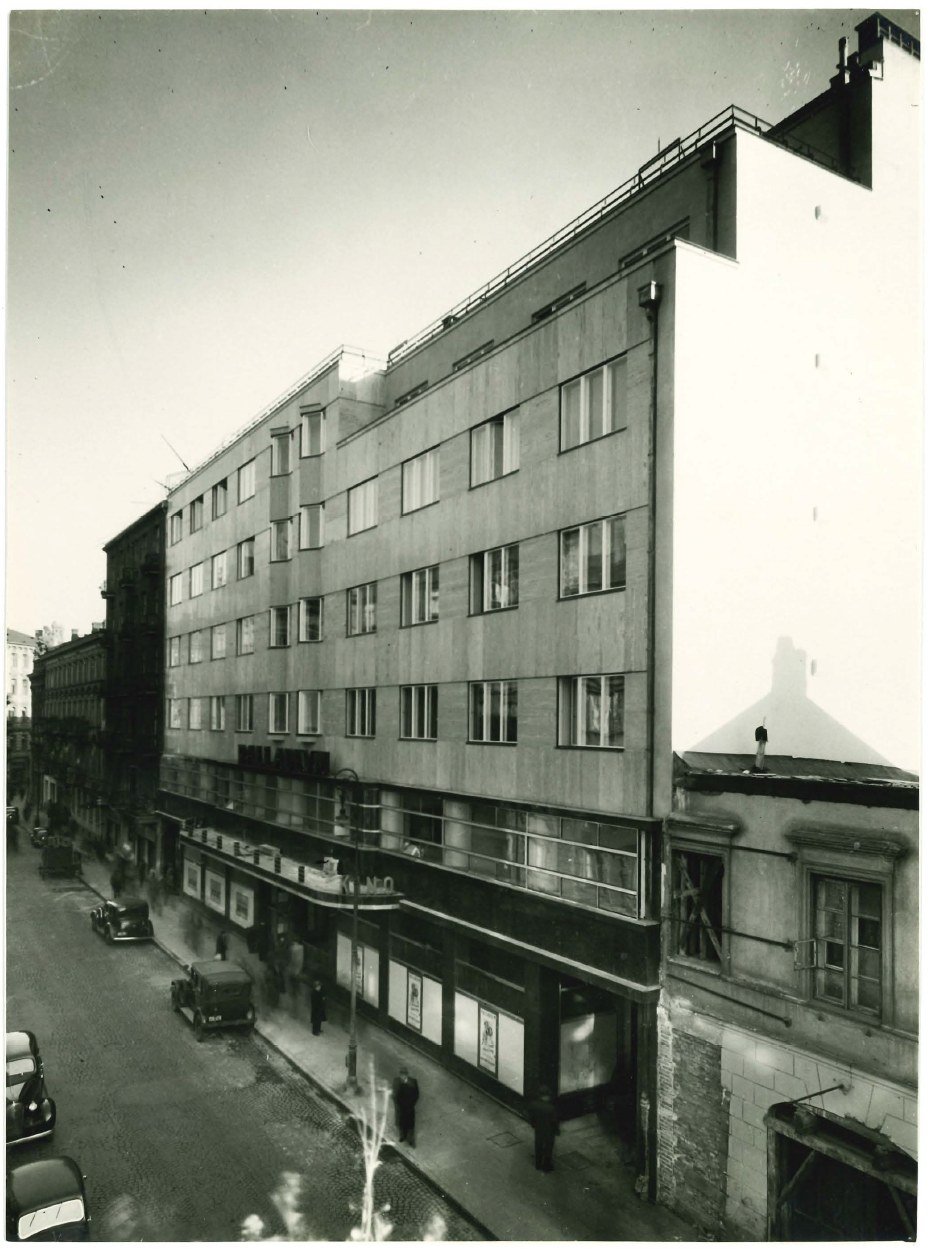
The house they moved into was one of the most distinctive addresses of the city centre: the modern building of Złota 7/9 with the „Palladium" cinema on the ground floor, flats and offices on the upper storeys. In those same months the Gagos' neighbours were people of an entirely different world — in apartment number 6, just above the cinema's neon, the dental surgeon Stanisław Fiszhaut had lived since the autumn of 1937, and in apartment number 9, into which the Gagos would move two years later, the firm „Rabmil" of the brothers Rabinowicz and Milikowski still had its seat, and the clerk Kiwel Klebański, arrived from Słonim, lived there. One house — and the whole of pre-war Warsaw in miniature: a mechanic from Mokotów, a Jewish doctor from the New Town, merchants, clerks, reserve officers.
VI. September 1939
Whether Michał Gago, a reservist on the rolls of the Recruiting Office Warsaw City I, was mobilised in September 1939 — we do not know; the residents' register records no movement in apartment 22 at that time. The building of Złota 7/9 survived the siege of the capital, and the registration office resumed work under the occupation: the subsequent entries already bear the stamps „Municipal Board in Warsaw — Registration Office" with the numbers of police precincts.
VII. 29 April 1940 — apartment 9
On 29 April 1940 the couple moved within the same building to apartment number 9 — a spacious flat vacated by the firm „Rabmil", which had moved to 6 Jasna Street. Together with them moved in eleven-year-old Halina Jadwiga Hakiel, Czesława's niece. Lodgers began to appear on their card: from March the private clerk Rajmund Stefan Jedliński from Ordynacka Street, from June the seventeen-year-old office worker Tadeusz Ziemowit Chyborski from 23 Krasickiego Street in Mokotów.
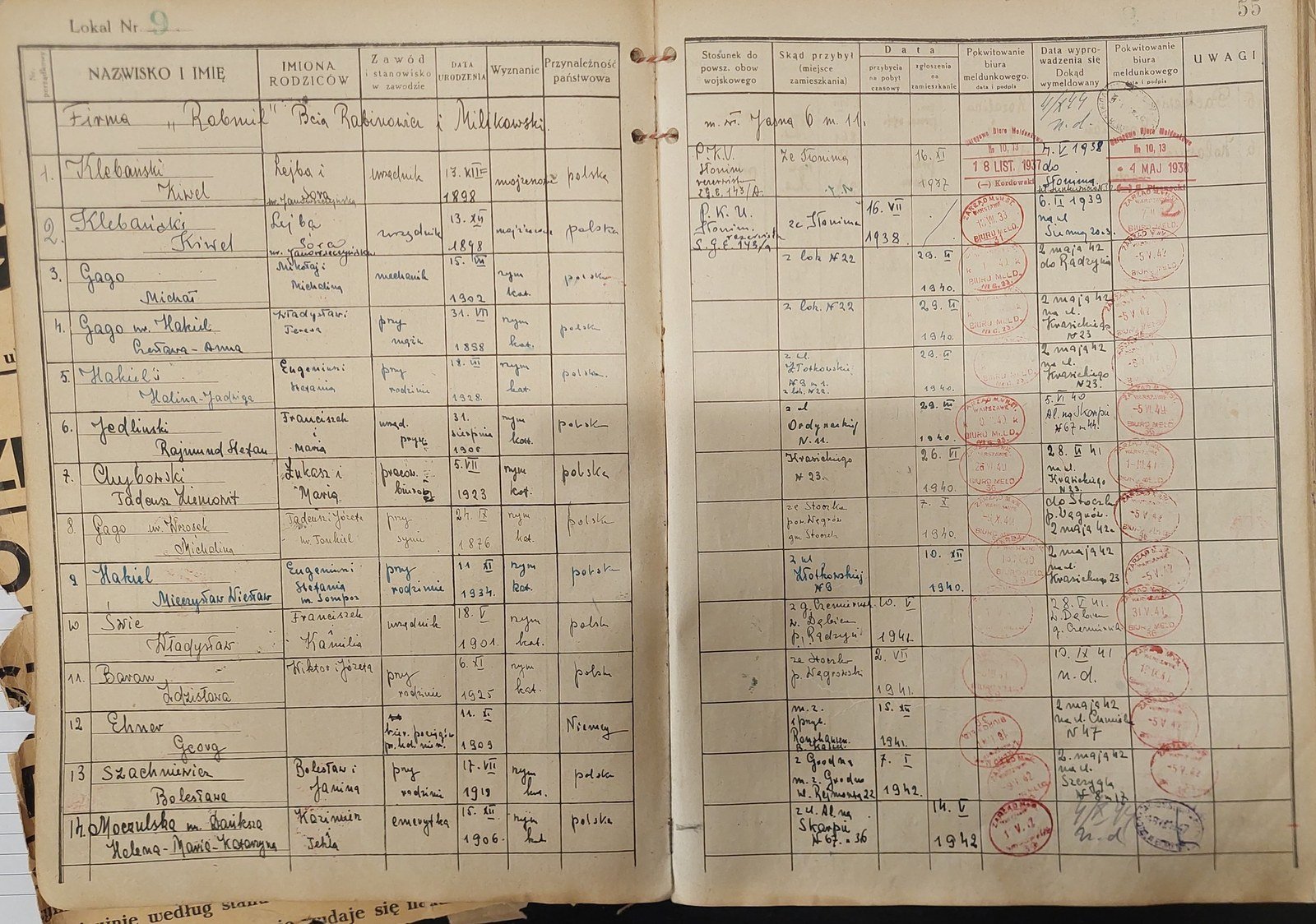
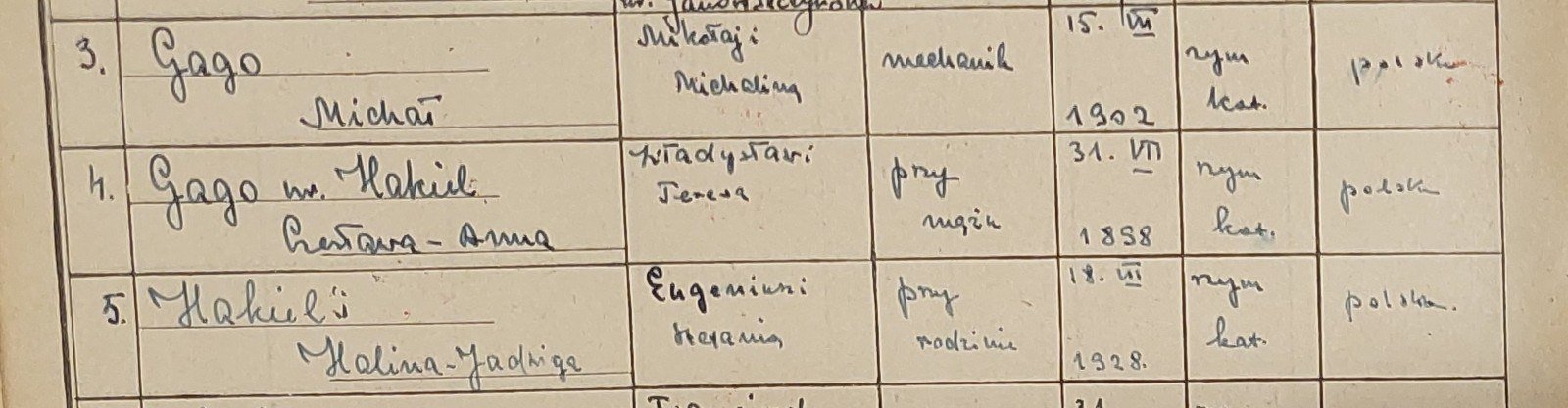
In the autumn of 1940 the family grew by its oldest and its youngest generation. On 7 October sixty-four-year-old Michalina Gago, Michał's mother, arrived from Stoczek in the Węgrów district, entered in the occupation column as „supported by son". On 10 December six-year-old Mieczysław Hakiel, Halina's brother, was registered. From then on, in the spacious flat on Złota Street lived three adults and two children of the family, along with a changing set of lodgers.


The list of lodgers from 1941–1942 says much about how life went on in occupied Warsaw. In May 1941 the clerk Władysław Świec from Dębica in the Czemierniki commune of the Radzyń district stayed for eighteen days — the first trace of the family's connection with Radzyń. In the summer of 1941 fifteen-year-old Zdzisława Baran, also from Stoczek, lived here. On 15 December 1941 Georg Ehner was registered, a German citizen, born in 1909, a train supervisor of the German railways — the Reichsbahn billeted its personnel in private Warsaw flats, and the presence of a German under the same roof could be for the Polish tenants at once a burden and a shield. In January 1942 twenty-two-year-old Bolesława Szachniewicz joined them, from Grodno — a city which after June 1941 had come under German occupation and from which young Poles were then fleeing.
VIII. 2 May 1942 — dispersal
Apartment card 9 closes in a single day. On 2 May 1942 the registration office deregistered all the residents at once: Michał — „to Radzyń"; Czesława, Halina and Mieczysław — „to 23 Krasickiego Street", the Mokotów address from which the lodger Chyborski had come two years earlier; Michalina — back to Stoczek; Georg Ehner — to 47 Chmielna Street; Bolesława Szachniewicz — to Praga, to Szeroka Street. All the receipts bear the same stamp dated 5 May 1942. Twelve days later the pensioner Helena Moczulska was registered in the emptied flat. So simultaneous a deregistration of an entire apartment — the family and lodgers who were strangers to one another — points to the loss of the flat rather than to a voluntary move; the register does not give the reason.
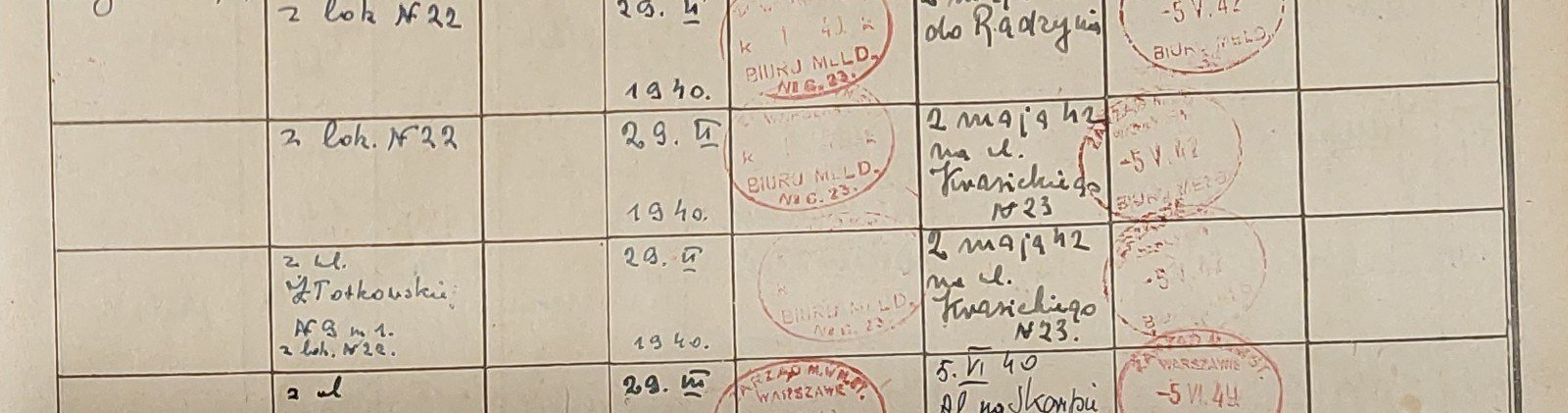
The family separated in three directions. Czesława with her brother's children returned to her native Mokotów. Michał's mother went to Stoczek — a little town that in September 1939 had suffered badly in fighting and fires. Michał himself set off for Radzyń — presumably Radzyń Podlaski in the Lublin district, where the trace of the lodger from Czemierniki had led before. In the spring of 1942 „Operation Reinhardt" was already under way in the Lublin district; a mechanic might have found work there in workshops, on an estate or in an enterprise working for the occupier — or simply gone to family in the countryside, where survival was easier. What he did in Radzyń and how he came through the next three years of war — the sources at our disposal do not say.
IX. Olsztyn — 13 January 1959
The last trace of Michał Gago lies three hundred kilometres north of Warsaw. The records of the parish cemetery of St Joseph in Olsztyn note a burial: Michał Gago, born 15 March 1902, died 13 January 1959. The date of birth agrees to the day with the entry in the residents' register of Złota 9 — it is the same man. He was fifty-six. After 1945 Olsztyn was one of the cities to which Varsovians deprived of their homes flocked in the greatest numbers; for a mechanic from Mokotów who had survived the war, the rebuilt capital of Warmia could be a place of new beginning. Whether Czesława was with him and whether she rests beside him — remains to be established. Of the fates of Halina and Mieczysław Hakiel, who in 1942 were fourteen and eight, we know nothing.
X. Memory
Of the Gago family there remain two cards of a residents' register, three notices in newspapers and one grave in an Olsztyn cemetery. It is not much — and yet enough to see the people who for four years, from May 1938 to May 1942, lived at 9 Złota Street: a mechanic with a turbulent youth in Mokotów, his wife who under the occupation took in her brother's children, his mother from Stoczek, and a host of passing lodgers whom the war had driven from Grodno, Słonim, Radzyń and Stoczek to one city-centre address. Passing the gateway of Złota 7/9, it is worth remembering that beside the doctors and merchants they lived here too — ordinary Varsovians, of whom no one wrote memoirs.
Timeline
| Date | Event |
|---|---|
| 24 IX 1876 | Birth of Michalina née Wrosek, daughter of Tadeusz and Józefa — Michał's future mother. |
| 31 VII 1898 | Birth of Czesława Anna Hakiel, daughter of Władysław and Teresa. |
| 15 III 1902 | Birth of Michał Gago, son of Mikołaj and Michalina née Wrosek. |
| [1927] | „Express Poranny" (no. 66): „Gago Michał, unemployed (Al. Szucha 7—3)" among the readers awarded the 50-złoty prize of the „Kurier Czerwony". |
| 27–28 V 1928 | Whitsun; the „Kurjer Poranny" and „Express Poranny" of 29 V name „Michał Gago, driver" (Freta 53) among those treated by the ambulance service after brawls. |
| 18 VII 1928 | Birth of Halina Jadwiga Hakiel, daughter of Eugeniusz and Stefania. |
| 17 VIII 1931 | Fight with Jan Siedlecki in Mokotów; the next day „Dzień Dobry" writes of the „terror of Mokotów", Michał Gago of Belgijska 16. |
| 11 XI 1934 | Birth of Mieczysław Hakiel, son of Eugeniusz and Stefania née Sompor. |
| 2 V 1938 | Michał and Czesława Gago register at 9 Złota Street in apartment 22, arriving „from Plac Napoleona No. 9" (the „Prudential" building). |
| IX 1939 | The siege of Warsaw; the building of Złota 7/9 survives. Whether Michał, a reservist of the Recruiting Office Warsaw City I, was mobilised — unknown. |
| 29 IV 1940 | Move within the house to apartment 9 (vacated by the firm „Rabmil"); the niece Halina Jadwiga Hakiel lives with the couple. |
| 7 X 1940 | Michalina Gago, Michał's mother, arrives from Stoczek (Węgrów district). |
| 10 XII 1940 | Six-year-old Mieczysław Hakiel, Czesława's nephew, is registered. |
| 10–28 V 1941 | The lodger Władysław Świec from Dębica, Czemierniki commune, Radzyń district. |
| 15 XII 1941 | Georg Ehner, a German railwayman and train supervisor, is registered in apartment 9. |
| 2 V 1942 | Deregistration of the whole apartment in one day: Michał „to Radzyń", Czesława with Halina and Mieczysław to 23 Krasickiego Street (Mokotów), Michalina to Stoczek. |
| 13 I 1959 | Michał Gago dies in Olsztyn; buried at the parish cemetery of St Joseph. |
A Note on Sources
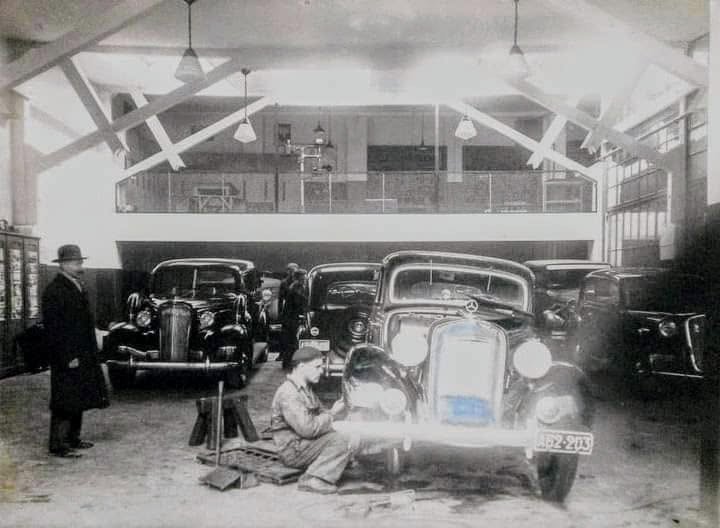
The account rests exclusively on sources: the residents' register of the house at 9 Złota Street — apartment card no. 22 (p. 134) and apartment card no. 9 (p. 55) — from the years 1937–1944 (State Archive in Warsaw, collection of residents' registers); the „Express Poranny" no. 66 [1927] and of 29 May 1928; the „Kurjer Poranny" of 29 May 1928; „Dzień Dobry" no. 225 of 18 August 1931; the records of the parish cemetery of St Joseph in Olsztyn (index of burials: Michał Gago, 15 III 1902 – 13 I 1959). The identification of the Michał Gago of the press notices of 1927–1931 with the tenant of Złota 9 rests on the coincidence of first name, surname, age („a young man") and Warsaw addresses; it has not so far been confirmed by a document bearing a date of birth. The reading of the street name „Krasickiego" in the deregistration column of 1942, and the identity of „Radzyń" with Radzyń Podlaski, are interpretations of a handwritten entry. Information on the „Prudential" building — after the Warszawa1939.pl Foundation; data on the motorisation of the Second Republic (numbers of vehicles, prices of cars and fuel, the Fiat licence, assembly plants) — after the studies of historia.org.pl and the specialist literature. Photographs of the Polski Fiat showroom — Institute of Art of the Polish Academy of Sciences; photographs of a motor-repair workshop (illustrative, not directly connected with the subject), the cover of „Auto" of February 1934 and the photograph of the building of Złota 7/9 — from the project's collection; quotations and illustration from „Auto" 1934, no. 5 (May), pp. 137–140 (H. Glücksmann, „The Motorisation of the Third Reich. Observations from the Berlin Motor Show") and from „Auto" 1935, no. 10 (October), p. 250 („In Defence of the Taxpayer") — after the copies in the Digital Library of Greater Poland.
Opracowanie w ramach projektu upamiętnienia mieszkańców kamienicy przy ul. Złotej 7 i 9 w Warszawie — prepared as part of the project commemorating the residents of the house at 7 and 9 Złota Street in Warsaw · www.zlota7-9.com