„In the underground from January 1940."
They were mother and daughter. Zofia Henrietta — widow of the director of the largest tannery in the Kingdom of Poland, granddaughter of a gardener from Bohemia and great-granddaughter of a British woman. Zofia Janina — an eighteen-year-old who joined the underground a few months before moving to Złota Street, and in August 1944 went to the Uprising from the gateway of her own house. In their ancestry five countries met, three Christian confessions, a royal coat of arms and the signboards of several great Warsaw firms.
This account gathers everything that is known about them. Every fact comes from a source: from the residence register, from vital records and cemetery registries, from military files, from a German transport list, from studies of the family firms' history. Where the sources are silent, it is silent too.
I. The tanner who came with Napoleon
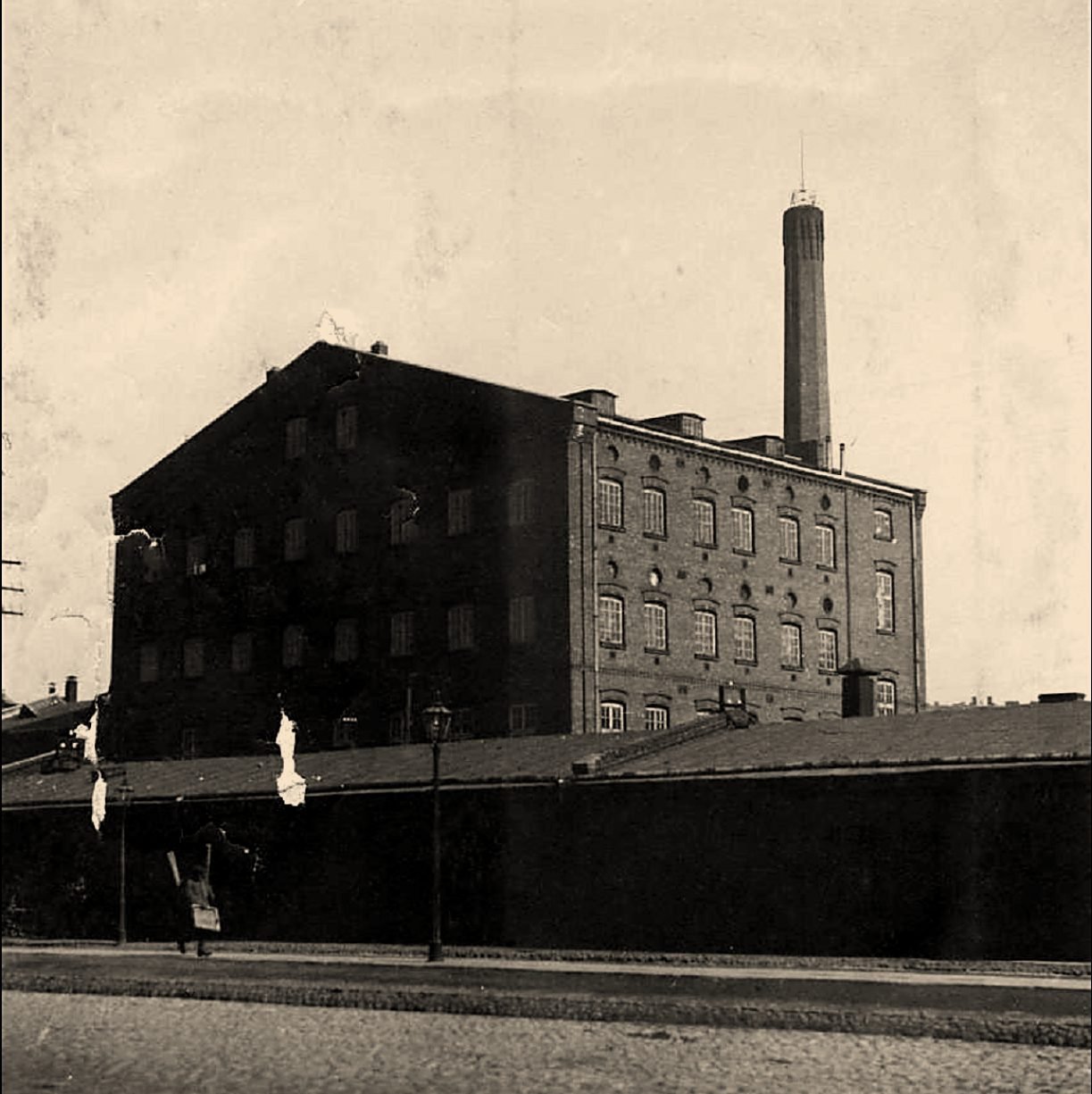
Jan Gotfryd Temler (1793–1885), born in Gera in Saxony, came to Warsaw — as the studies devoted to the firm's history, among them those of the Wilanów Palace Museum, agree — with the Napoleonic armies, and in Warsaw he stayed. He founded a tanning workshop, lived to the age of ninety-two, and lived to see his sons, Karol Ludwik and Aleksander Ferdynand, together with the engineer Ludwik Szwede, transform their father's workshop into an enterprise known far beyond Warsaw: the „Temler i Szwede" tannery at 78 Okopowa Street.
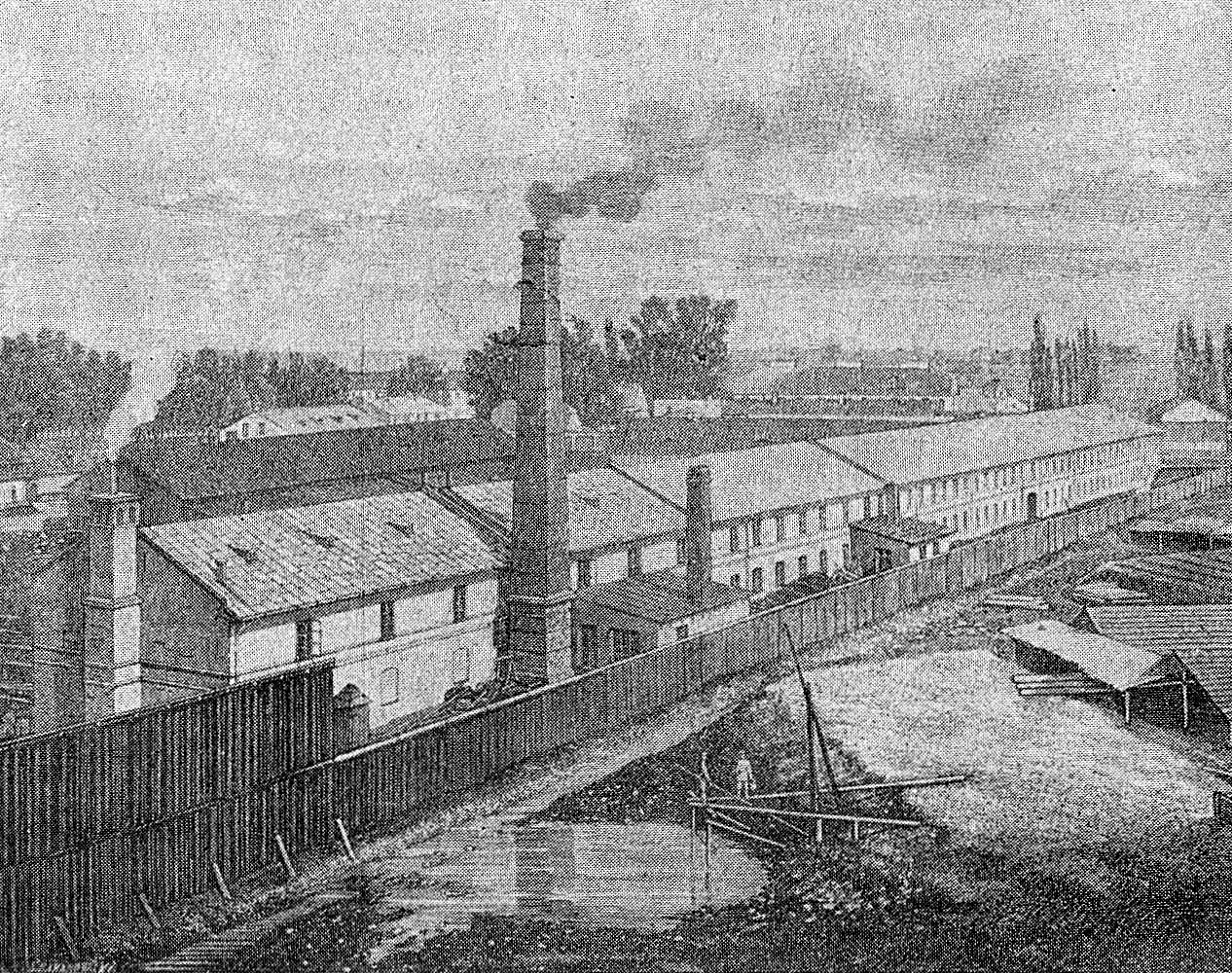
The studies of the firm's history allow the story to be told in more detail. The workshop arose in the favourable climate of the pro-industrial policy of the finance minister Franciszek Ksawery Drucki-Lubecki; the first tannery stood at 13/15 Ogrodowa Street, and a considerable part in running it was played by the founder's wife, Anna Maria née Franke (1797–1857). In January 1859 Jan Gotfryd's sons formed a partnership with Ludwik Szwede — a friend of Aleksander Ferdynand from the days of their education abroad in Paris — and bought an extensive plot by the Powązki toll-gates; at Ogrodowa there was no water, without which a tannery cannot do.
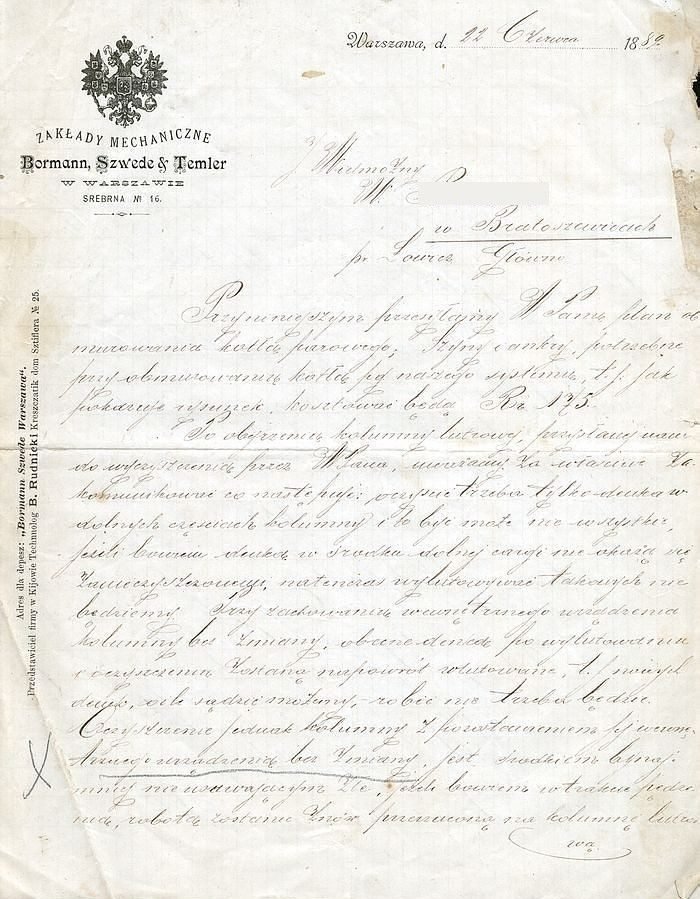
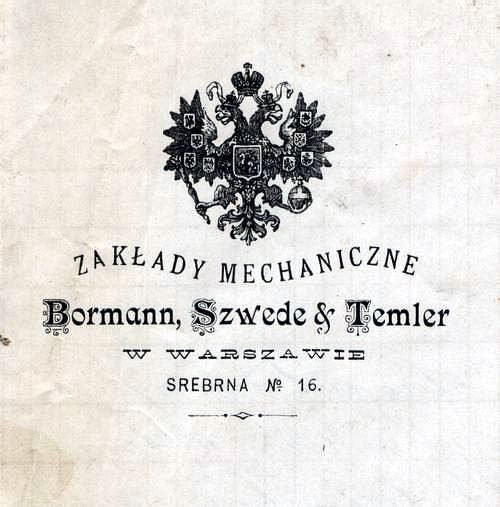
From then on the firm traded as „K.A. Temler i L. Szwede". A wider web of family interests is attested by a surviving letter of 1889 on the stationery of the „Bormann, Szwede & Temler" Mechanical Works at 16 Srebrna Street — the names of the tannery's partners appear here together in the machine industry as well.
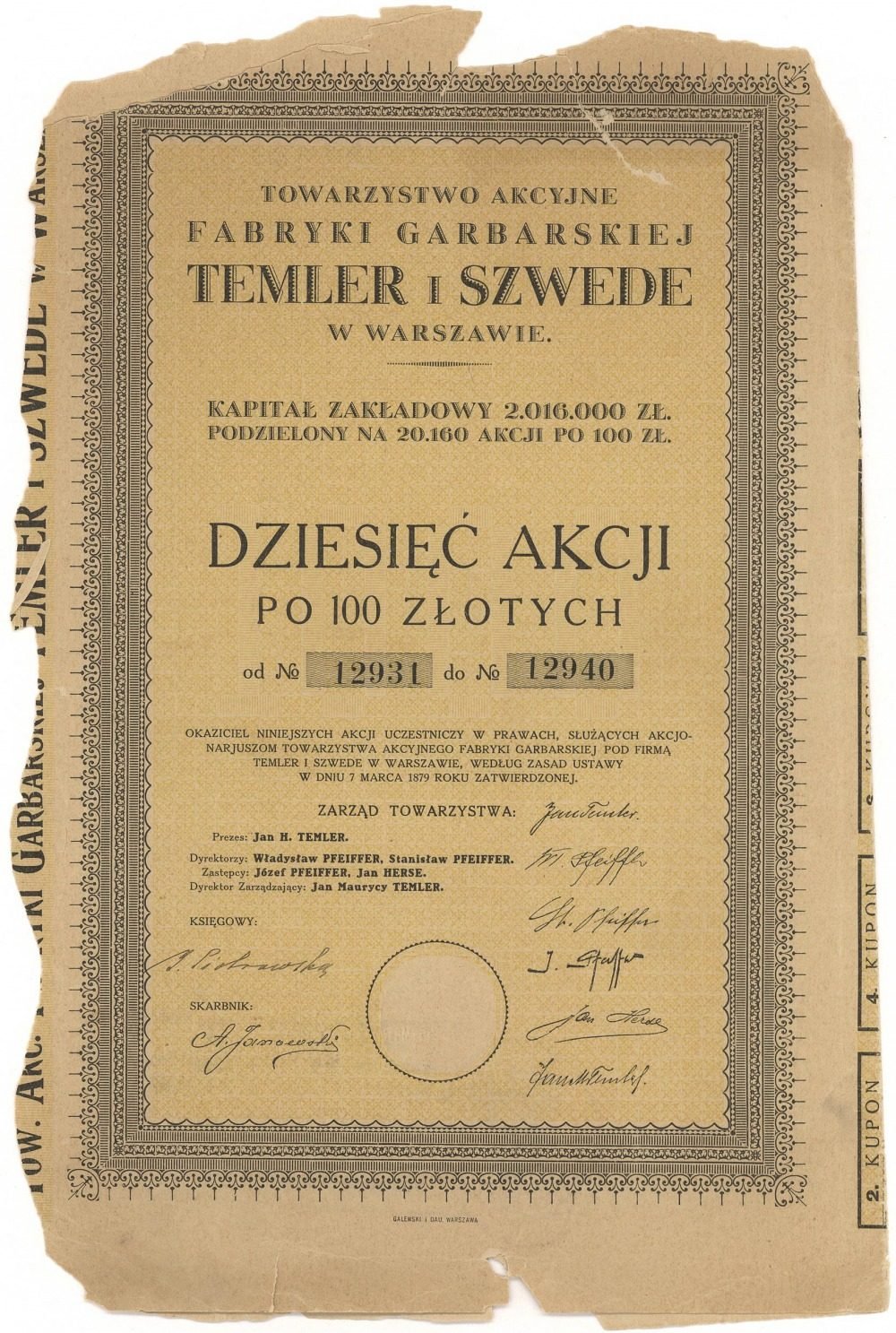
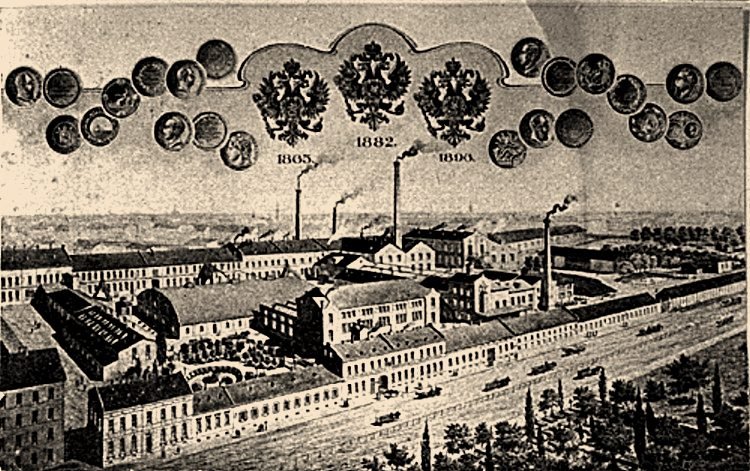
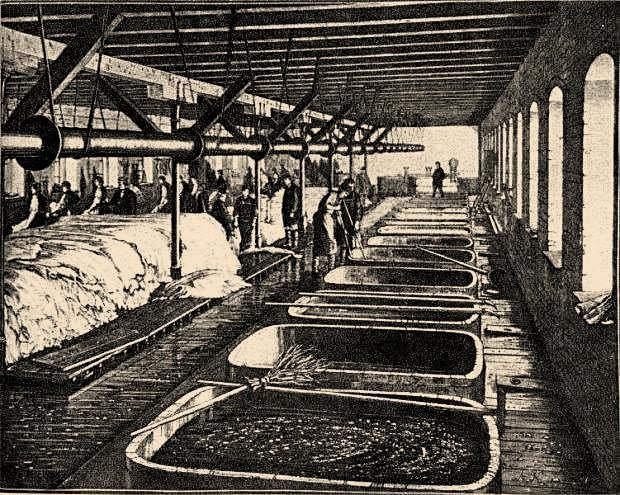
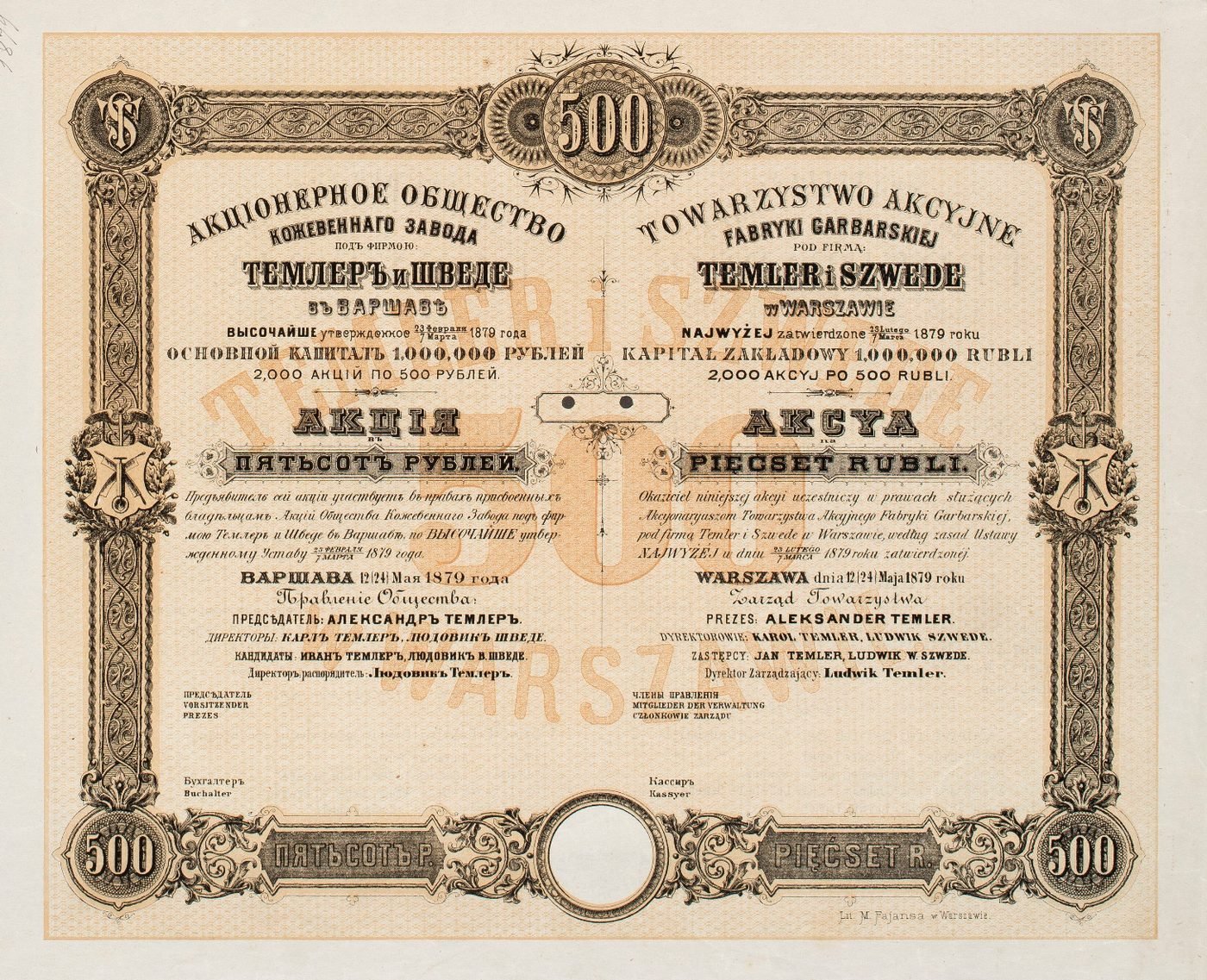
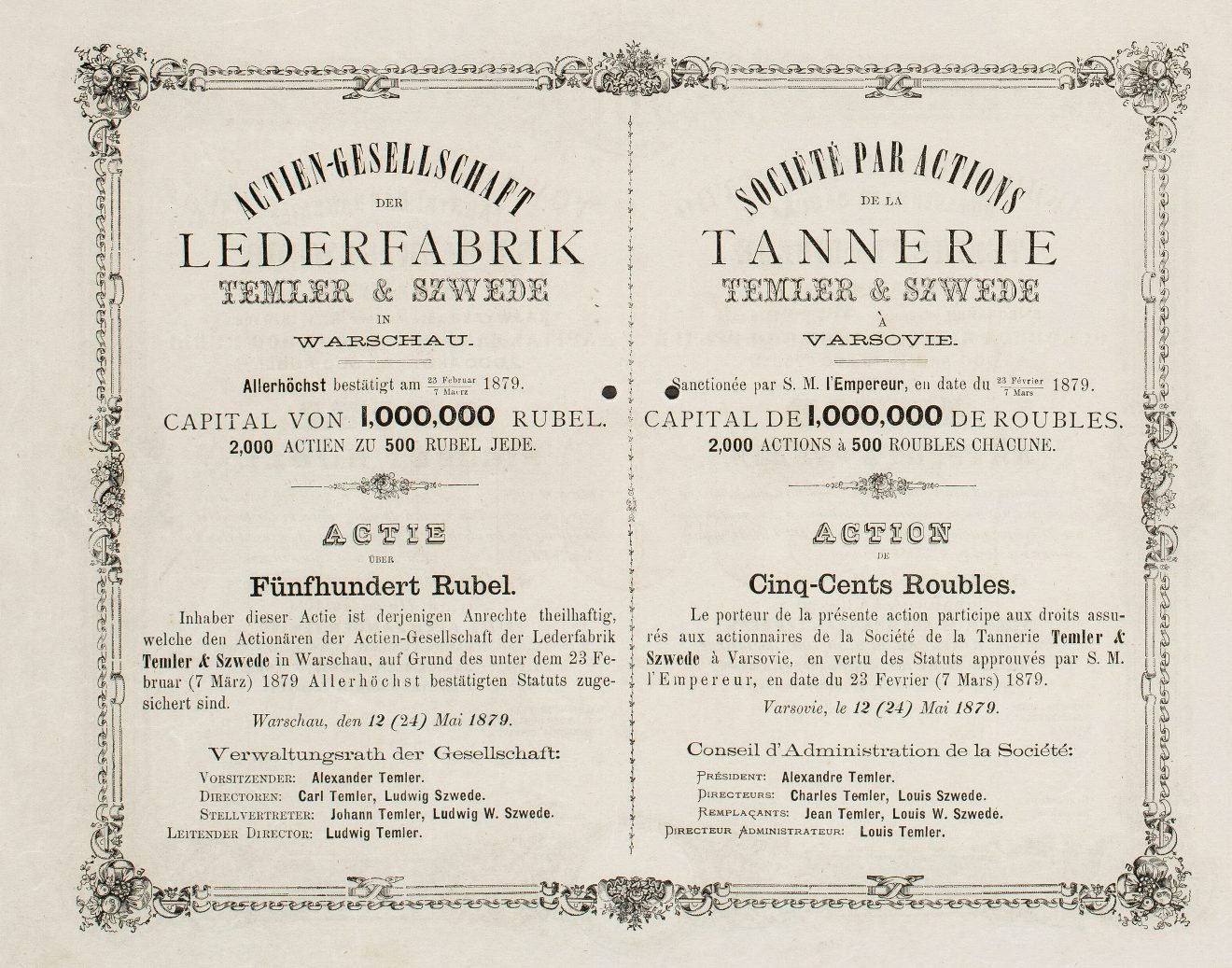
The new works tanned hides brought from Australia, India and America, and its products won medals at the exhibitions of Warsaw (1857), Moscow (1865), Paris (1867) and St Petersburg (1870); in Moscow the firm obtained the highest distinction — the right to place the state emblem on its products. The works aroused the curiosity of the press: J. Jaworski's „Illustrated Calendar" for 1870 reported that beside the tannery „by the Powązki toll-gates" a glue factory had opened, producing glue „of the finest sort", and that „the cutting of the blocks into thin slices is done by a little machine of Mr Temler's own invention". In 1879 the enterprise was transformed into a joint-stock company with a capital of a million roubles — a four-language share certificate of the first issue from May of that year survives, Russian-Polish on the obverse, German-French on the reverse, with the brothers on the board: Aleksander as president and Karol Ludwik among the directors; before the First World War the tannery employed 350 workers and its annual turnover exceeded two and a half million roubles.
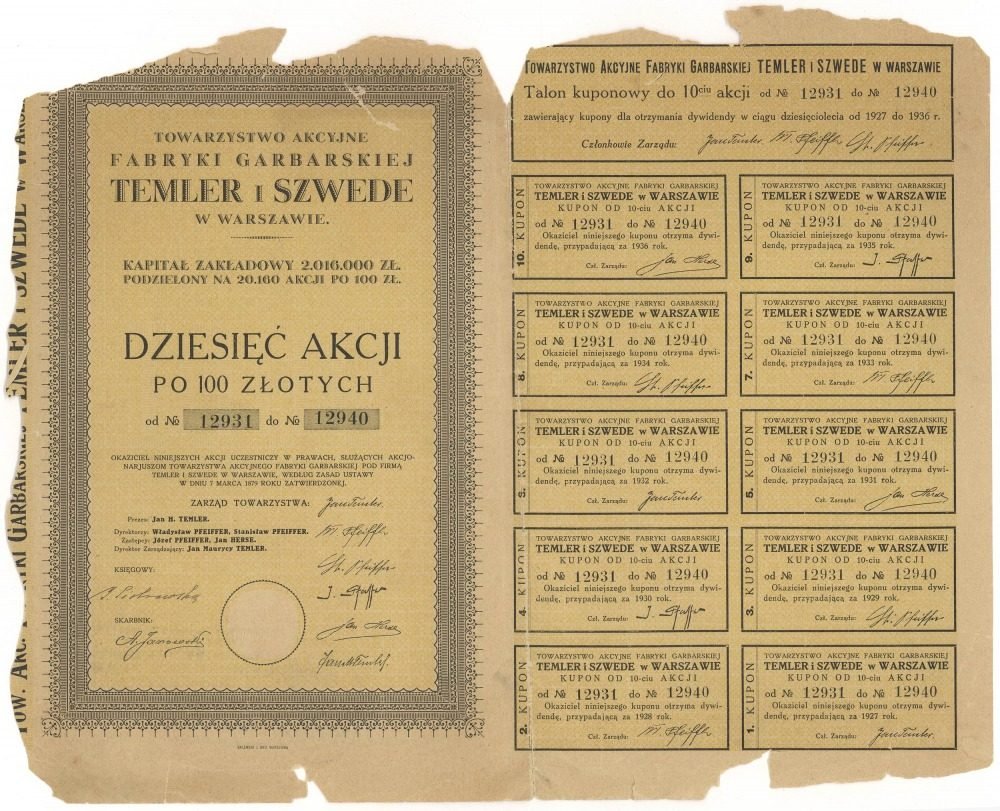
After the crisis of the mid-1920s the board was shared by the Temlers with the related Pfeiffer family — the second great dynasty of Warsaw tanners; Jan Maurycy Temler remained managing director, and among his deputies sat Jan Herse of the family that owned the famous fashion house. Precisely this composition of the board — with Jan Maurycy's own signature — is preserved on a surviving collective share of the company with dividend coupons for the years 1927–1936.
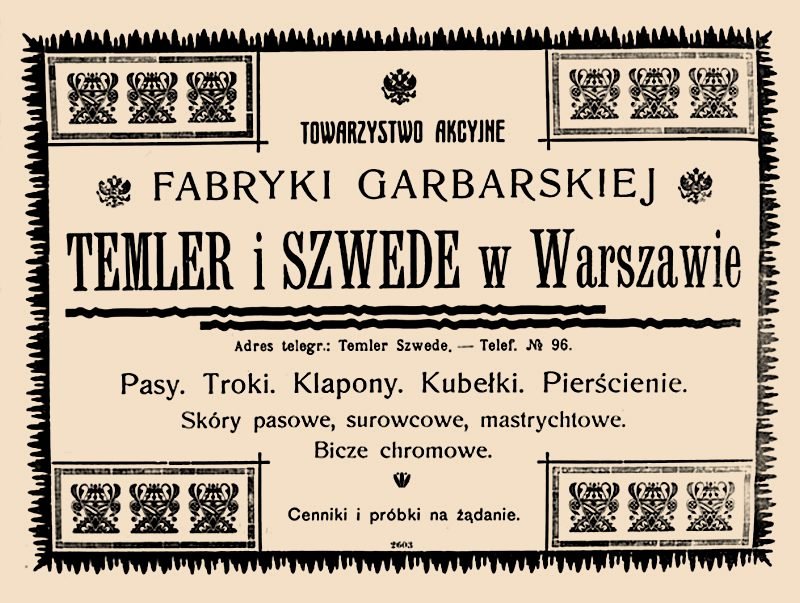
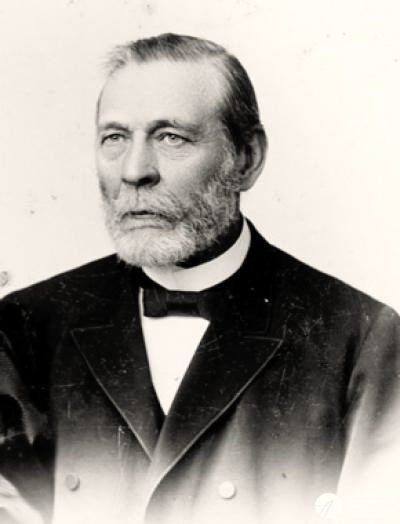
At the close of the nineteenth century this was the largest tannery of the Kingdom of Poland, and its leathers went out across the whole Russian empire. The family's position, however, was not measured by production alone: Aleksander Ferdynand — elected to the City Council in 1862 — was a judge of the Commercial Tribunal, a co-founder of the Commercial Bank, the Warsaw Industrialists' Savings Bank and the Municipal Credit Society; he also supported the founding of the Museum of Industry and Agriculture, organised agricultural companies and the Agricultural Settlements at Studzieniec with Father Jan T. Lubomirski, and, as pillars of the Warsaw Evangelical congregation, the family maintained the „Posiłek" soup kitchen, the crèche at 77 Karolkowa Street erected in 1909, and a bed in the Evangelical Hospital on Karmelicka Street. The settler family also quickly grew into Polish causes: Jan Gotfryd fought in the November Uprising, and Aleksander Ferdynand was for a time imprisoned in the Citadel for financially supporting the January Uprising.
A separate instrument for building the family's position was marriage. Daughters and sisters were married to the Szwedes (the partner's family), the Pfeiffers (the future co-owners), the Szlenkiers (the third great tanning dynasty) — and in two independent marriages, of an aunt and a granddaughter of the founder, the line allied itself with the family of the famous Herse Fashion House: with the brother and with the son of its creator. Through the Herses the threads reached further still, to the publishers Gebethner and Wolff. A dozen or more families of the Evangelical industrial bourgeoisie formed in this way a coherent milieu bound by capital and kinship; the Temlers belonged to its inner core.
II. A coat of arms, soap and Norblin's silver
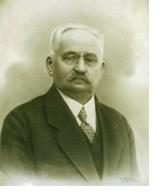
In 1852 Karol Ludwik Temler married Emilia née Werner — and with that marriage the Werner family entered the ancestry of the future residents of 7 Złota Street. The Werners, Polonised Germans from Obrzycko in Greater Poland, bore the Miron coat of arms, granted them by King Stanisław August — in gratitude, as the studies of the family relate, for painting the royal coronation portrait. The Warsaw branch was founded by Samuel Fryderyk Werner (1761–1836), a soap manufacturer who in 1794 stood in the Kościuszko Insurrection. His painted portrait survives to this day — the oldest preserved likeness of a direct-line ancestor of this family.
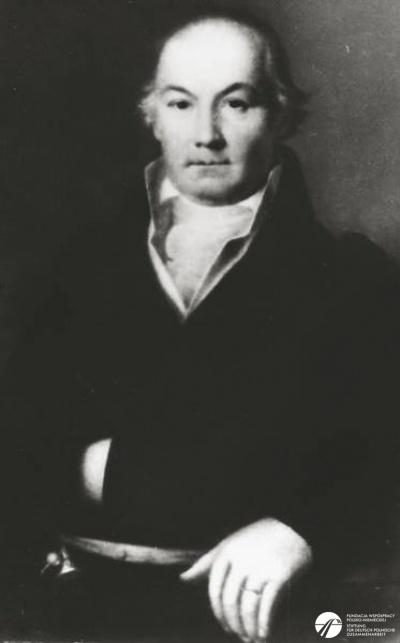
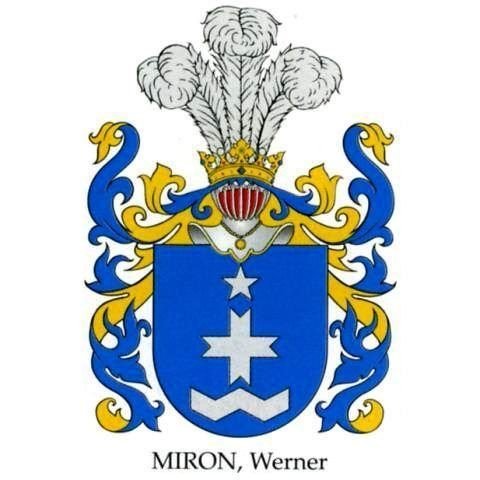
The children of Samuel Fryderyk wrote themselves into the city's history in several fields at once. Franciszek Ferdynand — a soldier of the November Uprising with the Gold Cross of Virtuti Militari — became a professor of pharmacy and the author of the apothecary act of 1839, for which the tsar confirmed the family's nobility. Karolina married Karol Filip Malcz, the most brilliant goldsmith of the century; with uncle Malcz her nephew August Teodor Werner later served his apprenticeship, and in 1864 he founded with Ludwik Norblin the factory „Norblin, Bracia Buch i T. Werner" — today its revitalised halls on Żelazna Street still bear that name. Emilia, the born sister of Norblin's co-founder, brought that tradition into the Temler house. The coat of arms — inherited under the old law exclusively in the male line — she could not pass to her descendants; the family's position rested in any case not on a heraldic jewel but on firms, offices and foundations.
III. Gardeners from Bohemia and a grandmother from the Isles
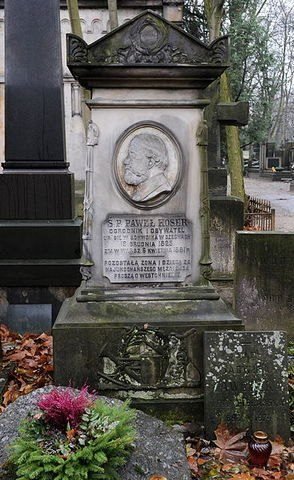
The second half of the ancestry belongs to gardeners. The Hosers — a line with roots reaching back to the patriciate of Augsburg — had lived for generations in northern Bohemia, in Česká Lípa and the village of Svojek. From there, in the middle of the nineteenth century, three brothers came to Warsaw: Piotr, brought over to work in the Saxon Garden, Paweł and Wincenty. Their „Bracia Hoser" Horticultural Establishment in Aleje Jerozolimskie became the largest gardening firm of the city — it was Hoser flowers that Bolesław Prus immortalised in „The Doll", and Piotr's son created the famous Żbików Nurseries near Pruszków. From the same line came, three generations later, Archbishop Henryk Hoser.
The brothers' fates illustrate well the multi-confessional character of the Warsaw of that day: Piotr married among the Lutherans, Wincenty — married to a Scotswoman from the Żyrardów factory colony — was laid to rest among the Calvinists, while Paweł joined the Catholic Church. And it is precisely Paweł who leads us to 7 Złota Street: in 1851 he married in the parish of St Alexander Anna née Flemming, born in Great Britain, daughter of David Flemming and Agnes née Hill. British blood entered the ancestry. The daughter of Paweł and Anna, Józefa Karolina, was the maternal grandmother of the future participant in the Warsaw Uprising.
IV. The young lady of St Barbara's
Józefa Karolina née Hoser married in 1882, in the parish of St Barbara, the Warsaw Catholic Karol Szulc. Their younger daughter, Zofia Henrietta, came into the world on 30 October 1886. When on 16 February 1915, in the middle of the Great War, she stood at the altar with Jan Maurycy Temler — grandson of Karol Ludwik and Emilia née Werner, managing director of the family tannery — two families of old Warsaw were joined: the horticultural and the industrial, the Catholic and the Evangelical. It was a marriage across confessions — in both lines such unions were made in every generation.
The firstborn son, Jan, died in infancy in 1920; a year later a daughter was born, Zofia Janina. And in the summer of 1929 Jan Maurycy died suddenly in Amsterdam, at the age of only forty-eight. The forty-two-year-old widow was left with an eight-year-old daughter, and from then on kept the household by her own work.
V. 2 Małachowski Square
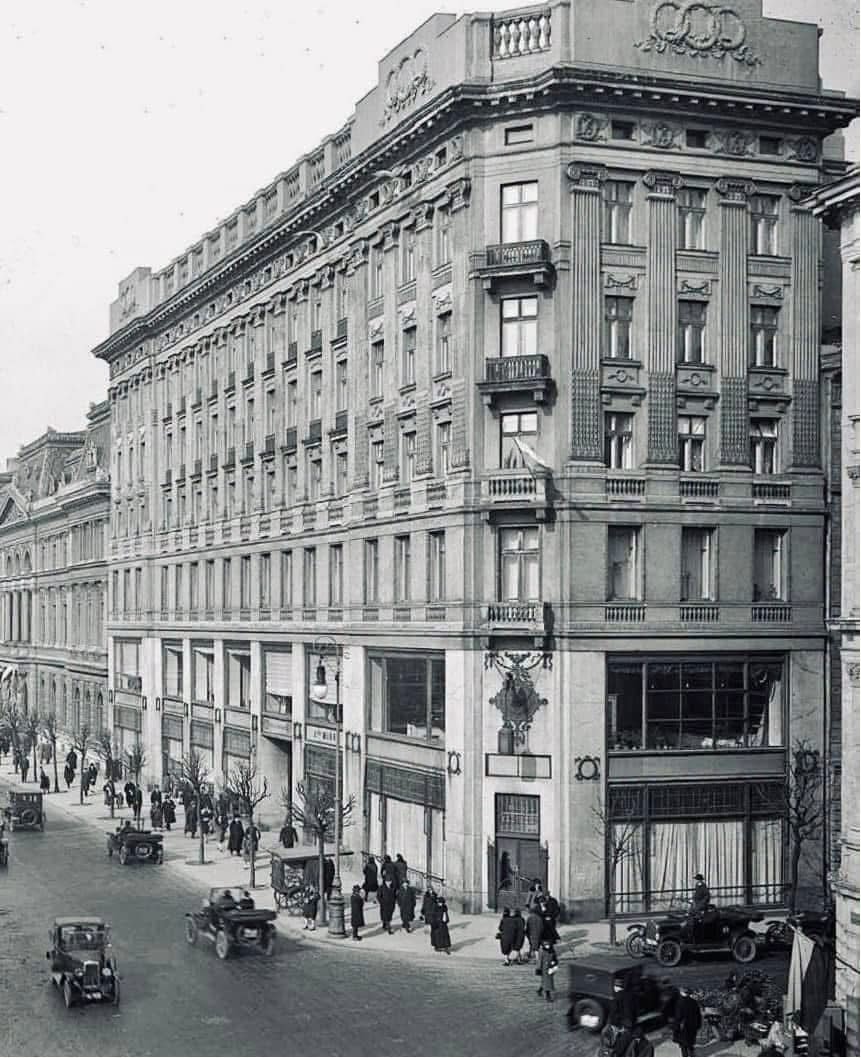
The widowed Zofia Henrietta settled with her daughter at 2 Małachowski Square — in the heart of old Evangelical Warsaw, opposite the Holy Trinity church in which generations of Temlers and Werners had prayed. It is this address that appears in the residence register of 7 Złota Street in the column „arrived from": „Pl. Małachowskiego 2"; next to Zofia Henrietta's name the register also records an occupation — commercial employee. From here, in the spring of 1940, already under German occupation, mother and daughter moved to Złota Street.
VI. Złota 7, apartment 10
In the spring of 1940 mother and daughter moved to 7 Złota Street. Through the whole occupation they lived here openly, under their own name. Most of their neighbours in the house were Jewish families, soon resettled behind the ghetto wall — the principal part of the accounts on this site is devoted to their fates. The Temler ladies belonged to the tenants who remained in the house to the end of the occupation.

The dates of that neighbourly exodus are set by the history of the Warsaw ghetto. In October 1940 the Germans announced the creation of a „Jewish district", and on 16 November they closed its walls, behind which some 400,000 people were crowded. The ghetto boundary cut across Złota Street itself — its western stretch found itself on the other side of the wall, a fragment of which stands to this day in the courtyard of the house at 62 Złota Street. In the summer of 1942, during the Great Deportation, the Germans deported from the ghetto to the extermination centre at Treblinka about 300,000 people. Among the victims of the ghetto and the Holocaust were former neighbours from this house — Dr Dawid Amsterdamski, the Czapliński brothers, the Feller family and many others whose fates we describe on this site.
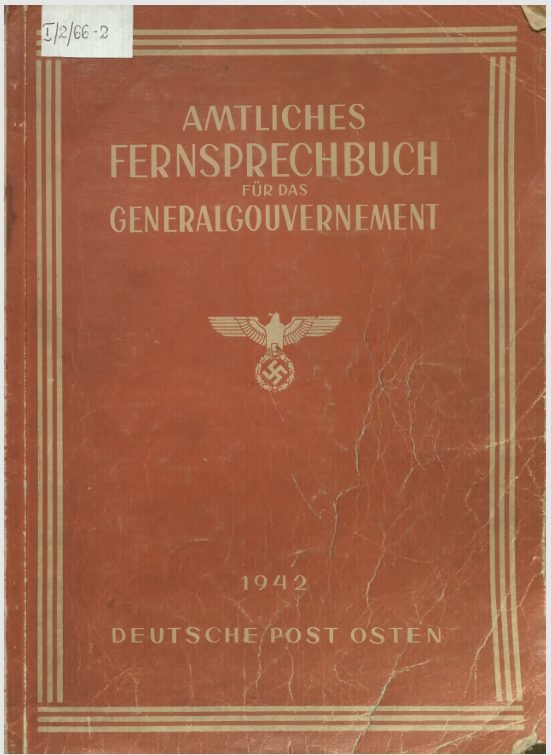
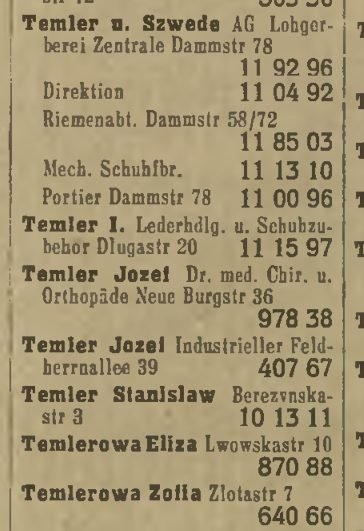
A trace of both ladies' wartime presence at this address survives in an unexpected source: the official telephone directory of the General Government, published by the Deutsche Post Osten in 1942. Among the Warsaw subscribers there stands „Temlerowa Zofia, Zlotastr. 7", number 640 66 — and a few lines above, the switchboard of the family tannery „Temler u. Szwede" at the former 78 Okopowa Street, renamed Dammstrasse by the occupier.
VII. „Zofia"
In the biographical entry for Zofia Janina Temler in the database of the Warsaw Rising Museum is written: „In the underground from January 1940." She was eighteen at the time. When the Uprising broke out on 1 August 1944, she stood to fight under the pseudonym „Zofia" — a rifleman and member of the women's auxiliary (peżetka) of the 2nd platoon, 8th company of the „Kiliński" Battalion of the Home Army, a company formed from the former Kedyw unit „Kolegium C". Her combat trail led through the Northern Śródmieście — that is, through the immediate neighbourhood of the family house.
The „Kiliński" Battalion, formed in the underground in 1940, fought for the blocks a few streets from Złota. Already on 2 August 1944 its soldiers took the Main Post Office building on Napoleon Square, and on 20 August — after a many-day assault — the PAST-a high-rise on Zielna Street, a German position towering over the city centre and one of the most celebrated conquests of the whole Uprising.
In those same August days, on the other side of the city, in Wola, her kinsmen were dying: during the Wola massacre the Germans shot Henryk and Janusz Hoser — the grandfather and father of the future archbishop; in the garden of their villa an insurgent arms cache had been kept. The Uprising fell after sixty-three days; the act of capitulation was signed on 2 October 1944, and the civilian population was driven out of the city, which the Germans then methodically demolished. Zofia Janina survived; she left Warsaw with the civilian population, and after the war returned to the same house on Złota Street.
VIII. Two soldiers' roads
On the ninth of February 1948 Zofia Janina married Zygmunt Jan Skoczyński. He, born on 25 September 1917 in Kyiv, a descendant of a Galician family from Radomyśl on the San, was the son of Stefan Skoczyński (1882–1934) — a mechanical engineer, in 1927–1934 director of the Warsaw Rohn-Zieliński Works, which built electrical machines under Brown Boveri licence — and of Halina née Haensel. He passed his school-leaving examination in 1935 at the Jan Zamoyski gymnasium in Warsaw; he served his year in the Cavalry Reserve Officer Cadet School at Grudziądz (class of 1935–1936) and on attachment with the 2nd Light Horse Regiment at Starogard, and in 1936 began studies at the Electrical Faculty of the Warsaw University of Technology. On 1 January 1938 he was commissioned second lieutenant of the cavalry reserve. The war interrupted his studies: in September 1939 he fought in the defence of Warsaw — beside his elder brother, Second Lieutenant Jerzy Bohdan — as a platoon commander in March Squadron no. 1 of the Pomeranian Cavalry Brigade. After the capital's capitulation he went into German captivity, to the oflags: XI B, and then II C Woldenberg. She served in the Home Army — so in one apartment two soldiers' roads of that generation met: the insurgent trail of Śródmieście and five years of a prisoner-of-war camp. Skoczyński moved to Złota Street in the summer of 1948; Zofia Henrietta then moved to apartment number 30 in the same house.
Oflag II C Woldenberg — today Dobiegniew — was the largest German prisoner-of-war camp for Polish officers: behind its wires were held nearly seven thousand men. The prisoners organised there an elaborate scholarly and cultural life — academic courses, a theatre, orchestras, and in the summer of 1944 even a camp Olympics, held under an Olympic flag sewn from a bedsheet. The camp was evacuated on foot at the end of January 1945, and the columns of prisoners were driven west, into the depths of the Reich.
IX. Pawiak and Ravensbrück
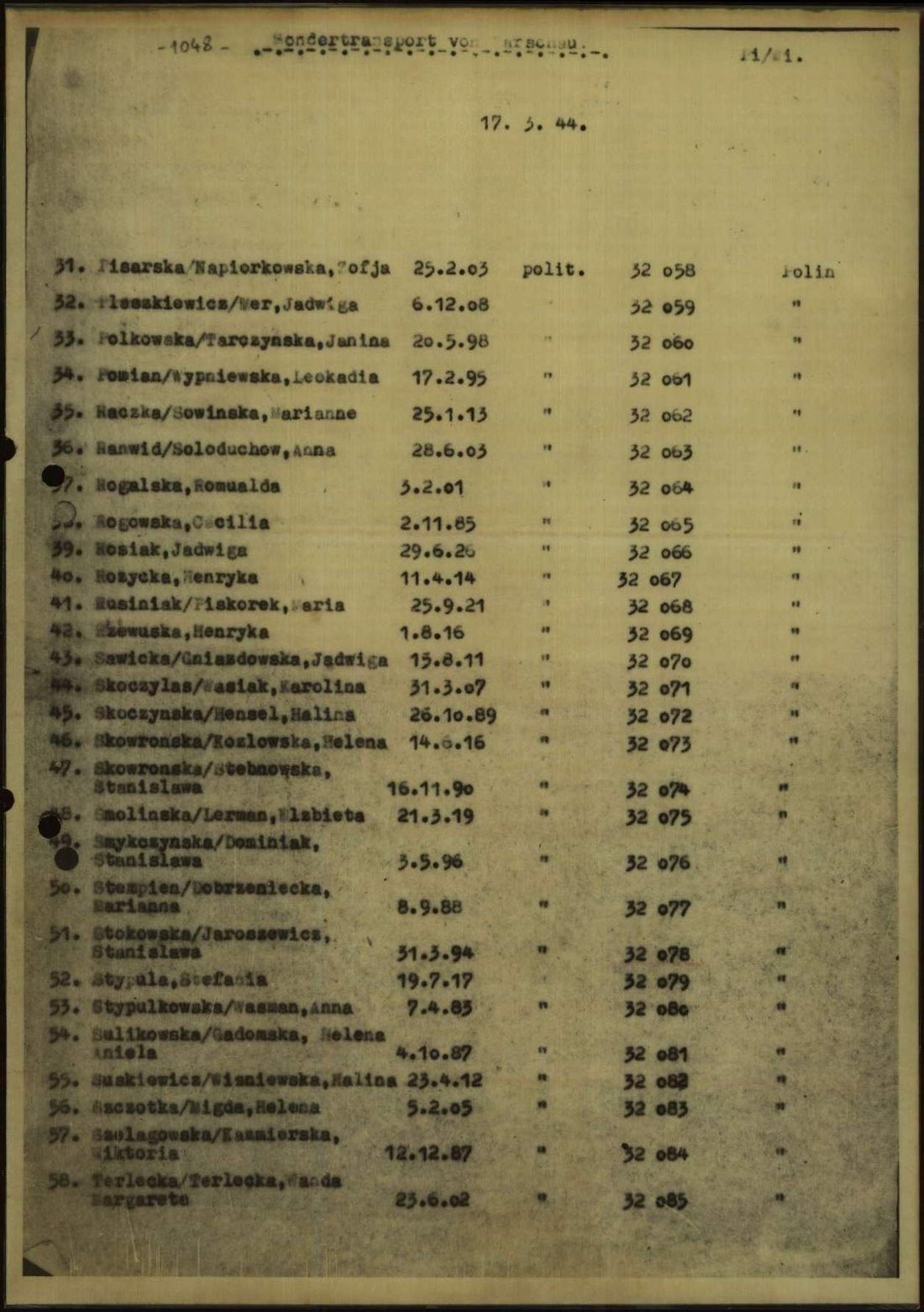
With Skoczyński's family is also connected one of the most piercing documents in the whole collection. His mother, Halina Skoczyńska née Haensel, was arrested as a political prisoner. A German list, „Sondertransport von Warschau" of 17 March 1944, has survived, published in the compilation „Sonderausgabe Ravensbrück" prepared by the Ravensbrück Club (Warsaw 1962) and covering the deportations of Polish women from the Pawiak prison to Ravensbrück in 1941–1944. Under item 45 stands „Skoczynska/Hensel, Halina", category „polit.", camp number 32072. Halina was thus a prisoner of Pawiak, deported on that transport to the concentration camp. She spent more than a year in it; according to family and cemetery records she perished in March 1945, a few weeks before the liberation — the exact date has so far no confirmation in documents. Her son learned of her death only after the war; her grave in the Evangelical-Augsburg cemetery is symbolic.
Both places on that road have their statistics. Pawiak was the largest German political prison in occupied Poland: between 1939 and 1944 about 100,000 prisoners passed through it, of whom nearly 37,000 were murdered and about 60,000 deported to concentration camps; women were held in the ward called „Serbia", and from there the transports to Ravensbrück departed. Ravensbrück itself, opened in May 1939 north of Berlin, was the principal concentration camp for women in the Third Reich: about 120,000 women prisoners passed through it, among whom Polish women were the largest national group. The camp's last winter, at the turn of 1944 and 1945, was the hardest — extreme overcrowding, hunger, epidemics, and from the beginning of 1945 a gas chamber as well. It is on those very months that the death of Halina Skoczyńska falls; the camp was liberated on 30 April 1945.
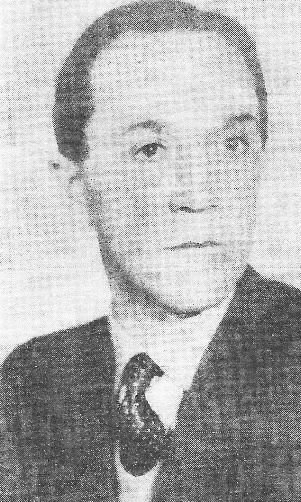
The fates of mother and son are closed by his post-war road, described in his entry in the Polish Biographical Dictionary. The end of the war found Zygmunt in Lübeck, where the evacuated prisoners had been driven. From there he made his way to Italy — in search of his mother; there he learned that she had perished in Ravensbrück. He then left for England: from 1946 he studied at the college run by the Council of Academic Technical Schools, then at Battersea Polytechnic in London, and after completing his coursework, in December 1947, he returned to Poland. Two months later he married Zofia Janina Temler.
X. The engineer and the translator
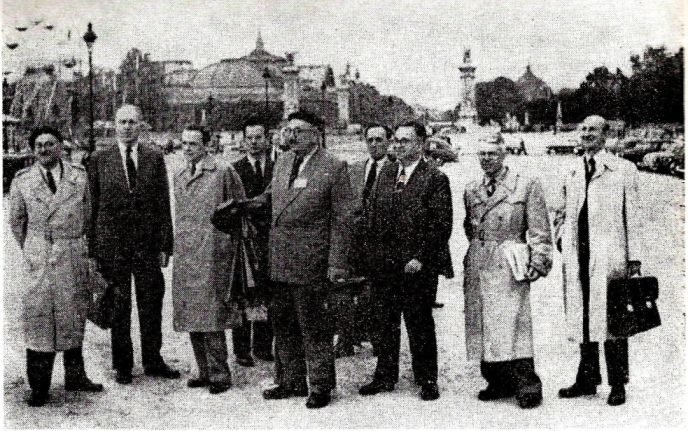
Zygmunt's professional life began in earnest in the same weeks as his marriage. From February 1948 he worked at the Electrical Faculty of the Warsaw University of Technology, and on 23 June 1948 — four and a half months after the wedding — he received his diploma in electrical engineering for a thesis on the theory of symmetrical components. At the University of Technology he travelled the whole academic road: from senior assistant, through adiunkt and docent (1955), to associate professor (1963) in the Chair of Electric Power Networks and Systems. In parallel, from 1948, he was attached to the Main Institute of Electrotechnology at Międzylesie (from 1951 — the Institute of Electrotechnology): he headed its research division, then the Power Engineering Department, and from 1958 until his death he was deputy director for research — in effect the institute's scientific head. On his initiative Poland's first direct-current network analyser was built in 1949; under his direction the country's first analyser-based short-circuit calculations were carried out; he co-created the high-power testing station and the numerical-methods division with a computing centre equipped with its own digital machine, took part in Poland's first short-circuit network trials and in the work on the 110 and 220 kV networks, and headed the team that drew up the conceptual design of the Warsaw Power Node. He translated the four-volume American work „Electric Power Transmission and Distribution" (1951–1952), and together with Paweł J. Nowacki published the monograph „Short Circuits in High-Voltage Power Systems" (1954). He twice received the State Prize: the team prize of the second degree for the analysers for the power industry (1952) and of the third degree for the monograph on short circuits (1955); he was vice-chairman of the Electrotechnology Committee of the Polish Academy of Sciences, chairman of the Polish committee of the 13th conference of the Grands Réseaux Électriques (CIGRE) — to whose sessions he also submitted a paper of his own, one of a dozen or so Polish papers in the post-war quarter-century — and an activist of the Association of Polish Electrical Engineers, decorated among others with the Knight's Cross of the Order of Polonia Restituta (1961) and the Gold Cross of Merit (1954). He died on 29 October 1964 in Warsaw, at the age of forty-seven; he rests in the Powązki cemetery, plot D, row VI, grave 13/14.
Zofia — described in her husband's biographical entry as an economist and Romance philologist — worked as a translator; the same occupation was entered against her name in the residence register of 7 Złota Street. The Skoczyńskis had a son, Jan, a mechanical engineer. And when in the 1990s the Polish Biographical Dictionary was preparing Zygmunt's entry, the information was supplied to the author by Zofia Skoczyńska herself — it is in large measure thanks to her that we know so much about him today.
XI. A map of memory
Zofia Henrietta Temler died on 6 August 1978 and was laid to rest in the Szulc family grave in the Old Powązki cemetery, beside her parents and her sister. Zofia Janina departed on 24 March 2009 — and returned to her father's world: to the Evangelical-Augsburg cemetery on Młynarska Street, where her Werner ancestors have lain since 1836 and where Jan Maurycy was buried in 1929. On the black granite of her tombstone is carved: „Zofia Skoczyńska née Temler".
The family's graves are spread today across four Warsaw necropolises — an arrangement that maps its history: marriages were made across the boundaries of confession, burials took place according to them. In the ancestry of the residents of 7 Złota Street five countries met and three Christian confessions — Roman Catholic, Evangelical-Augsburg and Evangelical-Reformed; the war struck the family from several sides at once: in the Wola massacre, in Ravensbrück, and also in the Soviet East, where the heir of the tannery, Karol Temler (1896–1941), disappeared — a lieutenant of sappers of the September campaign, who marched the trail from Toruń to Lwów and was arrested there in March 1940 by the NKVD. Despite all this the family endured and rebuilt its life in post-war Warsaw.
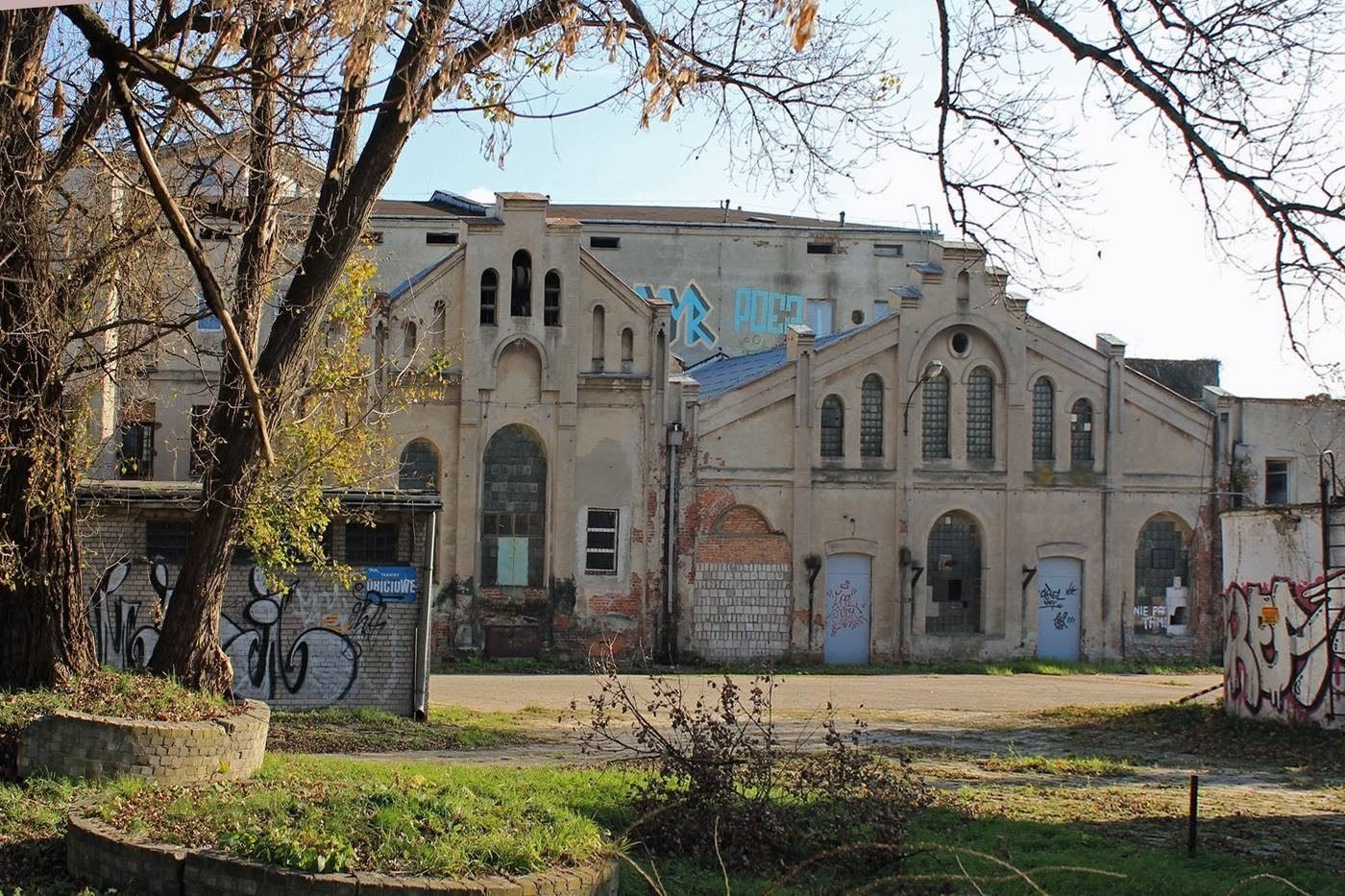
The fate of the tannery itself is a separate epilogue. In September 1939, during the siege of Warsaw, most of its buildings burned down; the occupier imposed a commissary administration, and part of the production was moved to the grounds of the Pfeiffer brothers' tannery, where in the mechanical footwear department the engineer Kręglewski, in secret from the Germans, made boots for soldiers of the Home Army. In August 1944 the Germans burned the buildings almost to the ground — and already in the autumn of that year four partners, among them Stanisław Temler, began secretly to rebuild the rear parts of the buildings, hiding the work behind the rubble of the frontages. On 20 June 1945 the saddlery started up; in December the first hides were finished; the rebuilding was financed, among other means, from the sale of gold hidden on the works' grounds during the war. In 1946 the firm was placed under compulsory administration and soon nationalised; on its base operated in turn the Warsaw Tannery Works no. 1, the „Syrena" Footwear Factory and the „Lux-But" works — until the mid-1970s. Heritage status did not come easily: at the end of the first decade of this century the complex still faced demolition, and the initiative to place it under conservation protection was opposed by the city hall; the complex finally entered the register of historic monuments in 2010. Today the family's descendants are seeking its restitution.
Of the world described in this sketch there remain the ruins of the tannery on Okopowa, Werner's name in the name of the Norblin Factory, graves in four cemeteries — and two lines in the residence register of 7 Złota Street, from which this reconstruction began. We publish it in agreement with the Family, whom we thank for their trust.
Timeline
| Date | Event |
|---|---|
| 1793 | Jan Gotfryd Temler, founder of the Warsaw tannery, is born in Gera in Saxony. |
| 1794 | Samuel Fryderyk Werner of the Miron arms, Warsaw soap-maker, takes part in the Kościuszko Insurrection. |
| 1817–1819 | Jan Gotfryd founds the tannery on Ogrodowa Street (sources give 1817 or 1819). |
| 1851–1852 | Marriages joining the lines: Paweł Hoser to Anna née Flemming; Karol Ludwik Temler to Emilia née Werner. |
| 1859 | The partnership „Temler i Szwede" is formed — the future largest tannery of the Kingdom of Poland. |
| 1864 | August Teodor Werner founds with Ludwik Norblin the factory „Norblin, Bracia Buch i T. Werner". |
| 1879 | The „Temler i Szwede" tannery is transformed into a joint-stock company with a capital of a million roubles. |
| 1882 | Marriage of Karol Szulc and Józefa Karolina née Hoser in the parish of St Barbara. |
| 30 Oct 1886 | Zofia Henrietta Szulc is born in Warsaw. |
| 16 Feb 1915 | Zofia Henrietta marries Jan Maurycy Temler. |
| 25 Sep 1917 | Zygmunt Jan Skoczyński is born in Kyiv. |
| 22 Oct 1917 | Aleksander Ferdynand Temler dies, the last of the founder's sons; he rests in the Evangelical-Augsburg cemetery. |
| 1 Jul 1921 | Zofia Janina Temler is born. |
| 26 Jun 1929 | Jan Maurycy Temler dies in Amsterdam. |
| Sep 1939 | Zygmunt Skoczyński, platoon commander in the Pomeranian Cavalry Brigade, is taken into German captivity; he will pass through oflags XI B and II C Woldenberg. |
| Jan 1940 | Zofia Janina Temler joins the underground. |
| 1 May 1940 | Mother and daughter take up residence at Złota 7, apt. 10. |
| 16 Nov 1940 | The walls of the Warsaw ghetto are closed; the boundary cuts across the western stretch of Złota Street. |
| 17 Mar 1944 | Halina Skoczyńska is deported from Pawiak to Ravensbrück. |
| 1 Aug 1944 | Outbreak of the Warsaw Uprising — Zofia Janina fights in the „Kiliński" Battalion in the Northern Śródmieście. |
| Aug 1944 | Henryk and Janusz Hoser perish in the Wola massacre. |
| 2 Oct 1944 | Capitulation of the Uprising; Zofia Janina leaves Warsaw with the civilian population. |
| Jan 1945 | Evacuation of Oflag II C Woldenberg; the end of the war will find Zygmunt in Lübeck. |
| Mar 1945 | Halina Skoczyńska perishes in Ravensbrück. |
| 1946 | The tannery under compulsory administration; nationalisation soon follows. |
| 1946–1947 | Zygmunt studies in London (Battersea Polytechnic); in December 1947 he returns to Poland. |
| 9 Feb 1948 | Marriage of Zofia Janina to Zygmunt Skoczyński, second lieutenant of cavalry of the September campaign, former prisoner of Oflag II C Woldenberg. |
| 23 Jun 1948 | Zygmunt receives his diploma in electrical engineering at the Warsaw University of Technology. |
| 1949 | On Zygmunt Skoczyński's initiative Poland's first direct-current network analyser is built. |
| 1958 | Zygmunt Skoczyński becomes deputy director for research of the Institute of Electrotechnology. |
| 29 Oct 1964 | Zygmunt Skoczyński dies — professor of the Institute of Electrotechnology and the Warsaw University of Technology; he rests at Powązki. |
| 6 Aug 1978 | Zofia Henrietta Temler dies; she rests in the Szulc grave in the Old Powązki cemetery. |
| 24 Mar 2009 | Zofia Janina Skoczyńska née Temler dies; she rests in the Evangelical-Augsburg cemetery. |
A Note on Sources
This account rests exclusively on sources: the residence registers of the house at 7 Złota Street from the collection of the State Archive in Warsaw; the Insurgent Biographies database of the Warsaw Rising Museum; the cemetery registries of four Warsaw necropolises; the German transport list of 17 March 1944 (after the compilation „Sonderausgabe Ravensbrück", Ravensbrück Club, Warsaw 1962); the official telephone directory of the General Government (Deutsche Post Osten, 1942); studies of the officer corps of the Polish Army of the Second Republic (S. Radomyski on the Cavalry Reserve Officer Cadet School at Grudziądz; R. Rybka, K. Stepan, „Officer Promotions in the Polish Army 1935–1939"); the database of the programme „Personal Losses and Victims of Repression under the German Occupation"; parish records; and studies of the history of the Temler, Werner and Hoser families and of the „Temler i Szwede" tannery (among others the Wilanów Palace Museum, the Polish Biographical Dictionary, Zeszyty Wolskie, the „Poles by Choice" service of the Foundation for Polish-German Cooperation) and genealogical services. The full documentation is available from the project's author. Where discrepancies remain between sources, the best-documented version has been adopted.
Opracowanie w ramach projektu upamiętnienia mieszkańców kamienicy przy ul. Złotej 7 i 9 w Warszawie — prepared as part of the project commemorating the residents of the house at 7 and 9 Złota Street in Warsaw · www.zlota7-9.com