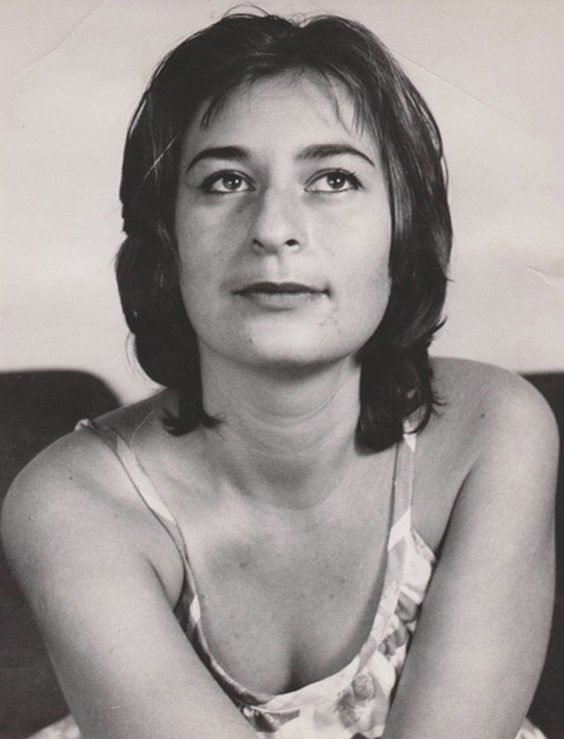
„A child named after a mistress! No wonder I was a renegade all my life."
There were seven of them in that apartment. Julian Singer — an industrialist, co-owner of a factory of insulating materials, a man who wanted to become an engineer and inherited a firm from his father. Bronisława née Lisek, at home Bronka — a daughter of a large family from Częstochowa, a secretary and translator who came to Warsaw for work and after ten years of engagement married her employer's son. Dorota, Julian's sister, entered in the register as living „with her brother". Two little girls: five-year-old Anna — at home Anetka and Janina, in Canada Annette — and two-year-old Maria, Marysia. And two women without whom this household would not have run, registered in the same book, under the same number: the governess Stanisława Kraśnik and the domestic help Stanisława Lewandowska.
They moved in on 6 October 1937, having come from Podkowa Leśna, into a six-room apartment on the fourth floor. They moved out on 5 July 1939 — two months before the war — and no one in the family ever returned here. The father died in a prison in Arkhangelsk, the younger daughter in Uzbekistan, the father's sister on a Warsaw pavement beneath the balcony of her own apartment, an uncle at Katyn, the grandmother at Auschwitz. Two people came back: the mother and the elder daughter — and not to Warsaw, but by way of Zabrze, Wrocław and Paris to Montreal, where the same Anetka, now Annette, told the young Leonard Cohen what she thought of his new song, and danced in a city that loved her the way she loved it.
This account gathers everything that is known about them. Every fact comes from a source: from the residence register of the house at 9 Złota Street, from advertisements and reports of the Silesian press of 1935, from the Patent Office trademark register of 1939, from the cards of the Jewish relief organisation AJDC and the emigration lists from Paris of 1949, from a Canadian certificate of identity, from Jim Murray's memoirs, from obituaries and gravestone inscriptions — and above all from three accounts by Anna herself: the memoir „Janina Singer's Odyssey", dictated in the last two years of her life, an earlier autobiographical sketch, and a letter of 5 August 1997.
I. Two households — Warsaw and Częstochowa
Julian Singer was born on 16 August 1896, the son of Izrael Singer and Chana née Teigenblatt — so the clerk keeping the residence register of Złota 9 recorded his data. His daughter remembered that he came into the world in Warsaw, in a Jewish family so Polonised that Jewishness was spoken of in it rarely or not at all. „Like the Polish poet Julian Tuwim, my father was a Pole by choice — and like me, he had good reason to make that choice."
Izrael Singer ran an enterprise in Warsaw concerned — as his granddaughter remembered — with reinforcing and securing buildings. His wife Chana, in the family Anna, was a great beauty; she suffered from what was then called melancholia. She took her own life by jumping from a fifth-floor balcony, before her namesake and granddaughter was born. She had announced it beforehand and no one believed her. „They said that people who threaten to kill themselves never do it. Well, they were wrong." Julian had a sister, Dorota, born 20 May 1907 — the same who would live with them on Złota — and brothers: Michał, a gynaecologist, and Zdzisław, a lawyer and reserve officer. After the father's death the three brothers inherited the firm.
Bronisława Lisek was born in Częstochowa at the end of December 1904, the daughter of Salomon Lisek and Klara née Zylber. Salomon, son of Kafel and Ewa née Grosman, appears in the Częstochowa population register as a seller of machines; his granddaughter remembered him as a chemist or apothecary who barely supported his brood of children. Klara, daughter of Zysman and Małka née Zelten, kept the house. There were at least seven children: Sara, Mina, Perla, Bronisława and her twin brother Zygmunt, Henryk and Józef. Anna remembered „seven or nine siblings, including a twin brother" — and that most of them later perished at Auschwitz.
Bronka went to work as a teenager. She finished commercial school, learned German, became a secretary and translator — and came to Warsaw, where a large firm belonging to Julian's father employed her. That is how they met.
II. Leipzig and ten years of engagement
Julian wanted to be a civil engineer. He was admitted to a Polish university only after several refusals, and as a Jew he had to sit in the last row of the lecture hall. He could not bear that humiliation — he left to study architecture in Leipzig. He returned with a diploma to his father's firm.
The engagement to Bronka lasted ten years: they had nothing to marry on, and Julian's well-to-do family did not accept a poor girl from Częstochowa. „What drew him to her? No doubt her beauty and youth — and also that she adored him." About Julian himself the daughter noted the thing that returns in her every memory of him: he was no Adonis, he was stout, he loved to cook and to eat, and from time to time he would send the maid out of the kitchen and prepare a feast himself.
III. Katowice, 35 Plebiscytowa Street
The first child, Anna, came into the world on 13 July 1932 — so says her Canadian identity document, which gives Katowice as her birthplace; the Warsaw residence register notes the date 15 July. The birth was hard. „Mother often repeated to me that father shouted: kill the child, save my wife!" — so her memoir begins. „That is how I was welcomed into the world. I came reluctantly, as if I knew what awaited me." She was named after the grandmother who had jumped from the balcony — but at home she was called Janina, because that, as her father maintained, was the name of the mistress of one of the uncles, who insisted on the name and got his way. „A child named after a mistress! No wonder I was a renegade all my life." Three years later, on 14 July 1935, Maria was born.
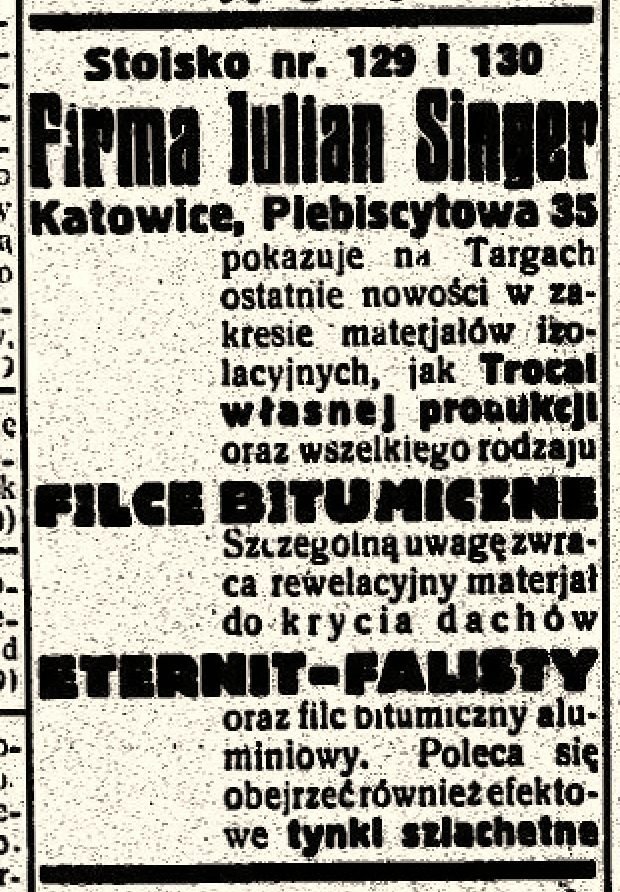
In the same year the firm of Julian Singer appears in the Silesian press. In the issue of „Polska Zachodnia" of 26 May 1935, in the advertising block of the sixth Katowice Fair, a whole column is taken by an advertisement: stands nos. 129 and 130, „The firm Julian Singer, Katowice, 35 Plebiscytowa Street, shows at the Fair the latest novelties in insulating materials, such as Trocal of its own production and bituminous felts of every kind", and further corrugated Eternit, aluminium bituminous felt and noble plasters.
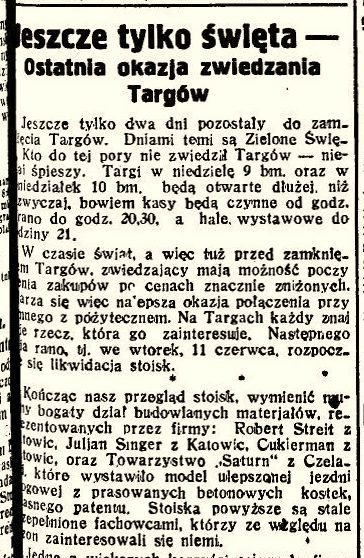
Two weeks later, on 9 June, the same newspaper summed up the fair: „Closing our review of the stands, one must mention the rich section of building materials, represented by the firms: Robert Streit of Katowice, Juljan Singer of Katowice, Cukierman of Czeladź and the »Saturn« Company of Czeladź".
IV. „Bitalum" — Warsaw 1938–1939
From Katowice the firm moved — or at least expanded — to Warsaw. The proof is an entry in the „Wiadomości Urzędu Patentowego" (Patent Office Gazette) of 28 February 1939: under register number 29552, with priority from 11 April 1938, the trademark „Bitalum" was registered. The owners: „Zdzisław Singer and Julian Singer. Warsaw. Factory of insulating materials". The list of goods is long and very specific: sealing and insulating materials for damp-proofing, thermal and acoustic insulation, insulating materials combined with aluminium, aluminium sheet and aluminium alloys, bituminous materials, impregnated fabrics, bituminised boards, cork panels and roofing materials. Even the possibility of writing the name as „Bit-Alum" was reserved.
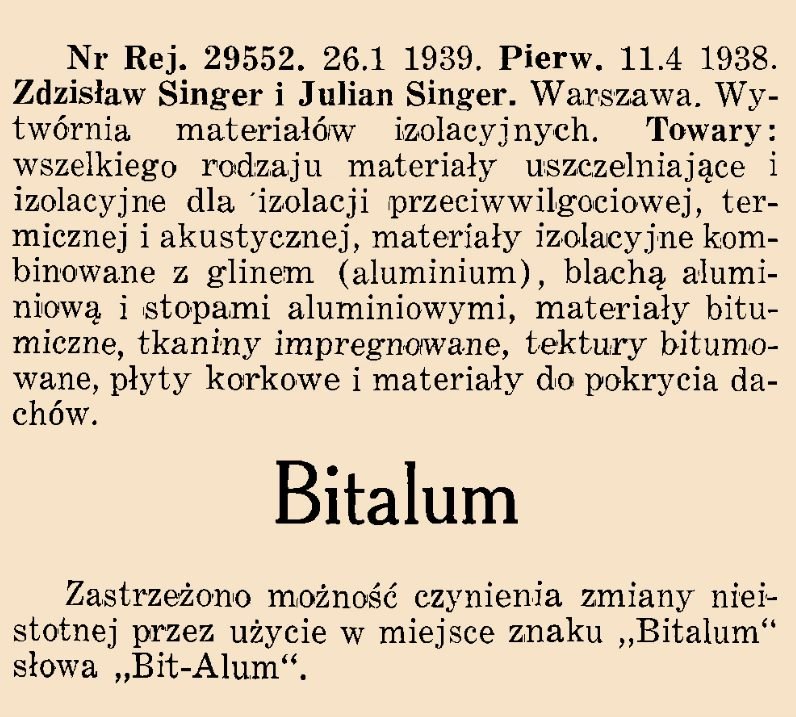
It is the only known document in which the two Singer brothers appear together — and the only one that names outright what Julian did professionally. In the residence register of Złota 9 it was recorded in one word: industrialist. The mark was registered seven months before the outbreak of the war.
V. 6 October 1937 — Złota 9, apartment 15
Before Warsaw they lived in Podkowa Leśna. They moved into the house at 9 Złota Street on 6 October 1937: all five on one day, the governess with them, the domestic help a week later, on 12 October, straight from Łódź. They took apartment no. 15 — six rooms on the fourth floor, with a separate room for the maid.
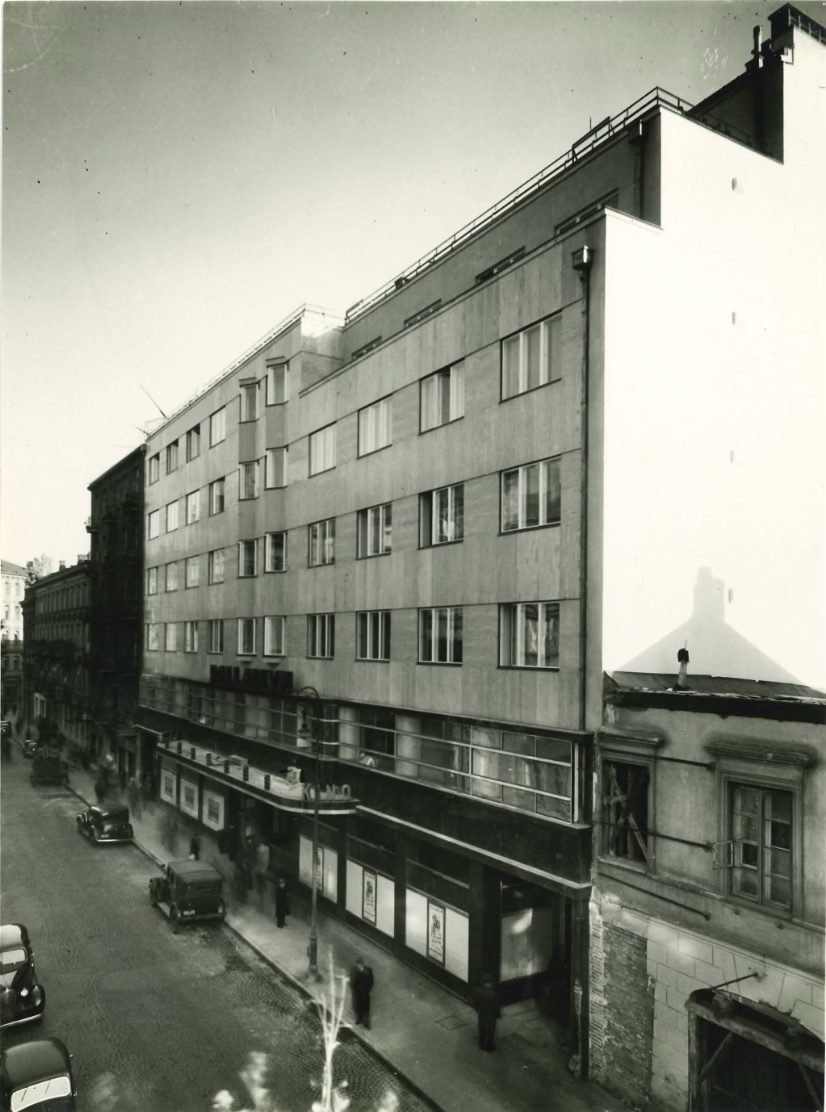
The columns were filled in carefully. Julian: industrialist, Mosaic religion, Polish citizenship, and in the column on the universal military obligation — sergeant of the reserve. Bronisława: „with her husband". Dorota: „with her brother". Anna and Maria: „with their parents". In the same house, three weeks after them, apartment number 6 was taken by the dental surgeon Stanisław Fiszhaut, senior assistant of the Academy of Stomatology — a neighbour from the same register, whose history is a separate chapter of this project.
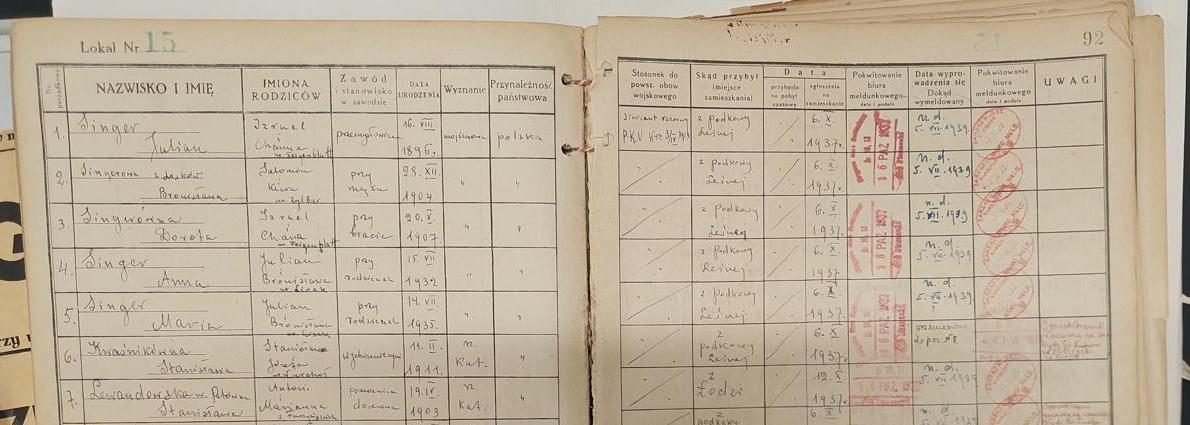
VI. The house and its people
Anna's memoirs and the residence register describe the same household from two sides. She remembered: „we lived very comfortably, in a six-room apartment on the fourth floor in the centre of Warsaw, with a maid — she had her own room — and a governess. Father had a car, a Buick, and a chauffeur, Wiktor — I remember his name! — because he could not drive himself. Besides, in 1932 there were so few garages that to get a driving licence you had to be a mechanic." The residence register adds names and dates of birth to that picture.
The governess was Stanisława Kraśnik, born 11 February 1911, daughter of Stanisław and Józefa, a Roman Catholic. She came with the family from Podkowa Leśna on the same day — so she had worked for the Singers already before. The clerk first recorded her as „Kraśnikówna"; the entry was later struck out, moved to position 8 and corrected, and the annotation of the correction was made in red ink in February 1938.
The domestic help was Stanisława Lewandowska, born 19 April 1903, daughter of Antoni and Marianna née Tomczyk, a Roman Catholic. She is the heroine of one of the most surprising threads of this story: in September 1939 she went east with the family — and we shall return to her in the account of the flight. „She was very good to us", Anna wrote seventy years later, remembering the surname though not the first name.
There was, in fact, more than one governess in this household. Anna remembered German and French teachers: her father, after what he had experienced at university, resolved to educate his daughter at home and in foreign tongues. „Until I went to public school I was exclusively a Pole" — she wrote, and in that sentence the whole family strategy is contained. One of the governesses fed her oranges in the park, which the girl hated and spat out whenever the woman turned her head.
VII. Anetka — the wunderkind
For three years she was an only child and the world revolved around her. Her father declared her a wunderkind: she read at three, and one of the first books he gave her was „Uncle Tom's Cabin" — after reading it she wanted to go and rescue „all those black people". From her third year he groomed her for an architect or a great scholar and spent hours teaching her recitation. He played guessing games with her, tapping the rhythms of popular songs on her bare back. She was perhaps five when he offered her a chocolate cigarette and tried to light it; the chocolate melted on the white shirt in which he was about to go dancing with his wife. „Mother was furious."
When Marysia was born — girlish, easy, the apple of her mother's eye — Anetka, as she herself recalled, „devised ways to murder her". The father, however, never stopped favouring her.
The parents did not tell their daughters that they were Jewish. Anna learned it on her first day at the school she entered as a five-year-old: she came home with a black eye, beaten for having — as was screamed at her — killed Christ. „Who was Christ? And why does someone say I killed him? I am five years old and I have killed no one." Her father took her on his knee and told the story as the Christians had written it: that Jesus, whom his own father called Yeshua, was a rabbi and a Jew, that the Romans killed him, and that the Jews became the scapegoat — „just like you today at school".
Excused from religion classes, she stayed in them out of curiosity and made friends with the priest, who — as she understood later — saw in her a soul to convert. From him she heard about Judas and that all Jews are like him. When she repeated this at home, her father went into the other room, wept, shouted and smashed the porcelain figurine of a horse and rider standing on the desk. In the night she heard him say to her mother: „Let us leave for Canada. I do not want my children to grow up here." They did leave for Canada — mother and she — twelve years later. The father did not live to.
VIII. A million złoty
In the spring and summer of 1939 the firm was doing well — well enough that Julian Singer lent the tottering state a million złoty for the army. His daughter was convinced it was nearly the whole of his fortune. „He felt he was a Pole, and as a Pole he had that duty."
At the same time he volunteered for the army — and was turned away. He was told, so his daughter remembered his account, that despite the million złoty they had no need of lousy Jews; that he was not good enough to give his life fighting for Poland. After the war Bronisława sued the German state for compensation for the ruined enterprise; the case, as Anna noted in a footnote to her own memoirs, „went nowhere".
IX. 5 July 1939 — deregistered
In the residence register of Złota 9 all seven entries end with the same date: 5 July 1939. The clerk recorded no new address. We do know, however, where the family was at the end of August: in Świder near Otwock, in the summer house where the Singers and the Liseks gathered every year for the holidays. Three days after they moved out, on 8 July, two women from Świadecka Street moved into apartment no. 15 — Łaja-Mirla Cukierman and Łaja Zygielman, a domestic worker. The great apartment began dividing into smaller lives.
X. 30 August 1939 — Świder
„I was seven years old on 30 August 1939, when the first bomb fell on Otwock." Everyone was in Świder then: the parents, she and Marysia, grandmother Klara, then seventy-two; cousin Romek with his mother Mania and sister Helena; Tadek, her favourite cousin, with his parents — Kazik and Genia.
She slid down the banister with twelve-year-old Helena. Helena said: England and France are with us, the war will last a few days, we shall win. Anna — as her mother remembered — answered that it would last long: one had only to look at those foolish Polish officers on the roof, waiting for the Messerschmitts with carbines. Her mother called her a black prophet, a Cassandra. „But I was right: there were many of us there that 30 August, and the six long years after that first bomb only a few of us would survive."
XI. Eastward
They went east by train — without a destination, „maybe Belarus, maybe Ukraine". They packed in bedsheets, because they were at the summer house and had meant to return to Warsaw before the school year began. There were six of them: Julian, Bronka, Anna, Marysia, sixteen-year-old cousin Roman — and the maid Lewandowska. Julian tried to the last moment to join the army, like his brother Zdzisław, a reserve officer; he had to jump onto the moving train in which the family was travelling.
They stopped in Równe or in Baranowicze — to the end of her life Anna was not sure in which of the two towns. There they met Zdzisław, Cyla's husband, in the uniform of a Polish officer. They saw him for the last time. The first months were calm: they rented an apartment, even went camping. Then the bombs began to fall, the town burned, and in the middle of the night the Russians came. They were taken away in cattle wagons, then loaded onto a barge and carried north along a river for two weeks. Somewhere on the way Lewandowska was no longer with them — Anna supposed she simply left. She also remembered a rumour circulating in the family that their maid later went into service in the household of the Marshal himself; a beautiful and impossible rumour, for Piłsudski had been dead since 1935.
XII. The Urals
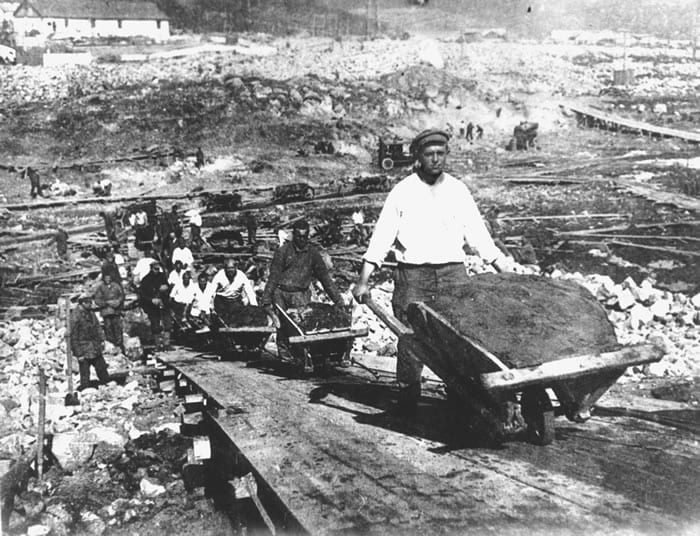
They were set down in the Urals, by a row of huts. „Here you stay. This is your hut. This is your hut" — and so on. There were mainly Jews there and some Poles suspected of troublesome views. Julian, forty-five, never in his life having done physical work, could not manage at the felling — so he sharpened the tools. Roman felled the trees and hauled them.
Anna spent a year there and remembered it in the episodes of a seven-year-old. The school with Soviet propaganda, from which she ran away and a militiaman walked her back. Arrest in the commandant's house for stealing books she had not stolen — the commandant's son had stolen them, but she did not give him away; instead she spent the whole night pretending to be a rooster and crowing until they let her out. The rusty nail she stepped on: the camp medic diagnosed gangrene and wanted to amputate the foot, whereupon her father promised to amputate something of his in return — they were given a horse and cart and travelled three days under armed escort to a real doctor in the neighbouring camp. There was no anaesthetic; four men held her while the doctor cut out the infected tissue. „There were good moments too: mushrooms, berries, clean air. Children did well there. Those who died — like my sister — died later, of the heat, malaria and hunger in Uzbekistan."
XIII. Bukhara and Arkhangelsk
After Germany's attack on the Soviet Union in June 1941 they were told: you are free, you may go where you wish. Julian chose Uzbekistan — from there it is close to Iran, and through Iran one can get out to the West. They never reached Iran.
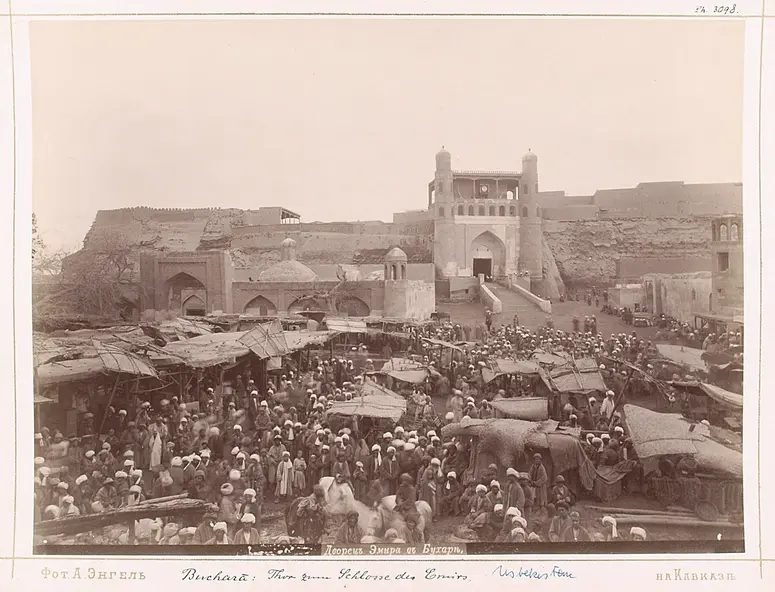
In Bukhara they lived in one, perhaps two rooms, together with a doctor, a Polish Jew, who saw patients in their lodging. Ten-year-old Anna dispensed medicines to the sick — or rather what there was: aspirin or baking soda — and felt herself his nurse. In 1942, during the purges, first Julian was arrested, then Roman. Anna was then in an orphanage, thirty or forty kilometres from her parents, who could no longer feed her. Roman came back after two years of the Gulag — with a stainless-steel smile, because when he heard that fellow prisoners were playing cards for his boots, he hid for two days in a chimney; when they found him, they took his boots and his teeth. The father never came back.
Of his death Anna learned by chance, in a chaikhana — an Uzbek teahouse where one bought odds and ends. She heard two men talking about the prison in Arkhangelsk, and her father's name fell.
She went up: „That is my father's name. Do you know something?" They were Poles released from that prison years before. They said Julian Singer had dysentery, and when the political prisoners were evacuated, he was simply left to die. „Whether it is true or not — I do not know." The mother sold everything she had, cheated by a „helper" who promised news of her husband and swindled her out of the remnants of her savings.
Marysia died in Uzbekistan of malnutrition and malaria. She was seven — the age Anna had been when the first bomb fell.
XIV. What happened to the others
Dorota — „Doris", the father's sister, the same who on Złota lived „with her brother" — stayed in Warsaw. She suffered, like her mother, from the illness then called melancholia. Of her death Anna learned thirty years after the war from Cyla: Dorota walked out onto the fifth-floor balcony of her apartment in occupied Warsaw and shouted to the soldiers below: „I am a Jewess, kill me". They did.
Grandmother Klara perished at Auschwitz. Michał, the father's brother, the gynaecologist, hid with his wife Ruth in the cellar of a Polish couple; as long as it was safe he was sent out at night to patients — he delivered babies, performed procedures — and as long as he paid, he could stay. When going out became too dangerous and the money ran out, the landlord came down to the cellar and shot them both.
Zdzisław, last seen in uniform near Równe, perished in the Katyn massacre. His wife Cyla survived thanks to a Pole thirty years her senior, who married her to give her Catholic papers: „When the war ends, your husband may return and you will of course go back to him — but now I am marrying you to save your life". The husband did not return. She stayed with her rescuer until his death; he later received the Israeli medal of the Righteous Among the Nations and was a Polish consul in Belgium. His name was Szelągowski. „She was one of the most beautiful women I have seen in my life" — Anna wrote — „and past eighty, on crutches, she was still teaching poor children."
Of the mother's family two brothers survived. Józek, after the war in Zabrze, came through the camps as a Jewish policeman — „we all knew what that meant: to save a few friends he had to hand over others". His wife Helena gave birth in a camp near Częstochowa to a baby girl whom she was ordered to drown; her fellow prisoners did it for her, for otherwise her husband would have had to denounce her. Kazik, Genia's husband, a prisoner of the Częstochowa HASAG camp, was released by a Gestapo man who came up to him saying it would be a pity to waste so distinguished a man, for tomorrow they would make soap of him — and ordered him to take off his armband at noon the next day and walk away. From 1941 to the end of the war Kazik sat in a wardrobe in his own wife's home, listening as a German officer courted her. Genia — a beautiful, illiterate village girl whom the family before the war had refused to see as a daughter-in-law — saved his life. „People tell me this proves Poles are not antisemites: after all, she saved a Jew. But he was her husband and she loved him."
XV. 1945–1948 — return to a foreign country
In 1945 Bronka and Anna returned to Poland the way they had left it: in cattle wagons, forty-five days, forty or fifty people to a wagon. „We were hungry, thirsty, dirty and sick. Most of us were Jews. But we were going home, to rebuild Poland. And we were Poles. We sang Polish patriotic songs." Anna was thirteen and a Polish patriot. „Over the next two years I was to be reminded of it every minute."
She lived with uncle Józek in Zabrze, then with Kazik and Genia in Wrocław, then in Zabrze again. Fourteen, without formal schooling, she taught the younger classes — the schools lacked teachers — for which her schoolmates pronounced her a conceited Jewess. On her bench they drew a Star of David in chalk, so that it would print itself on her navy-blue uniform; the priest laughed along with them. „Where was God then?" On the train between Zabrze and Wrocław armed men ordered all Jews and Russians off; two Soviet soldiers sitting beside her were led out, and she buried her nose in a book and went unnoticed. A moment later she heard two shots from outside. In August 1945 pogroms passed through Polish towns.
Then she resolved to leave for Palestine. She came to a home run in Zabrze for Jewish children who had not found their parents — Rabbi Yeshayahu Drucker gathered them — and went through a two-month Haganah training in the countryside, with weapons and with a provocation as the examination: she was accused of stealing a camera, to see whether she could be broken. For the road her mother gave her a ring, and uncle Józek — a revolver. With the whole group she crossed the Czechoslovak border illegally; most of her companions later ended up on ships of the „Exodus 1947" kind. Her mother pulled her off the road: she sent after her a friendly security-service officer, who found her ill on the third day. „I was not very sorry to be going back."
Before leaving Poland Bronka sold the tenement house in Gdańsk that Julian had made over to Anna, and gave the money to her brothers. They were to go to America, to a rich cousin whom grandfather Salomon had helped flee Poland before the war — „otherwise he would have ended up in Bereza". The cousin promised the fourteen-year-old the Actors Studio and everything else; in the end he abandoned the mother, and, as Anna put it, „we landed in Montreal, in manual work, without the language".
XVI. 1949 — Paris, the „Samaria"
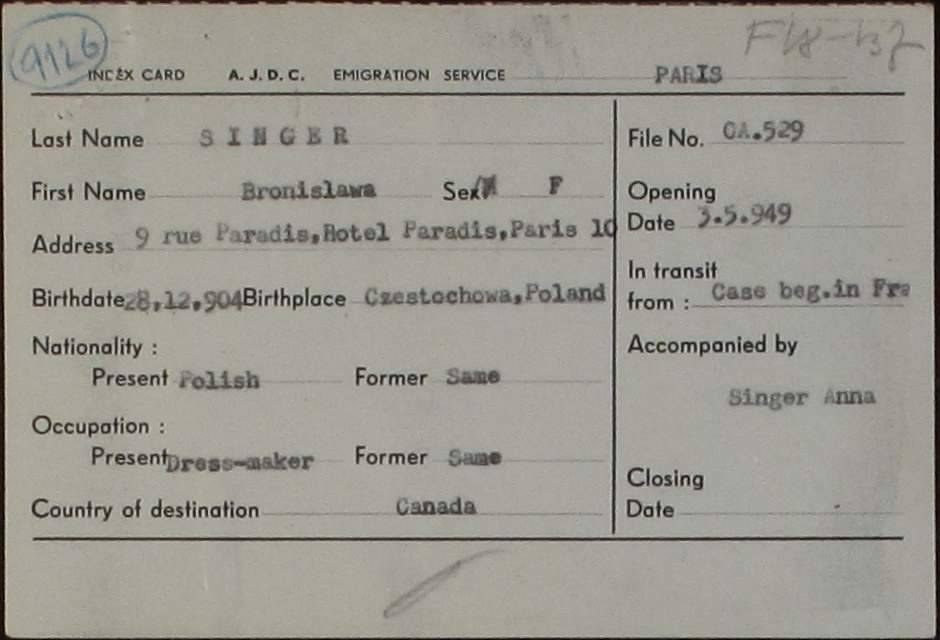
The official trace reappears in May 1949, in Paris. The registration card of the AJDC emigration service, file no. OA.529, opened on 3 May 1949: „SINGER Bronislawa", born 28 December 1904 in Częstochowa, Polish nationality, occupation — dressmaker, address: 9 rue Paradis, Hôtel Paradis, Paris X. Country of destination: Canada. In the column „accompanied by", one name: „Singer Anna".
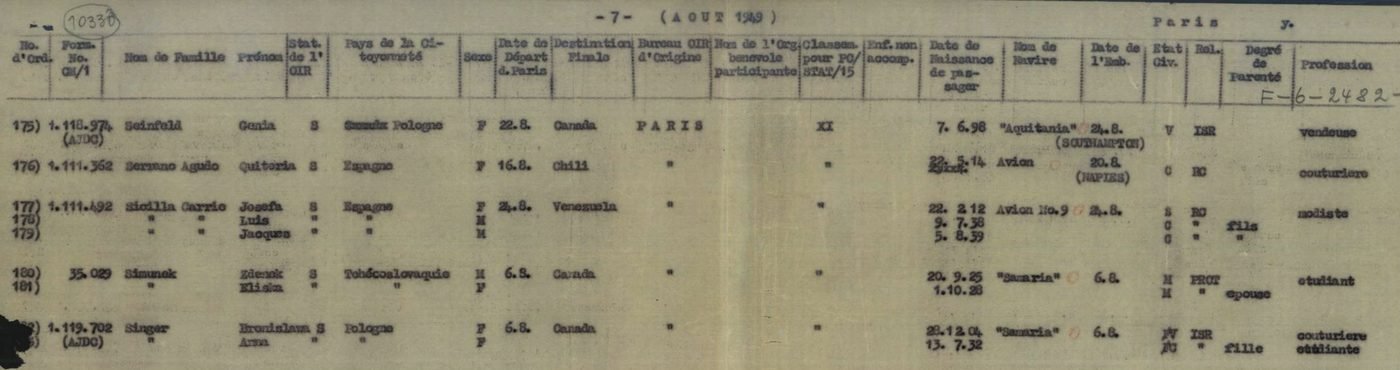
On the departure list of the International Refugee Organization of August 1949 both appear under one number: entries 182 and 183, „Singer Bronislawa" and „Anna", Poland, departure from Paris 6 August, destination — Canada, ship „Samaria". Against the mother: widow, Mosaic religion, occupation couturière. Against the daughter: „fille", étudiante. The Paris year was not wasted: Anna enrolled in a course at the Alliance Française, and before the departure Cyla and Szelągowski visited them.
XVII. Montreal — the time of Annette
In Montreal they began with manual work — Anna remembered the port wharves, the pennilessness and the longing — while learning two new languages at once. She was seventeen; before leaving she had received an invitation to the „Mazowsze" ensemble and to a drama school, and for years she could not forgive Poland that all this had stayed behind her. „We left not as economic refugees, but because of antisemitism."
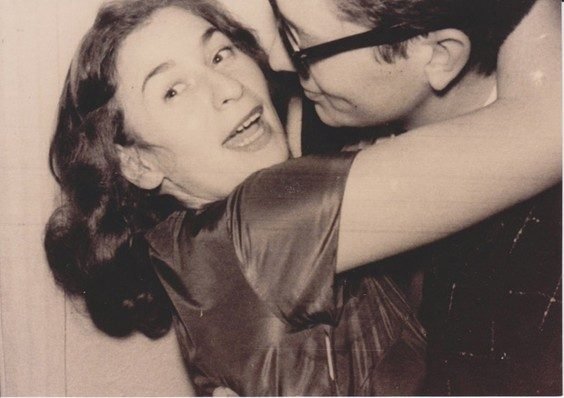
In time Anetka became Annette — one of the more colourful figures of the Montreal folk and literary scene of the fifties and sixties, a woman of whom her closest friend would say years later that Marilyn Monroe stood no chance beside her.
She studied at William Grieves's drama school, connected with the New York Actors Studio, finished the interpreters' school in Geneva, spoke five languages and in all of them was, as her obituary put it, „colourfully direct". From 1960 to 1967 she ran The Folk Centre — a Montreal school of modern languages and the performing arts.
Five languages — Polish, Russian, French, English and Spanish — became her tool for life: she taught them, translated from and into them, and in them, as her friends remembered, she swore. The Folk Centre joined under one roof language lessons and the performing arts — exactly the two things she had had to leave behind in Poland in 1949, together with „Mazowsze" and the drama school.
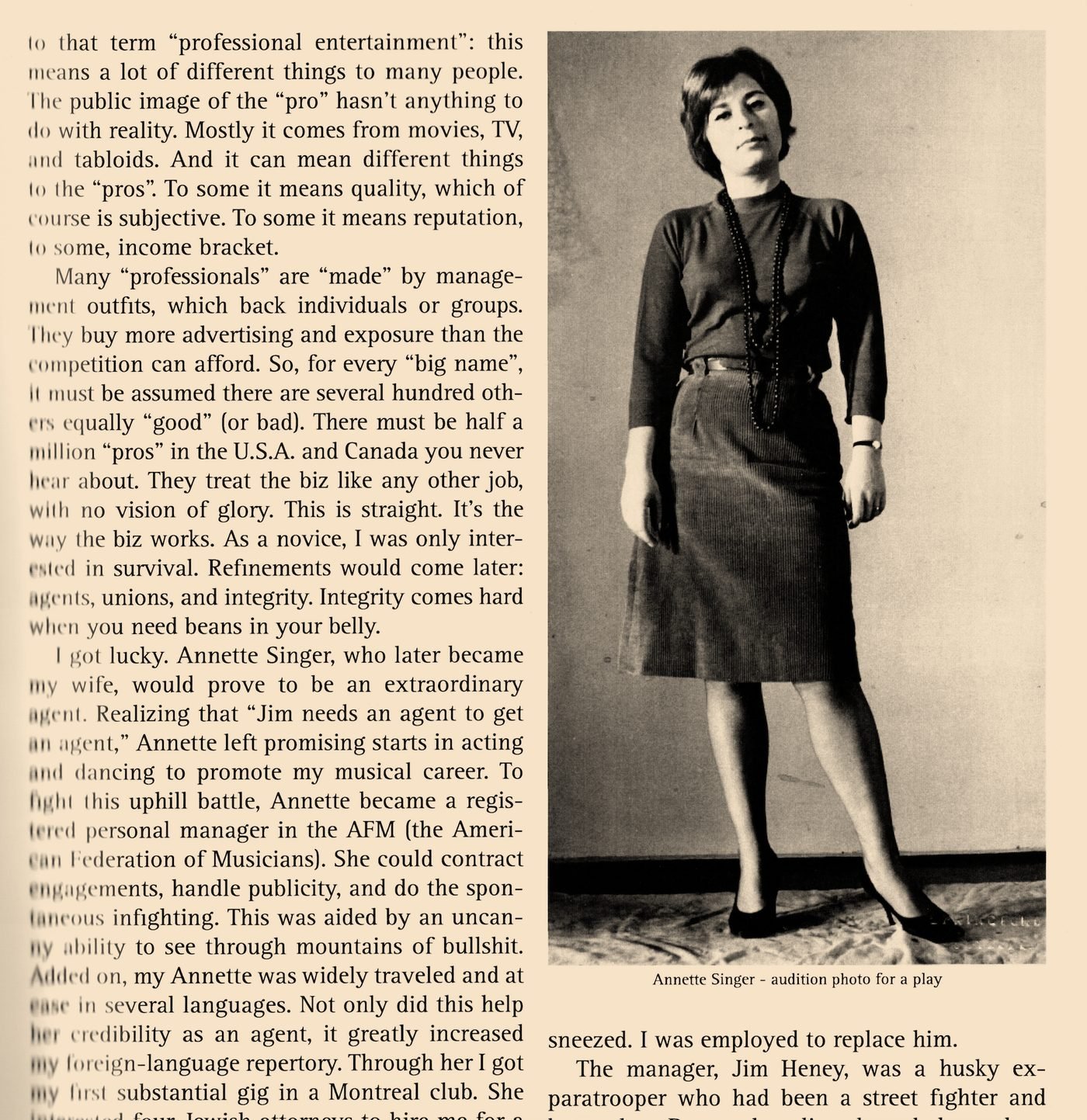
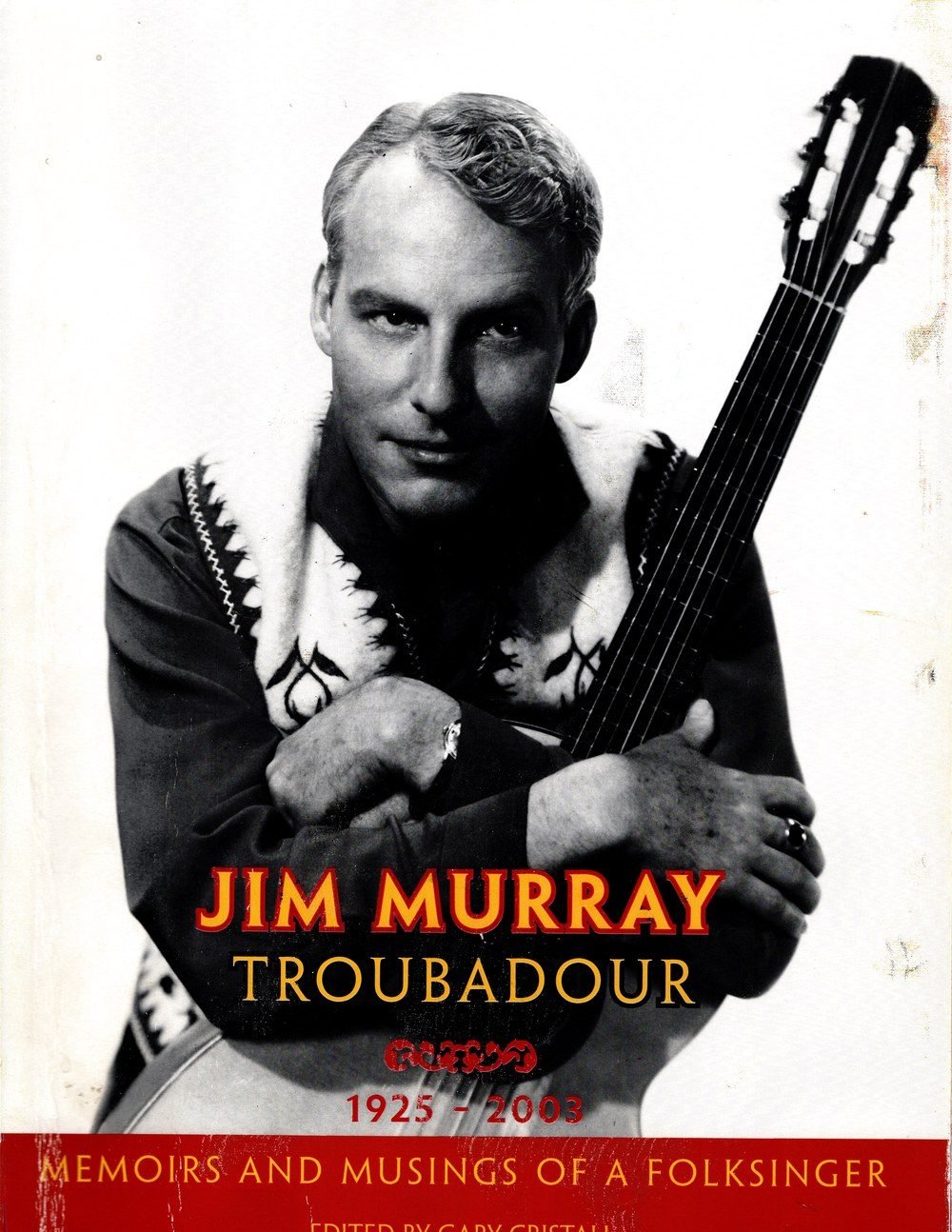
She married Jim Murray, an American folk singer with a baritone and the build of an oak, who performed in the Montreal Taproom, on CBC and NBC, and was friends with Burl Ives, Pete Seeger and Wade Hemsworth. She became his manager — registered with the American federation of musicians — got him his first serious engagement in a Montreal club and, as he himself recalled, thanks to her languages broadened his repertoire with foreign-language songs. In 1954 their son Julian was born — named after the grandfather he never knew.
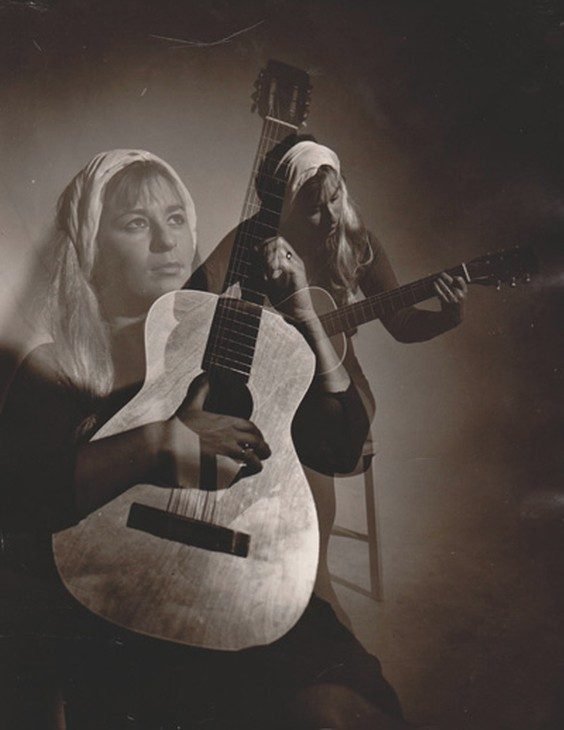
Anecdotes circulated around her which she herself loved to tell: that she bathed naked with Pierre Trudeau before anyone had heard of him; that when the young Leonard Cohen asked her opinion of his new song „Suzanne", he heard that it was dreck; that she advised the young Bob Zimmerman — not yet Dylan — after a performance to go back to university; and that she once struck a bargain with a Soviet sailor: a balalaika for a pair of red leather boots.
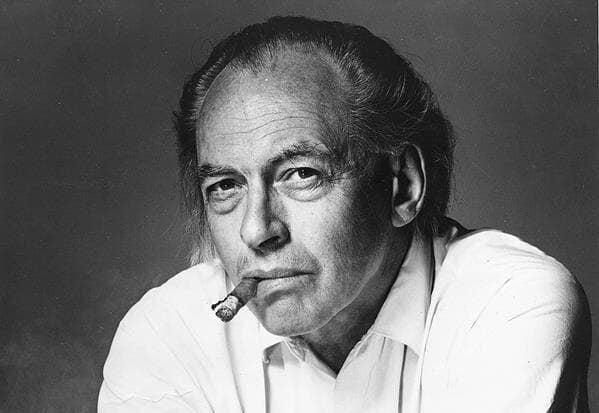
At her parties in Outremont F.R. Scott and Irving Layton were guests; poets worked on poems in the corners, and flamenco was danced till morning.
XVIII. A certificate instead of a passport
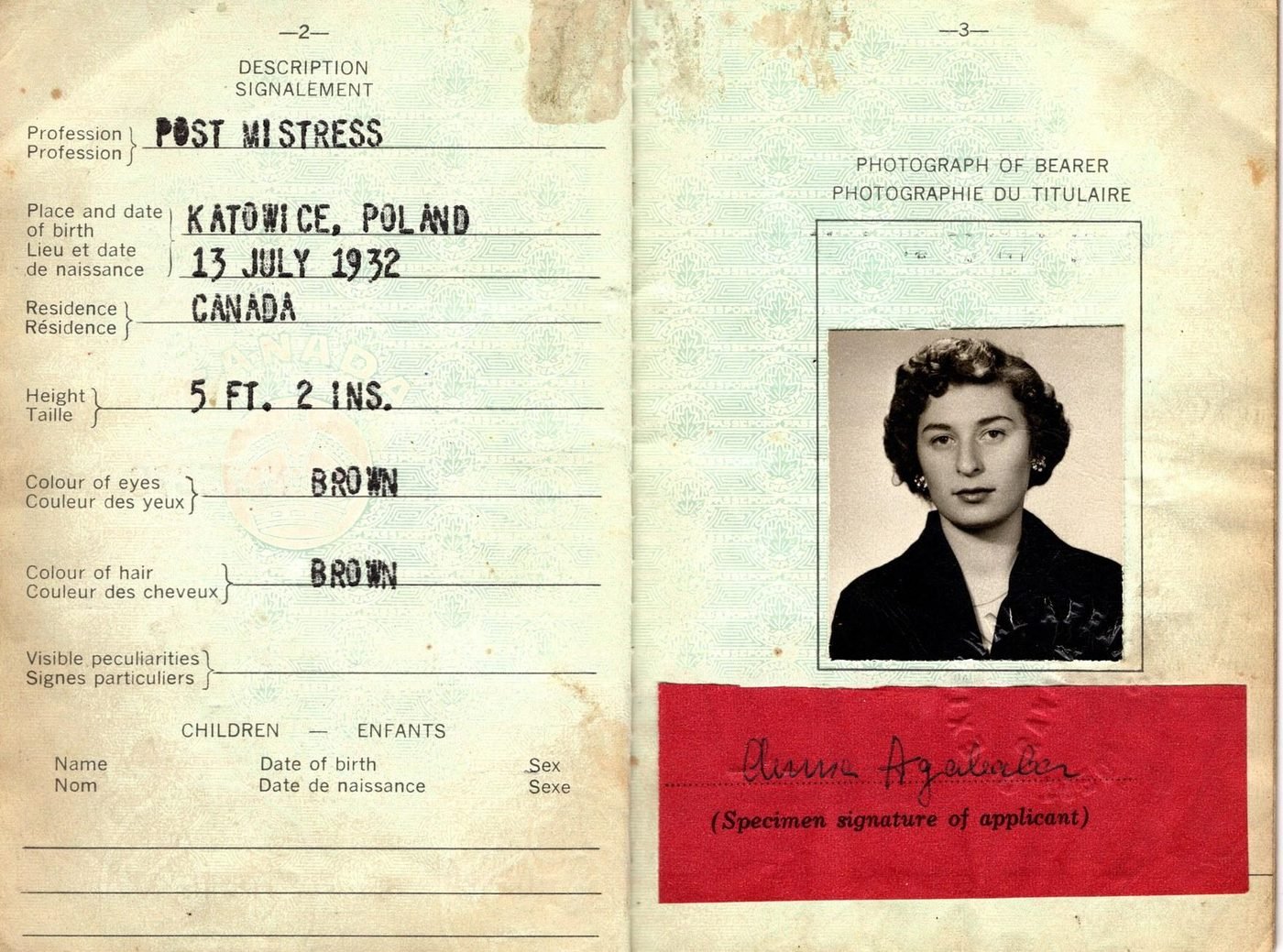
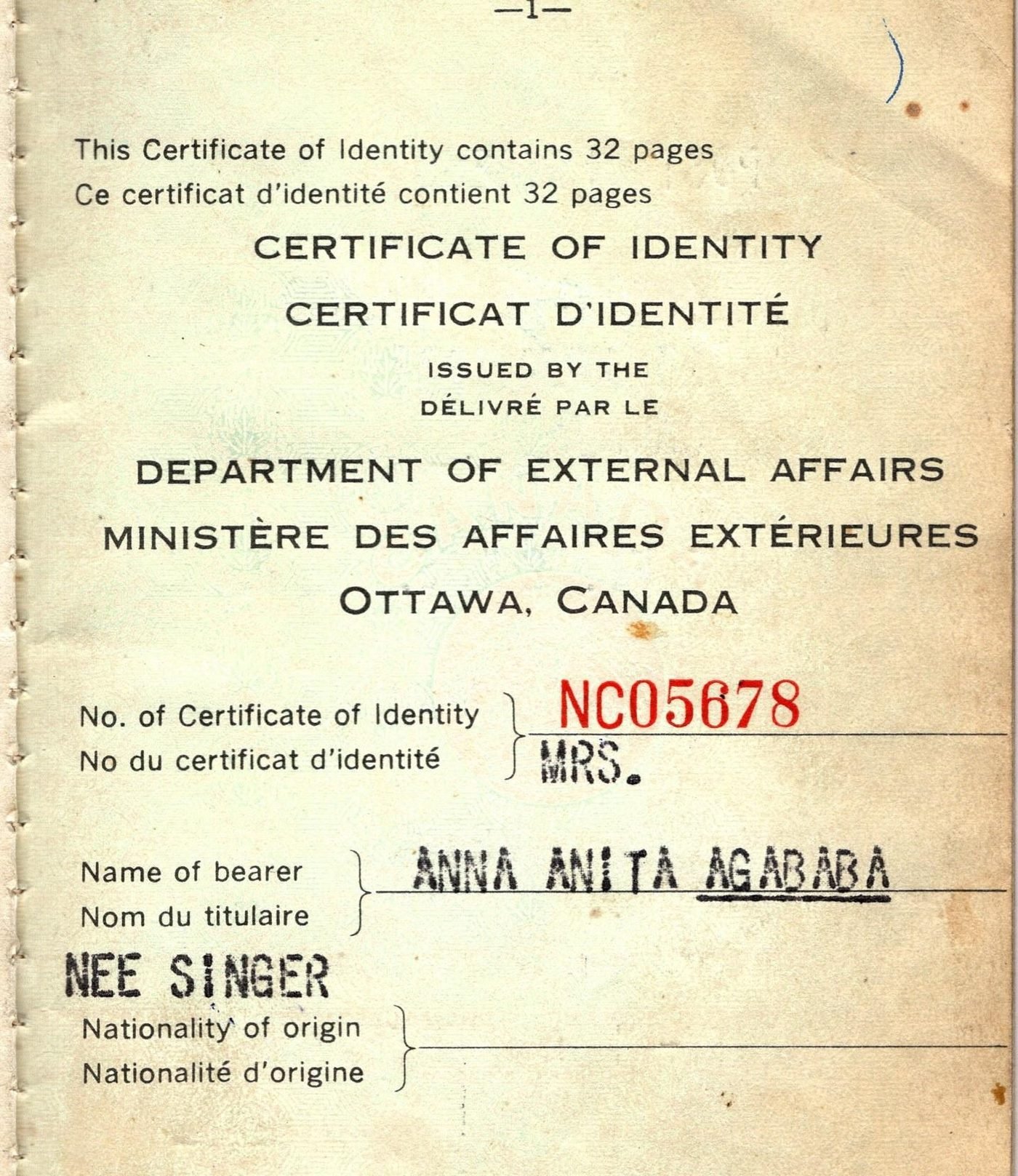
For years Anna held no passport of any state. Canada issued such people a certificate of identity — an identity document for the stateless. Copy number NC05678, preserved in the family collection, was made out to „Mrs. Anna Anita Agababa née Singer"; the columns were typed: occupation — post mistress, place and date of birth — Katowice, Poland, 13 July 1932, height five feet two inches, eyes brown, hair brown. It is this document that settles the Katowice birthplace — and it preserved her earliest post-war photograph.
In 1968 Jim was invited to perform in Poland and the Soviet Union; Anna was refused a Polish visa and the trip fell through. She travelled to the country only in 1980 — and saw Cyla then for the first time since 1949. She returned twice more.
XIX. The last of the family
In 1972 Julian, nineteen, musically gifted, was killed in a car accident — Anna's only child and Bronka's only grandchild. „In 1972 her world stopped" — a journalist would write in a posthumous remembrance. Annette and Jim left Montreal and set out on the road for twenty years: he with a guitar, she with her languages. They lived in British Columbia, in Arizona and New Mexico.
The trace of that road survives in her professional résumé. Still in Vancouver she completed Russian studies at Simon Fraser University and obtained a teaching certificate; then a year of substitute teaching in the local schools (1972–1973). A year in Bogotá, where she taught English at the private Leonardo da Vinci school (1973–1974). Two years as a concert agent in Montreal and Vancouver — manager and interpreter of Canadian artists on tours of Latin America, Europe and the Middle East (1976–1978). Finally Tucson, Arizona: a Russian lectureship at the University of Arizona (1987–1989) crowned with a master's degree, proficiency examinations in Polish, Russian conversation courses at Pima Community College, interpreting for Soviet delegations and scientists, classes in high schools in a programme for the gifted, commissions for Rosetta Stone. To the end of her life she belonged to the Slavic society Dobro Slovo, the teachers' association AATSEEL, the musicians' federation AFM and the actors' union ACTRA — the visiting card of someone who never ceased to be at once a teacher, a translator and an artist.
In a letter of 1997 she wrote that she wanted to „reinvent herself" and return to the roots of her survival: to go to Tashkent and write a book about the Jews, Poles and Russians whom the war had thrown into Central Asia. She did not live to.
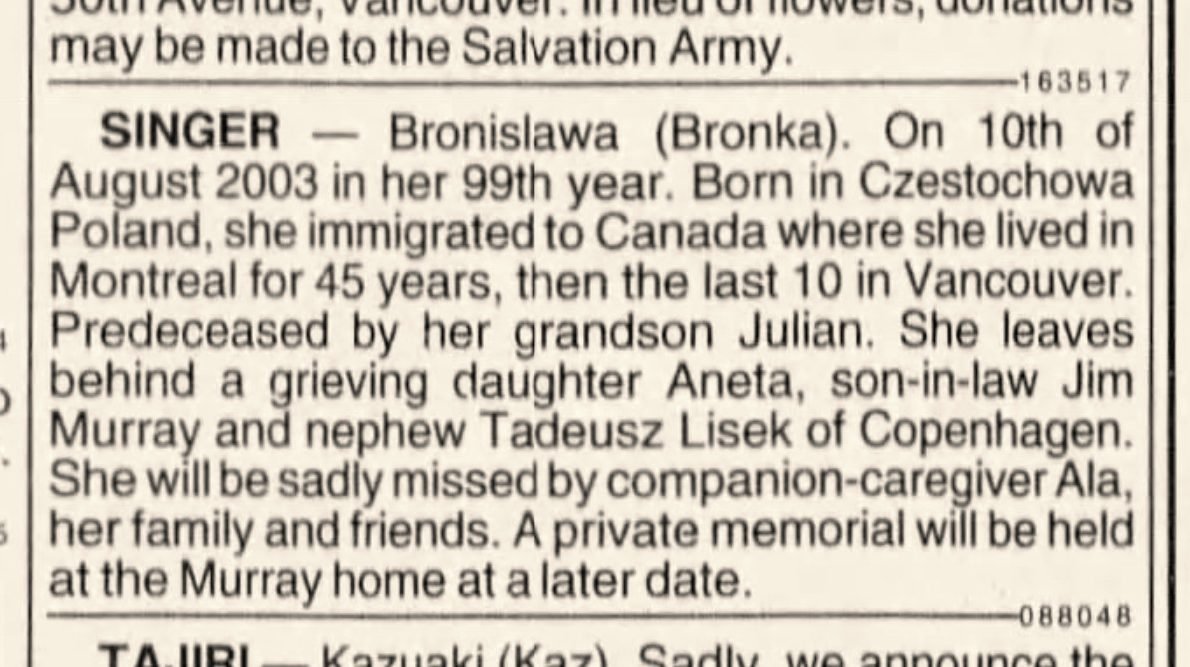
Bronisława Singer died on 10 August 2003 in Vancouver, in the ninety-ninth year of her life — fifty-four years after walking off the ship, after forty-five years in Montreal and ten in Vancouver. The obituary named the grieving daughter Aneta, the son-in-law Jim Murray, the carer Ala — and a nephew: Tadeusz Lisek of Copenhagen. That is almost certainly the same Tadek, the favourite cousin who played with Anna in Świder in the summer of 1939. Jim Murray died of cancer two months after his mother-in-law.
Annette spent the last decade of her life as the only living member of her family — surrounded by people she still drew to herself: a cable-television fitter dropping in for tea, a young coach taking her to jazz, a Venezuelan flamenco singer she called her daughter, Polish immigrants bringing cigarettes. She liked being called „perfervid" — ardent. In her last two years she dictated her memoirs to a retired psychologist, Barry Ledwidge, who came every week with a bottle of red wine and called those meetings „Tuesdays with Annette". The account reached the year 1947 and breaks off.
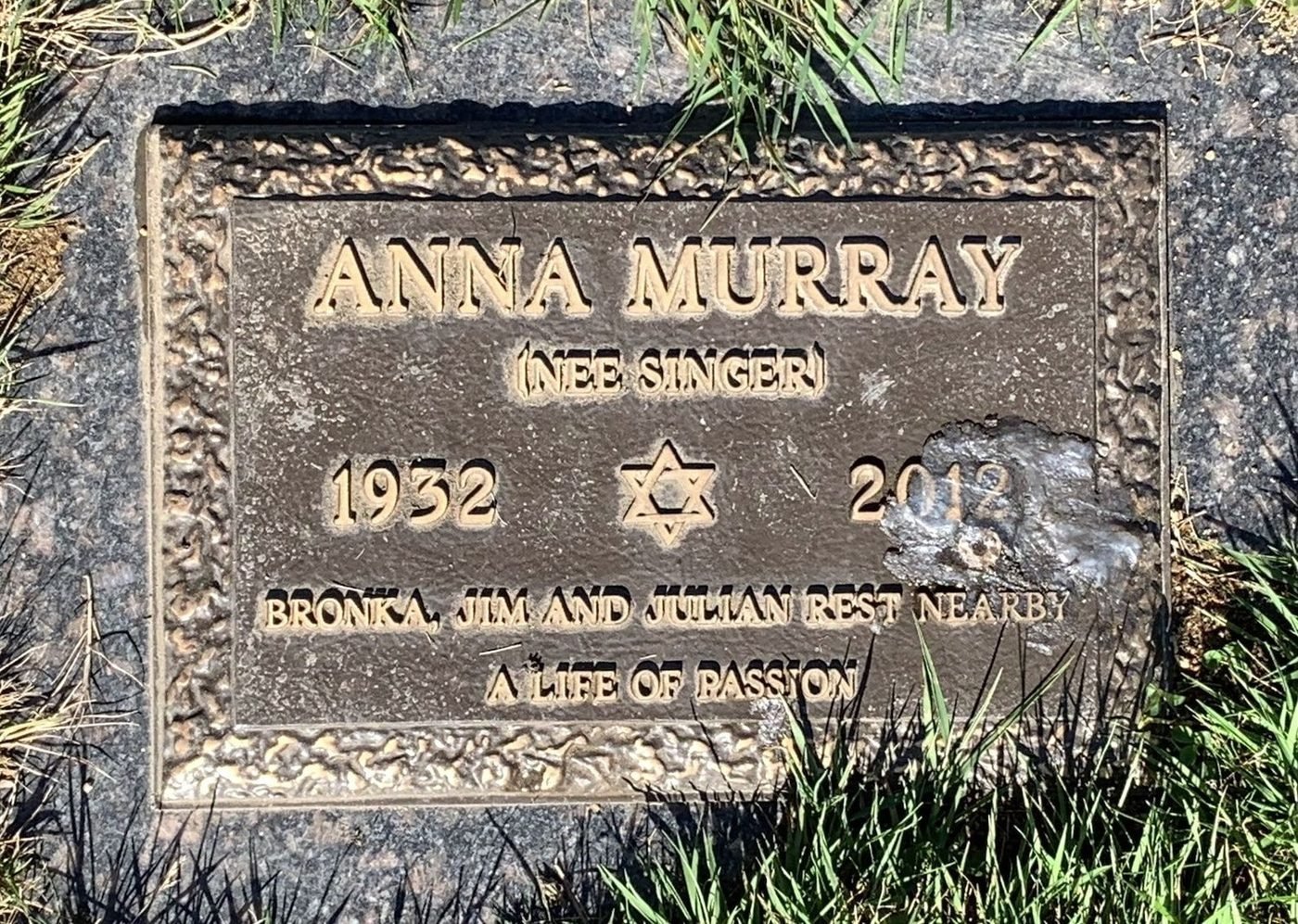
She died on 4 February 2012 in a hospice in Surrey, British Columbia. At the end of January she telephoned a friend once more, asking her to come at once: she had to get out of there, she could not die, not yet — she was the last, and she had to tell this story to the end.
What remained after her was not archives but people. The executor of her will was Dave Smith, a friend since the late fifties; it was he and others who after her death set up the website to which memories of Annette are brought to this day.
XX. Memory
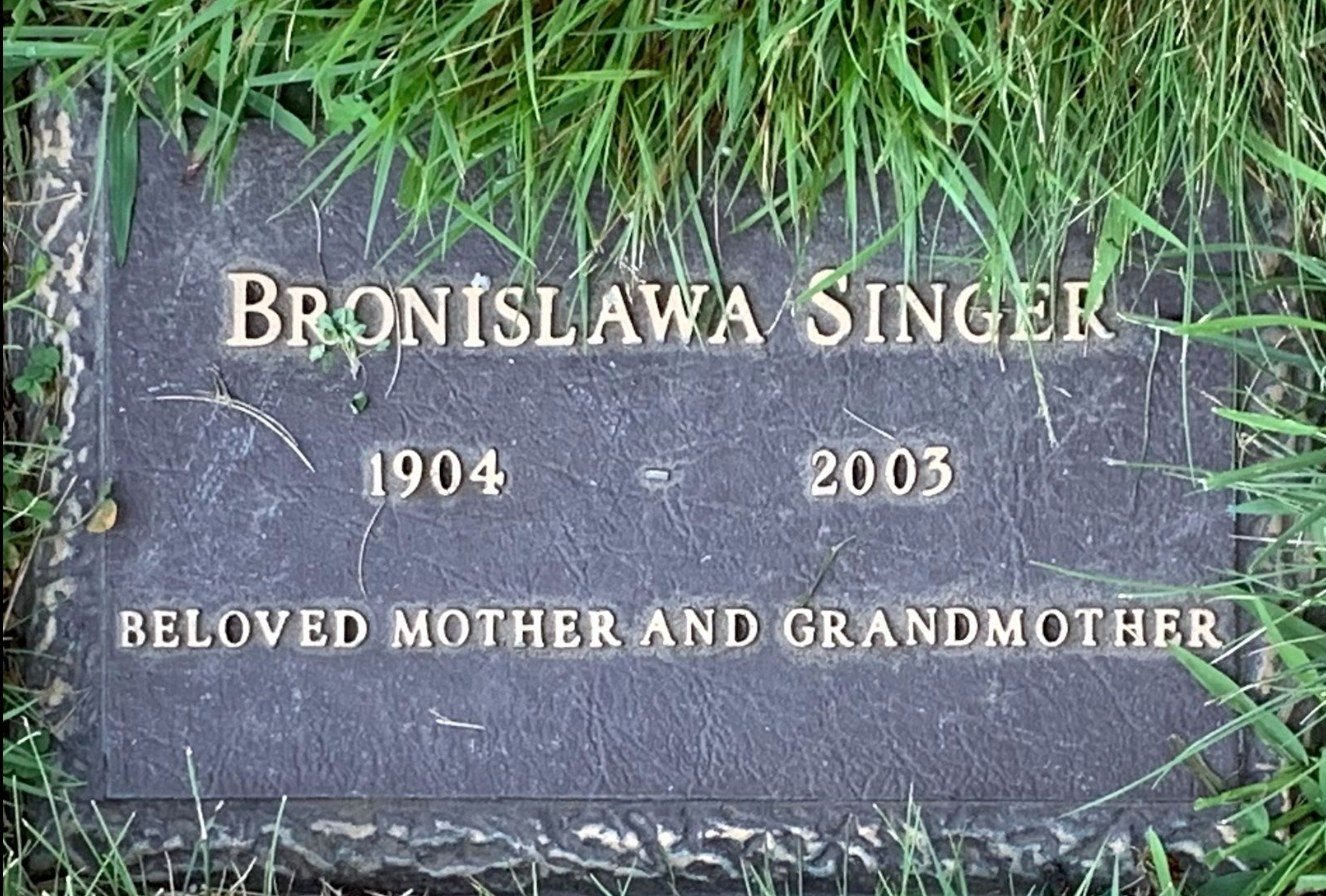
They left Złota 9 on 5 July 1939, calmly, the way one leaves for the holidays. Two months later began the war that scattered this family from the Urals to Uzbekistan and from a Warsaw balcony to Katyn. Julian Singer has no grave; nor do Marysia, Dorota, Klara, Michał, Ruth or Zdzisław. Bronisława and Anna lie near Vancouver, beside Jim and beside Julian — the grandson who bore the name of the grandfather who died in Arkhangelsk.
Passing the house at Złota 7/9, it is worth remembering that under number fifteen lived a family that did not manage to leave for Canada in time: an industrialist who lent the state a million złoty and was refused a uniform; his wife from Częstochowa, who survived the Urals and Uzbekistan and lived to nearly a hundred; his sister, who cried out from a balcony; two little girls, one of whom died in Bukhara while the other later danced in Montreal so that poets wrote of her — and two women in the service of this household, Stanisława Kraśnik and Stanisława Lewandowska, whose further fates we are still seeking.
Timeline
| Date | Event |
|---|---|
| 2 Jan 1863 | Salomon Lisek, Anna's grandfather, is born in Częstochowa (son of Kafel and Ewa née Grosman). |
| 2 Jan 1867 | Klara née Zylber, Anna's grandmother, is born (daughter of Zysman and Małka née Zelten). |
| 16 Aug 1896 | Julian Singer is born, son of Izrael and Chana née Teigenblatt. |
| 21/28 Dec 1904 | Bronisława Lisek is born in Częstochowa (the Częstochowa register: 21 December; later documents: 28 December). |
| 20 May 1907 | Dorota Singer, Julian's sister, is born. |
| 1920s | Julian studies architecture in Leipzig; on his return he works in his father's firm, where he meets Bronka. Ten years of engagement. |
| 13 (15) Jul 1932 | Anna Singer is born in Katowice — at home Anetka and Janina, later Annette. |
| 26 May 1935 | „Polska Zachodnia" prints the advertisement of the Julian Singer firm (Katowice, 35 Plebiscytowa St.) from stands 129–130 at the 6th Katowice Fair. |
| 9 Jun 1935 | The same newspaper names „Juljan Singer of Katowice" among the exhibitors of the building-materials section. |
| 14 Jul 1935 | Maria (Marysia) Singer is born. |
| until 1937 | The family lives in Podkowa Leśna. |
| 6 Oct 1937 | Registration at Złota 9, apartment 15: Julian, Bronisława, Dorota, Anna, Maria and the governess Stanisława Kraśnik. |
| 12 Oct 1937 | Registration of the domestic help Stanisława Lewandowska, arrived from Łódź. |
| 11 Apr 1938 | Priority date of the „Bitalum" trademark. |
| 26 Jan 1939 | The Patent Office registers the „Bitalum" mark (reg. no. 29552) for Zdzisław and Julian Singer — Warsaw, factory of insulating materials. |
| 1939 | Julian lends the Polish army a million złoty; as a Jew he is rejected when he volunteers. |
| 5 Jul 1939 | The whole household deregistered from Złota 9 — with no new address recorded. |
| 8 Jul 1939 | Łaja-Mirla Cukierman and Łaja Zygielman move into apartment no. 15. |
| 30 Aug 1939 | The family at the summer house in Świder; the first bomb falls on Otwock. |
| Sep 1939 | Flight east, six of them: the parents, both daughters, cousin Roman and the maid Lewandowska. In Równe or Baranowicze the last meeting with Zdzisław in uniform. |
| 1940 | Deportation in cattle wagons and by barge; a year in a labour camp in the Urals. Lewandowska disappears on the way. |
| spring 1940 | Zdzisław Singer perishes in the Katyn massacre. |
| Jun 1941 | After Germany's attack on the USSR, the „amnesty"; the family sets out for Uzbekistan with hopes of Iran. |
| 1942 | In Bukhara Julian and Roman are arrested. Roman will return after two years of the Gulag; Julian dies in the prison in Arkhangelsk. |
| 1942/43 | Marysia dies in Uzbekistan — malnutrition and malaria. |
| occupation | In Warsaw Dorota perishes; Klara Lisek is murdered at Auschwitz; Michał Singer and his wife Ruth are shot by the Poles hiding them. |
| 1945 | Bronka and Anna return to Poland — 45 days in cattle wagons. Zabrze, then Wrocław. |
| Aug 1945 | Pogroms in Polish towns; Anna begins to define herself as a Jewess and a Zionist. |
| 1946/47 | Rabbi Drucker's children's home in Zabrze, Haganah training, illegal crossing of the Czechoslovak border; her mother brings Anna back from the road to Palestine. |
| 3 May 1949 | The AJDC in Paris opens file OA.529 for Bronisława Singer, resident at the Hôtel Paradis, 9 rue Paradis. |
| 6 Aug 1949 | Departure from Paris aboard the „Samaria" for Canada (entries 182–183 of the IRO list). |
| 1949–1950 | Anna at the Alliance Française; then manual work in Montreal and the learning of two languages. |
| 1954 | Julian Murray, son of Anna and Jim, is born in Montreal. |
| 1959–1962 | The interpreters' school in Geneva; William Grieves's drama school in Montreal. |
| 1960–1967 | Anna runs The Folk Centre — a Montreal school of languages and the performing arts; as manager she runs Jim's career. |
| 1962 | Al Purdy publishes „Poems for All the Annettes". |
| 1968 | Jim is invited on a tour of Poland and the USSR; Anna is refused a Polish visa — the trip falls through. |
| 1970/71 | Degree in Russian studies and teaching certificate of Simon Fraser University. |
| 1972 | Julian Murray is killed in a car accident at the age of 19. |
| 1973–1974 | A year in Bogotá: Annette teaches English at the Leonardo da Vinci school. |
| 1976–1978 | Concert agent in Montreal and Vancouver; artists' tours of Latin America, Europe and the Middle East. |
| 1980 | Anna's first return to Poland; meeting with Cyla after 31 years. |
| 1987–1990 | Tucson: Russian lectureship at the University of Arizona, master's degree (1990), interpreting for Soviet delegations. |
| 10 Aug 2003 | Bronisława Singer dies in Vancouver, in the 99th year of her life. |
| Oct 2003 | Jim Murray dies. |
| 2010–2012 | Anna dictates her memoirs — „Janina Singer's Odyssey"; the account breaks off at the year 1947. |
| 4 Feb 2012 | Anna Murray née Singer dies in a hospice in Surrey, British Columbia. |
A Note on Sources
The account rests exclusively on sources: the residence register of the house at Złota 9 for 1937–1943, card of apartment no. 15, pp. 92–93 (State Archive in Warsaw); the advertisement and report of the Katowice Fair in „Polska Zachodnia" of 26 May 1935 (p. 16) and 9 June 1935 (p. 3); the „Wiadomości Urzędu Patentowego" of 28 February 1939, fascicle 2, p. 75 (registration of the „Bitalum" mark, reg. no. 29552); the Częstochowa population register (the Lisek family, house 121, vol. 12, p. 1163); the registration card of the Emigration Service of the AJDC in Paris (file OA.529) with its reverse; the IRO departure list of August 1949, entries 182–183; Canadian certificate of identity no. NC05678; the obituaries of Bronisława Singer (Vancouver, August 2003) and Anna Murray („The Globe and Mail", 25 February 2012) and Joe O'Connor's article in the „National Post" of 11 March 2012; Jim Murray's memoirs „Troubadour 1925–2003" (Vancouver 2007, ed. Gary Cristall); photographs of the grave plaques in British Columbia; and above all on three accounts by Anna herself: the memoir „Janina Singer's Odyssey" (chapters 1–4), dictated in 2010–2012, the undated autobiographical sketch „Aneta's Story" and the letter of 5 August 1997. Family photographs — from the collection of Annette Singer's heirs.
All quotations of Anna Singer's words come from these three accounts, originally written in English and quoted here after them. Where memory differs from a document — as with the dates of birth or grandfather Salomon's occupation — both versions are given in the text. The full analysis of discrepancies, the leads rejected and the inventory of unused material are contained in the project's separate working document.
Opracowanie w ramach projektu upamiętnienia mieszkańców kamienicy przy ul. Złotej 7 i 9 w Warszawie — prepared as part of the project commemorating the residents of the house at 7 and 9 Złota Street in Warsaw · www.zlota7-9.com